


In an interview for the book Naked Screenwriting, Tom Schulman, who won an Oscar for writing Dead Poets Society, tells a story about one of his later scripts. The director asked him where the second-act break was, and Schulman told him it came on page 93. He doesn’t name the film or the director, but he described what happened next:
He said, “It’s three pages late. We’re going to have to take out a scene.” I said, “Just because it’s three pages late?” He said, “Yeah.” And I said, “We can’t get this crazy about structure.” But we ended up taking out a scene right then and there.
Those page numbers come from Syd Field’s 1979 book Screenplay, which sets out the three-act structure most screenwriters use. (In later editions, he was a little looser with the page counts but held firm on the principle).
Do all good screenplays fit the paradigm? Yes. But just because a screenplay is well structured and fits the paradigm doesn’t make it a good screenplay, or a good movie.
I set out to discover how many films actually follow it.
And it turns out, fewer than you’d think.

What do the screenwriting books say?
Let's start with a quick refresher on the four story structures I tested:
Syd Field’s three acts (1979). A beginning, middle and end in the ratio 1:2:1, with turning points about a quarter and three-quarters of the way through.
Save the Cat (Blake Snyder, 2005). The three acts split into 15 named beats, each with a set page number, starting with a ‘catalyst’ about 11% of the way in.
Kristin Thompson’s four parts (1999). Four parts of roughly equal length (setup, complicating action, development, climax), which splits Field’s long middle act in two.
The eight sequences (Frank Daniel, written up by Paul Gulino in 2004). Eight mini-stories of about 8 to 15 minutes each, with two in act one, four in act two and two in act three.
The chart below lays them out on the same timeline, from the first frame of the story to the start of the end credits.
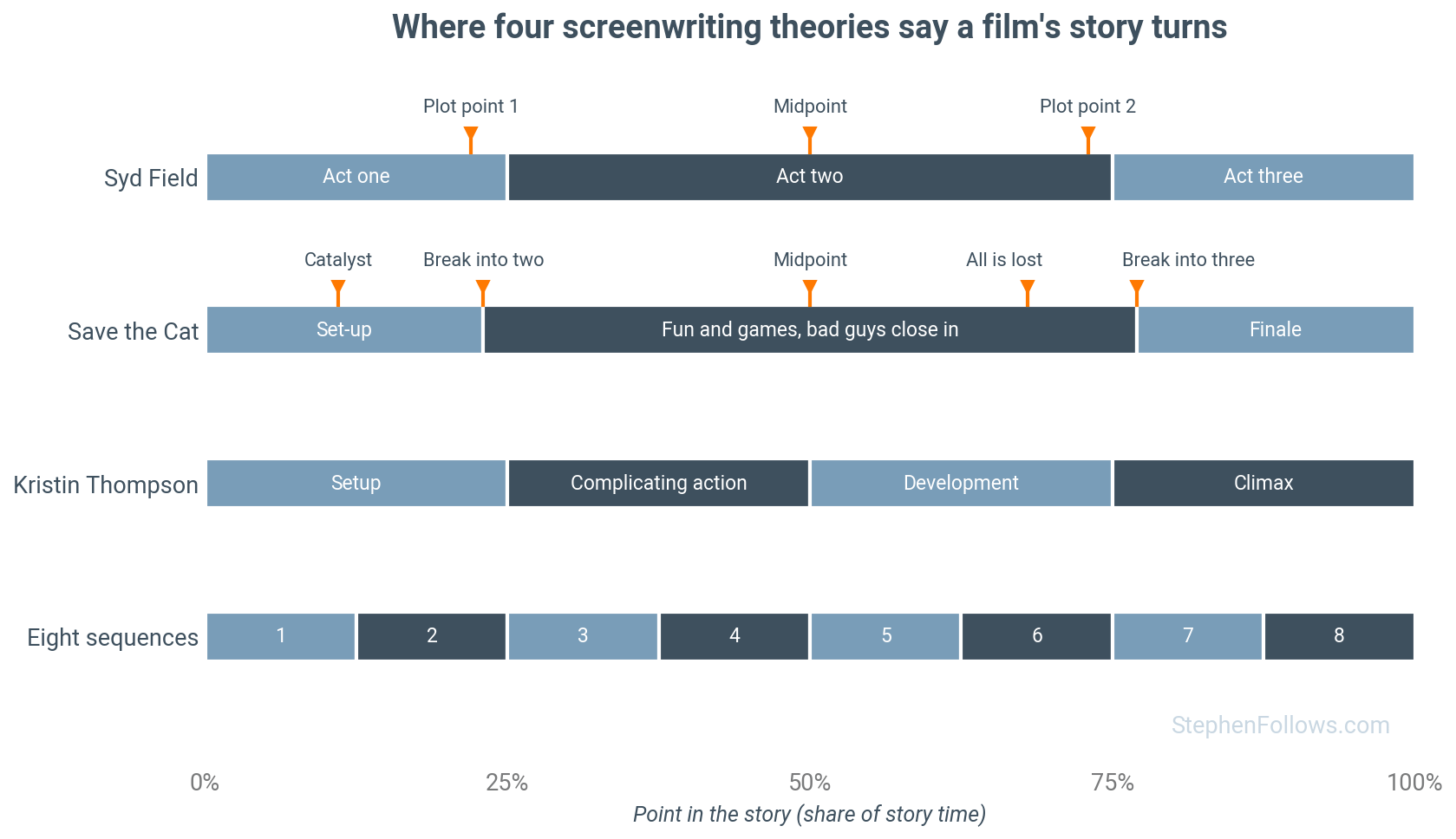
The four theories differ in a few places, but all have the major turns at (or very close to) a quarter, a half and three-quarters of the way through.
But is that what we see in real movies?
Where do films really turn?
Some very famous films do hit Field’s exact pages. In The Matrix, Neo takes the red pill at minute 29 of 129 and goes back into the Matrix for Morpheus at minute 95. Good Will Hunting, Argo, and Terminator 2: Judgment Day also follow the plan closely.
But plenty of famous films don’t. GoodFellas has Henry fully inside the crew by minute 15, 11% of the way in. The Lion King doesn’t send Simba into exile until minute 38 of 81 (47%), and The Truman Show stays in the first act until 43%.
In order to get the largest picture I could, I studied the plot and the script (or subtitles) of 7,225 films and tracked when four key plot moments took place:
The inciting incident
The end of act one
The end of act two
The start of the final climax
The chart below shows when those events took place in relation to the film’s running time. The median for each of the moments was:
The inciting incident, 11% of the way into the movie.
The end of act one, 28% of the way in.
The end of act two, 81% of the way in.
The start of the final climax, 89% of the way in.
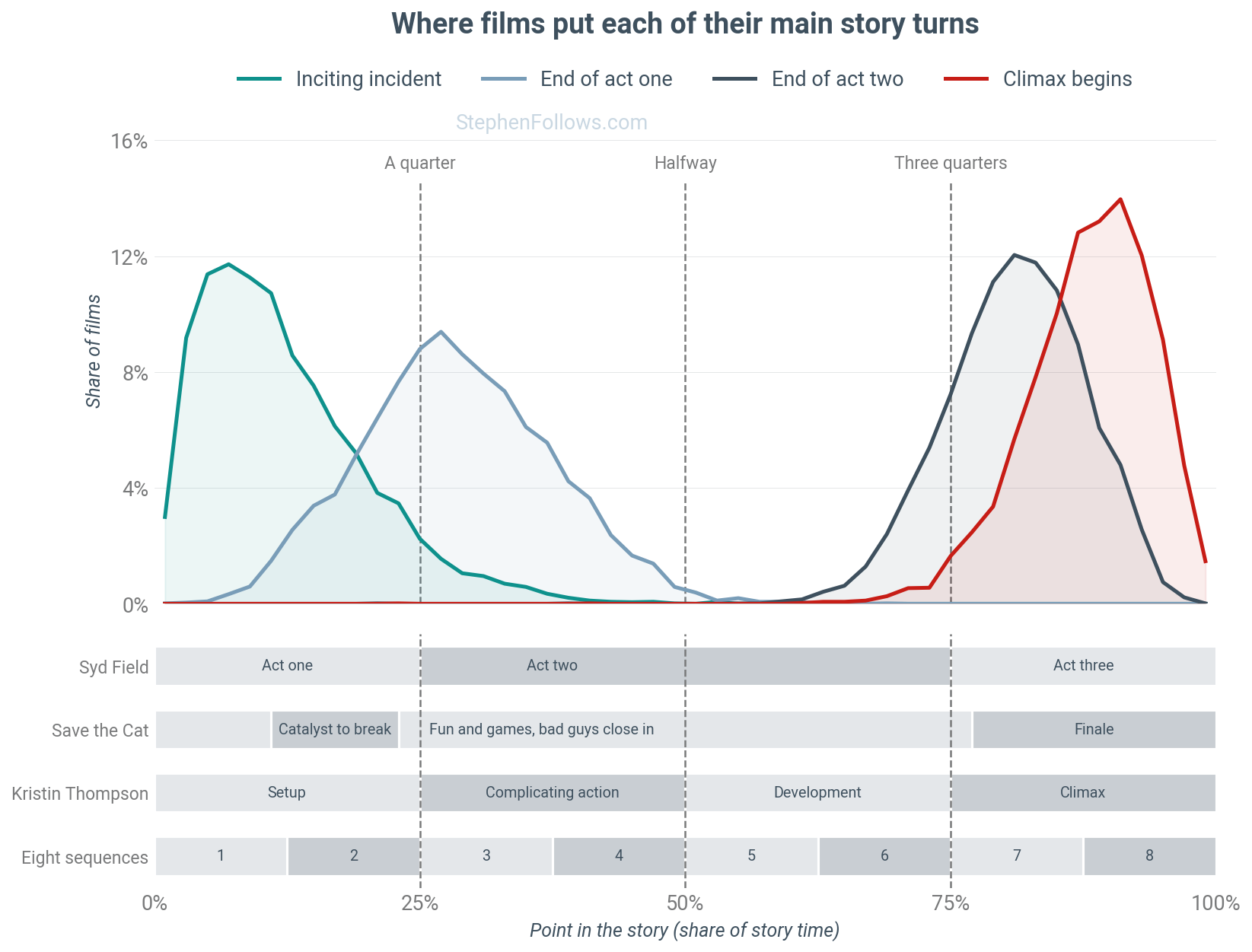
Each turn has a clear home, but none of them sits on the line. The first act typically ends a little after the quarter mark, and the second act well after three quarters. That makes act three short. The median acts take 28%, 53% and 19% of the story, against Field’s 25%, 50% and 25%, and act three is shorter than act one in 79% of films.
The spread is wide, too. Only 41% of films end act one within five points of the quarter mark, and only 37% end act two within five points of three quarters.
How many big turns does a film have?
Part of the reason that real movies don’t exactly fit the big theories is that theories are simplified headlines. They are built around a small number of big turns, whereas real movies have far more.
I logged every point where each story changes direction, and how big each change was. The typical film has 16 clear turns, of which four are major (the whole story is redirected, and the main characters want or face something different afterwards). Only 17% of films have exactly the two major turns a three-act story needs, and half have four or more.
The chart below shows where those major turns fall across all 7,225 films, as a share of all major turns in each twentieth of the story. If turns were spread evenly, every bar would sit on the dashed line.
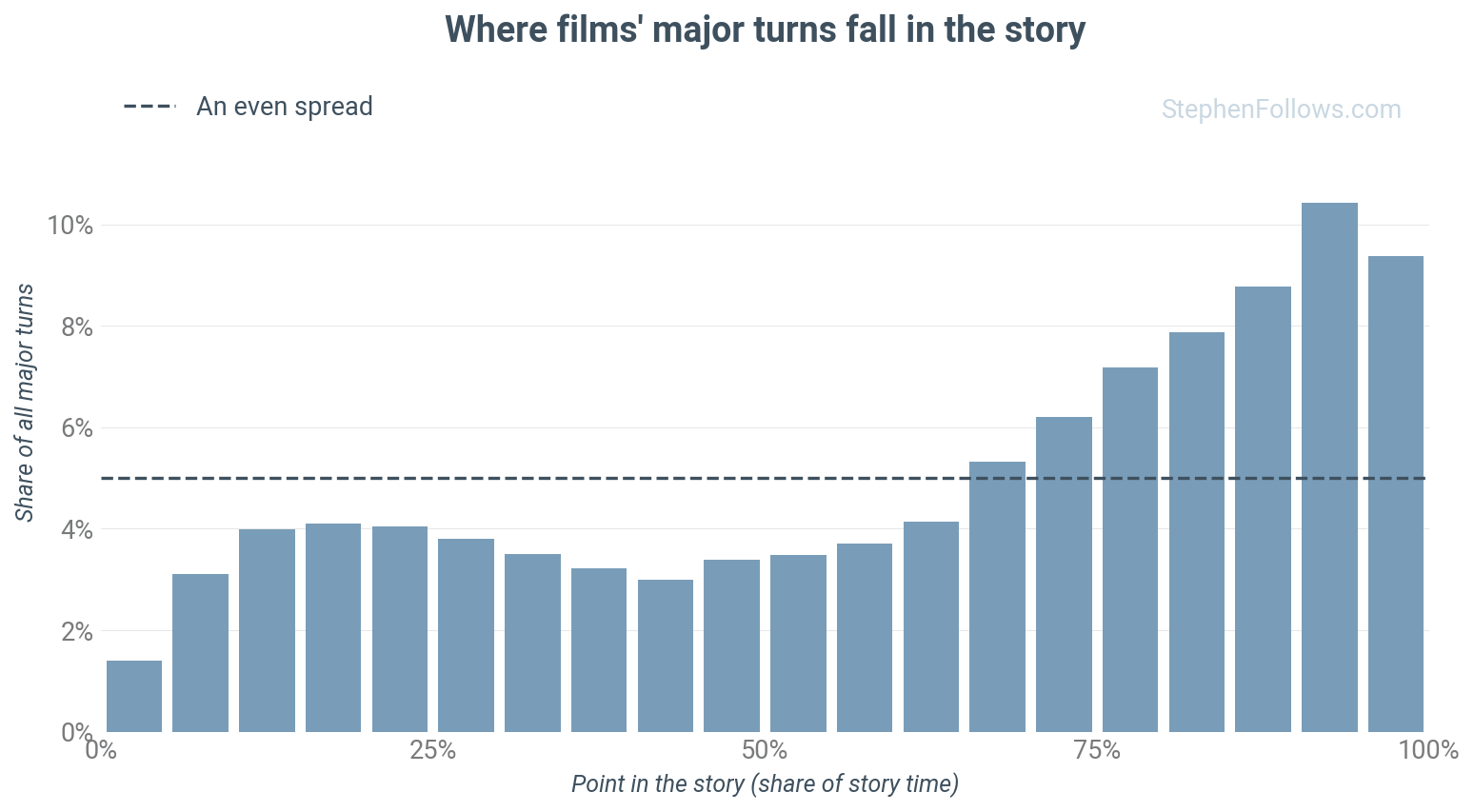
There’s no bump at a quarter, a half or three-quarters. Major turns are fairly flat through the first two-thirds and then climb steadily, so the last tenth of a story holds almost three times as many as a tenth in the middle.
That chimes with an experiment by the psychologist James Cutting, who asked students to split films into large parts. Taken together, their splits matched his own, but in his 2021 book Movies on Our Minds he described what happened when he looked at each student on their own.
Nonetheless, the data of individual students show that they believed that there were important narrative turns almost everywhere.
So if a film has 16 turns, which ones become the act breaks? In 63% of films, the end of act one is the biggest turn in that stretch of the story. Only 33% of the time is it the turn closest to the quarter mark, against 20% if one were picked at random.
The act breaks are real moments, usually the biggest in the right general area, with only a small pull towards the theory’s prescribed positions.

How has this changed over time?
So far I have been squashing all the movies together, but we know that writing goes through fashions and trends. Plus, these theories appeared in the latter half of the 20th century (or the start of the 21st in the case of Save the Cat), so their popularity may have changed movie structure.
The chart below shows where each of the four moments falls in films from each decade. The line is the typical film, the coloured band shows the middle half of movies, and the dotted line is where the theories say the turn should be.
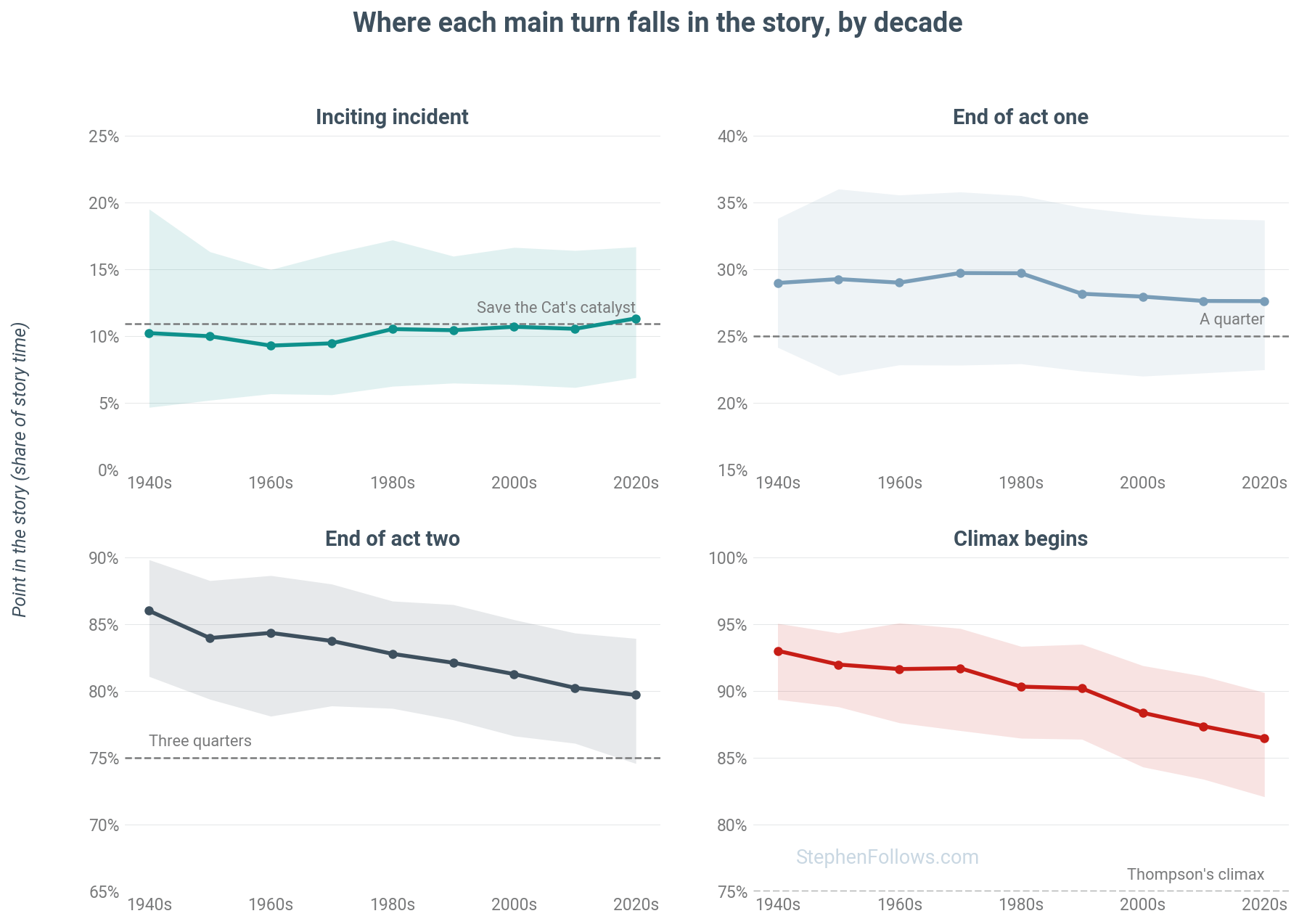
The start of a film has hardly moved in 80 years. The inciting incident came 10% of the way into the typical 1940s film and 11% of the way into the typical 2020s film.
Act one ends at about the same point it always has (29% then, 28% now). Save the Cat puts its catalyst about 11% of the way in, where films in the 1940s put their inciting incident.
The real change is what’s been happening to endings. Act two now ends 80% of the way through the typical film, down from 86% in the 1940s, and the final climax starts at 86%, down from 93%.
Movies are giving their endings more room. The typical act three has grown from 14 minutes in the 1940s to 22 minutes in the 2020s. The time between the end of the climax and the end credits has grown from about a minute and a half to about six minutes.
This is the second change in rhythm I've found in my research this year. In March, I showed that movies have become more intense because they no longer ease off in the middle. Now it seems they also take longer to wind down at the end.
That longer ending has pulled films closer to Syd Field’s shape. Since 2010, about one film in five has both act breaks within five points of a quarter and three quarters, against about one in ten from the 1940s to the 1980s. But the rise only shows up in the 1990s, more than a decade after Field’s book came out.
None of this means the writing systems are wrong. They work best as aids to writing, rather than unbending rules every script must follow. Also, I have been measuring movies, and so it could be that scripts follow the system more closely, but by the time the film has been shot and edited, the timings drift.
Kenneth Lonergan put it well on Variety’s Playback podcast in 2017 when he said:
It may be that every movie has exposition, development, resolution and a coda, but it’s a description of what’s happened after the work has been done. It’s not really a program for getting the work done.
On this evidence, he’s right. Films are full of turns, most of them crowd into the final third, and the three-act shape is something we find by picking two of them out afterwards.
Notes
Today’s research is based on my study of 7,225 feature films with timed English subtitles, between 60 and 240 minutes of story time (i.e. from the first frame to the start of the end credits).
Each film’s dialogue was read with its timings, minute by minute, by an AI language model. In a first pass, it marked every turning point, each with a strength from 1 (a small turn) to 3 (the whole story is redirected), and the film’s sequences, without naming any theory.
In a second pass, with the first pass fixed, it named eight points (the inciting incident, the end of the setup, the end of act one, the midpoint, the end of the complicating action, the end of act two, the start of the climax and its end). Each was defined by a story event. The exception is the midpoint, which was defined as a turn near the middle and is not used as evidence here.
The reading uses dialogue, so turns carried by pictures alone are under-read, which is one reason I also measured sound and picture.
It's fascinating research. The act break page number rigidity has always sat fishy for me.
I suspect that the origination of looking for the patterns comes from a physical limitation that wove itself into theory. Back in the day, films were delivered to theaters in reels, typically a set of seven for a normal run film. Those reels averaged about 14 minutes each within the size limitations of the wrap of film on the standard sized can/empty reel. If you placed an act break/new scene right about that minute mark, you'd not lose anything if there was a physical transition that didn't quite hit exactly every time on the reel change. The page count act structure aligns pretty well to the reel change points.
The physical limitations of the theater projection is also one of the main reasons we think that a movie should be less than 2 hours in length. Not only does going longer mean an extra reel or two back then, but, running longer than 2 hours cuts out an entire showing on the day when you span out the runs at the theater. A less than 2 hour film can be run 5 times. Longer films, 4, cutting out 25% of the box office potential.
People don't often consider the practical, physical limitations that could be behind our industry "standards".
I wonder whether any variations are introduced by genre.