


It’s a common claim that movies today feel more intense than they used to.
In a world of multiple screens, endless distractions and an attention span of… wait, what was I saying?
Oh, yeah, intensity is increasing because people can’t focus on… you know, the thing.
In a recent interview on The Joe Rogan Experience, Matt Damon articulated this point of view far more eloquently than I have. He explained that when they made their recent film The Rip for Netflix, the streamer gave them very specific notes on how to structure their story:
The standard way to make an action movie that we learned was you usually have three set pieces… and now [Netflix is] like, ‘Can we get a big one in the first five minutes? We want people to stay tuned in. And it wouldn’t be terrible if you reiterated the plot three or four times in the dialogue because people are on their phones while they’re watching.’”
So Netflix certainly feel that movies are (or should be) paced differently than they used to be. Are they right? Are movies more intense? Is the way movies tell stories changing?
There are a few places we might look to get to the heart of this, including:
Stories - I.e. What stories are being told and the types of characters whose journeys we follow. See: What are the most common moral lessons within movies?
Scriptwriting - How the stories are being told and the choices the writers are making in the dialogue. I touched upon writing changes here Are movies becoming more simplistic?
Sounds - I might be getting old, but it certainly feels like movies are getting louder.
Cinematography - Last year, I looked into whether modern movies use flatter lighting than older movies. I won’t spoil the result, as you can read the whole thing here: Are modern movies using flatter lighting than in the past?
Sins - In past research, I have shown that the levels of drug use, violence, and swearing have not changed in recent decades, but the levels of sex have fallen by around 40% since 2000. More at Why is sex in movies declining?
Today I’m going to tackle the second on that list. Namely, are stories being told in a more intense way than they used to be?
To find out, I analysed the dialogue of 70,985 English-language feature films released between 1940 and 2022. In each movie, I mapped a number of linguistic high-arousal signals (i.e., fear, anger, urgency, profanity, punctuation pressure, and emphasis), scoring them and noting their timing within the movie.
This gave me a deep insight into how movies build, sustain and release dramatic intensity.
Here’s what I found…
Have movies actually become more intense?
The story of the 20th century was indeed that “movies are getting more intense”, but in the past few decades, things have actually declined ever so slightly.
The most intense year for movies was 1991.
Below is the per-year average intensity of the movies I studied. We see a strong rise from the mid-1940s through the mid-1960s. Intensity drops slightly towards the 1970s, then resumes a steady rise, peaking in the early 1990s. Since then, the picture is mostly a gentle decline, with a brief rise in the early 2010s.
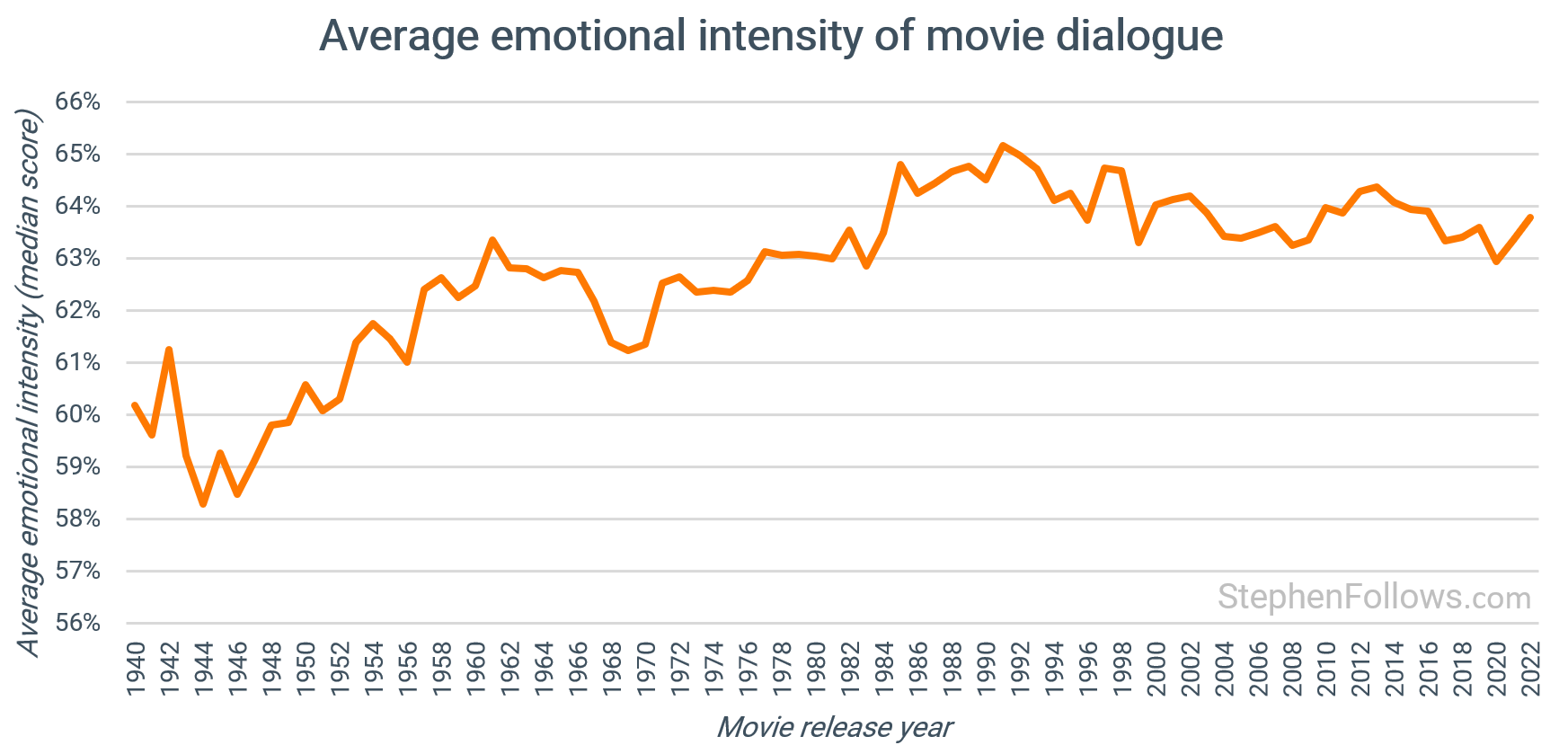
The chart above looked at the average accross the whole movie, whereas perhaps we would like to study the most intense point in each movie. When we do that, we see a much flatter journey. Four decades (the 1960s, 1980s, 1990s and 2000s) shared the same level of intensity extremes.
Since around 2010, the ‘most intense’ part of the average movie has been less intense than in the past half-century.
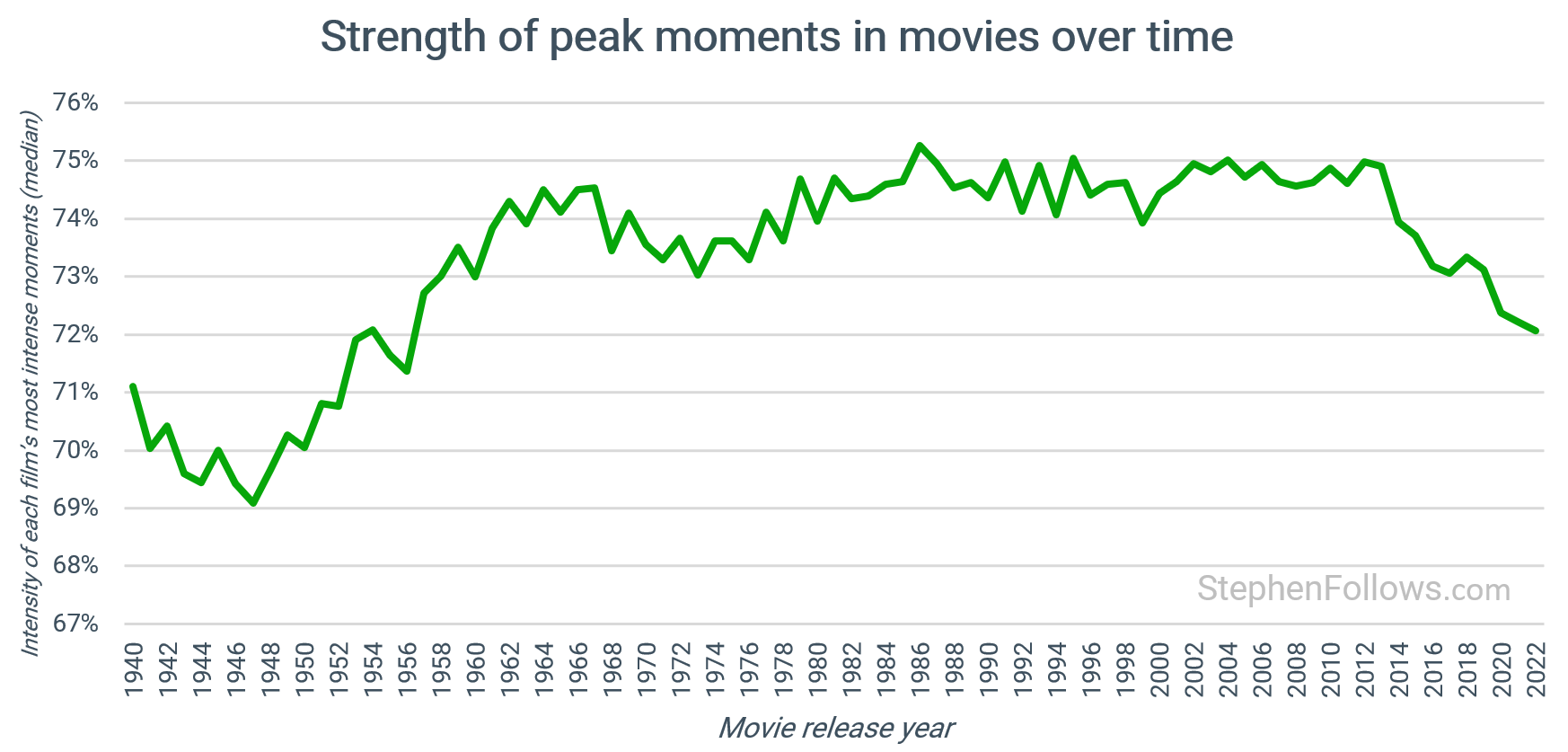
So we’re not seeing the kind of results one would expect if it were true that “recent movies have been getting more intense”.
So something else must be driving the perception.
Did peaks get bigger, or did films just stop calming down?
The more interesting change is not how high films climb but how long they stay there.
Between 1940 and 2022, the share of runtime spent in high-intensity dialogue rose by 21%.
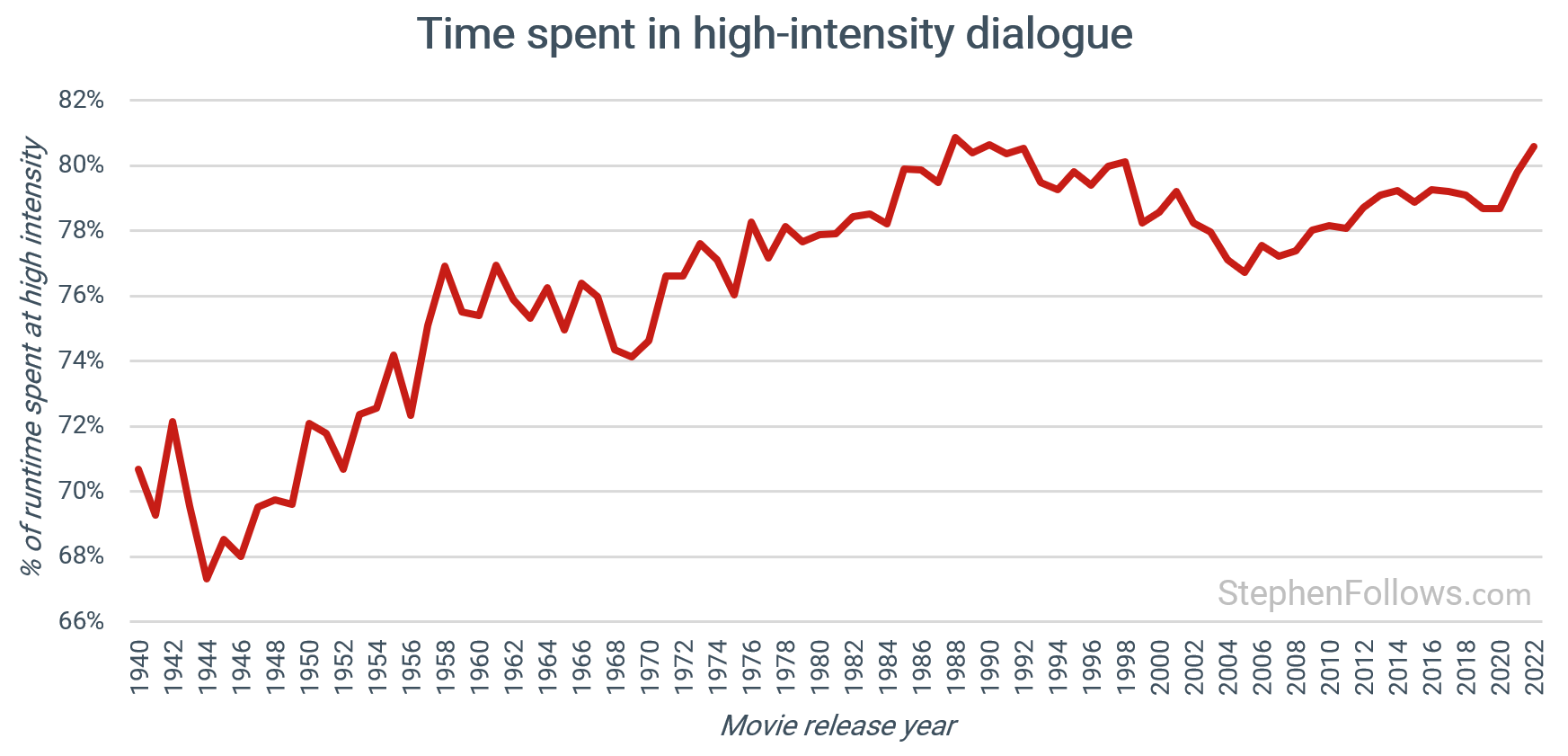
We, as the audience, are spending more time in a high state of intensity (well, technically the characters are, but I’m going to assume we’re matching their feelings).
Another way to graph the same effect is to look at how movies ease off the intensity in the middle. This “downshift index” fell by roughly 35% over the past eighty years.
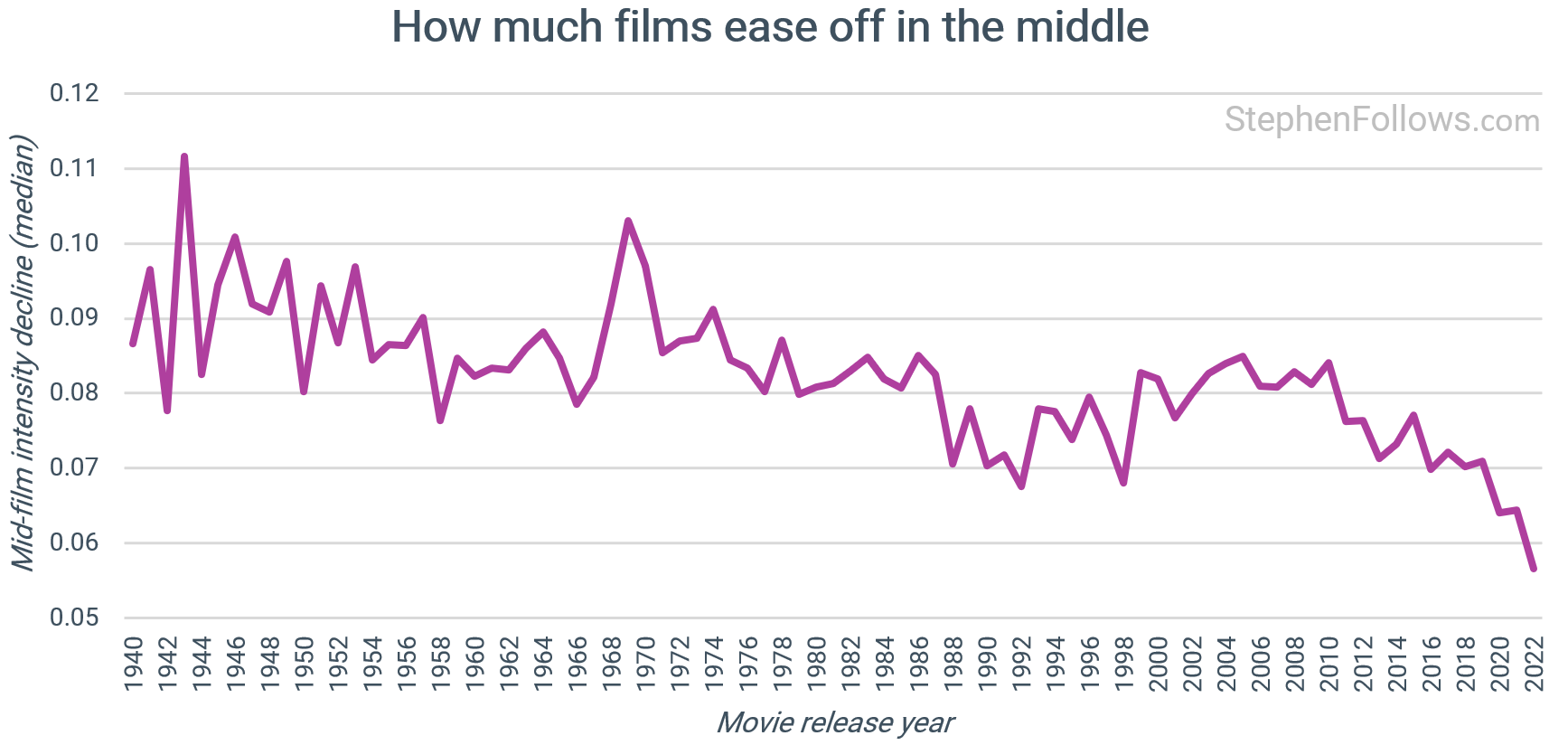
This means that older films often follow a familiar rhythm - namely an early destabilisation, then a spike, followed by a middle section that cools. But many contemporary films behave differently. Once the pressure is introduced, it sticks around.
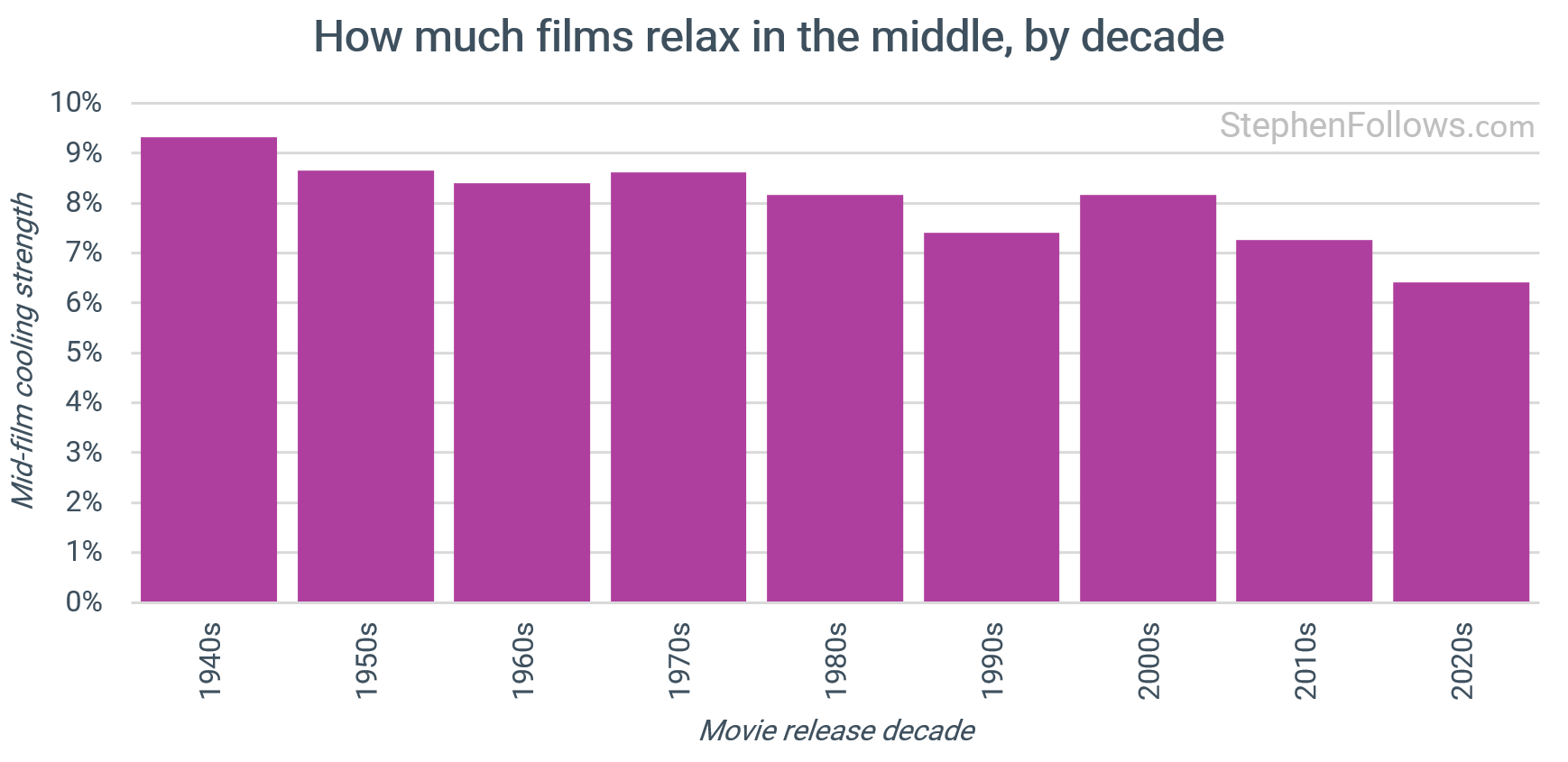
So movies have become more intense, not because their peaks have risen but because the spaces between them have reduced.
When did this shift happen?
Regular readers will see a familiar pattern in the 20th-century data. In a number of past articles, I have noted the idea that “Something weird happened with movies in the 1970s”. We’ve seen this in:
How often do lead characters die in movies? In the 1970s, lead characters became significantly more likely to die on screen, reflecting a shift toward darker, more morally ambiguous storytelling.
Has the way movies use dialogue changed? 1970s dialogue became looser, more naturalistic and less formally structured, moving away from mid-century theatrical polish toward a grittier, more conversational style.
Can we measure if movies have become “too woke”? The 1970s were a period of more politically and socially controversial movies, marking a sharp rise in overtly divisive themes.
And we see it in today’s research, too.
The single largest year-on-year jump in the overall dramatic intensity index occurs in 1971.
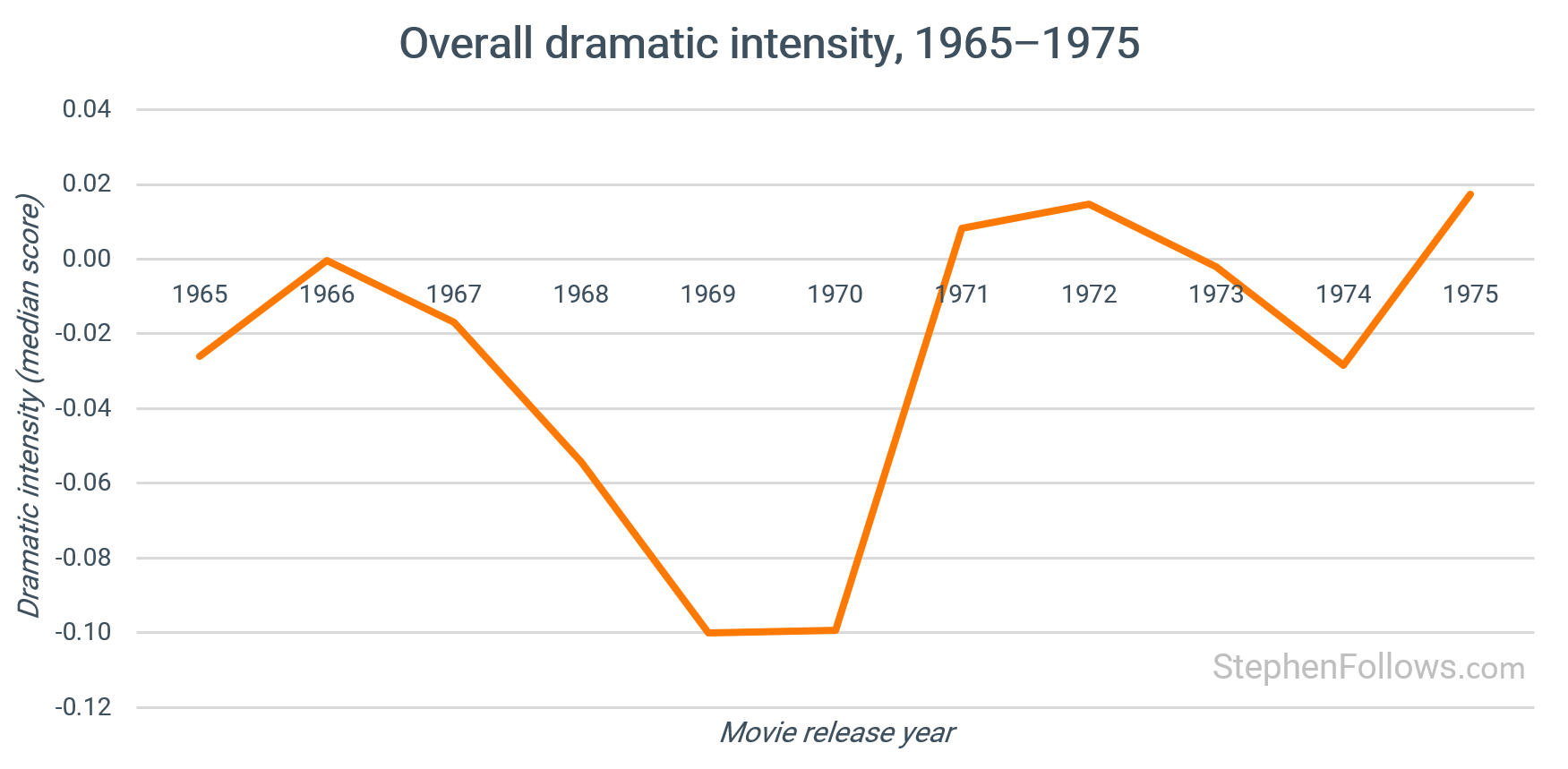
While 1971 is dramatic, it’s probably better to describe the 1970s as a traditional era rather than to attribute all the change to a single year. Pre-1970 films show stronger mid-film downshifts and lower high-intensity occupancy. Since 1971, the baseline has lifted and remains elevated.
What this means for how films feel
To sum up, when audiences say that films feel more intense today, they may not be reacting to bigger explosions or louder climaxes. Instead, they may be reflecting the change in rhythm.
Mid-century films were often comfortable alternating between pressure and relief. Emotional spikes were followed by cooling phases, and while the stakes remained, the tone widened. Not everything was always on the line at every moment in a way that left the characters always maximally charged.
Contemporary films don’t want to let go of you, even for a moment. Once pressure enters the story, it tends to persist, via more intense middle acts and constant reminders of the emotional stakes.
Cinema today does do not want you to… just… breathe.
Notes
Thank you to everyone who got in touch after the Matt Damon interview to ask me to look into the data behind what he was saying. I am particularly grateful to Jayson Abalos, who gave a detailed accounting of his theory, including (correctly) predicting that the 1970s were a key inflexion point for the trend.
Today’s analysis is based on 70,985 English-language feature films released between 1940 and 2022. I have reported the result at the year level using medians.
The measure I used is a subtitle-surface proxy for dramatic intensity. It captures dialogue-level emotional pressure, rather than cinematography, editing, music, or performance. Intensity is constructed from linguistic and formatting signals within subtitles, including high-arousal vocabulary (fear, anger, threat, urgency, profanity), punctuation pressure (such as exclamation and question marks), and all-caps emphasis.
To compare films of different lengths structurally, I normalised them into 20 equal-run-time bins, representing narrative progress from beginning to end. I then worked out that an intensity score between 0 and 1 is computed for each bin, yielding a 20-point intensity curve for each film.
From these curves, I had two broad types of metrics:
Amplitude measures included average intensity across runtime, upper-percentile intensity (a proxy for peak pressure), and the share of runtime spent above a high-intensity threshold.
Structural measures captured rhythm and persistence, including the “downshift index” (how much films cool in the middle after early destabilisation), the “ratchet index” (whether pressure builds again toward the end), the number of high-to-low resets, autocorrelation between adjacent bins, and the longest uninterrupted high-intensity stretch.
I calculated a composite dramatic intensity index as a standardised z-score across those components.
Epilogue
This is the second time I have been pushed to conduct data research based on something Matt Damon said. Previously, I fact-checked his thoughts on changing movie budgets in Has the mid-budget drama disappeared?
I guess I’m lucky that, in both cases, it’s only taken me a day or so, and not the combined $900 billion that his characters have apprently cost humanity. According to Kynan Eng, this breaks down as:
Courage Under Fire (Gulf War 1 helicopter rescue): $300k
Saving Private Ryan (WW2 Europe search party): $100k
Titan A.E. (Earth evacuation spaceship): $200B
Syriana (Middle East private security return flight): $50k
Green Zone (US Army transport from Middle East): $50k
Elysium (Space station security deployment and damages): $100m
Interstellar (Interstellar spaceship): $500B
The Martian (Mars mission): $200B
TOTAL: $900B plus change
Thanks for the sub-crunching - this is intensely intriguing.
The levels drop off c. 1945 and 1968. Perhaps the intensity of the wars outside the theatre may have been enough for the audiences.
A common critique of films (and not only from Netflixers doing the ironing) is that they "sag in the middle" (like many viewers, I suspect). With the ease of vid-hopping, this is no idle concern. However, this nonstop narrative approach can lower other vital story-enrichers: world-building, character development and emotional processing.
PS - I had no idea Matt Damon was so bloody expensive. However, had be been successful in stopping the invasion of Iraq in Team America, he could have saved the American taxpayer $1 trillion !