


Barton Weiss from VideoFest got in touch to ask:
Do you know the percentage of a film festival’s budget that comes from entry fees? I have heard that it was 9% - what have you heard?
Thirteen years ago, when I interviewed 523 film festival directors, the average was under 14.8% of income.
However, when the Raindance Film Festival opened its books to me three years later, its submission-fee income accounted for 35.6% of its total income.
So I didn’t have a clean figure to provide to Barton off the top of my head. I went digging around for data sources. In the US, most film festivals are non-profits, and non-profits file a public tax return, the Form 990. Buried inside it, on the Statement of Revenue, the festivals list where their money came from.
For example, in 2023, the Portland Film Festival took in $307,194 in income, 82% of which came from fees.
So, we can already see that the answer will differ widely between festivals. Let’s take a systematic approach, looking at the details of two sources of data:
2013 Festival Director Interviews. The answers given by film festival directors in 2013. Each provided a single, self-reported figure for their festival.
2026 Tax Records Analysis. The tax records of US-based non-profit film festivals. Most organisations lump all income into a vague bucket marked “programme revenue”, but a minority break it out into a separately labelled line item, “Submission fees” or “Film entry fees”. Out of around 2,500 candidate organisations, 57 itemised their fee income cleanly enough to use, giving 266 festival-years of data.
The short answer is “it varies enormously”
Using the new data, I found that three-quarters of film festivals earned less than 11% of their income from fees.
The smallest share from fees was just 0.2%, and we’ve already seen the largest, at 82%, for Portland.
The average percentage across these festivals and all the tax records was 10.7%. The median was 4.4%.
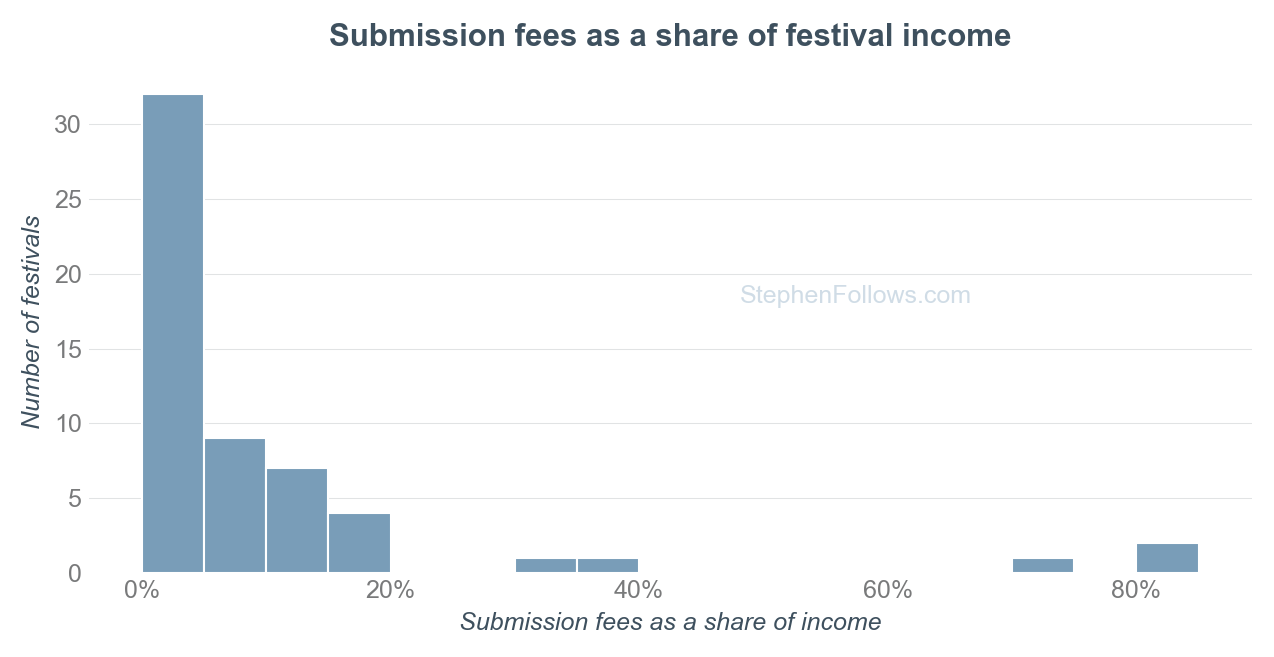
One thing worth noting is that the smallest festivals are the ones most likely to rely on fees, and yet they are also the least likely to have detailed tax records.
Has it changed much?
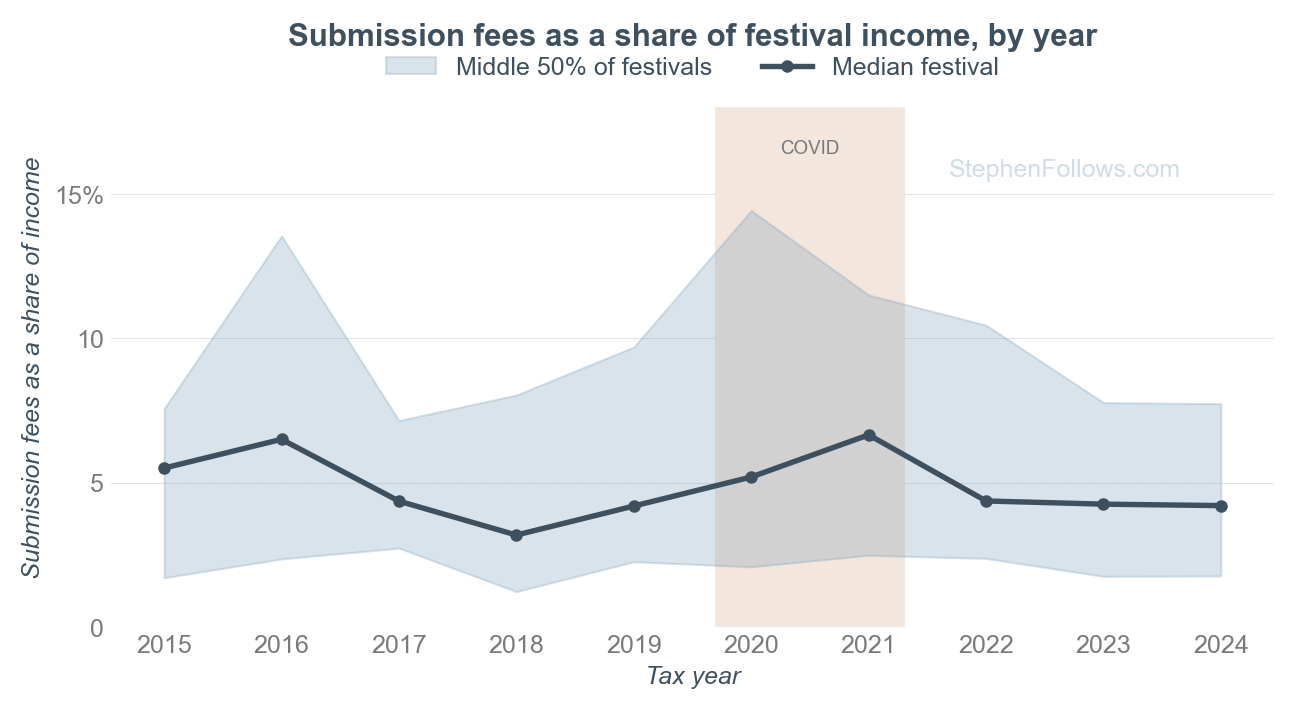
Using the tax records we can look back over the past decade. This reveals that the median festival has fluctuated between 3% and 7% over this period.
How are film festivals funding themselves?
At this point, you might be wondering how festivals stay afloat, if filmmaker fees are such a thin slice.
Festivals earn their money from three types of income:
Submission fees paid by filmmakers
Donations, grants and sponsorship
Commercial income, mostly ticket sales, but some do have merch.
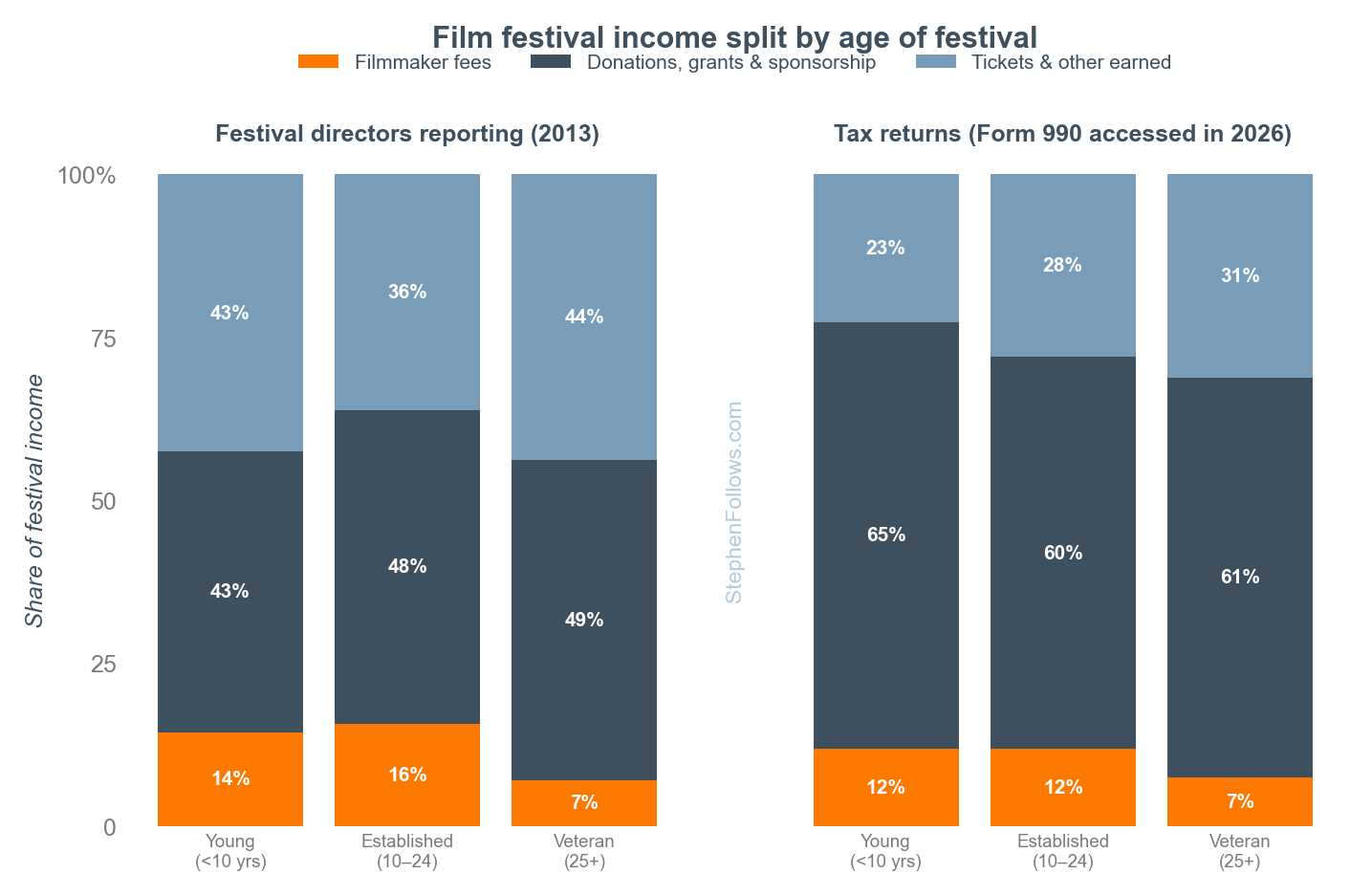
Fees are the smallest of those three types. Below, I’ve broken it down by festival age and put both datasets side by side: the 2013 director survey and the 2026 tax records.
The oldest festivals rely on fees the least. Veterans take just 7% of their income from fees in both datasets because they’ve had the time to build donor and regular audiences that younger festivals are still chasing.
My reading of the data reveals four kinds of film festivals:
The donor-funded are the mainstream, getting the bulk of their income from grants and gifts and only a few percent from fees.
The sponsor-and-ticket festivals are the biggest, covering their costs with a mix of donations, box office and sponsorship.
The small-and-fee-leaning are tiny operations scraping a third from donors and leaning on fees for close to a fifth of their income.
The fee-funded are tiny, donor-less, and running on filmmaker money for three-quarters or more of their income.
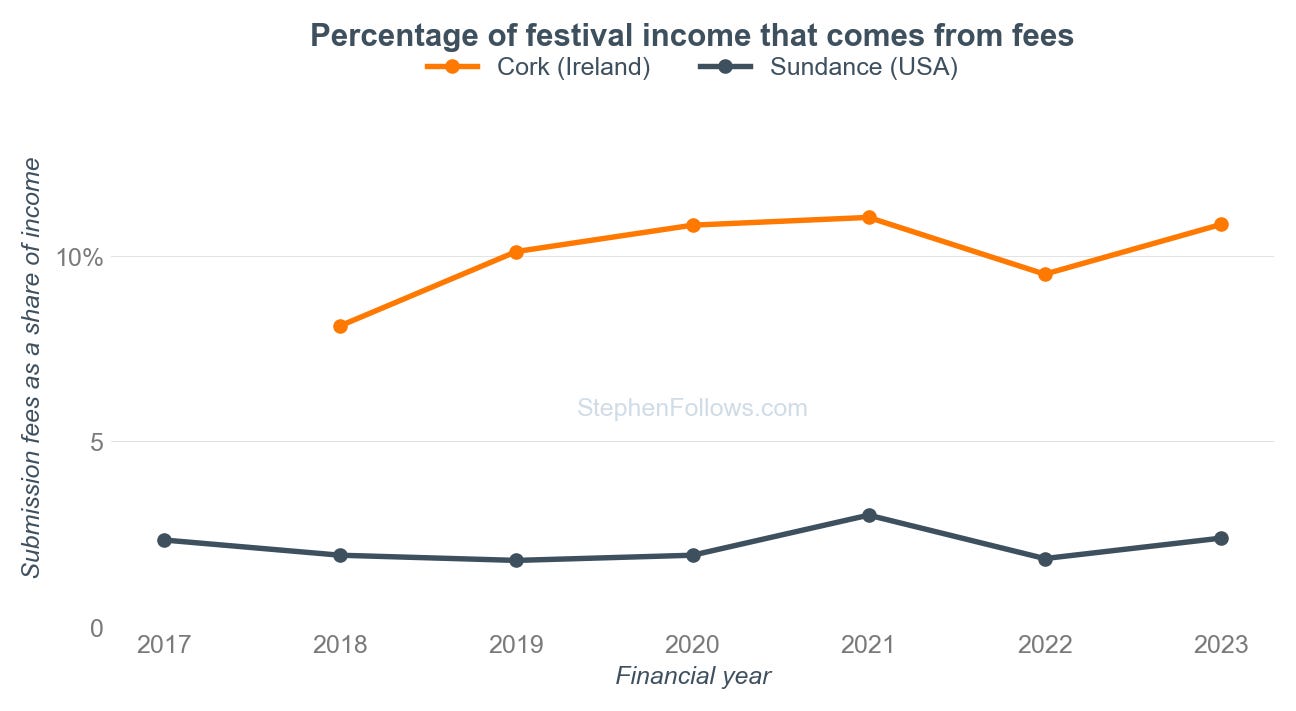
The biggest of the “Donor-funded” cohort is Sundance. Its audited statements reveal that fees account for only around 2% of total income. Sundance processes roughly 15,000 submissions a year and earns far more from sponsors, donors, and ticket sales, so the $1 million it collects from submission fees is a rounding error on its books.
Cork International Film Festival, Ireland’s oldest, is a useful contrast as a public-arts festival rather than a US non-profit. Its published accounts have held steady between 8% and 11% over six years.
How much money are we talking about?
I have focused on the percentage of fees earned, rather than the dollar amount, for two reasons. Firstly, that was the focus of Barton’s initial question, but also because I think it’s a more meaningful number.
However, I’m sure I will be asked about the numbers at play, so here’s a quick overview.
Last year, I studied the cost of a single entry to a film festival, discovering that the average fee ranged from $30 (for an early-submitted short film) to $87 (for a late-submitted feature film).
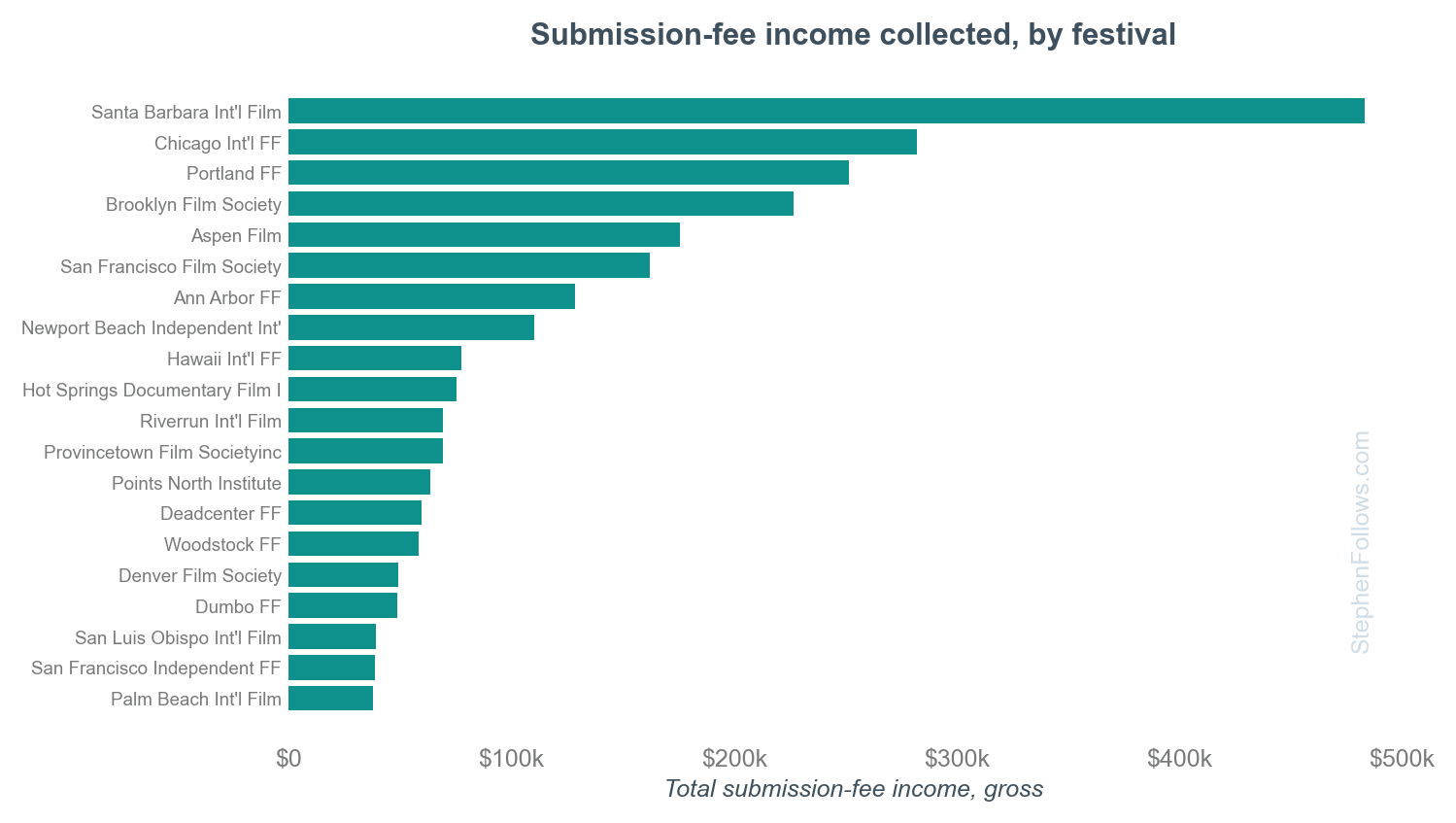
In today’s new research on tax returns, the festival that reported the highest income from fees was Santa Barbara, at close to half a million dollars. But Santa Barbara is a multi-million-dollar operation, so that half-million is only about 4% of its income. (There will be many festivals earning more, but their tax reporting prevents us from knowing the figures).
The Dumbo Film Festival has a much lower total but is at the other end of the spectrum. They reported that in one year all of its $51,964 funding came from fees, and 72.7% was paid out to just three people.
Below are the festivals that had the largest declared income from fees.
So what of ‘scam’ festivals?
Filmmakers have been warning each other about ‘scam festivals’ for well over a decade. These are events that exist mainly to trick filmmakers into paying to submit, under the false premise that the festival is well-respected, useful, or even real.
The concern is neither new nor fringe. Back in 2019, Screen Daily reported calls for a festival regulator after a run of scam events, and noted that FilmFreeway had already delisted 42 of them. The Hollywood Reporter has documented how below-the-radar festivals prey on struggling filmmakers, including a horrifying story of a writer-producer who borrowed money to fly from New York to London for her ‘UK premiere’ and found a near-empty room. One Rhode Island showcase ended up branded the ‘Fyre Festival’ of film festivals.
It helps to picture a spectrum. At one end sit the outright frauds, which take your fee for an event that never happens. At the other side are the ‘award mills’, which are technically real but exist to manufacture laurels. They run rolling monthly deadlines, nominate almost everyone, spin up a dozen city-branded editions of the same event, and then sell you a certificate, a trophy or a ‘social media package’ once you’ve ‘won’. The laurel, not the screening, is the product.
Sadly, the tax data I’ve been using can’t really tell the difference between a ‘real festival’ and one that just farms fees. And to be fair to the small festivals at the top of my charts, a festival funded almost entirely by fees isn’t necessarily doing anything wrong. It may simply be a small event in a town with no arts money and no wealthy donors, funding itself the only way it can.
Similarly, the fact that most of the income goes to a small number of people is not automatically suspect. We have all met the person who makes a community event happen through sheer dedication and hard graft. If they secure venues, volunteers and resources for free, then paying them for their time is good value, not a red flag.
So how do you tell the two apart? The community has settled on a familiar set of warning signs: dozens of award categories, near-automatic nominations, vague or shifting venues, screenings that turn out to be ‘online only’, and a flurry of upsells the moment you’re selected.
There are good rundowns of the red flags from Noam Kroll, Submitting to Film Festivals and Show Me Shorts. The single most useful habit is to do your due diligence before you submit your film each time. Check that the venue exists, look for photos and press from past editions, and ask what will be screened if you’re accepted.
The platforms have, belatedly, started to respond. FilmFreeway now runs ID checks, demands venue proof, and holds a new festival’s first-year payouts until it can prove the event actually took place. Filmmakers have petitioned for more, and bodies such as the Universal Film Festival Organisation have launched specifically to stamp the practice out.
The voice of the festival directors
I don’t want to end on a negative note, as the vast, vast majority of film festivals are working hard and doing well.
A filmmaker who is starting to submit to festivals might be forgiven for initially decrying the amount of money it costs to submit to festivals, but once you dig into what it takes to put festivals on, the fees seem far more defensible.
Running a film festival is a lot like making a film. I.e., it makes no rational sense, so the only people who do it are those who are most passionate, most resourceful, and who really believe in the mission.
In preparing today’s article, I reached out to a number of the festivals in my dataset, especially those leaning most heavily on fees, to ask how it looks from their side of the desk.
Josh Leake, Executive Director of the Portland Film Festival, rightly pointed out that tax filings only capture cash, not the volunteer and community support that keeps a small festival running. He said:
The submission-fee revenue can appear larger on the filing than it would if one were looking at the festival’s broader support base as a whole.
Jeff Ross of SF IndieFest explained why a festival’s fee reliance can climb without anyone raising a single fee.
Before the pandemic, our revenue was mostly from ticket sales, with some grant money and submission fees making up a much smaller percentage. The percentage of revenue from submission fees has gone up, but that’s mainly because our revenue from ticket sales has declined so much. The overall event budget has declined about 50% since 2020. We don’t have sponsors, donors or a membership program. We are truly a grass roots DIY arts org.
At the other end, Leslie Raymond of the Ann Arbor Film Festival, whose fee reliance has actually fallen over the decade, said:
Submission fees are an important part of our funding mix, but our goal has always been to build a sustainable festival through a diverse range of revenue sources rather than relying too heavily on any single one.
And Kitty Boone of Aspen Film showed how one organisation can do both. Its feature festival is invitation-only, with no submission fees at all, whereas its shorts festival, Aspen Shortsfest, charges one, because:
…we receive well over 3,300 submissions, [and] it requires a lot to program a festival such as this.
The same themes came through thirteen years ago, in the anonymous answers to my original survey:
“It is a labor of love. No one is getting rich off your entry fees.”
“Generally, I think filmmakers believe that festivals have more money than they have… there usually is no ‘profit’ to share. The vast majority of film festivals barely get by.”
“There is very little funding, and small festivals like us rely on the nominal entry fees to let us run a festival.”
“We know people don’t like paying submission fees, but without them our festival (and I assume many others) would not be able to make ends meet.”
Notes
I built the festival list via ProPublica’s Nonprofit Explorer and the IRS Business Master File. That gave around 2,500 candidate organisations. I matched them to the IRS e-file index and read the underlying Form 990 XML directly. 57 festivals itemised submission or entry fees on their own line (Form 990, Part VIII, line 2), giving 266 festival-years across the 2015 to 2024 tax years. The denominator throughout is total revenue (Part VIII, line 12).
I only used a festival year where entry fees sat on their own labelled line. Where a festival bundled them into something mixed, like “Tickets and entry fees” or a generic “Festival fees”, I left it out rather than guess.
These are fees as booked (i.e. gross, not net), before FilmFreeway’s commission of around 12%, payment processing, sales tax or fee waivers. The cash retained is somewhat lower, so if anything, these figures slightly overstate reliance.
Organisations below the filing threshold submit a Form 990-EZ or a one-page postcard, neither of which itemises fees. Of 609 festivals that filed the short form, only about one in eighteen mentioned submission fees anywhere, and never as an isolable number. They are exactly the festivals most likely to live on fees, so the true long tail sits higher than this sample, not lower.
Sundance and Cork come from their own published accounts, not the IRS data. Sundance’s audited statements carry a “Submission” line and Cork’s accounts, filed as an Irish charity, carry a “Submission Fees” line.
Very interesting piece, Stephen (as always!!) and Bart asked a great question to set you off on your research! I can tell you anecdotally why having a higher percentage of fest revenue from submissions fees matters for a sustainable festival: At Slamdance (of which I'm a cofounder, but not at all active on the day-to-day side), I think one accidental key to our longevity (32+ years) has been a disproportionate reliance on submission fees. Over the years I've seen a lot of other festivals do a much better job at getting state and municipal financing, as well as corporate sponsorship. For all kinds of reasons, Slamdance has simply not been good at either of those sources. As for box office revenue, for most of our existence in Park City, we were limited to our rather small venues. And as a matter of policy, Slamdance has always tried to keep ticket prices much lower than other festivals - especially compared to that big one that was also in Park City. Why has this helped us? In the grand scheme of things, it's meant that Slamdance has weathered the economic and political ups and downs over the years much more smoothly than other festivals that are proportionately more reliant on sponsorship, grants and ticket sales. Over the last 30+ years, Slamdance weathered the DotCom boom and crash, 9/11, the 2008 recession, Covid, our move to LA, etc. Meanwhile, submission rates have remained remarkably steady and robust over the years. So since they're a higher proportion of our budget, Slamdance has been able to persist easier than other festivals that have come and gone during this same time period. Another reason - and I have to give full credit to fellow cofounder @JonFitzgerald who came up with this idea in our second year - we started a screenplay competition as an alternate source of revenue and activity during our slow months. There are plenty of other reasons why Slamdance has persisted this long - not least of which the incredible dedication of our filmmaker community and stalwart leadership of Peter Baxter over most of our existence. But I always tell other festival directors - especially new ones - to learn lessons from the Slamdance model, one way or another.
I’ve seen a similar pattern while distributing independent films across Europe and the Middle East. The projects that succeed usually build a community long before release.