


A year ago I spoke at the Creators Conference of the German Producers Alliance in Munich, detailing the interesting bifurcation in German cinema. (You can read my article write-up here Why German films look so different at home and abroad).
Last month I was asked to return, this time to look into the future and consider what the German cinema industry might want to do.
(I am aware that an Englishman going over to Germany and saying “This is what you must do” is a tough gig! But the organisers were very supportive, the audience highly engaged, and overall I feel my suggestions were taken in the spirit they were intended. Zum Glück!)
Today’s article is a précis of the ideas, partly as a record and because many of the lessons will apply to countries worldwide.
A quick recap: the two German cinemas
Last year I showed that German cinema has two distinct identities depending on who is watching. At home, the box office belongs to comedies and family films. They are warm, silly, hugely popular and almost never seen outside German-speaking countries. Abroad, the German films that succeed are serious dramas about moral conflict, psychological weight and difficult history.
Comedies and family films have taken 73% of the domestic box office for German-language films since 2000. In North America, those same kinds of films account for 0.9% of German-language cinema's earnings.
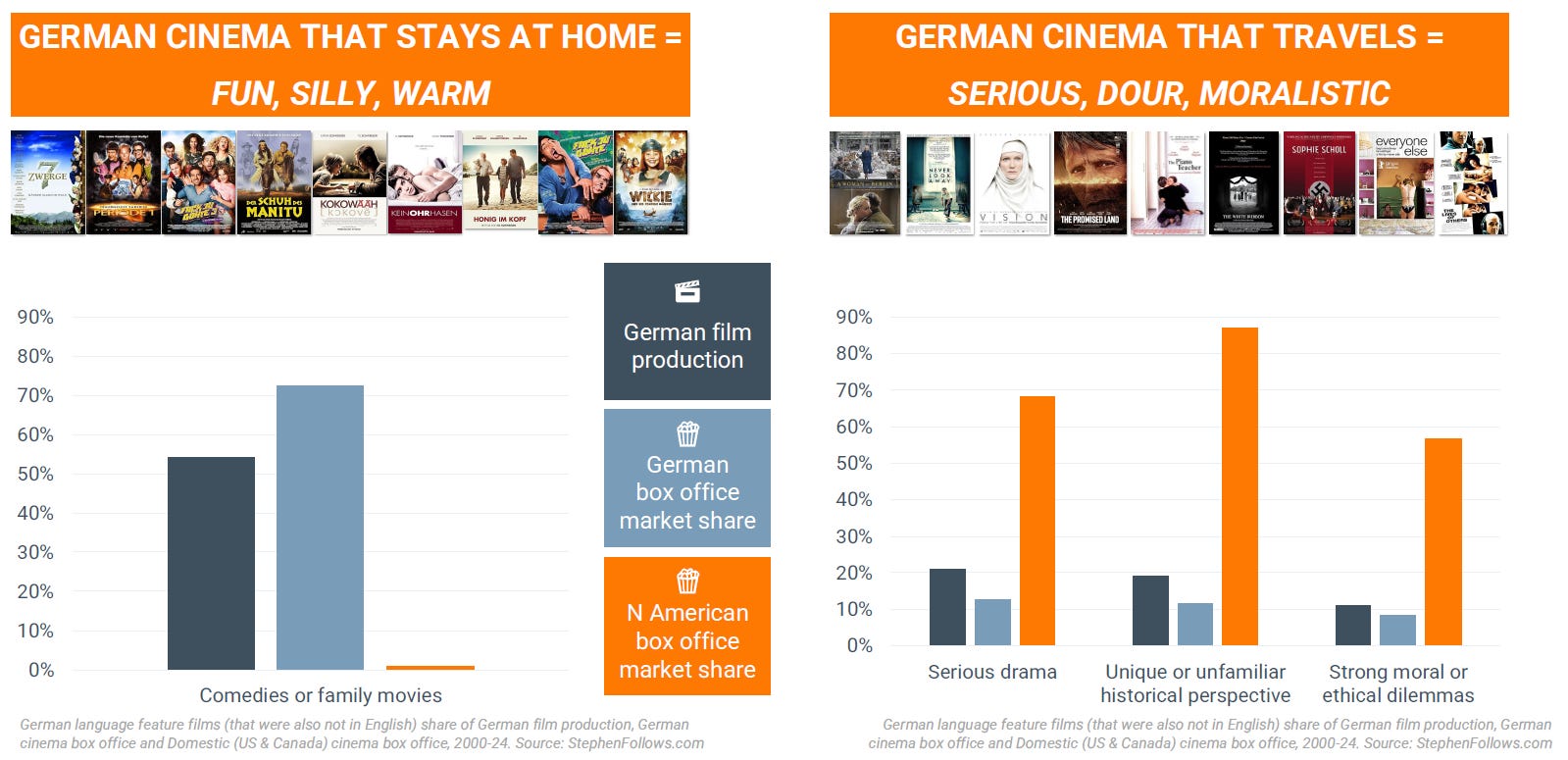
Two cinemas, in other words - one that stays home and one that travels.
How the world talks about German film
To add to last year’s findings, I also gathered 25 years of articles from Variety, The Hollywood Reporter, Screen and Deadline, around 1.3 million pieces in total, and identified roughly 49,000 that concern German film.
Then I counted the language used about seven major film nations: how often each country’s cinema is described in terms of success and breakouts, versus crisis and decline.
Every country gets more crisis talk than success talk. That is simply how trade journalism works. But the size of the gap varies a lot, and Germany’s is the widest of any nation I studied.
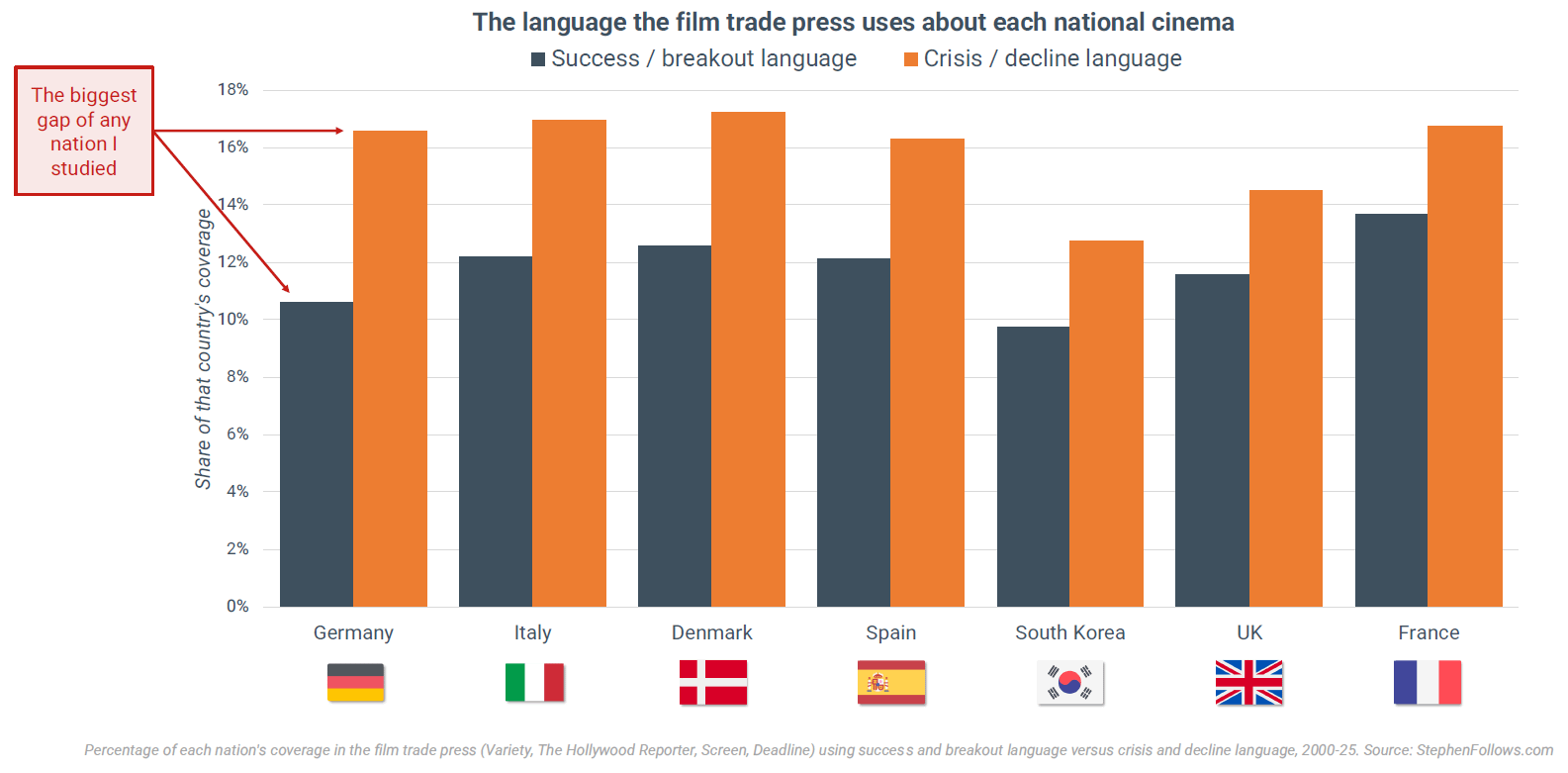
To be clear, this doesn’t show that German cinema is in decline. Instead, it shows how German cinema is framed in the press, which shapes whether an audience, a commissioner, or a distributor gives a film a chance.
So German cinema carries a reputation problem it hasn’t earned. Which turns out to be less of a burden than you’d think, because reputations like this can flip.
The world falls for a country’s cinema in waves
International attention doesn’t spread evenly across the world’s film industries. It moves in waves.
France had the New Wave, which reset the country’s cinematic reputation for a generation.
City of God put Brazilian film on the world map.
Britain has had at least two “British cinema is back” moments, one around Chariots of Fire and one around Four Weddings and a Funeral.
Amores Perros and Y Tu Mamá También launched a new generation of Mexican cinema.
Dogme 95 made Denmark, a country of six million people, a global brand.
Crouching Tiger, Hidden Dragon opened Western audiences to Chinese-language cinema.
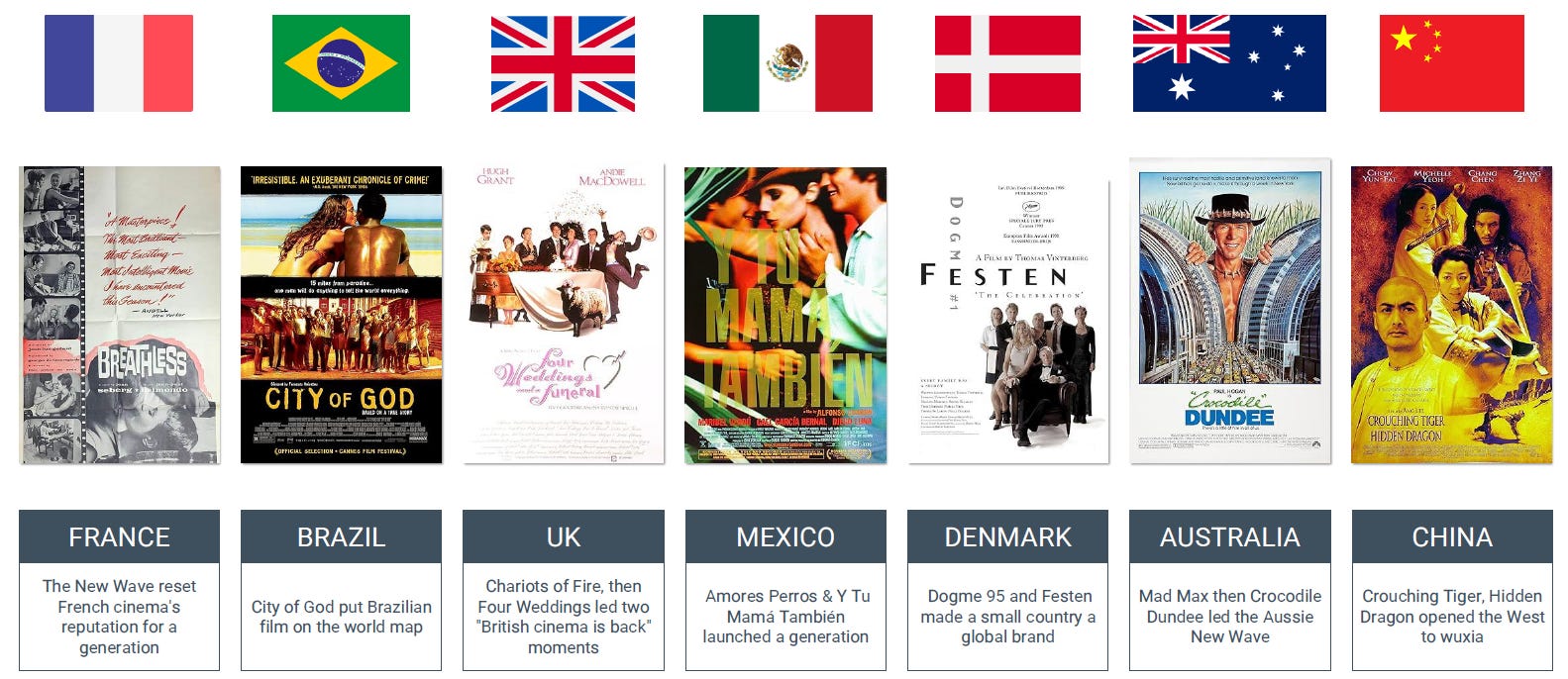
What makes these waves so valuable is that a single breakout film gets audiences fired up to ask what else there is, and when there’s a shelf of films waiting, many films benefit from this new halo.
The Parasite effect
Earlier this year I published a study of what happens to a country’s films after it wins the Best International Feature Oscar. I tracked the entire back catalogue of each winning nation, 12,267 films across nine countries, in the year before and after the ceremony, using Wikipedia attention and almost ten million written audience reviews.
After Parasite won, attention to Korea’s entire back catalogue rose by around a quarter relative to its peers, and the review data showed an even bigger jump. The lift lasted for years. And it wasn’t just people discovering Bong Joon-ho: the whole of Korean cinema rose by about the same amount.
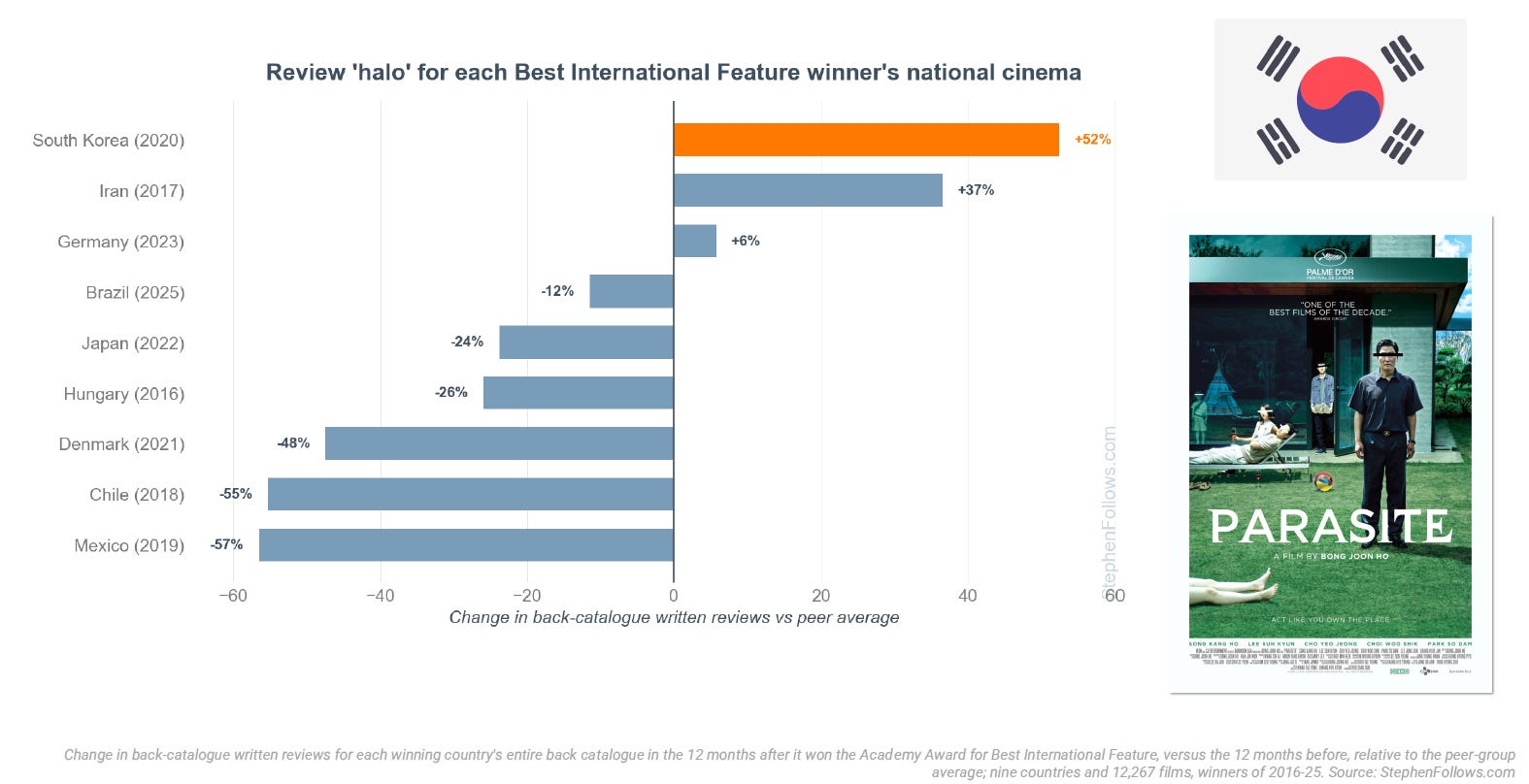
Notice that Germany is on that chart too. All Quiet on the Western Front won four Oscars and moved the rest of German cinema by a modest 8%, with some of that due to Netflix’s global release rather than the award.
It could be argued that had that film received a proper cinematic release (as opposed to being a streaming title), the effect would have been larger and more profound.
The broader point is that a single film can really lift an entire national cinema. It has happened, measurably, within the last six years. It’s not something we can conjure with certainty, but we can describe the conditions which make it most likely to happen.
Three conditions at once
Parasite did three things simultaneously.
It reached the world.
It was genuinely popular, a tense, funny thriller rather than a critics-only piece.
And it was completely, unmistakably Korean, with no attempt to sand that off for export.
Germany’s version of that film would need the same three things: international, mainstream and deeply German. Here’s what the data says about each.
1. It needs to reach the world
The reflex here is that German films don’t travel. That used to be a reasonable bet, but streaming has changed the landscape.
Dear Child, a German-language thriller, reached number one on Netflix in 92 countries and was the second most-watched title on the entire platform in the second half of 2023, behind only Korea’s The Glory. Around 90% of the audience for Dark was outside Germany, in German, with subtitles. All Quiet on the Western Front surpassed 150 million hours viewed, and its viewership tripled when the Oscar nominations were announced.
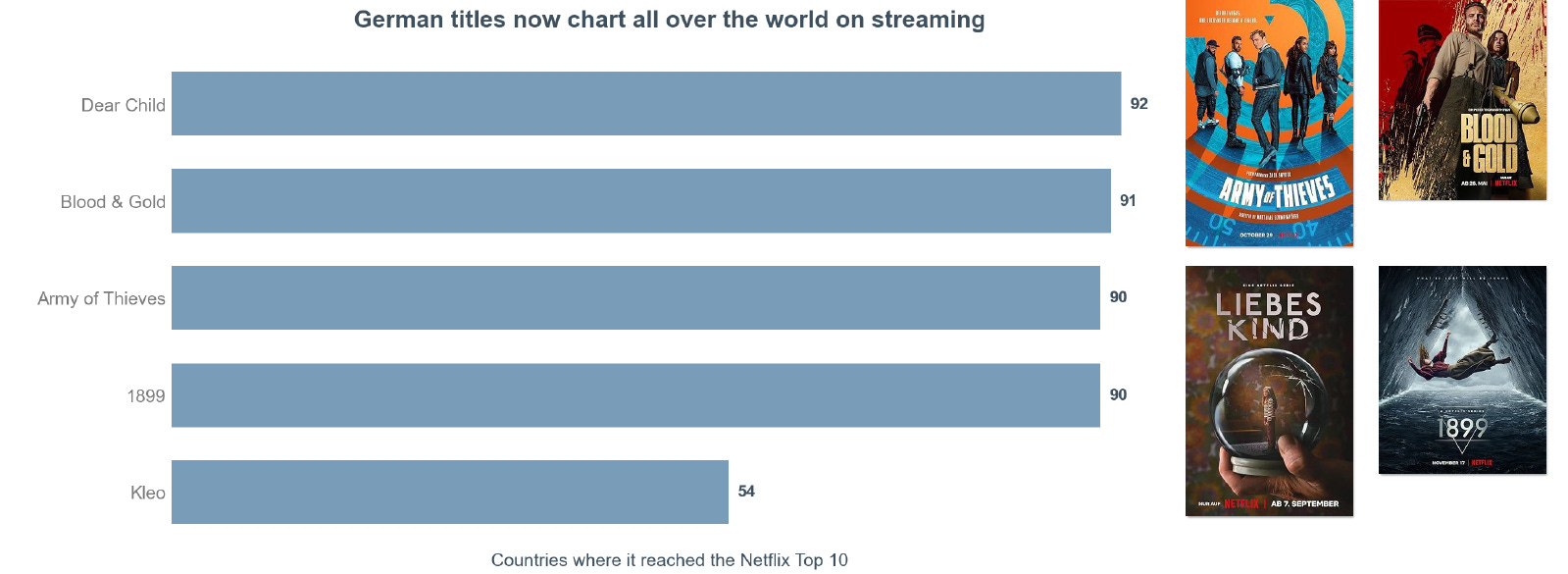
And when the films themselves don’t travel, the stories do. Wikipedia maintains a category of remakes of German films that runs to over 150 titles, with no comparable list flowing the other way. Fack ju Göhte, a German school comedy that never stood a chance in English-language cinemas, became No Manches Frida, a Mexican franchise worth roughly $50m. Paramount has held the remake rights to Toni Erdmann since 2017, at one point with Jack Nicholson attached. The BBC remade the cult NDR comedy Der Tatortreiniger as The Cleaner, written by and starring Greg Davies.
2. It needs to be properly mainstream
While the international community of cinephiles might think of prestige, dour dramas when they think of German cinema, within Germany it’s another matter. Multiplexes are regularly packed with home-grown, mainstream hits.
Der Schuh des Manitu sold 11.7 million tickets; six German films have surpassed seven million admissions; and only last year, Das Kanu des Manitu sold around five million tickets.
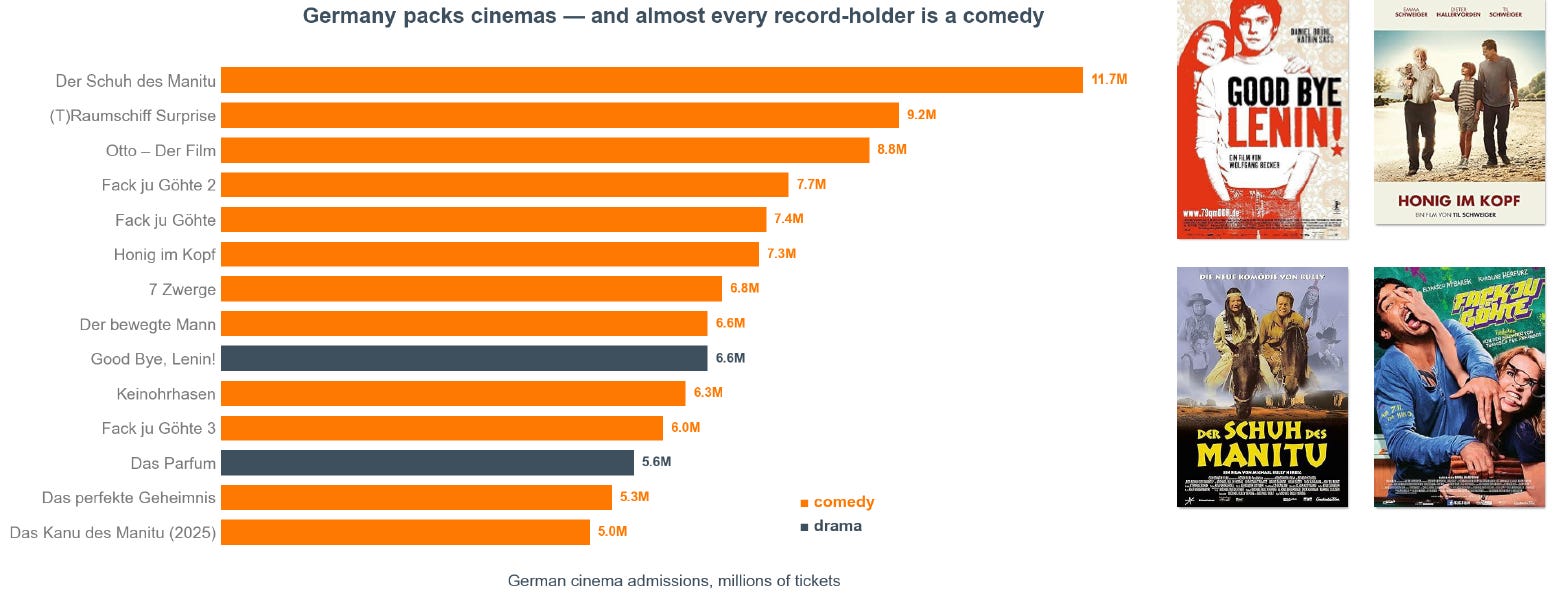
In a symbiotic loop of film and filmmakers, Germany has a wealth of experienced mainstream talent to draw from.
Michael “Bully” Herbig holds the all-time number-one and number-two spots.
Bora Dağtekin has released six films, and each has surpassed 2 million admissions.
Elyas M’Barek anchored a trilogy that sold over 21 million tickets.
Til Schweiger topped the annual box office repeatedly as both director and star.
While these will be household names to most Germans, they barely register outside of Germany. In my trade press dataset, the most-covered German film-makers are Wenders, Tykwer, Akin, Herzog and Petzold. Wonderful film-makers all, but they are the festival names.
The directors who actually pack German cinemas are pretty much invisible abroad. The world’s press covers the German cinema of prizes and misses the German cinema of crowds. Hence, why one film alone could awaken international audiences to Germany’s goldmine.
3. It needs to be undeniably German
The final part of the puzzle is to ensure that this breakout film is undeniably German.
Parasite was full of Korean specifics, and that specificity is what made the world curious. The equivalent German move is to lean into what the world already admires about Germany, and the polling on that is remarkably strong:
Germany holds the number-one “Made in” label on Earth, ranking first among 49 countries in the Made-in-Country-Index.
48% of global consumers trust German products “a lot”, the highest of any country YouGov tested.
It is the second-most admired nation brand in the world and the first in Europe, having held the global top spot from 2017 to 2022.
Gallup has rated Germany’s leadership the most approved of any major power for six years running.
The Brothers Grimm tales are inscribed in UNESCO’s Memory of the World and translated into more than 160 languages. The world’s most famous fairy-tale castle is Bavarian, and Disney’s logo owes it a debt.
Engineering, precision, order, fairy tales, music, forests, castles. They may, at first blush, feel like clichés, but they are, in fact, the best route to promoting Germany and German culture. They are pre-sold story worlds the global audience already trusts, the same way The King’s Speech and Downton Abbey sold the world exactly what it expected of Britain.
Two out of three, every time
As you can see, Germany already excels at all the other things our mythical new breakthrough needs to do. Many films have hit two out of the three requirements.
But I believe that all three are needed. With just two, you get the following:
Anonymous. International and mainstream, but not German. Films built to travel with the Germany taken out: shot in English, or a minority stake in someone else’s production. They reach people, but nothing of Germany travels with them.
Prestige festival dramas. International and German, but not mainstream. Toni Erdmann, The Lives of Others, All Quiet. Unmistakably German and they travel, but to festivals and critics rather than a mass audience.
Home hits. Mainstream and German, but not international. The comedies and family films German audiences adore, which the world never sees.
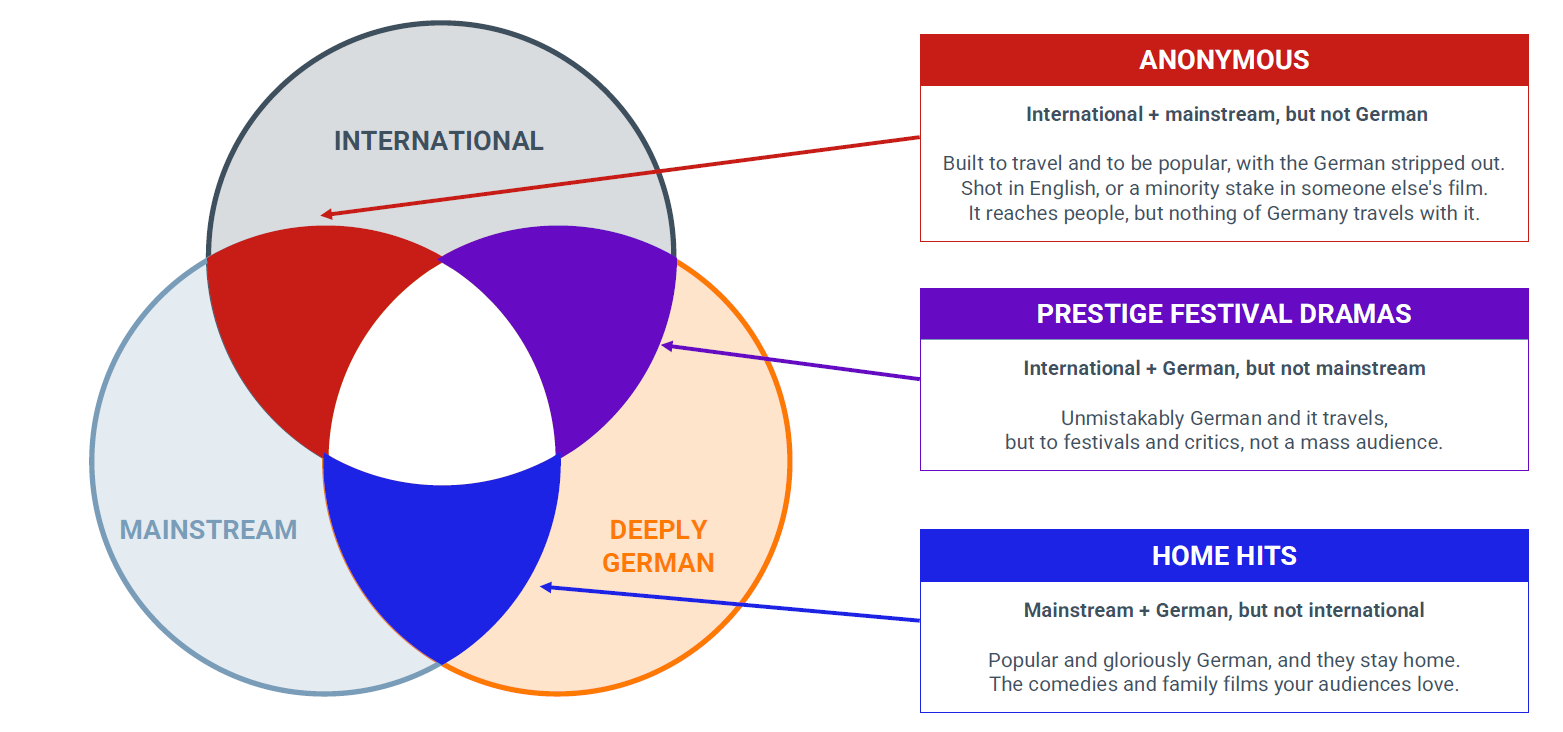
Three overlaps, all of them real, familiar, repeatedly successful kinds of German film. And a centre, where all three meet, that is empty.
Germany has never made a film that is international, mainstream, and unmistakably German at the same time.
What the film might look like
Here is a checklist for factors which are likely to improve the film’s path to success:
Fun first. Parasite was a thriller before it was anything else. Films break out by being entertaining, not by being important.
Unmistakably German. The specificity is the point, not something to hide or overcome.
A universal feeling underneath. A local layer on the surface, and something everyone knows beneath it. War, family, survival, love, grief, betrayal, revenge, justice, ambition, freedom, guilt, sacrifice, belonging, growing up, growing old. Or the brighter register: joy, friendship, first love, laughter, hope, wonder, homecoming, a dream coming true.
A genre to carry it. Genre is the passport that gets a local story across a border. Thrillers and science fiction travel best; comedy travels worst, which is precisely why Germany’s biggest domestic genre has stayed home.
A bench behind it. When curious viewers come looking for more, there has to be somewhere to go. Korea had Oldboy, Memories of Murder and Train to Busan waiting. Germany’s shelf runs from Metropolis and Nosferatu to Fassbinder, Wenders and Dark. Few countries have a deeper one.
Built for streaming. The modern breakout may be a series, and may never see a cinema. That is where the world now discovers non-English stories.
The empty middle
Germany makes films that travel, films that fill cinemas, and films that are gloriously, specifically German. It's time they did all three and aimed for what Parasite did, hopefully lifting the whole national cinema.
Notes
The trade press analysis covers around 1.3 million articles from Variety, The Hollywood Reporter, Screen and Deadline, 2000 to 2025, of which roughly 49,000 concern German film. The success/crisis comparison counts articles using breakout and success vocabulary versus crisis and decline vocabulary, applied identically across all seven countries. It measures the language of coverage, not the performance of the industries, and word-counting of this kind is a blunt instrument at the level of any single article. The cross-country comparison is more robust than the absolute percentages.
The Oscar halo analysis is described in full, with its own methodology notes, in my April piece on Parasite. In brief: winners of Best International Feature; each country’s back catalogue (excluding the winner) tracked for 12 months either side of the ceremony; controlled against the average of the other tracked countries, using Wikipedia pageviews and around 10 million dated audience reviews.
German admissions figures come from the FFA (the German Federal Film Board) and InsideKino and are measured by tickets sold rather than revenue, so that films from different decades can be compared fairly. The figure for Otto – Der Film excludes East German admissions; including them would lift it to roughly 14.5 million, putting it at the top of the list.
Netflix reach figures are drawn from Netflix’s published Top 10 and engagement reports, as well as third-party trackers (FlixPatrol, What’s on Netflix). Netflix self-reports these numbers and changed its headline metric in late 2021, so treat them as directional rather than audited.
Since the German action movie _Run Lola Run_ was popular in the 1990s, how about the action movie _Asphaltgorillas_?
https://www.imdb.com/title/tt6175802