


Ted Hope reached out to ask:
What percentage of first-time feature filmmakers made a second film within five years?
A damn fine question. Is it talent? Connections? Money? Luck? A famous parent and a good haircut?
So I turned to the data. I took every person whose first feature film was released between 1990 and 2018 (146,603 directors worldwide) and followed what happened next. For each of them, I gathered a pile of possible clues about the debut, such as:
Who produced it
What genre it was
Whether it won anything
Whether anyone actually watched it
What the director had made beforehand
and more.
Then I measured which clues went with a second film and which did not.
In the end, the biggest clue turned out to be one almost nobody talks about.
How rare is a second film?
Let’s start with the base rate. Of the 146,603 debut directors, 25.3% directed a second feature within five years. I’ll call this the ‘Comeback Rate’ (the share of debut directors who direct another feature within five years), and it’s the measure running through all of today’s research.
The chart below follows directors year by year after their debut (limited to people who debuted by 2013, so everyone has a full ten years of runway).
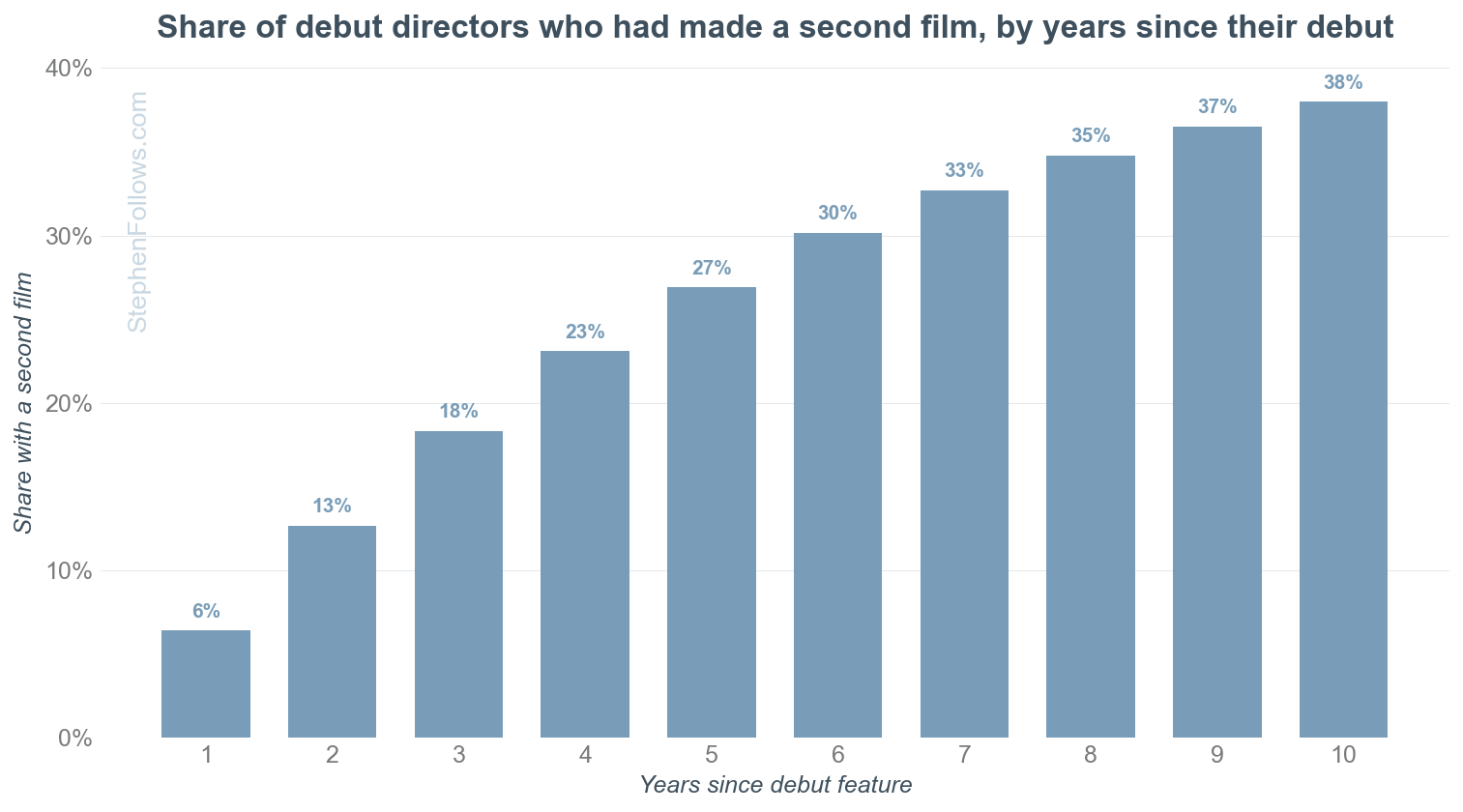
The climb is steep at first and then flattens. By year three, 18% were back. By year five, 27%. After that, each extra year adds less and less, and even a decade out, only 38% had directed a second feature. In short, comebacks tend to happen quickly or not at all. Of the directors who returned within ten years, seven in ten had done so by year five.
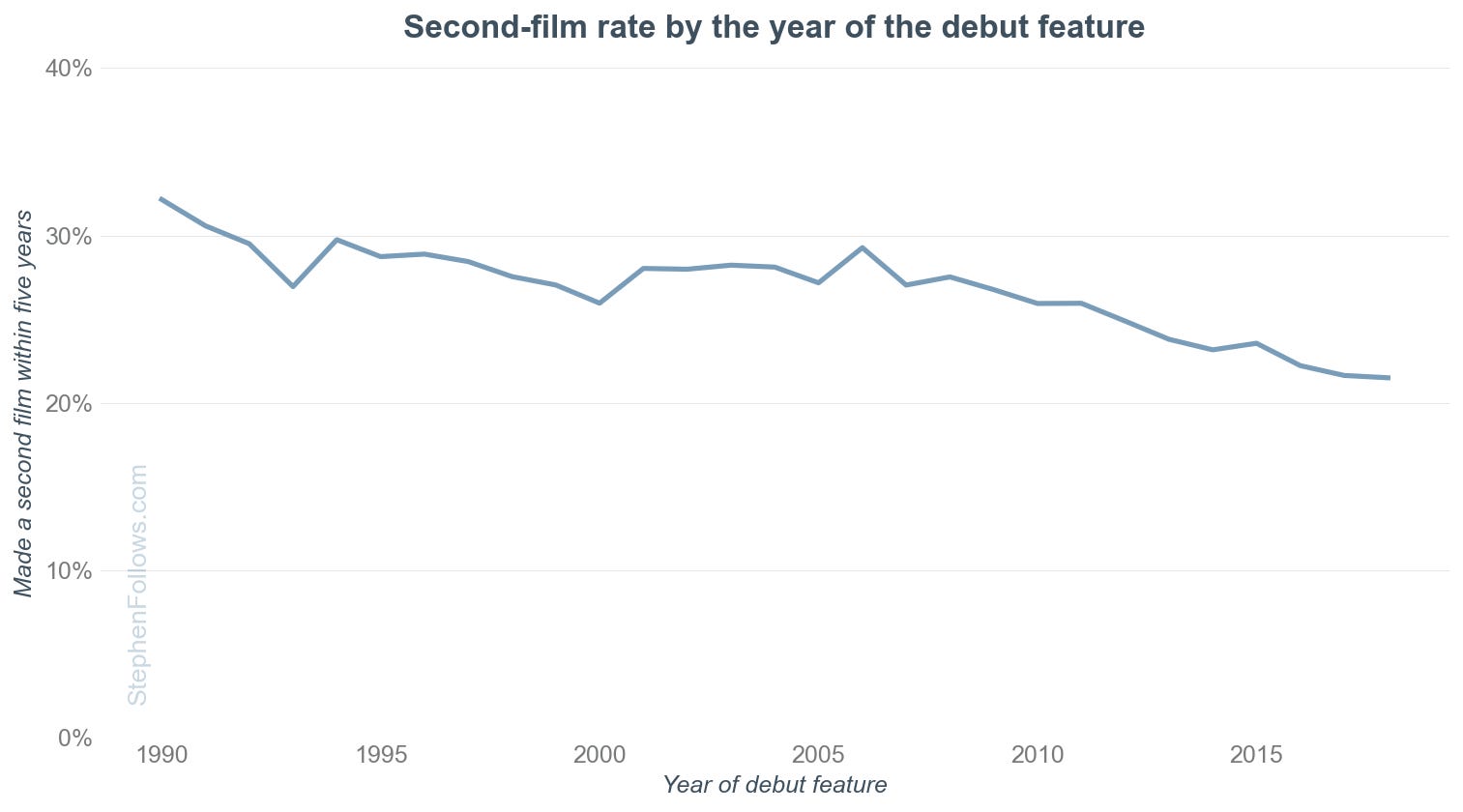
It’s also getting harder. Directors who debuted in 1990 came back 32% of the time. For the class of 2018, that was down to 22%.
Part of what’s going on here is how crowded the starting line has become. In 1990, about 1,350 people directed a first feature. In 2018, over 10,600 did. Nearly eight times as many debuts, chasing an industry that did not get eight times bigger.
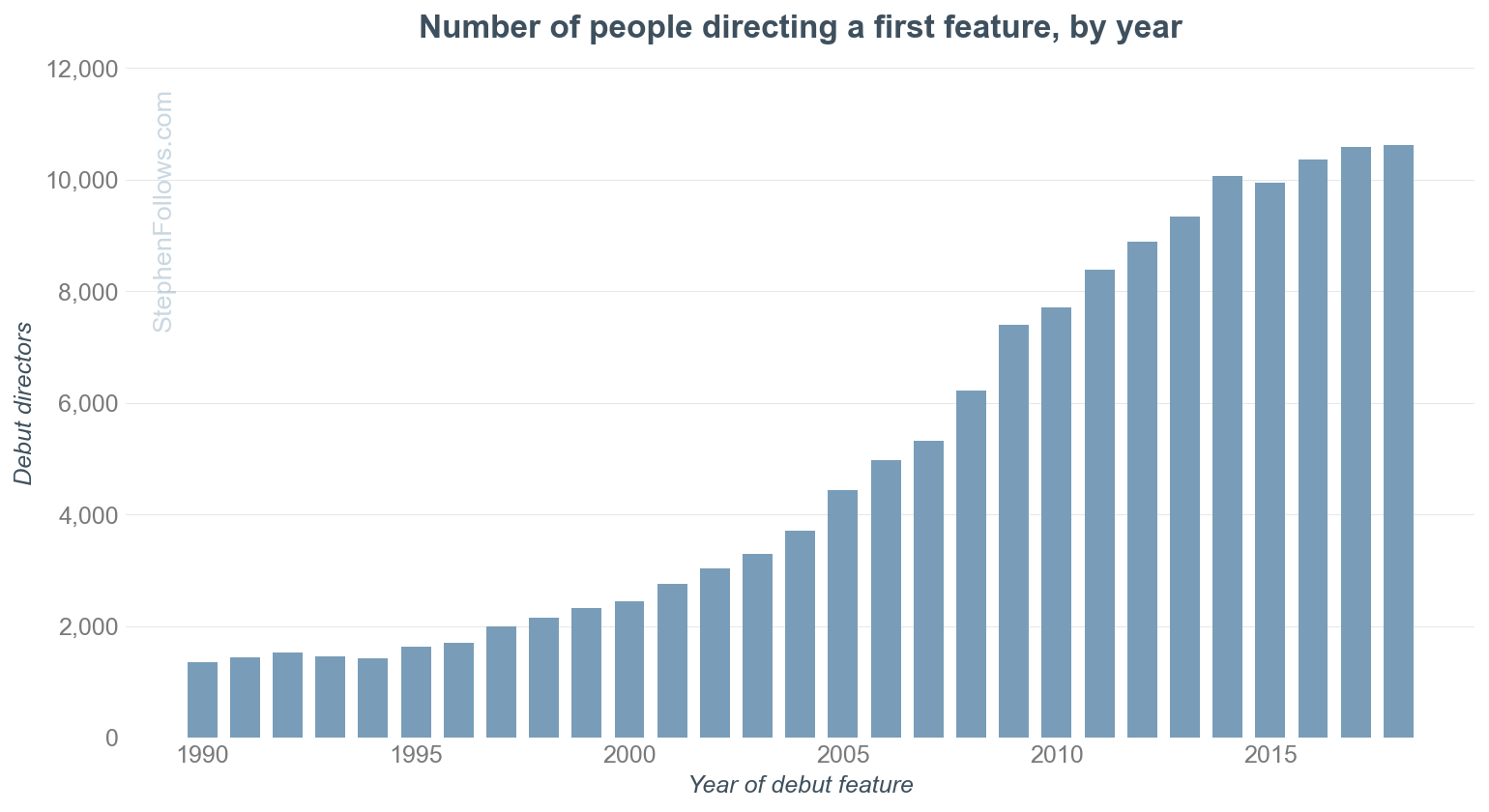
Digital cameras made the first film much easier. They did nothing for the second one.
The clues, all in one place
Now that we have an idea of who’s directing and what the average Comeback Rate is, we can start to separate the results by different factors. I’m going to refer to these as ‘Clues’ because I don’t want to imply that this is deterministic or highly predictable - these are soft factors that often correlate, rather than hard milestones you must meet.
For each clue, I compared directors whose debut had it with directors whose debut did not, and adjusted for the era of the debut so that older, gentler decades don’t flatter any group. A value of 1.5x means directors with that clue came back 1.5 times as often as those without it.
Below is a summary of all the clues, and then I’m going to pick out a few to go into more detail.
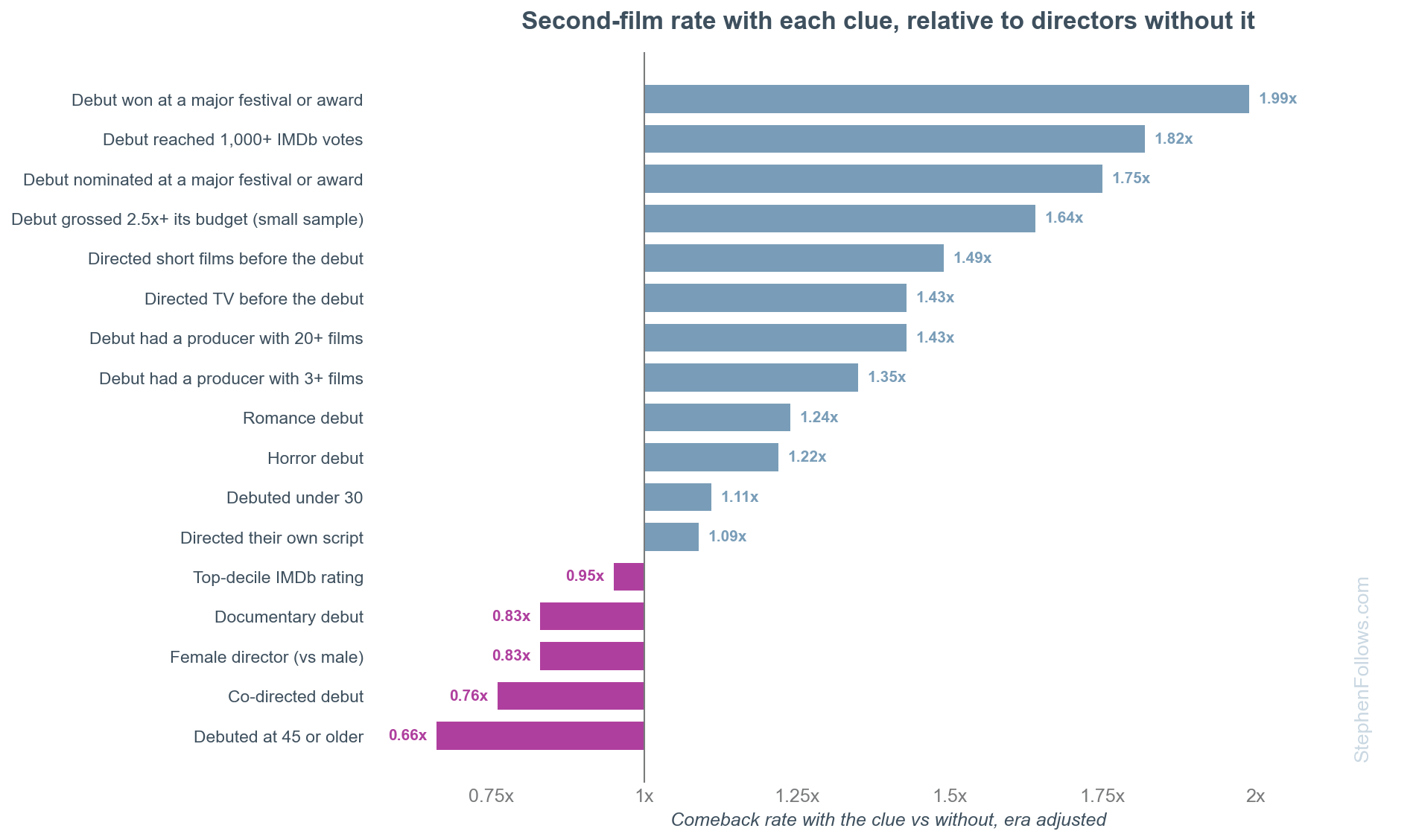
There’s a lot going on in there, so let’s take it a section at a time.
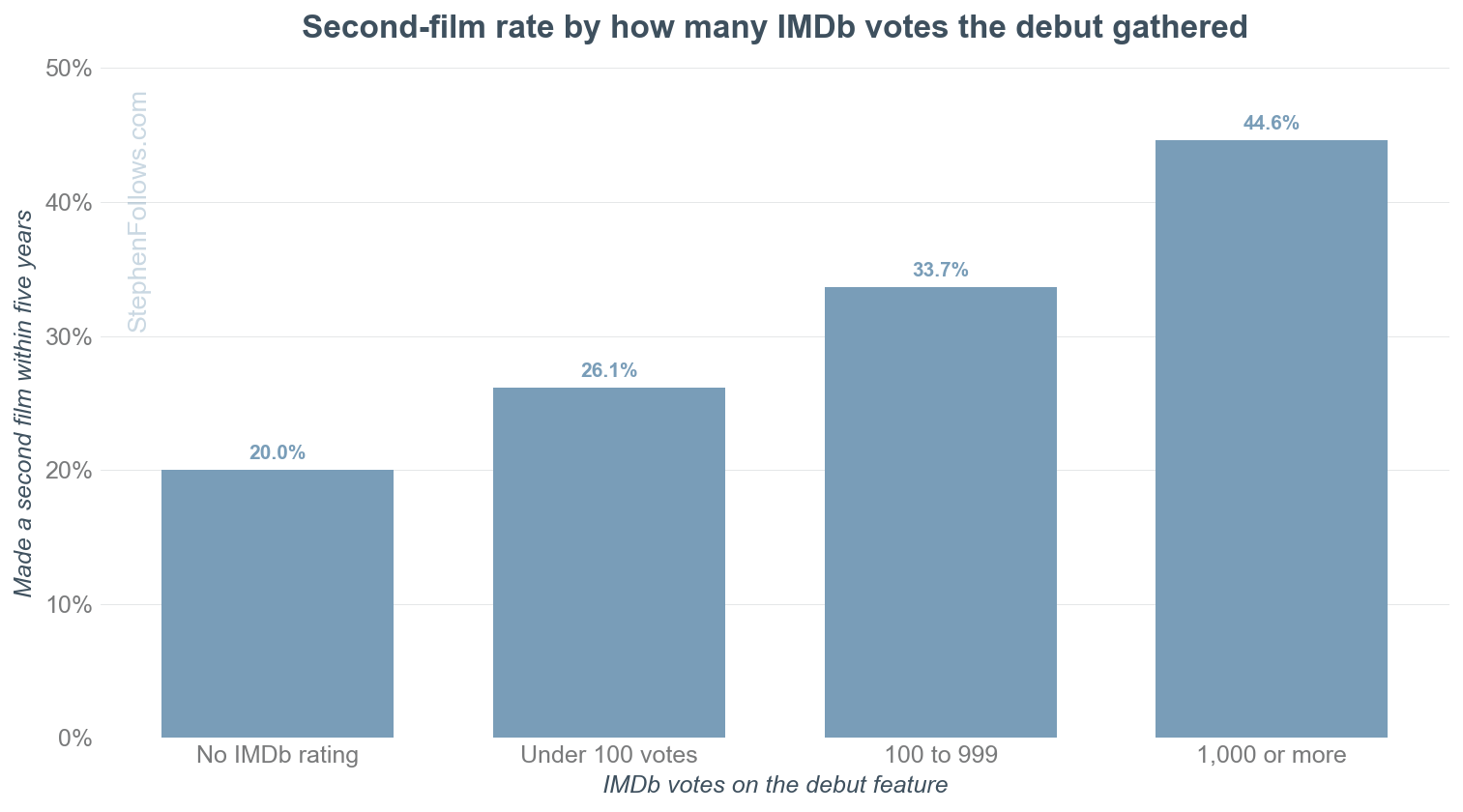
Being seen beats being good
A major factor is whether anyone actually watched it.
A debut with no IMDb rating at all (i.e. so few viewers that not one of them logged a score) led to a second film 20% of the time. A debut with 1,000 or more votes converted at 45%. That is more than double, and the gradient stays smooth all the way up.
I also flagged debuts with a top-decile IMDb rating, i.e. the best-reviewed tenth of all rated debuts. On their own, those brilliant debuts did not come back more often.
Quality that nobody sees converts to nothing.
Once a film has found an audience, quality starts to pay dividends. Among debuts with at least 1,000 votes, the top-rated tenth converted at 53% against 43% for the rest. The tiny group that managed both a top-decile rating and a real audience (201 directors out of 146,603) came back at 52%.
The industry does not reward the best first film - it rewards the best first film it actually watched.
The strongest clue is recognition
I checked every debut against whether the film received any kind of nomination at eleven major festivals and awards bodies (the Oscars, BAFTA, Cannes, Berlin, Sundance, Toronto, the Independent Spirits, the Golden Globes, and the DGA, SAG, and PGA awards).
A nomination roughly doubled a director’s chances, and winning helped even more. Nominees who lost converted at 42%, winners at 52%.
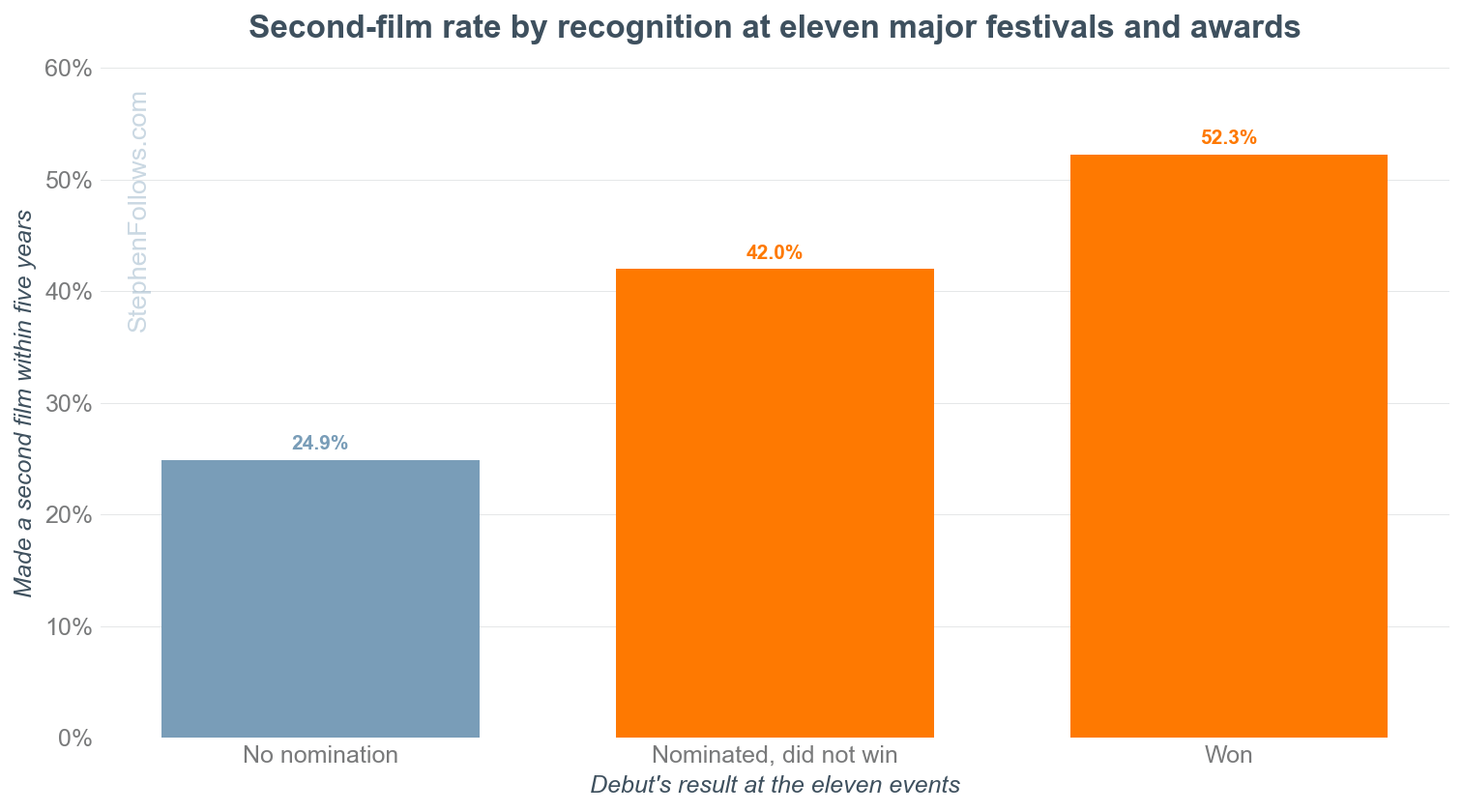
We would like to believe this is the meritocratic route, and to some extent it is. But getting a film in front of those juries is itself a question of access, submission fees and programmer attention. It’s also a fairly small club, so great if you get there but not a realistic expectation for most directors.
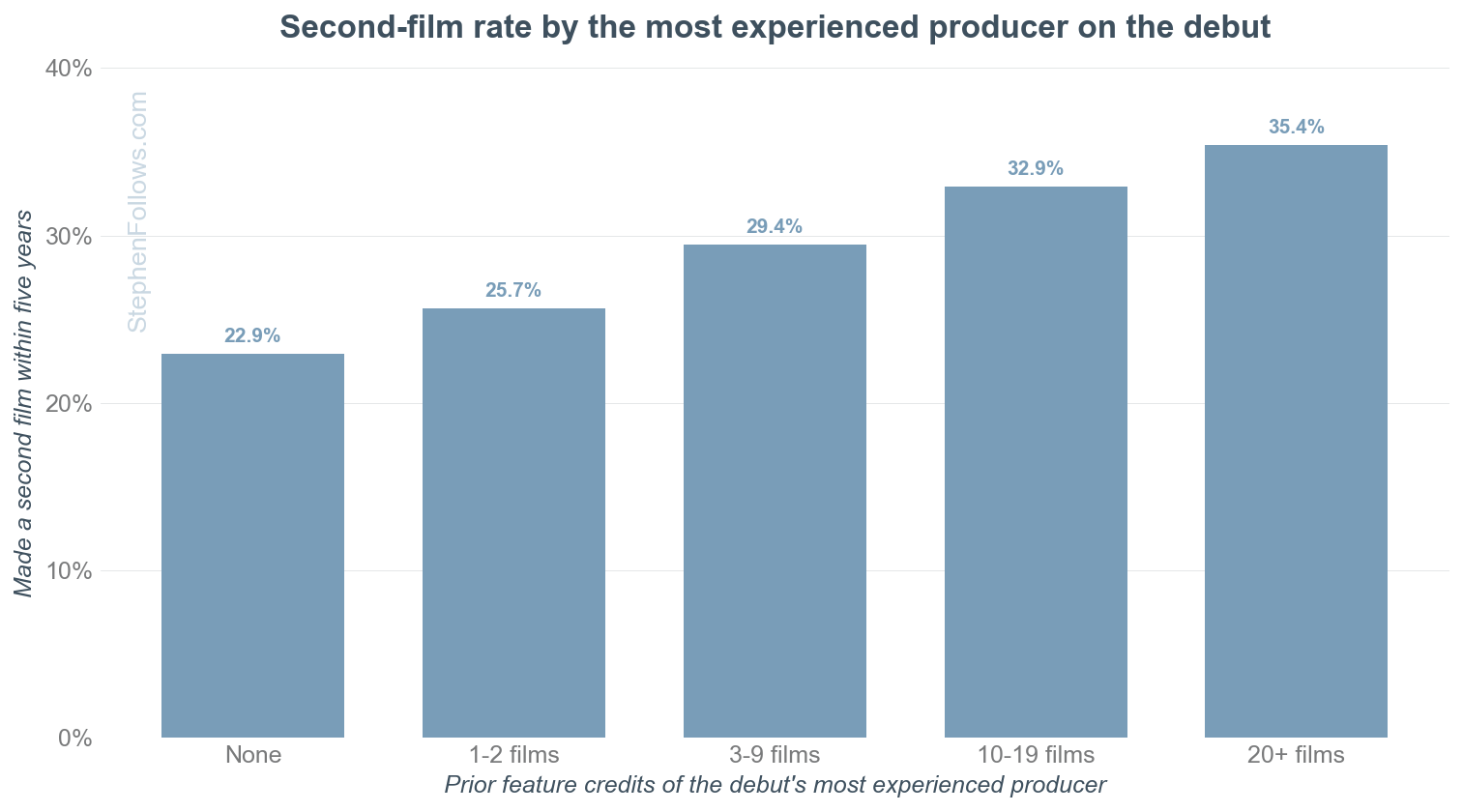
The producer effect
Next up, I checked whether each debut had at least one producer who had produced features before, and how many.
It’s a neat pattern whereby if the debut director’s film doesn’t have an experienced producer, their comeback rate is 23%. Compare that with 35% for directors with a producer who has twenty or more features behind them. Each step up in producer experience buys the director a little more persistence.
Previous form counts
I keep using the phrase “debut director”, but that doesn’t mean they have never stepped behind the lens before. As you might expect, the more experienced the director was in other fields (making short films and/or television), the better their chances of achieving a second movie.
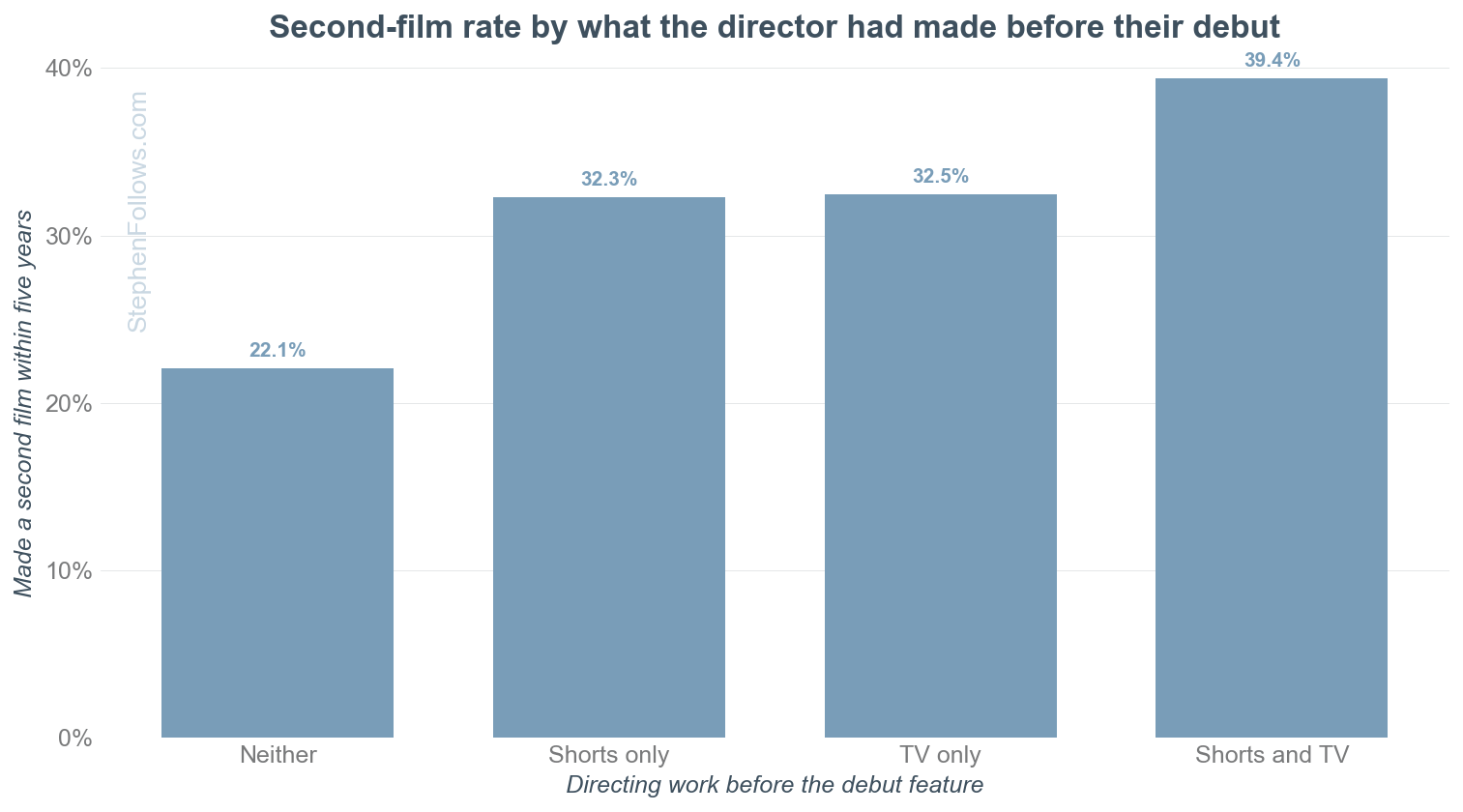
I like this one because it’s something you can take action on (well, you can choose to make shorts, albeit you can’t ‘choose to make television’).
The question then becomes whether the shorts cause the persistence or simply reveal the people who were always going to persist. The issue of correlation and causation runs through all of this research.
Does genre matter?
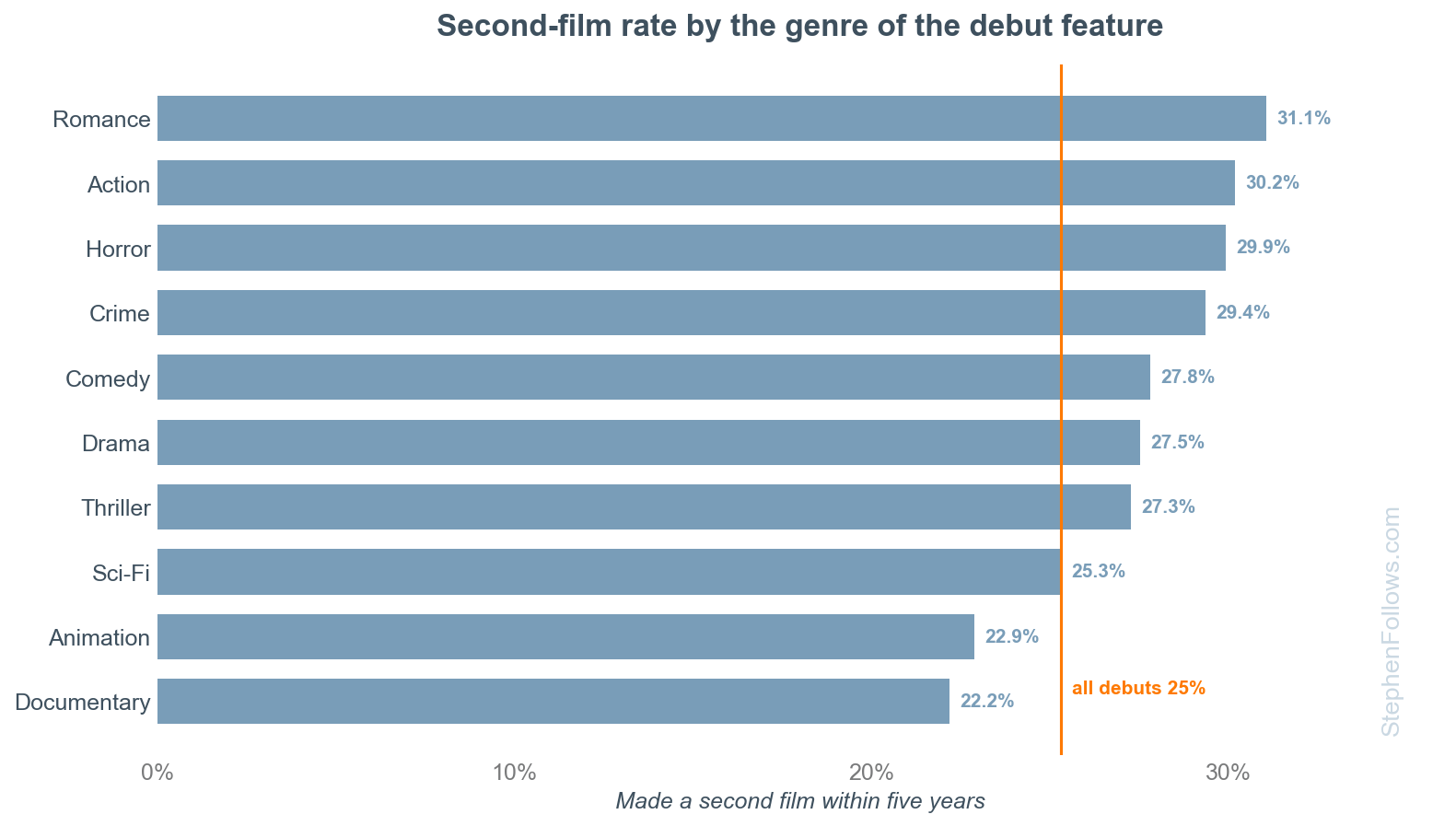
Romance, action and horror debuts sit at the top, converting around 30%. Dramas are mid-table. And documentaries sit firmly at the bottom on 22%, which matters because documentaries are 36% of all debuts in the dataset. A large share of first-time directors are working in the genre with the weakest route to a second film.
The person, not the film
Two clues have nothing to do with the debut film.
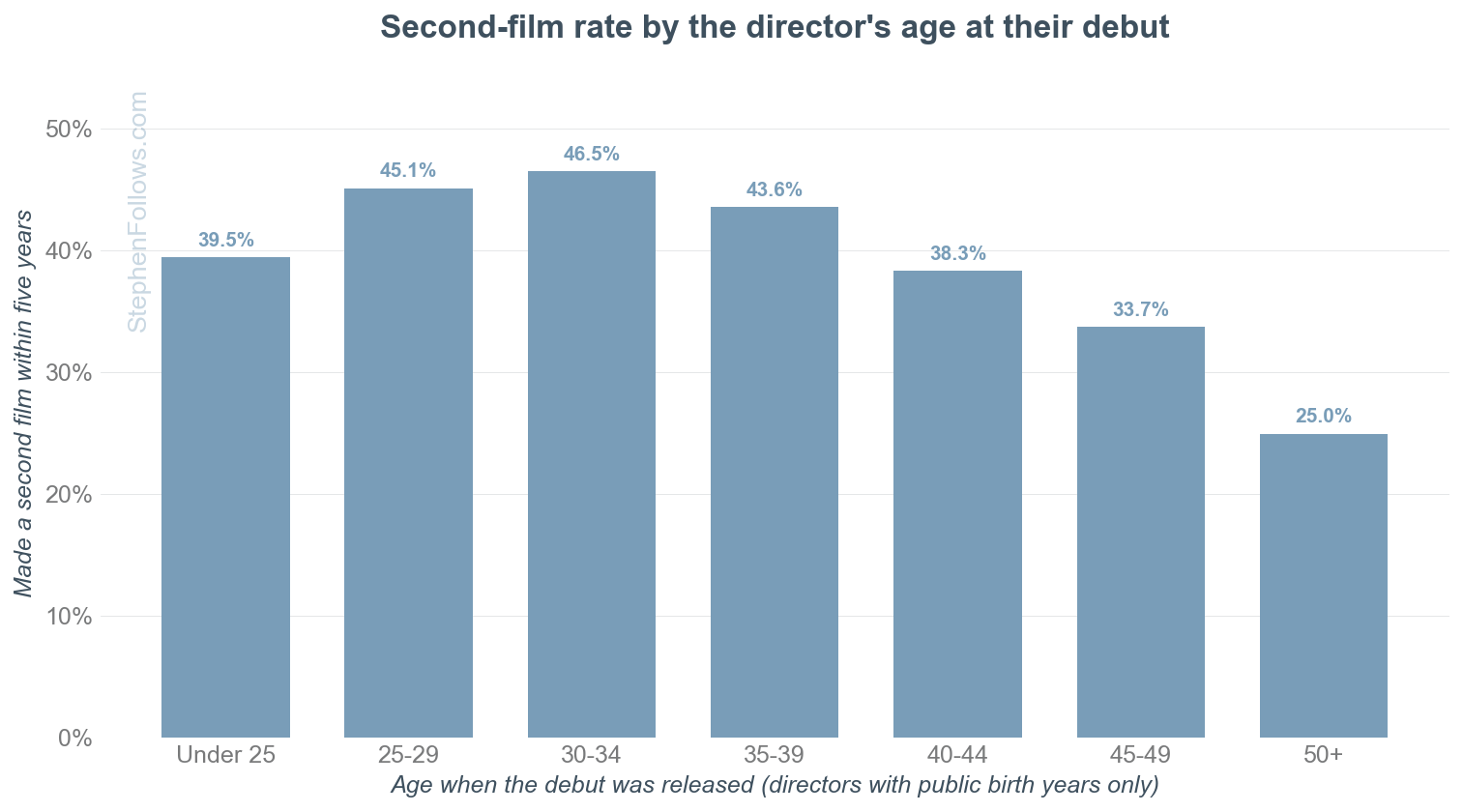
The first is age. Birth years are public for only about a quarter of these directors (skewed toward the better-known ones), so treat this as a picture of the visible end of the industry. Within that, we see a clearer story: people in their early thirties have the greatest chance of a second shot.
The second is gender. Whatever combination of financing, gatekeeping and family-load timing sits behind it, the second-film hurdle is measurably higher for women, and has been for the whole thirty years I can see.
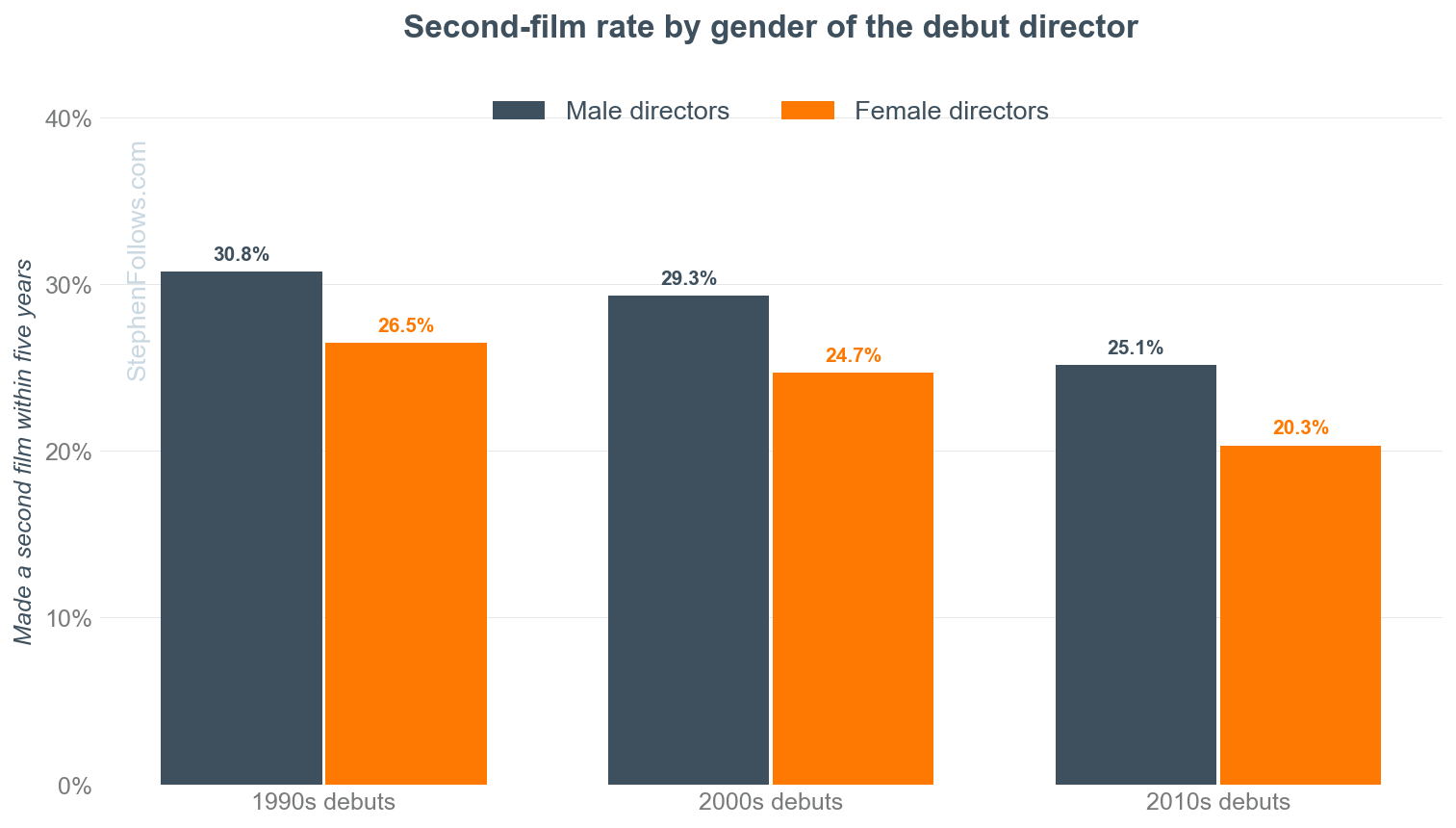
I wrote about this recently in much more detail in an article entitled Hollywood gives men second chances it doesn’t give women. The Hollywood Gadfly also wrote a long piece about it, taking a different reading of my data in a piece called Bomb Shelter.
Which effects stand alone?
So far, I’ve been measuring each clue on its own. But films can fall into multiple buckets, meaning that the clues overlap. For example, films with established producers tend to get seen more, films that get seen win more nominations, etc.
To separate them, I ran all the clues together in a single model (a logistic regression, i.e. a way of asking what each clue adds once you hold all the others steady), which showed that most of the clues we’ve seen so far survived on their own.
But one did not. Once you account for whether the debut got seen, the producer’s independent effect disappears.
You can see it visually on the chart below. The comeback rate is 25% for everyone. It rises to 45% for films with at least 1,000 IMDb votes. But then it is basically unchanged when we add the criteria of an experienced producer, only jumping again when we add the clue of receiving a major nomination (up to 52%).
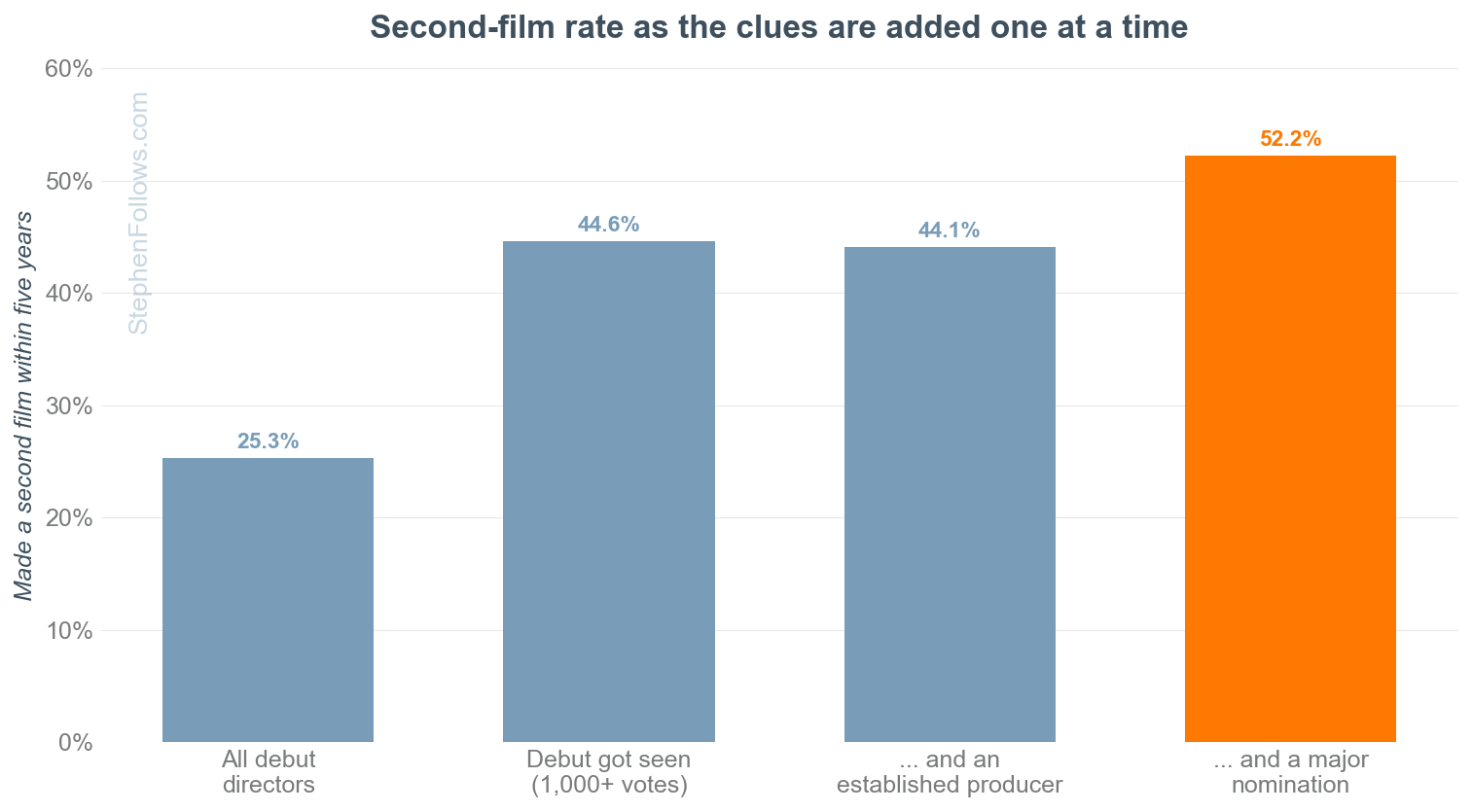
And when we pit the two clues against each other, it’s not even close.
A debut with an established producer but no nomination converted at 31%. A debut with a nomination but no established producer converted at 43%.
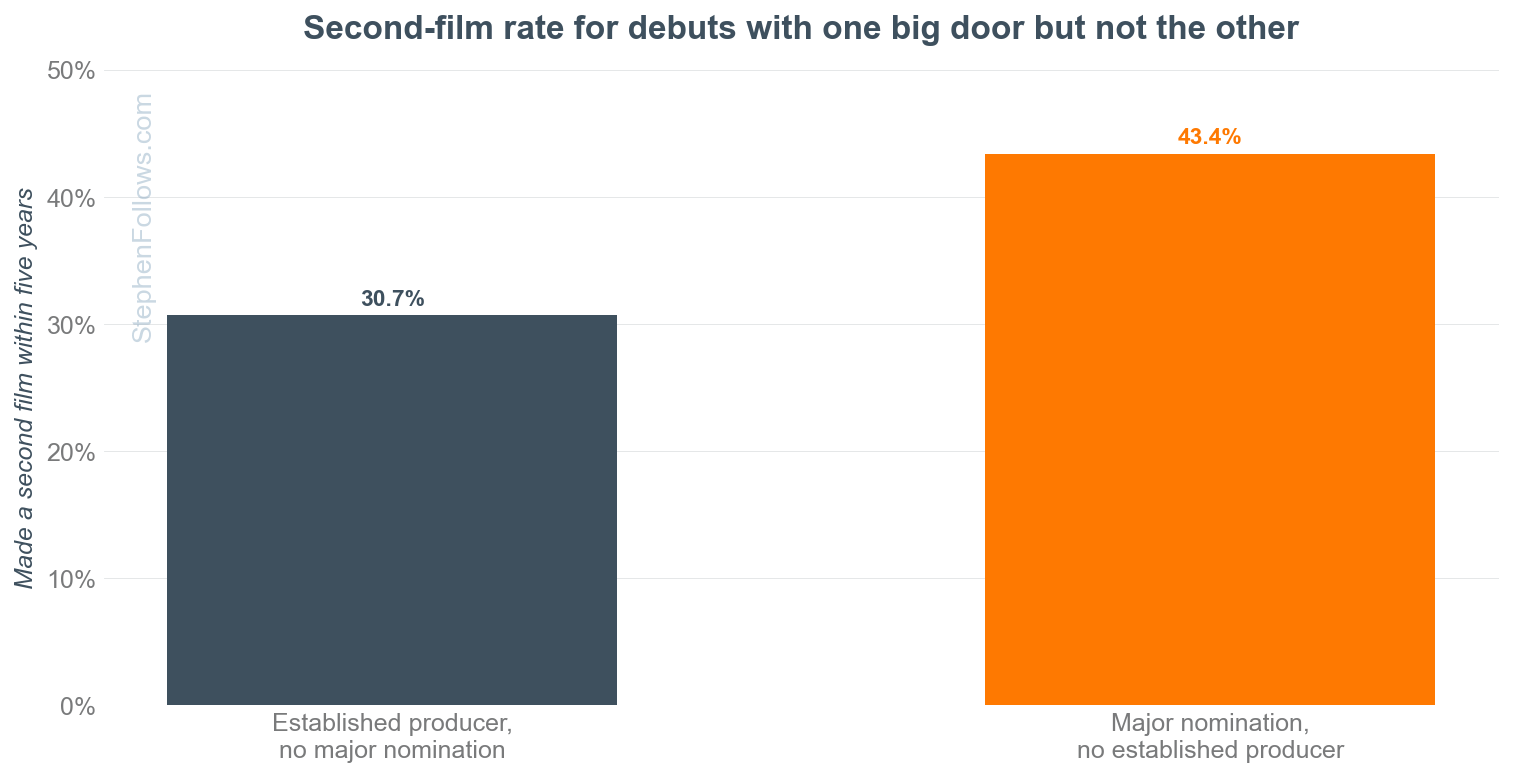
So the producer’s real contribution is the work. Producers are how debuts get seen, and being seen is what helps the director’s career.
What this means if you’ve made one film
Reading this as a first-time (or soon-to-be first-time) director, the data points somewhere fairly clear.
If you’re going to get to make a second film, it’s probably going to happen within five years of your first.
The best thing you can do to help your first feature not also be your last is to make shorts or television before your first feature.
Find an experienced producer, as the work they can do for your film will really help get it seen and recognised.
You need to ensure your film gets watched, as an ignored film is the strongest clue you’ll be part of the one-and-done club.
None of this is to say that talent doesn’t matter. Among films that got seen, quality predicts strongly. The tragedy in the data is the films that were good and invisible, because for career purposes, invisible and mediocre are the same thing.
Notes
The cohort is every person whose first feature-film directing credit was released between 1990 and 2018, which comes to 146,603 directors worldwide. “Second film” means a further feature directing credit released strictly after the debut year and within five years of it, unless a chart says otherwise. Same-year second films do not count. The year-by-year chart uses debuts up to 2013 so everyone has ten full years of follow-up in the data, which runs to 2023.
Producer experience counts distinct feature producing credits (including executive and co-producers) released before the debut year. The recognition flag covers nominations at the Oscars, BAFTA, Cannes, Berlin, Sundance, Toronto, the Independent Spirit Awards, the Golden Globes, the DGA, SAG and PGA awards. Festival sidebar coverage is incomplete, so it is a conservative flag. Visibility uses IMDb vote counts, and those accumulate after release, so some of the visibility effect runs backwards (a director who keeps working draws late votes to their old debut). I’ve been careful to describe it as a clue rather than a cause. Ages come from public birth years, available for 26% of the cohort and skewed to better-known names.
Everything here is correlation. Producers, festivals and audiences all select, so every clue partly measures the people who were always going to keep going. The data sees feature directing credits only, which means a director who moved into television, shorts, commercials or another crew role counts as not returning even though they kept working. Career-tracking work I’ve done elsewhere suggests figures like these overstate true career endings, so read every rate as “did not direct another feature”, never as “left the industry”.
Correlation does not equal causation. In fact, 100% of people who think it does, die.
Really great analysis. I have a few additional questions that I think might add some illumination.
1. Did the debut film make money? You have the variable of the debuts that made 2.5x increases is 1.64, but I'm curious if there's any additional details for any film that makes money.
AND then
2. I'd pair this with the market value of the genre. Are romances higher because they make more money? (More people see them? The mainstream likes them?) I don't know.
I found it interesting that the more people variable was more important than the good film variable (at least how I read your piece), that breaks my heart in a way, but I'm not surprised. A film that sells is more "valuable" because it makes money, not necessarily art.
Which points to the heart of all my questions: Capitalism. What gets made is what makes money. If you want to make art, you're probably not in it for the money.
Nice work. Thanks.
Great analysis. I appreciate how you broke down the takeaways so that for all of us preparing to make our first feature, we can make decisions to increase our chances of making this a career (though I feel like the biggest thing we can do is ignore the odds and do the work)