


Two years ago, top UK producer Tim Bevan was speaking at the BFI London Film Festival about his new movie Blitz. The film is set in 1940s London and was shot there, including several days on Roupell Street in Waterloo, but its main street was built at Leavesden and, in Bevan’s words, its streets “on the whole were in Hull”.
Talking about a film his company had just made in Manchester, he told the festival audience:
It’s got very expensive to shoot in London. Manchester is a much more film-friendly place to be. It is tricky to make films in the city now… [It] was primarily a studio picture; the streets on the whole were in Hull.
This is notable in part because Bevan’s company, Working Title, is behind movies which are basically tourist commercials for London, such as Notting Hill and Love Actually, so for them to build their London streets in Hull and on a stage, something must have changed.

I teamed up with Matt Gallagher from The Callsheet (who also runs an industry Substack) to see if London is really losing the battle for filmmakers, and together we asked a number of top location managers what's behind it.
How much location filming does London host?
Film London is the capital’s screen agency, a charity funded by the Mayor of London, the National Lottery and the BFI, that liaises with and supports all the council, bodies, and agencies you might need to engage with if you want to film on London’s streets.
They don’t publish neat annual figures for the volume of location filmmaking in London, but they do occasionally announce the odd figure. (In this case a ‘filming day’ is one crew filming in one London borough on one day).
I tracked as many of their public figures as I could, drawing on a London Assembly answer, a trade news story, Film London’s evidence to a House of Lords committee, and, most obscure of the lot, trustees’ reports Film London files with the Charity Commission.
These figures show that the high point for location filming in London was around 2012 to 2013, and it has since roughly halved.
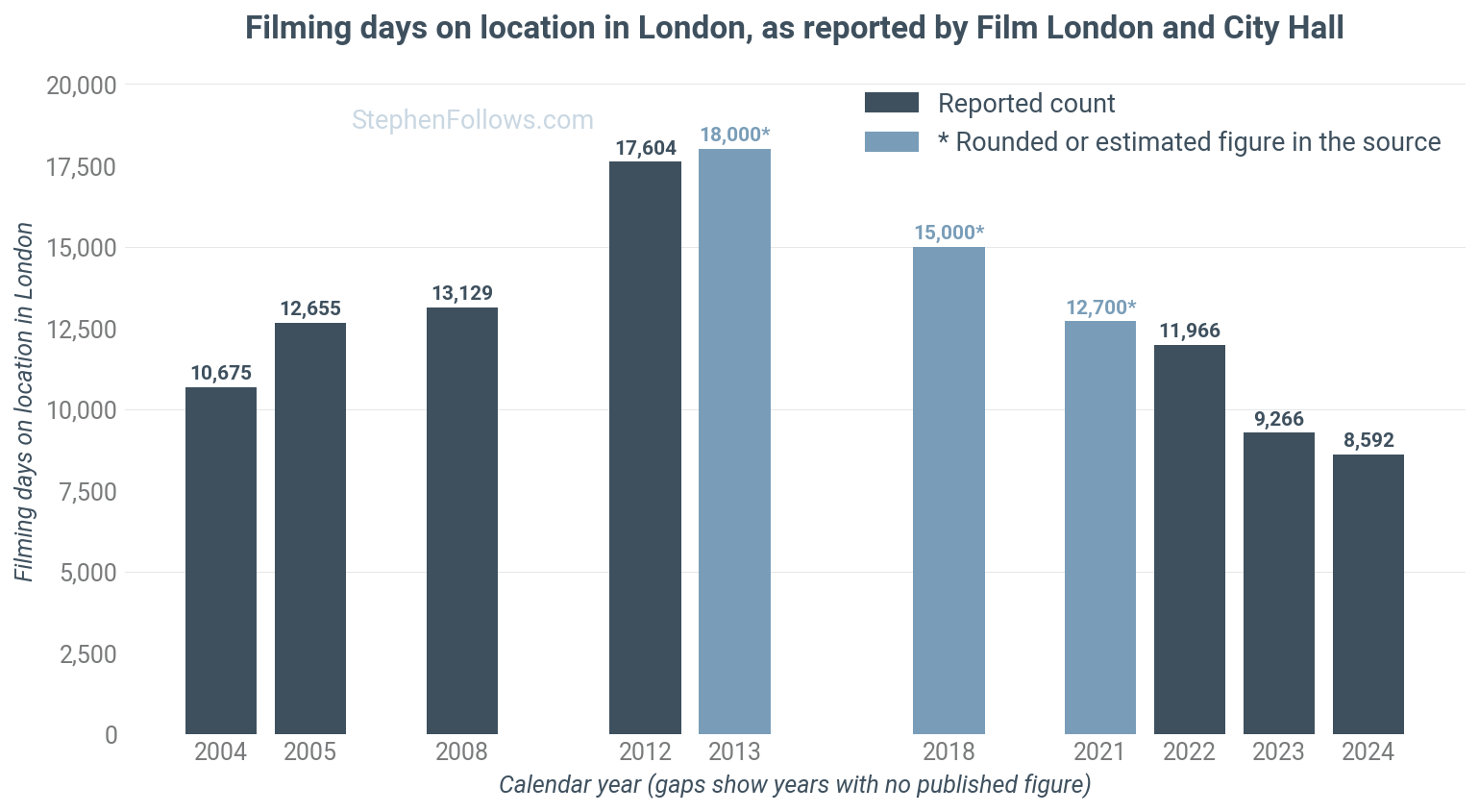
A word on the peak, because Film London’s own Impact page can give a different impression. It says that in 2022 “there were 11,966 filming days in London, with TV drama filming days at the highest levels ever seen in the capital.” That record is for TV drama alone. The total for 2022, on the same page, is 11,966, a third below the 17,604 the Mayor’s office announced for 2012 as “the busiest year for filming since we started collecting stats”.
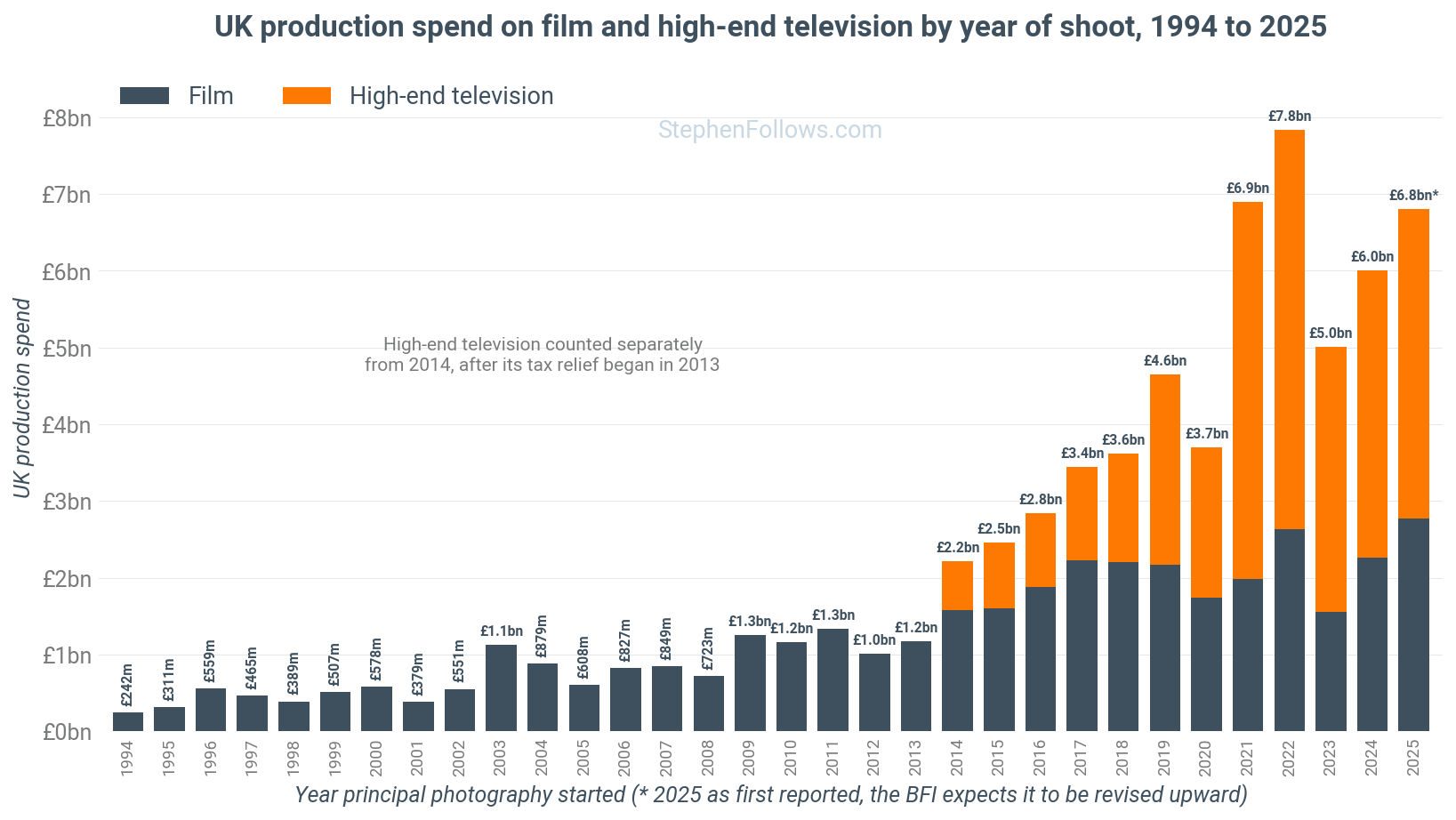
Over this same period, the BFI reports that filmmaking in the UK has boomed. Film and high-end TV spend in the UK was £2.2 billion in 2014, rising to £7.8 billion in 2022, and falling to £6.8 billion last year (the BFI’s first count for 2025, which it expects to revise upward).
To make this difference easier to see, here are the two series set to 100% in 2012.
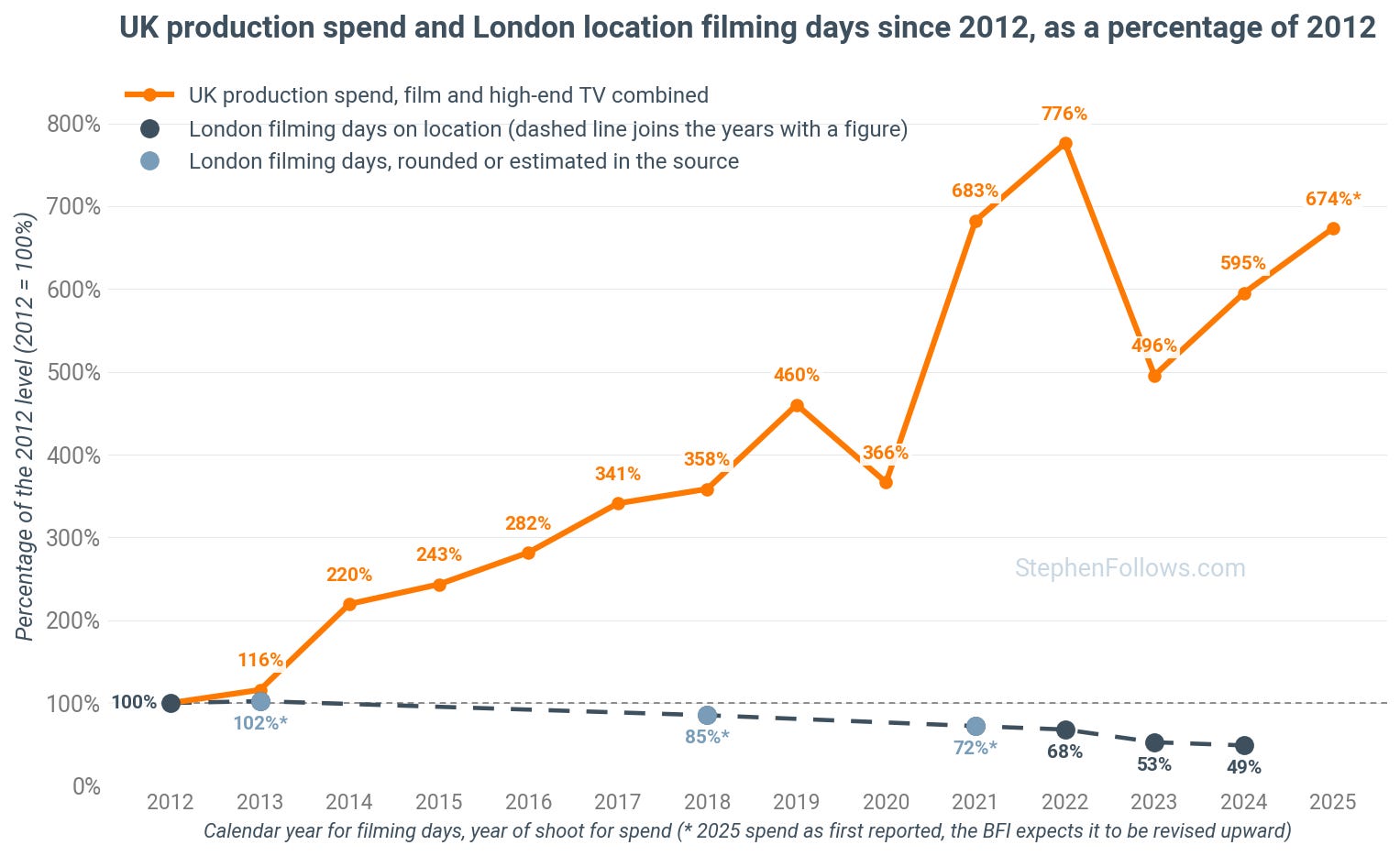
So over a period in which filmmaking in the UK more than tripled in cash terms (from 2014, and roughly six times since 2012; allowing for inflation of 39% between 2012 and 2024, it roughly quadrupled), why did location filmmaking in London fall by half?
What happened to London’s location filming?
We are specifically talking about crews shooting on London’s streets, in its parks and inside its buildings, not on its sound stages. Studio space in and around London has grown over the same period, and some work that used to be done on location is now done indoors.
Also, it’s worth noting that every major production centre had a rough 2023 and 2024. The US strikes and the commissioning slowdown cut UK spend by more than a third in 2023, and the BFI’s first-half figures for 2026 show the recovery has stalled again.
The question is not whether London had a bad couple of years. Everyone did. The question is why London’s location days were already lower before the pandemic, and have kept falling since, while spend across the UK as a whole has grown.
Most of the reasons Film London’s trustees cite for the reduction in London location filmmaking are not really about filmmaking on location, nor are they London-specific - i.e. the pandemic, streamer commissioning changes, and industry strikes.
They do note that more films are choosing to build sets rather than go on location:
2022 also saw a tail-off of location filming in London as the need to make up for shutdown post pandemic slowed down. This resulted in fewer HETV productions filming on location in London as well as a shift for more filming to be limited to the studio.
But overall they don’t address whether London is losing out to other UK cities. In fact, they seem to end the topic on a cheerful note, such as in their most recent report:
This also affected our locations partners across London whose activity and income dipped again with only 8,592 filming days on location recorded in 2024 (calendar year), down by 7% on 2023. However, we began to see an uplift in TV drama production again (up by 11% on 2023) as streamers started to make their way back to the capital.
If we’re not going to discover the reason for London's decline from Film London, Matt and I felt it was time to go directly to the people who book and manage these shoots.
What do the people who book locations say?
We contacted several top-end location professionals and asked what was going on. (We’re very grateful to FilmFixer and BECTU Locations Branch for helping us get the word out to the right people).
In the end, we canvassed the views of 57 location professionals, 50 of whom have filmed in London in the past three years.
The answer came through loud and clear. It’s the money. Not the cost of London in general, but the fees attached to filming in it.
We asked them to rate their worry about six different types of costs, from 1 (not concerned) to 4 (critically concerned). Unit bases (the car park or yard where the trucks, catering and dressing rooms live for the day) scored 3.35, and 40 of the 46 people who answered were very or critically concerned about them. Local authority fees scored 3.22 and location fees 3.17.
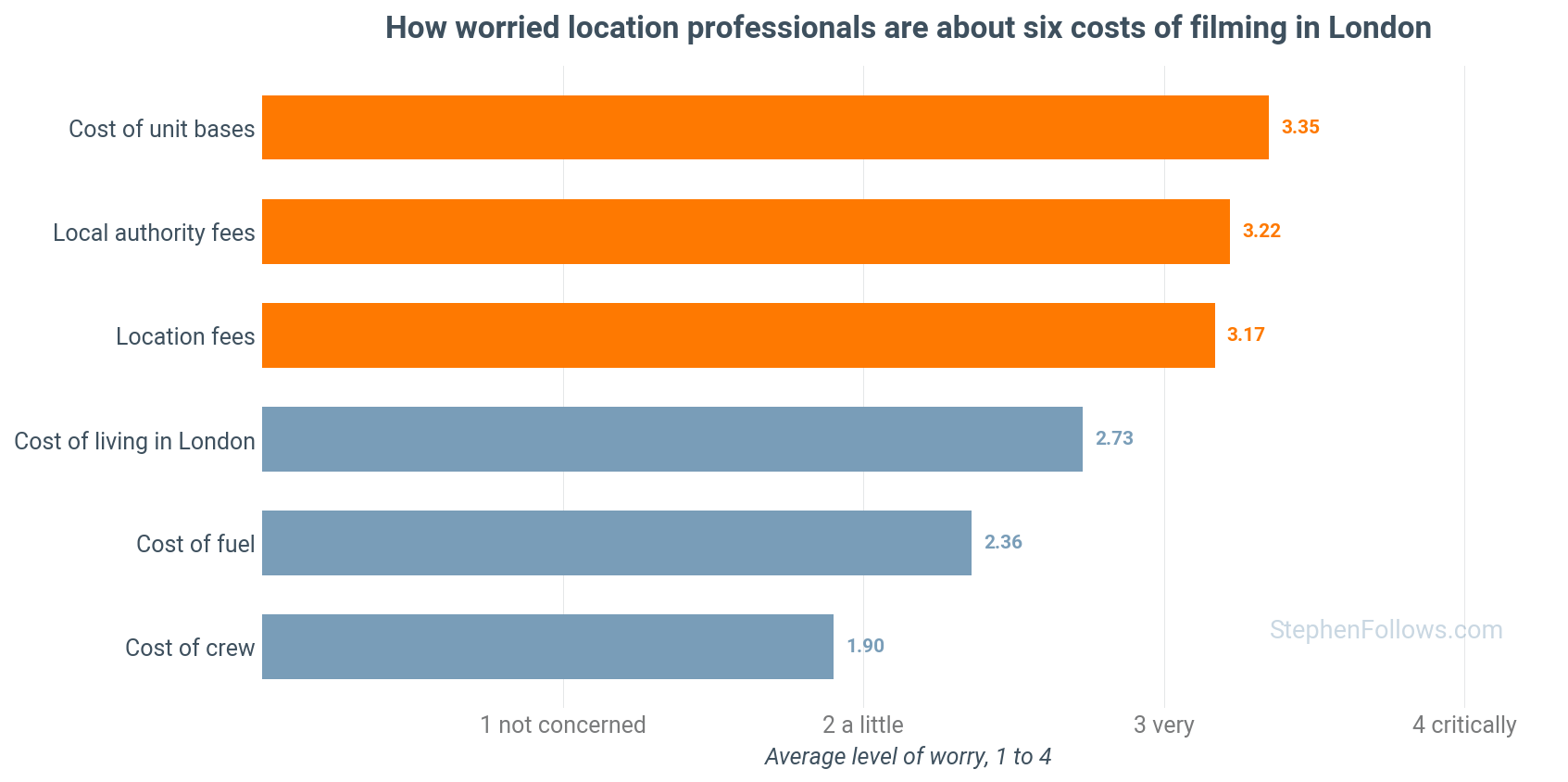
The three least worrying costs are general ones about London and modern life. Those matter less to them (though the cost of living in London still scored 2.73). The real concern is the fees attached to filming in London.
One production executive put the situation bluntly. A senior executive who works in HETV Drama, told Matt:
Budgets are getting tighter. You take your show up to Manchester and you save a million off your budget straight away. You might then have to take your Heads of Department and accommodate them, which costs a lot, but it’s hard to shoot a Band 2 drama [one budgeted at £1.25m to £3m an hour] in London.
How have the costs changed?
In January 2012, Film London compiled the admin fees and location fees of every London borough. According to the ONS consumer price index, prices in general have since risen by 51%.
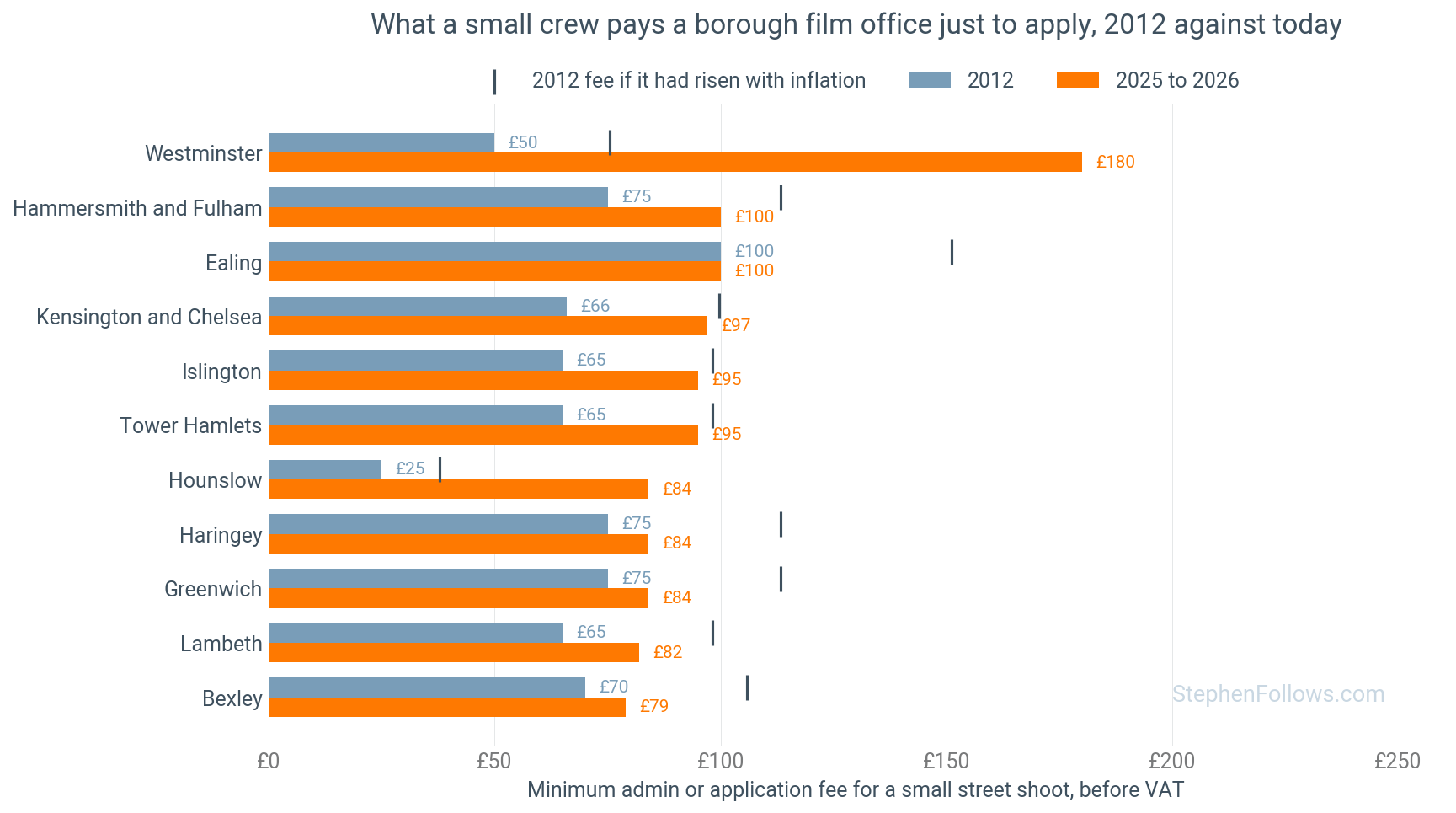
A crew of three, or five in some boroughs, with handheld kit can film on a public street without asking anyone. These fees start once the film office gets involved. Let’s start by looking at the smallest charge: the admin or application fee a small crew pays a borough just to shoot in the street.
In the chart below, blue is the 2012 price, orange is the most recent price, and the little black lines show where prices would be if they had kept pace with inflation.
In most boroughs, the entry fee has not kept up with inflation. Tower Hamlets and Islington went from £65 an hour to a flat £95. Greenwich and Haringey from £75 to £84. Ealing charged £100 an hour in 2012 and today charges a small crew £100 to film in the street, with no separate admin fee. The exception is Westminster, where a simple application went from £50 to £180, or £370 if your company turns over more than £1m, plus £185 an hour of officer time.
Huh. This isn't the story we expected. What gives?
That's because this isn't the type of filmmaking that is being charged the most, or leaving London in significant numbers.
The survey revealed that the costs people worried about most are the kinds of things only larger productions really have to factor in, and those are the productions that employ the most crew and hire the most facilities.
A cleaner way to see this is to compare against 2012. For a dozen London boroughs we have the official rate card for every year from 2021/22 to 2026/27, all issued in the same format by the same film office operator (more on them later).
The chart below tracks two lines from those cards: the smallest admin fee a crew of one to five pays, and the highest full-day location fee printed for a crew of 50 or more.
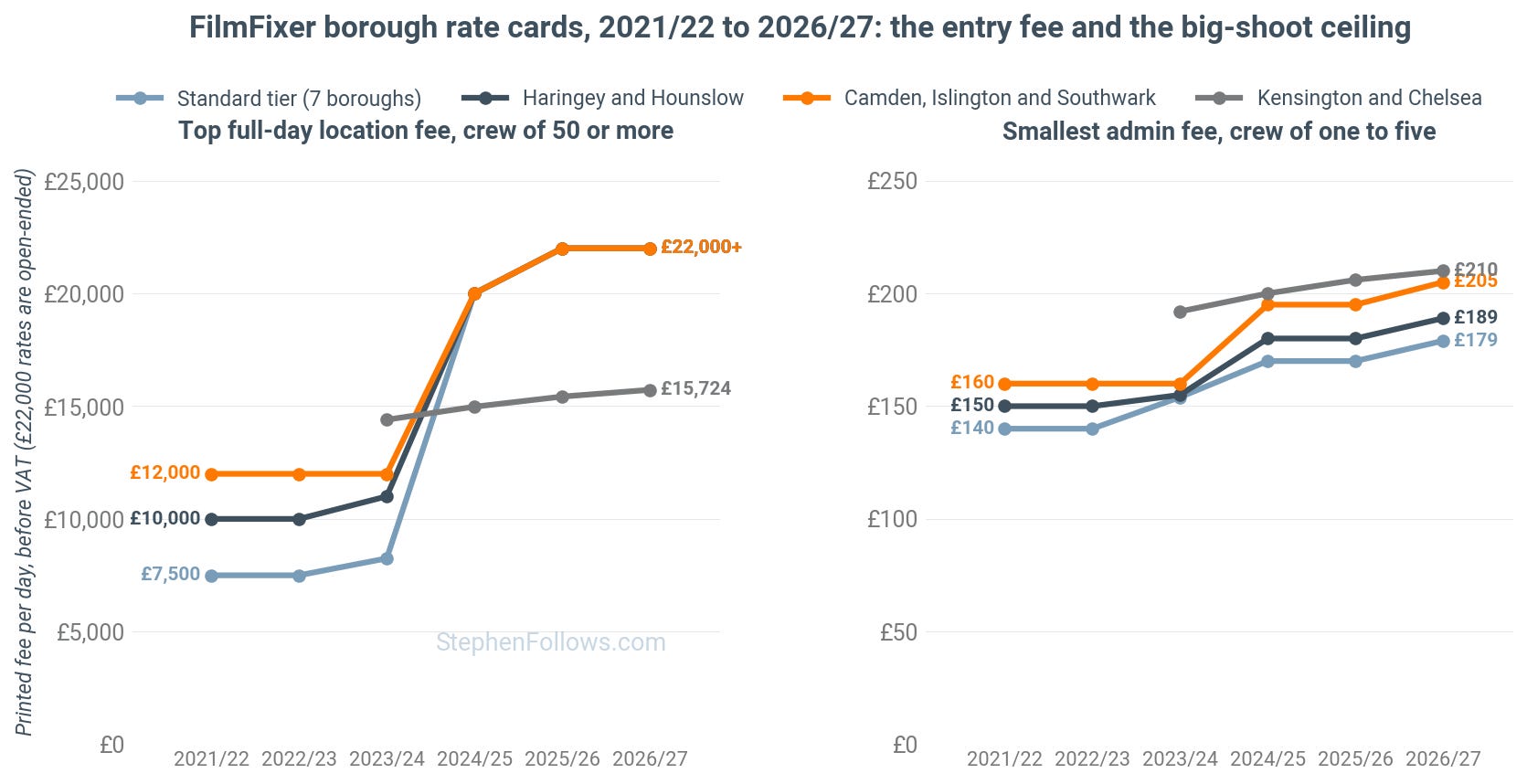
The small-crew admin fee in the seven cheapest boroughs went from £140 to £179 over five years, a rise of 28%, which is exactly what inflation did over the same period.
However, the high end is another matter. For three years the top full-day fee for a very large crew sat at £7,500 in the outer boroughs, £10,000 in Haringey and Hounslow and £12,000 in Camden, Islington and Southwark. In 2024/25 it jumped to £20,000 in almost every one of these boroughs at once, and by 2026/27 all of them print £22,000 and up, as the top of a range that starts between £2,720 and £4,460 depending on the borough.
The pattern is plain: the smallest shoots have had their prices protected, while the biggest have seen the top of their range nearly triple.
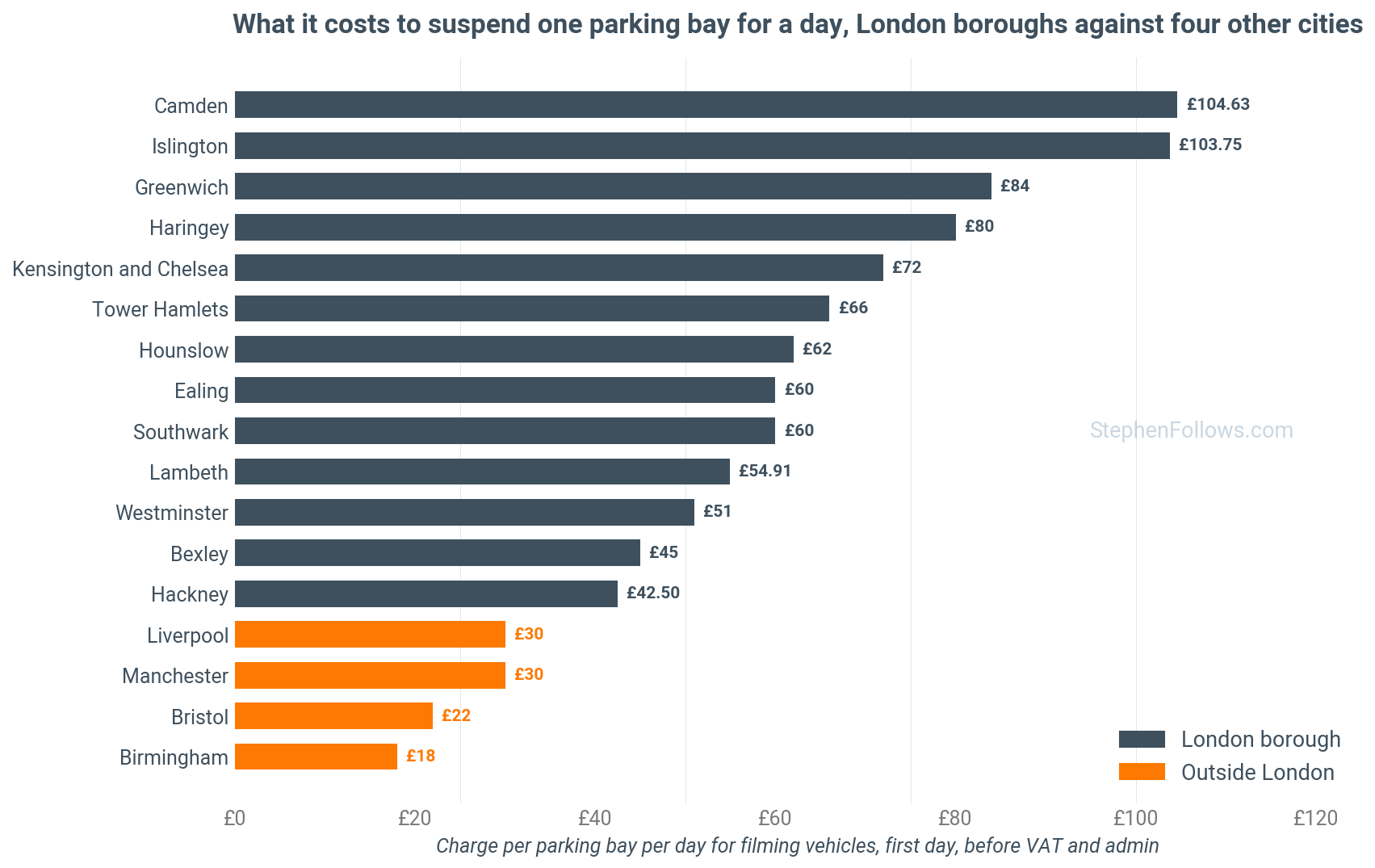
The chart below shows what it currently costs to suspend one parking bay for one day. Large productions might need dozens of such suspensions for each day of filming.
Some London boroughs charge more than three times what other UK cities charge.
In 2013, Camden charged £38, whereas the current rate is £104.63 for the first day. Manchester currently charges £30. A production taking 30 bays on a Camden street pays about £3,100 a day for the kerb before anyone has filmed anything, and that is before other admin and location fees.
What does a unit base cost, anyhow?
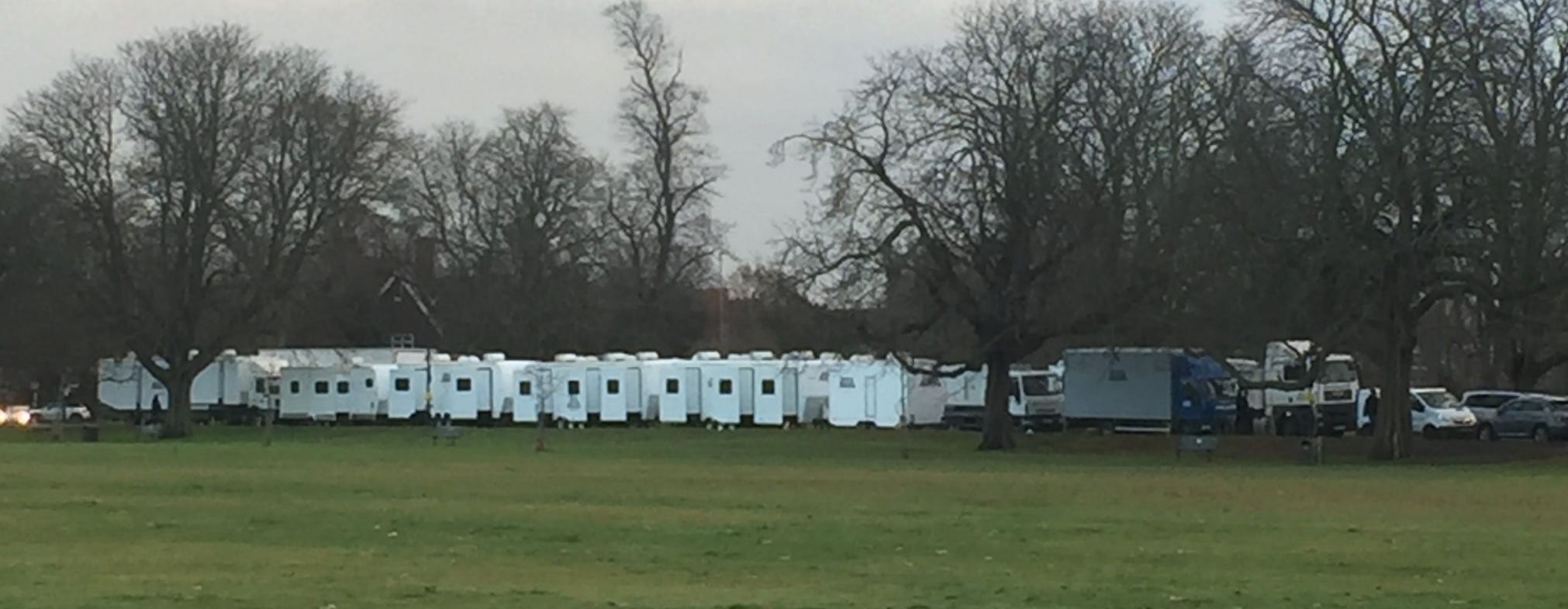
For anyone who hasn't stood in one at 5am, a unit base is the travelling circus of vehicles that forms the operational centre of a production, set up as close to the filming location as possible. It holds the honeywagon (the toilets), the three-way (one trailer split into three small dressing rooms), the artists’ trailers, the make-up and costume trucks, the production office, the catering vehicles and dining bus, the generators and the crew’s cars, with minibuses shuttling to and from the set.
Because each production does things differently, hiring from a whole range of companies that negotiate rates on every job, I can’t give you such neat figures for unit base costs. However, I have done my best to collect some sample costs to give you a sense of what we’re talking about.
In the crudest terms, you need two things - land and vehicles. As well as council-owned property, there are other options for productions to rent land:
Westway Trust, which lets the space under the A40 flyover to productions, describes its site as ‘one of the few remaining large unit base facilities in central London’.
The Royal Parks charge from £3,950 plus VAT a day for North Carriage Drive in Hyde Park, plus traffic management.
Hackney’s Victoria Park lists its lido car park at £2,500 a day for 15 to 20 facilities vehicles, plus a returnable deposit of up to £1,000 a day and an admin fee of £215 to £405.
Then you have to hire the vehicles. Public price lists are rarer here, because the facilities companies quote job by job. So Mars Proctor of Movie Makers, one of the facilities companies London productions hire their trailers from, kindly put together guide day rates for a full unit base. This isn't his rate card, it's the top and bottom of what a production is likely to pay, and the bottom sits about a quarter below the top.
Movie Makers’ guide rates put a honeywagon, make-up trailer, costume trailer, production office or dining bus £170 to £225 at a day each, artist trailers at £160 to £250, a generator at £185 to £245 (£310 to £415 for a hybrid with a battery pack), each 18-tonne truck for camera, grip, props or construction at £145 to £195, and the four crew who run the base and drive the trucks at £325 to £390 a day each with overtime bought out. The seventeen vehicles on his list, plus the people, come to roughly £4,200 to £5,300 a day.
Dickies Location Facilities in Surrey charges £375 for a honeywagon for ten hours on a weekday, £475 on a Sunday, £55 an hour overtime, £9 an hour for the generator and £1.50 a mile to get it there.
A minibus in London starts at about £120 a day, before the £18 Congestion Charge.
And that’s before fuel, and before you’ve moved any of it anywhere. Moving it is where London bites. Most productions move base regularly during a shoot, and a lot of London’s unit bases have curfews.
Mars gave us this fictional example:
You wrap in Wembley at 7pm and tomorrow’s base is Lincoln’s Inn Fields, which shuts at 10pm. Normally the unit would go in two runs, some tonight and the rest first thing in the morning. With a curfew, everything has to arrive in one go, which he calls a one hit move, and it costs twice as much because you need twice the swing drivers.
For a base of 16 vehicles, he puts a double run at £2,840 and a one hit move at £5,680. A drama filming in London for 18 weeks and moving three times a week is therefore looking at somewhere between £153,000 and £307,000 in moves alone, plus fuel and overtime. None of that appears on any council’s rate card.
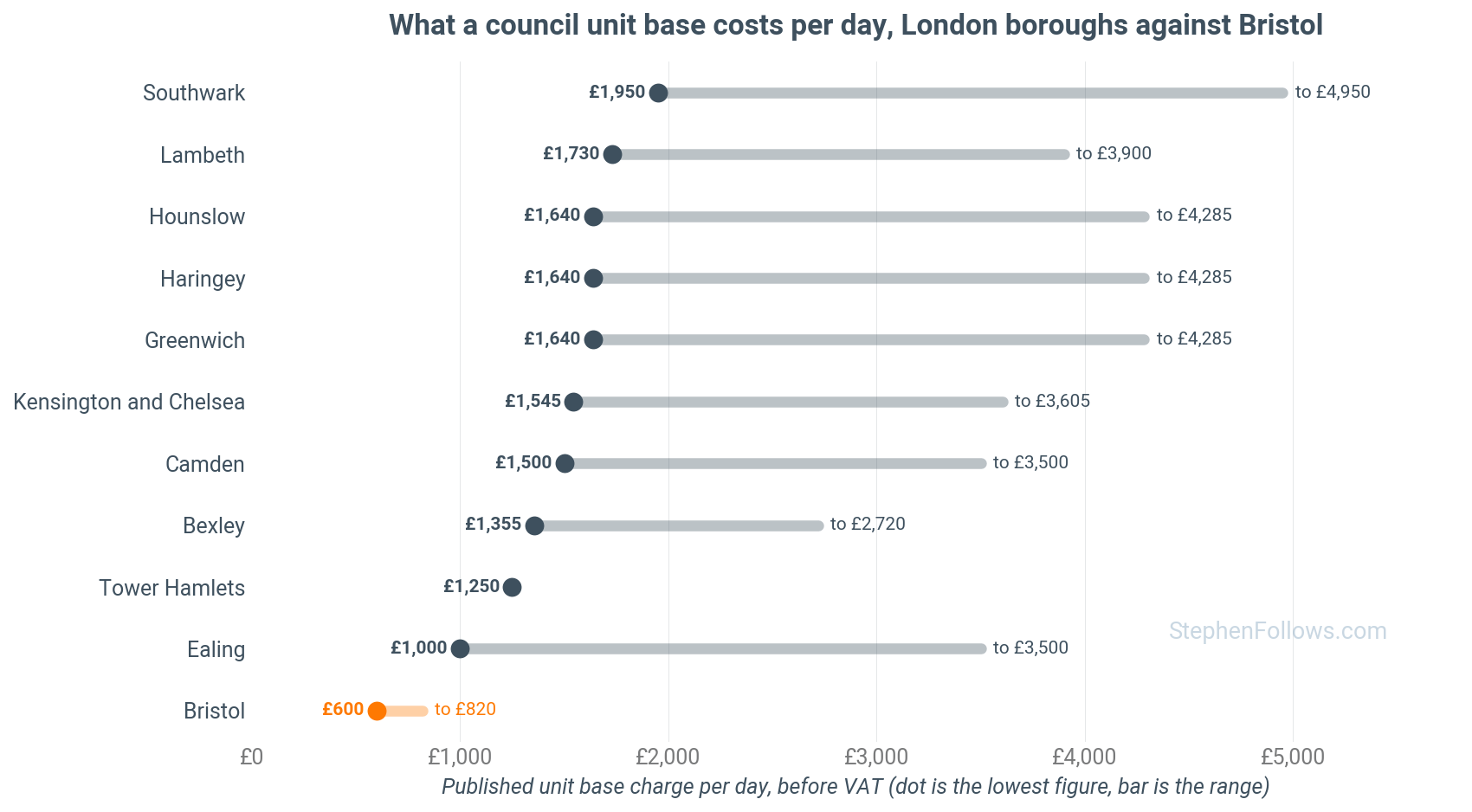
For the ground itself, the councils publish list prices. Reading the current rate cards of ten London boroughs, a council unit base starts at £1,000 to £1,950 a day and runs to nearly £5,000. Bristol’s run from £600 to £820. So London’s starting prices are roughly two to three times Bristol’s, and its top prices four to six times.
They have experienced the same price inflation we saw in the parking bay suspensions. Haringey’s was £750 in 2012 and now starts at £1,640. Camden’s was £800 in 2013 and starts at £1,500.
London’s location monopoly board
An interesting quirk of how London boroughs run their film offices is that many subcontract them to save money and, in some cases, to increase revenue.
And almost all of those subcontracted boroughs are run by the same private company. FilmFixer runs the location filmmaking operations of 17 London boroughs, giving it a near monopoly on the outsourced borough side of London filming.
Is this a good or bad thing? I can’t provide a view as (a) I am not at the sharp end; and (b) I know people on both sides of the debate, so I am not really an unconnected witness. What I can do is provide the case for each side:
The benefits of having a single company managing multiple boroughs’ location filmmaking operations are that they know what they’re doing. Over the years, they have built up a detailed knowledge of what both productions and boroughs need. They can also introduce efficiencies, such as a single application system, a single set of terms, a single phone number, and long-term relationships. Finally, the councils don’t agree to endless terms with FilmFixer, so other companies can submit bids when tenders come up for renewal.
On the other hand, detractors might point out that monopolies are inherently bad. The lack of market forces on prices could help explain why costs have risen so much in recent years, driving production to other cities. The rate cards above show what a single operator can do. In 2024/25, the top fee for a very large shoot jumped to £20,000 in almost every FilmFixer borough, and a year later to £22,000 and up, while Kensington and Chelsea, whose card is priced separately, moved up by a few per cent a year. Whether that is a monopoly at work or a portfolio catching up with what the market will bear, a location manager cannot shop around. To film in those 17 boroughs, you deal with one company, and you will need to deal with them again next month, so few are in a position to argue. Several respondents said as much, unprompted. One location manager wrote that FilmFixer “should not be allowed to monopolise the application industry”. An assistant location manager put it in six words: “FilmFixer has a monopoly which isn’t healthy.” A supervising location manager wrote: “FilmFixer is running 2/3 of the boroughs, and it is impossible to get hold of them sometimes”. Then there’s the argument that one company with a suite of borough operations is in a position to secure future contracts.
We asked our location professionals to rate each borough they had worked in over the past three years, from very difficult to very film-friendly. The average for FilmFixer boroughs was +0.29, compared with +0.68 for the rest.
The lowest-rated boroughs (Hillingdon and Kensington and Chelsea) are all FilmFixer clients. But so are Barnet, Southwark and Camden near the top, and Westminster, which runs its own office, is fourth from the bottom on 49 raters.
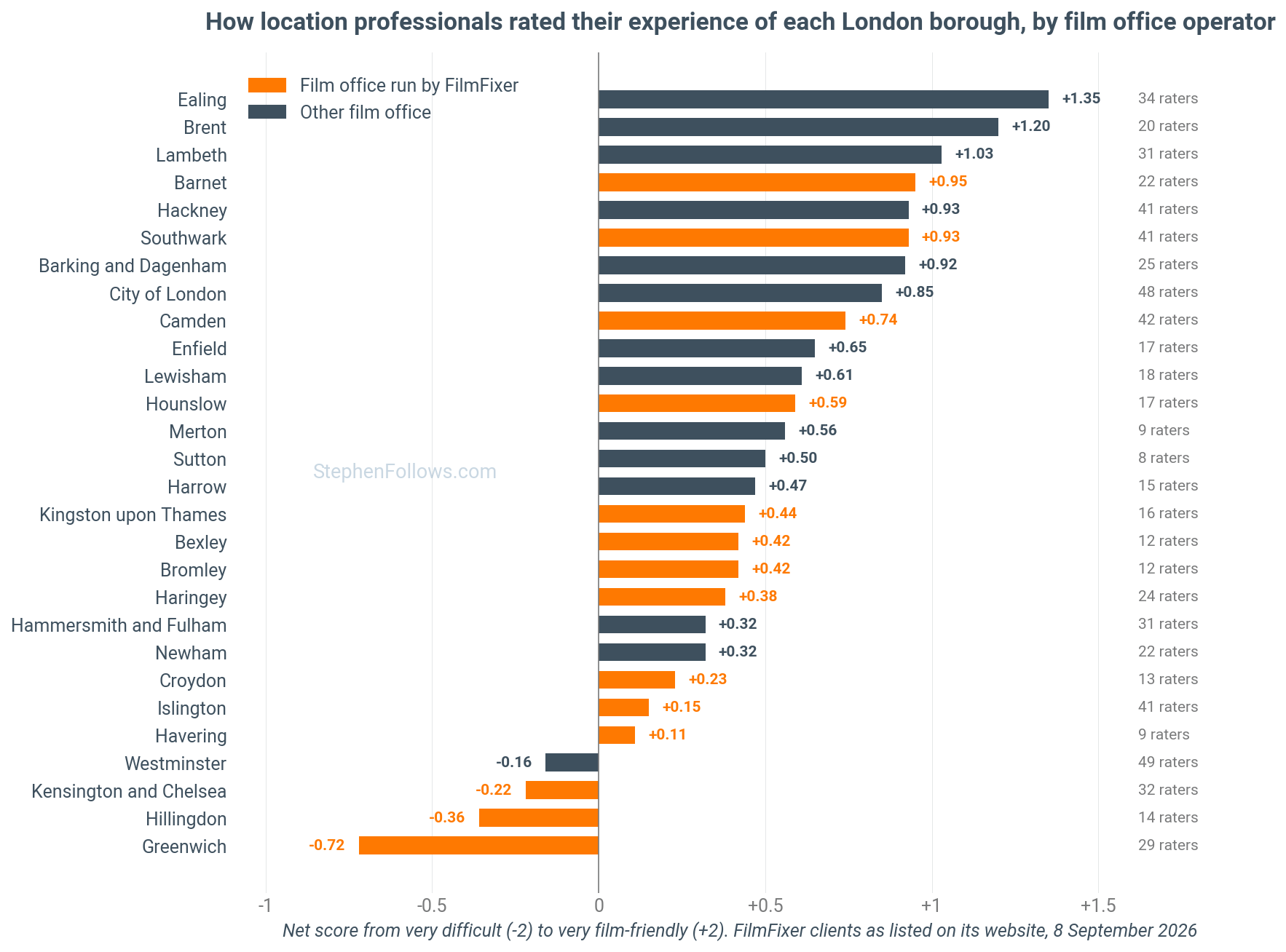
Greenwich, the worst-rated borough of all, stopped its in-house film unit in November 2024, and the borough ran no filming service at all. FilmFixer was appointed in February 2026, so it’s fair to assume that that score is not a reflection of FilmFixer’s work. Excluding the Greenwich data boosts the FilmFixer average score to +0.37 vs +0.68 for the non-FilmFixer boroughs.
What else can be done?
While cost was the main concern, it’s not the only factor that affects where a production chooses to shoot.
We then asked what causes the most friction and, separately, what makes a location viable in the first place. Each person could pick up to three.
Speed comes first on both lists. Slow response times are the top source of friction (chosen by 73%), and speed of approvals is the top thing that makes a location viable (69%).
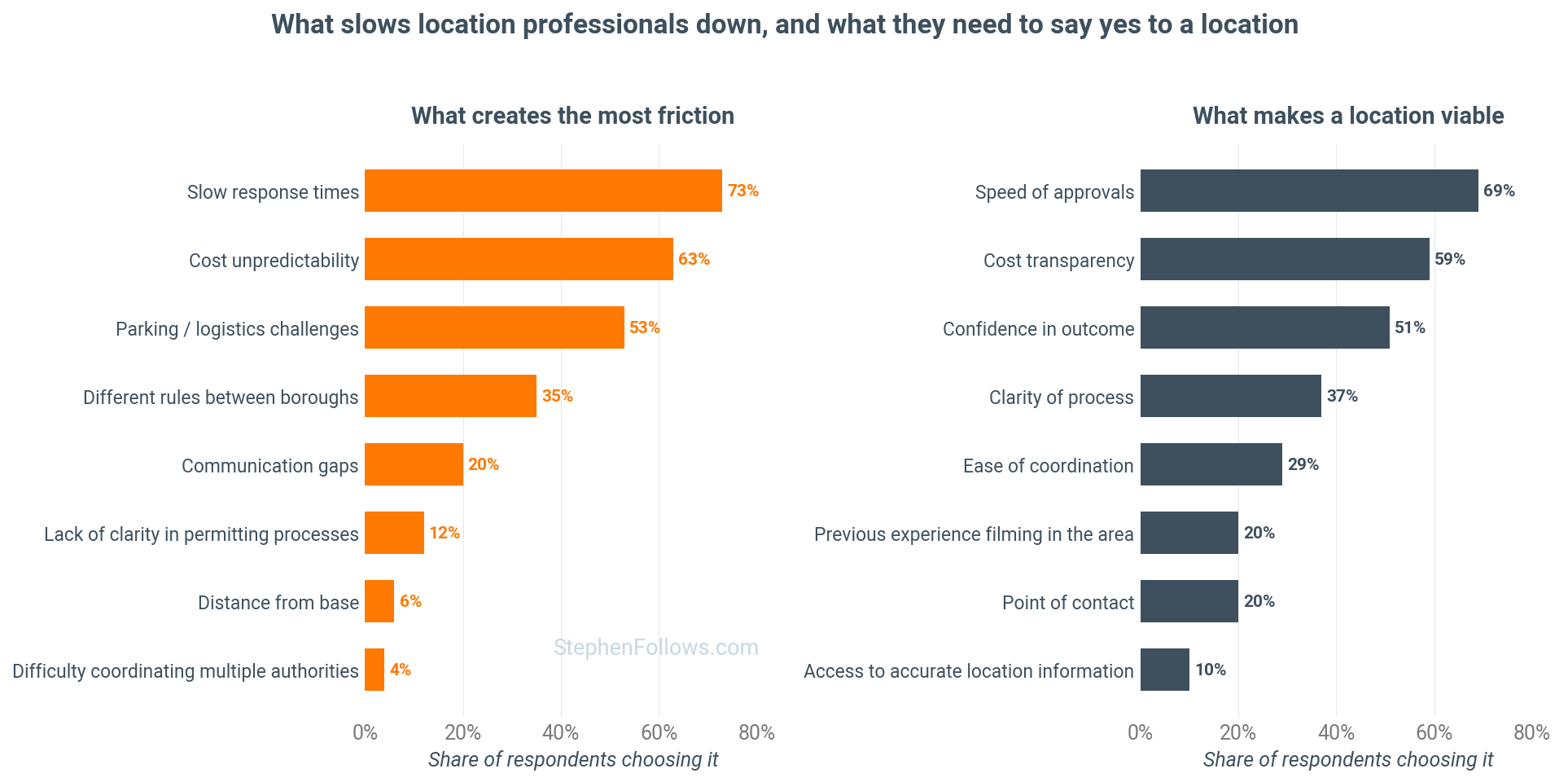
Cost unpredictability and cost transparency also feature. These folks need to budget and report to the Line Producer and Producer, and they can’t do this if costs are vague. One location manager put it like this:
There are a lot of positives with the hard working teams and we do appreciate them but having no idea [what the final cost will be] until the invoice process, [and] how it affects your budget, is such a pain.
Another asked for
Quicker responses, even if it’s to say no this isn’t possible.
Asked what single change would most improve London’s readiness for production, the top answers were consistent lead times for road closures, a consistent and transparent fee structure, standard terms across boroughs, and a guaranteed response to enquiries within 24 hours.
One respondent said the single most useful thing a film office could offer was ‘mobile numbers for film officers’.
Six in ten said the filming process is inconsistent or very inconsistent between boroughs. Nobody chose ‘very consistent’. Two thirds of the people we spoke with would value more standardisation.
The push from Whitehall
For the past century, London was the preeminent city for film and TV productions, but this started to shift with the passing of the Communications Act in 2003. It required public service broadcasters’ network programmes be made outside the M25, and charged Ofcom with setting the quotas. Today the BBC must make at least half of its network hours and spend outside London, ITV and Channel 4 35%, and Channel 5 10%. (A programme counts as made outside London if it passes two of three tests: a production base outside the M25, 70% of the production spend outside the M25, and half the off-screen crew usually employed outside it).
Initially, some production companies found workarounds by plonking their productions in places like Amersham, a few hundred yards beyond the motorway. Sneaky stuff, but Ofcom tightened the tests in 2019, and over time the UK’s regional hubs have grown into stable and thriving centres that face the same headwinds (strikes, downturns and the rest) as every other hub.
The quotas may initially sound like a compelling explanation for the fall in London location filming. There’s no doubt they have played a role, but there are two problems with this being the main driver:
The quotas have barely moved since 2012, and the broadcasters are beating them by a wide margin. Channel 4 promised in 2018 to lift its nations and regions spend from 35% to 50% of main-channel commissions by 2023 and to put commissioners in Leeds, Bristol and Glasgow. By 2021 it was taking 66% of its main-channel hours and 55% of its spend from outside London, and its chief content officer Ian Katz said they had “helped break London’s longstanding dominance of the TV industry”. The BBC’s Across the UK plan is doing the same job: 54% of its qualifying network TV spend was outside London in 2021, 58% in 2022 and 60% in 2023, against a quota of 50%. Across all public service broadcasters, Ofcom puts the share of spend outside London at 48% in 2019 and 56% in 2023.
They only apply to public service broadcasters. Netflix, Amazon, Apple, Disney and Paramount all face no quotas and yet they too are leaving London.
Where is the work going?
Many productions were always going to shoot outside the M25, and some simply wouldn't work in London. Supervising location manager Robbie Boake and location manager Naomi Liston scouted places across Northern Ireland that could become Westeros, and Game of Thrones would not have worked as well based in Croydon. His Dark Materials couldn't have been made anywhere but Wales. The same goes for Rivals in Bristol and the Cotswolds, and Peaky Blinders is back in its rightful home in Birmingham. Liverpool, Manchester and Glasgow regularly double for New York, London and Gotham. As well as showcase their own wide range of locations that attract lots of productions
But for the shows that could have been based in London and went elsewhere in the UK, or abroad, the people we surveyed point to one cause above all: the costs attached to filming there.
Film London’s own explanation is partly that production has moved indoors. But some of it has moved out of London altogether, and the cities that have taken it are not shy about saying so.
No other UK city publishes a run of location filming days I can set against London’s, so the evidence for where the work went is patchier: spend shares, the cities’ own reports and Matt’s tracking.
Between 2017 and 2019, according to the BFI’s Screen Business study, about a third of high-end TV spend and a fifth of film spend already happened outside the wider London area.
Pact’s census found that in 2023, for the first time, more than half of UK TV production spend was outside London.
Bristol’s film office reported a 55% rise in the economic impact of filming in 2024/25.
And just today I received a press release from Bristol’s Bottle Yard Studios stating that the value of location filming in Bristol “rose from £11.1 million in 2022-23 to a record £23.8 million in 2024-25”.
In addition, most screen agencies and regional governments now offer their own money on top of the cost savings.
Greater Manchester launched a £10.5m production fund in March 2026, offering recoupable investment to productions shooting in the city region.
Liverpool City Region’s fund, launched in 2019 as a first for a combined authority, now stands at £2.8m and puts up to £500,000 into a single production.
Screen Yorkshire’s Yorkshire Content Fund also invests up to £500,000 and has backed more than 60 productions.
Screen Scotland’s Production Growth Fund has £2m a year to hand out in £200,000 to £500,000 lumps.
The West Midlands is committing £2m a year from 2025.
Creative Wales awarded £23.7m to 45 productions between 2020 and 2025.
The North East’s £11.4m partnership with the BBC funds a production fund that is currently supporting an ITV drama about the infected blood scandal filming in Newcastle, according to Production Radar.
The West of England’s mayor launches a fund this autumn.
London has nothing like this. Film London only facilitates and cannot invest or financially support productions.
The rise in costs hits certain budgets hardest. Under the Pact and BECTU agreement that sets crew terms, high-end TV dramas are graded by their budget per hour of finished television:
Band 1 up to £1.25m
Band 2 from £1.25m to £3m
Band 3 from £3m to £8m
Band 4 above £8m.
Matt’s reading of the productions he tracks is that it is now increasingly rare for independent films, Band 1 TV, or Band 2 TV dramas to shoot inside the M25, and that lower Band 3 productions may not be far behind.
2026 has been very quiet for commissions everywhere. The BFI’s first-half figures show UK spend down on the same period last year, with high-end TV falling from £2.1 billion to £1.7 billion. Matt’s tracking suggests the rest of the UK is picking up as the year goes on, with a stronger end to the year and a positive outlook for 2027. Production Radar reports production activity has recently increased after a lean year for many crew and companies.
In the North West of England alone: Army of Shadows (Channel 4), Dirty (Amazon), House of Guinness (Netflix), Daddy Issues (BBC), Dragon Slayers (BBC), Twist of Fate (Netflix), The Woods (Netflix), You Are Here (BBC), Hercule (BBC/BritBox) and This City Is Ours 2 (BBC) have been filming or are about to shoot soon. Legacy of Spies (BBC/MGM+) shot a few days of exteriors in Liverpool after months of filming in Prague.
Multiple productions have been in Cardiff, including Industry 5 (HBO), The Lords’ Day (Netflix), Prisoner 2 (Sky), The Other Bennet Sister (BBC), and a returning ITV drama in the works.
In Belfast next year, two very large-scale productions are due to start filming for Netflix and Amazon, on top of returning HETV series.
And many productions that might have been based in the UK are finding better tax incentives elsewhere. The UK's credit is worth 25.5% of qualifying spend. Ireland pays 32%. Hungary pays 30%, and up to 37.5% once allowable foreign spend is counted. Czechia raised its rebate from 20% to 25% in January 2025. Malta offers up to 40%. And the Canary Islands pay 50% on the first €1m and 45% after that, which is why Gran Canaria and Tenerife keep turning up on British call sheets.
What’s to be done?
Film London convened borough film services, private operators, and location managers to a meeting last month to discuss this situation. (I shared an advance copy of our survey results with them ahead of the meeting).
I look forward to hearing publicly what was learned and decided in that meeting.
It remains to be seen how aware the London boroughs are of the scale the situation is becoming, especially when they review their ever-expanding ratecards.
Notes
Matt and I gathered location managers' thoughts in May and June 2026. We’re very grateful to FilmFixer and BECTU Locations Branch for helping connect us with location professionals. We also want to thank all the people who spoke with us off the record.
Frustratingly, a layout issue with how the questions were shown meant one batch of London boroughs wasn't shown to everyone, so we don’t have complete rating data for Tower Hamlets, Richmond, Wandsworth, Waltham Forest, and Redbridge. The borough ratings therefore cover 28 of the 33 boroughs, and some busy filming boroughs are among the missing five. That’s my mistake rather than anything deliberate, so apologies to anyone who that quite rightly annoys!
Filming-day figures come from Film London, quoted by a range of bodies.
The 2004 figure is from a London Assembly answer of May 2005, which gives a borough-by-borough table (Westminster alone recorded 1,937 days that year).
The 2005 figure is from a Cineuropa report of 2 February 2006 quoting Film London, which gives 2004 as 10,683, eight days different from the Assembly table.
The 2008 figure is from Film London’s written evidence to the House of Lords Communications Committee in the 2009 to 2010 session.
The 2012 figure is from the Mayor of London’s press release of 4 April 2013.
The 2013 figure is the phrase ‘around 18,000’ in a government release of October 2014.
The 2018 figure is the phrase ‘more than 15,000’ in a consultants’ report to the City of London Corporation.
The 2021 figure is ‘more than 12,700’ in Film London’s trustees’ report for the year to 31 March 2022.
The 2022 figure is from Film London’s Impact page, with the trustees’ report for that year saying ‘approximately 12,000’.
The 2023 and 2024 counts are on page five of the trustees’ reports for the years to 31 March 2024 and 2025, all filed with the Charity Commission.
Film London’s definition is one crew using locations in one borough on one day. I could not find a published figure for 2006, 2007, 2009 to 2011, 2014 to 2017, 2019, 2020 or 2025.
UK production figures are the BFI’s official statistics on film and high-end television production, counted by the year principal photography started and measured as UK spend. For each year, I have taken the most recent BFI publication that covers it, because the BFI revises earlier years upward as late-reported productions arrive, and the revisions can be large. The 2025 figures are as first reported in the full year 2025 release of 5 February 2026.
High-end television has been counted separately since its tax relief began in April 2013, and the series starts in 2014. Films with budgets under £500,000 were only included from 2009, and co-productions are missing from the film counts before 2002, so the earlier film figures are understated.
Fee comparisons use Film London’s Borough Film Services fee compilations, created on 24 January 2012, against the fee sheets each borough or its operator publishes for 2025/26 or 2026/27. Where the 2012 figure was an hourly rate it is compared as one hour. Fee sheets show minimum published charges before VAT. Admin fees are usually described as per hour of officer time and ‘may be multiplied’, and location fees are ranges. Real invoices can be higher, and this article compares list prices only.
The parking figures are the published charge per bay for the first day of a suspension, before VAT and any per-street admin or bagging fee. The unit base figures are the printed ranges on ten boroughs’ current rate cards, except Camden’s, which is from its 2019 sheet, the latest it has published.
The vehicle, crew and move figures are guide day rates supplied by Movie Makers at our request. They are not a published rate card, so there is nothing to link to. The lower figures are 25% below the higher ones and are rounded to the nearest £5.
The Manchester, Liverpool, Bristol and Birmingham figures are from those cities’ film office fee sheets for 2025/26 or 2026/27.
Inflation for the 2012 comparison is the ONS consumer price index from January 2012 to July 2026, and for the comparison of production spend with 2012 the annual averages of the same index for 2012 and 2024.
The year-by-year rate-card series uses 84 ‘Fees and Lead in Times’ cards for 2021/22 to 2026/27, supplied by FilmFixer, covering 18 boroughs; the lines on the chart use the 12 boroughs present in every year plus Kensington and Chelsea from 2023/24, and ‘£22,000+’ rates are charted at the printed figure. Inflation for that comparison is the ONS index from the 2021 annual average to July 2026, a rise of 28%.
Matt Gallagher and I are building a paid resource for councils and public bodies that handle filming, the Film Office Toolkit, and this article uses the survey and public data gathered for it. Matt runs The Callsheet and its Production Radar tracker. FilmFixer circulated one of the two survey links and supplied its historical rate cards. We both know people at Film London, FilmFixer and BECTU, and we showed a draft to each of them for factual comment before publication, and their responses are printed below where they gave one. Nobody has paid for anything or got us to publish anything we don’t agree with.
Quota levels are from Ofcom's regional production guidance and its 2017 review of that guidance. Channel 4's figures are from its press releases of 31 October 2018 and 15 March 2022. The BBC's are from Ofcom's annual report on the BBC for 2023/24, and the all-broadcaster figures from Ofcom's Review of Public Service Media 2019 to 2023. Regional fund sizes are as published by each fund in September 2026, or as reported by Screen Daily on 18 June 2026. Foreign incentive rates are the headline rates each scheme publishes for an incoming production, before caps and conditions. The Pact figure is from its 2024 census release of 11 September 2024, which covers 2023.
Finally, while researching this topic, I heard more than once that one particular borough is pricing high on purpose to keep filming away after resident complaints. Nobody would say so on the record, and I cannot verify it, so treat it as gossip. But if it is true, it is working.
Extra thoughts
I reached out to various people with an early draft of this piece.
Film London sent this statement:
Film London has spent the last two decades working to transform London from a city no-one was willing to film in, to one of the world’s most film-friendly cities.
We’re acutely aware of the recent challenges facing different parts of the industry, both public and private sector. Core to our remit is ensuring the competing concerns and demands of filmmakers, residents and businesses alike are carefully balanced. We are in constant talks with studios, producers, location managers, local authorities, politicians and private sector providers to ensure London remains film-friendly and competitive. For example, as well as facilitating a wide range of film and TV productions we have, over the last six months, focused efforts on unpicking how charges and services might be harmonised across London’s 33 boroughs, raised concerns about parking charges, lobbied for greater access to sustainable power sources and discussed ways in which the system can better serve lower budget productions taking advantage of the new indie film tax credit.
However, a critical point this report neglects to mention is that the time period focused on corresponds to both the absolute peak years for filming in London, and two of the worst troughs for the global industry. Everyone involved in making film and TV is keenly aware of the current commissioning slowdown and rising costs (energy; cost of living, etc.) over which no one has control, and which are global challenges.
But both sides of the equation are under pressure to do ‘more with less’. It is up to all of us to help balance this delicate ecosystem to ensure our city remains a highly-competitive production centre for domestic and international film and TV production. Film London, through the behind-the-scenes work of our Locations team and our Executive Task Force, are committed to resolving the challenges and supporting and championing the sector.
Andrew Pavord, Founder and Chairman of FilmFixer, said:
Thank you, Stephen and Matt, for this valuable work. We are very happy to have helped you reach the Location Managers who work so hard in this incredible city. Like everyone, I am concerned that productions feel priced out of London. It’s good to see proof that Borough admin fees have (on the whole) remained close to the rate of inflation. Location and Unit Base fees on the other hand have risen, and I feel this is due to simple supply and demand. London is special and unique, and owners of prime locations and their representing agencies are very aware of their true value.
I am very concerned that some Location Managers feel contacting FilmFixer is difficult. Our Film Service Managers publish their mobile phone numbers and offer scheduled meetings in their email signatures. Knowing my own mobile number is on speed dial for all senior Location Managers, I find that criticism hard to take.
There is a reason why 17 London Boroughs have chosen FilmFixer as their service provider. We have to go through regular procurement processes, and the competition is fierce. We will always keep improving the service we offer; helpful, constructive feedback is always welcome.
On the per-borough rating, FilmFixer makes the same point about the other two boroughs at the bottom of the table. Its contract with Kensington and Chelsea began in May 2025 and Hillingdon's in November 2025, so most of the three years our respondents rated fall under the councils' previous arrangements. The company says both boroughs are about to post much improved figures for July to September, that it has introduced film parking permits in Kensington and Chelsea, and that lead-in times have come down in both.
George Couch is the Chair of the Bectu Locations Branch, and he said:
The Locations Branch, welcomes the research published by Stephen Follows and Matt Gallagher. For some time, members have raised concerns about the slowdown in London, rising costs and the increasing difficulty of location filming within a variety of production budgets. The article reflects many of the experiences shared with us.
Improving members’ working conditions and supporting a sustainable industry remain central to our work. We have raised these issues constructively with Film London, film offices, service providers and other industry stakeholders and we welcome everyone’s engagement. We understand that these concerns have been acknowledged.
We also recognise and appreciate the important work carried out by FilmFixer, The Film Office, London’s boroughs and in-house film offices in managing often complex relationships between productions, councils, residents, landowners and other stakeholders. Continued dialogue with all parties will be essential to identifying practical improvements and keeping London attractive to production.
Whilst the reduction in London location filming deserves serious attention, it is encouraging to see production activity growing elsewhere in the UK. The regions offer competitive costs, excellent facilities, diverse locations and highly skilled crews. Although the Branch sits within the London Production Division, we will continue to advocate for location professionals across all regions while working with relevant stakeholders to help London remain competitive, accessible and welcoming to productions.
That's crazy. I mean, I guessed the reason probably was money. Really insightful to see it broken down like that. I appreciate the comprehensive work.
This is amazing. Much respect.