


The Berlin and Cannes film festivals are such big events in my professional calendar, and as they take place in February and May, respectively, I tend to regard the first half of the year as the busiest for film festivals.
But as I plan out my travel for the next six months, I was surprised how many major film events are yet to take place.
So I thought I would dive into the numbers to discover when is the busiest period for film festivals.
I gathered data on the operating days of the top 50 films festivals over the past quarter century.
When do the biggest film festivals take place?
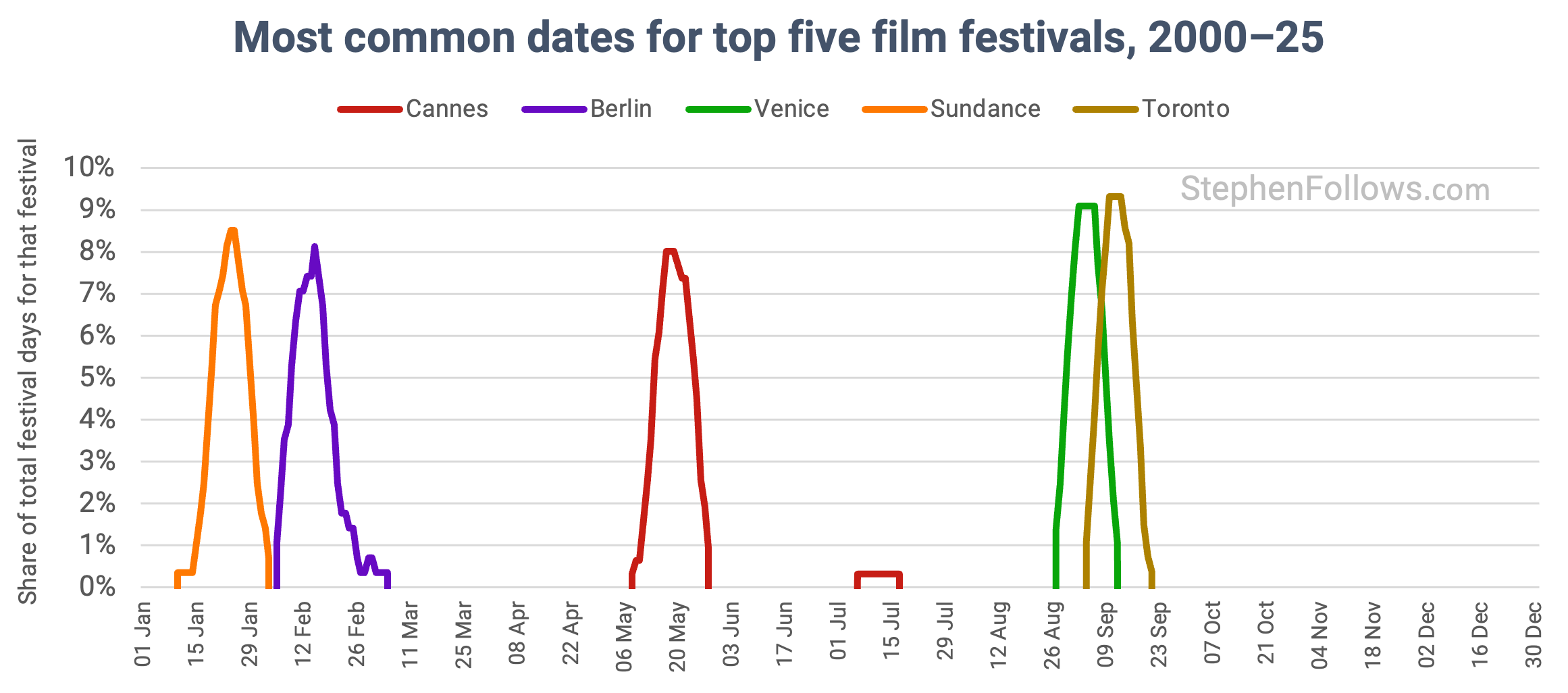
Most film professionals who attend festivals know of the rough dates of the biggest five festivals:
Sundance - January
Berlin - February
Cannes - May
Venice - August / September
Toronto - September
These act as the spine of the festival calendar.
However, it’s wasn’t always this way:
Berlin began in June, but in 1978 shifted to February. The move gave Berlin an open slot at the start of the year, away from the shadow of Cannes and Venice.
Cannes made an even more significant move after the Second World War. It originally fought Venice head-to-head in September. In 1952, Cannes switched to May. The aim was to avoid direct rivalry with Venice and instead position itself as the main spring event.
Sundance also started out in a different part of the year. The Utah/US Film Festival ran in September, but changed to January from 1981 onwards.
But these are far from the only film festivals. I looked at 50 major festivals and noted which days they took place on.
What is the busiest days of the year for film festivals?
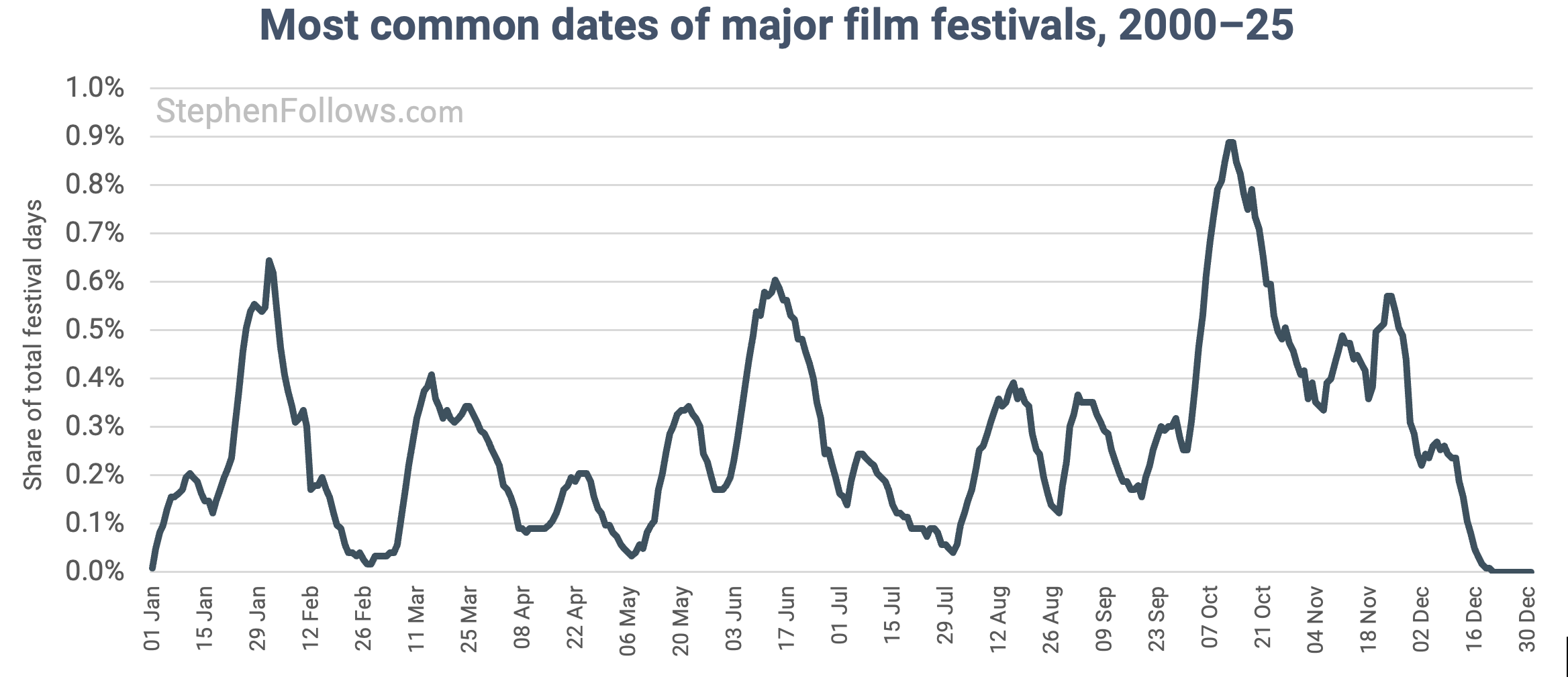
Overall, the busiest two days were 12th and 13th October, each accounting for 0.9% of all the festivals days I tracked over 25 years.
In contrast to my own presumption, only 44.3% of the festivals days have taken place by the midpoint of the year. This is more surprising when you take into account how unpopular December is, containing just 3.4% of festivals events.
Almost a fifth of all film festival events happen in the month of October.
What affects film festival dates?
When festival organisers pick their dates, they are weighing a number of factors, including:
The proximity of rivals. Organisers want their festival to stand out, so they look to avoid direct clashes with similarly sized events that compete for premieres, press, and industry attendance.
Timing within the awards season. Festivals that feed into national or international awards cycles can boost their status by giving films a timely platform for launches and securing their place in the awards conversation.
Local, school and public holidays, could affect volunteer numbers and audience turnout.
Local factors which may affect venue availability and practical concerns of travel and hospitality. Choosing dates that align with periods of lower hotel and flight prices can make a difference for attracting guests and international delegates.
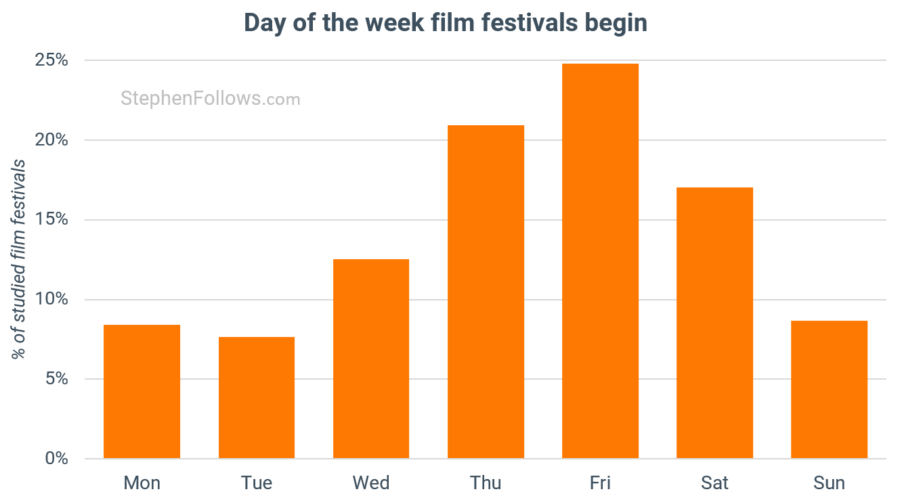
In a piece of research I conducted last year, I looked at most common days of the week for film festival dates (ranging from when they run to when they accept submissions).
I found that festivals most commonly begin on Fridays, with one in four of the festivals I studied starting on that day. This makes sense given the focus on weekend attendance, allowing attendees to participate without taking significant time off work.
Covid vs festivals
Force majeure can mess with even the best laid plans. For example, the COVID-19 pandemic forced a total rethinking of how film festivals operate.
Almost overnight, physical gatherings became impossible, and the longstanding rhythm of the global calendar broke down. Each festival responded in a slightly different way.
Cannes provides the most visible example of disruption. In 2020, organisers first postponed, then cancelled the physical festival for the first time since 1968. Rather than shifting online like many others, Cannes announced an “Official Selection” of 56 films, allowing those titles to carry the festival’s seal of approval.
Venice went in a different direction. In September 2020, it became the first major festival to return as a largely physical event, thanks to strict capacity limits, social distancing, and rigid health protocols. To reduce crowding, Venice introduced outdoor screenings, cancelled the Sconfini section, and moved its virtual reality component online.
Sundance was one of the first to build a robust digital model. Its 2021 edition ran entirely online, supported by a dedicated platform and a network of local partner cinemas across the United States. When faced with another COVID surge in early 2022, Sundance successfully pivoted from a planned hybrid festival to fully virtual less than three weeks before opening.
Berlin showed yet another approach. In 2021, organisers split the Berlinale into two distinct events. The first was a digital-only industry market in March, which allowed the European Film Market to proceed. Then, in June, Berlin hosted public open-air screenings and events in cinemas across the city, keeping both industry and public engagement alive while working within public health rules.
Advice on visiting film festivals
If you are preparing to attend a festival you may find it useful to read my piece called How to prepare for ANY film festival.
It was created from over a decade of surveys and conversations with filmmakers, producers, and festival directors and contains the 20 things people consistently say make a festival trip worth the time and money.