


If you’ve attended many film industry events, then you may have noticed that some familiar faces keep popping up. Most of them are people you’ve enjoyed hearing speak, or who did a great job moderating a panel (hence their repeated bookings).
I wanted to get a sense of how many speaking and moderating slots are taken up by a cadre of professional presenters and hosts.
These events serve a vital function for the industry, helping us share ideas, learn from others' experiences, and pick up best practice for our own continued self-improvement. They are also how consensus and echo chambers can be formed.
Curating an industry conference is no easy matter. Beyond the logistics, you will want a healthy mix of new voices and experienced speakers/hosts. You may be torn between wanting to give a platform to new and emerging talent and wanting to programme people you've enjoyed hearing from at previous events.
Which is it? Do we have:
An echo chamber of the same voice on tour, saying the same thing; or
A healthy mix of new and established voices?
To find out, I looked for every recurring film and TV industry event I could find with a published speaking programme and tracked the line-ups for every edition held between January 2023 and June 2026.
In the end, I had a dataset of 412 events, across 1,246 editions, with 22,704 sessions featuring 70,529 speaking appearances from 44,423 different people.
It’s also worth remembering that 2026 is only half a year. Wherever a chart shows 2026 it means January to June (i.e. the spring markets are in and the autumn ones are out). More detail is in the Notes section at the end.
Who asks the questions?
The most popular faces roughly fall into four categories:
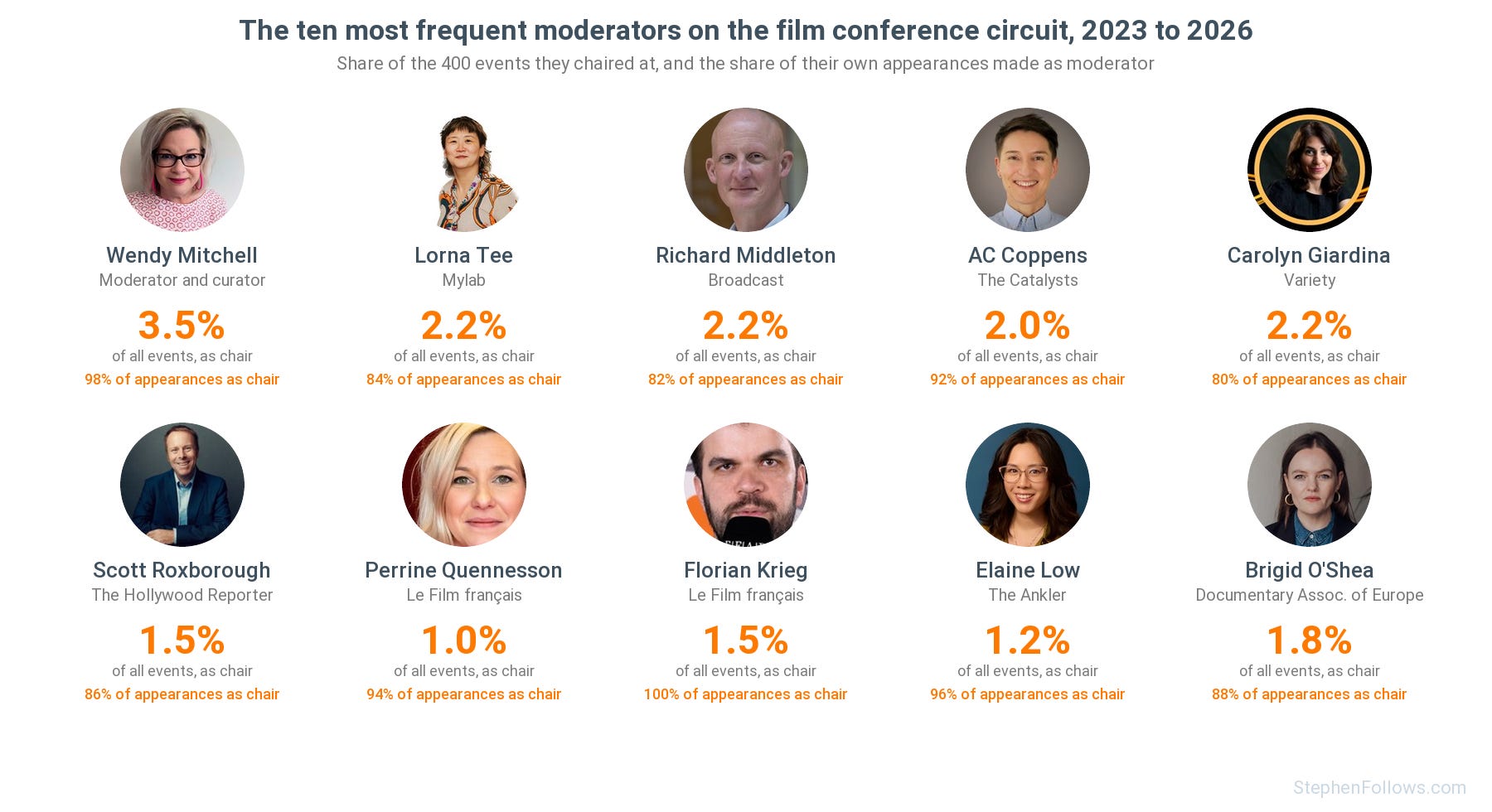
Professional moderators and curators such as Wendy Mitchell and AC Coppens.
Trade journalists such as Carolyn Giardina of Variety and Richard Middleton of Broadcast.
Market analysts such as Maria Rua Aguete of Omdia, Guy Bisson of Ampere Analysis, industry forecaster Johanna Koljonen, and Evan Shapiro.
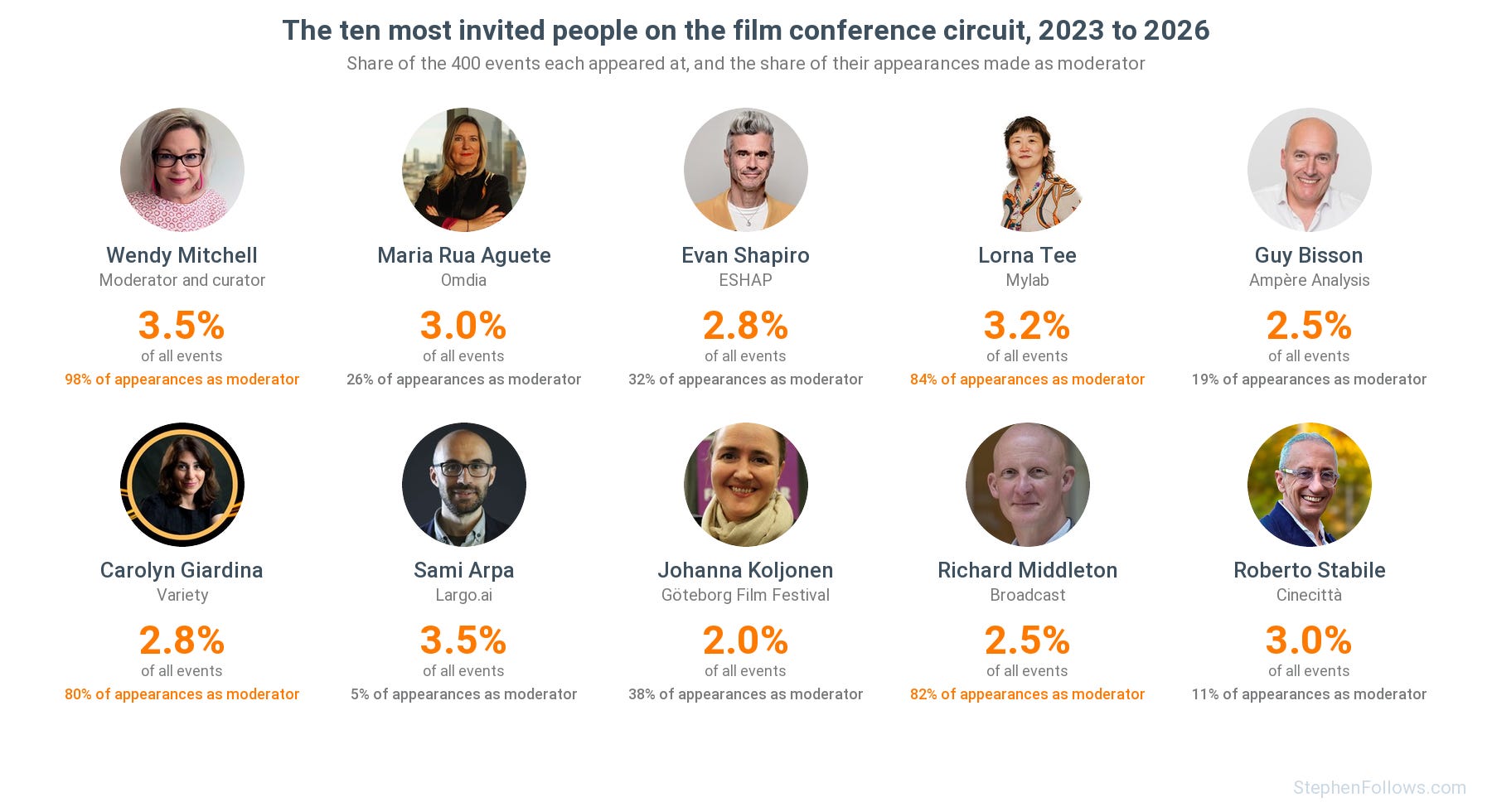
In the graphic above, I have included the percentage of their appearances as host, and you’ll see that the circuit’s most invited people tend to also be its most invited moderators.
In my personal opinion, that's because good moderation is really hard to do. If you are a guest on a panel, then there are a limited number of ways you could ‘get it wrong’ or truly mess up the session. But there is a huge difference between good and bad moderation.
This means only a relatively small number of people have perfected it and do it as part of their working life.
Some of them also help choose who gets on stage in the first place. Wendy Mitchell, for example, curates San Sebastián’s Creative Investors' Conference, so chairing many of its sessions is a natural extension of programming it.
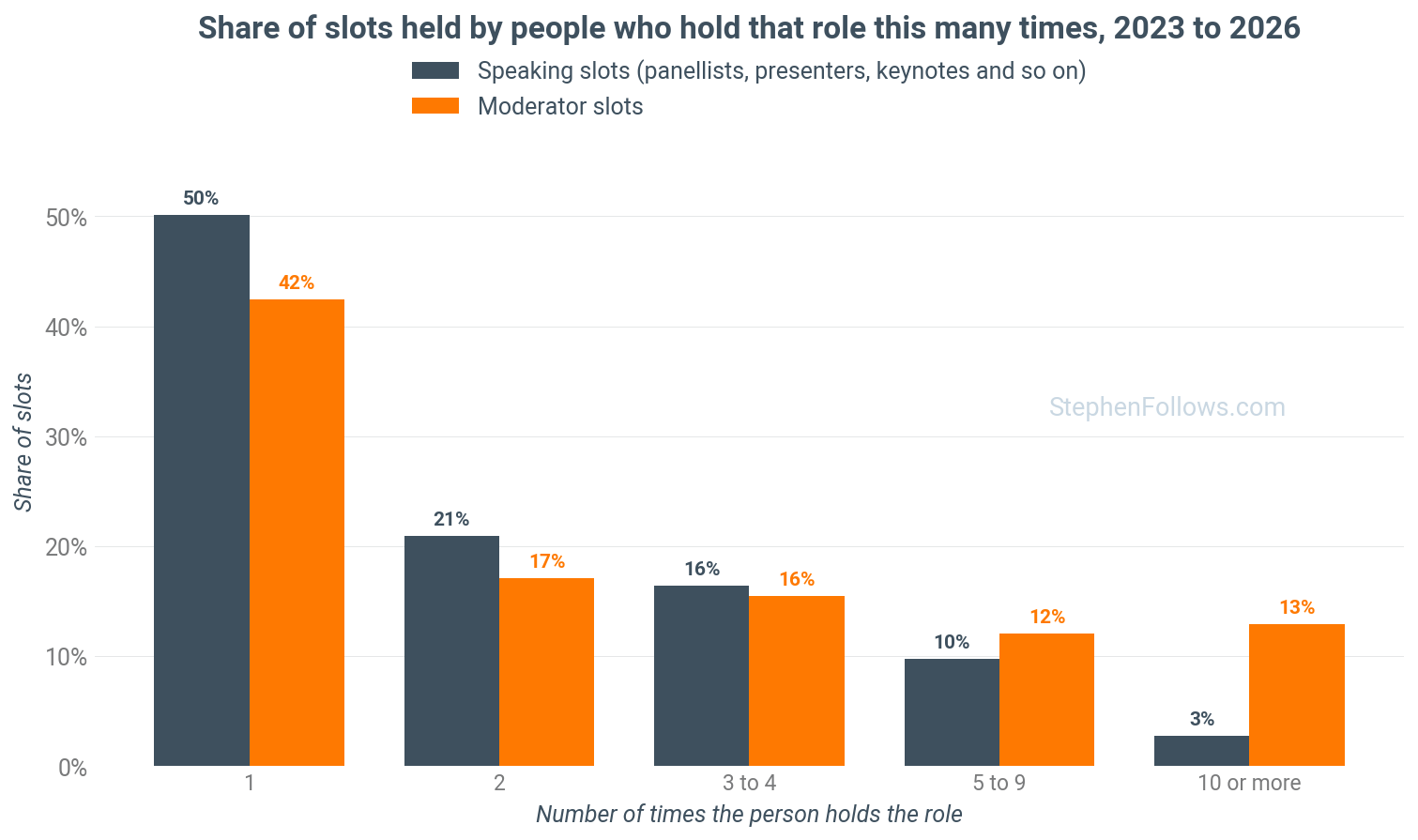
13% of all moderation slots at events were taken by one of just 80 people who had moderated at least ten times over the three and a half years I studied.
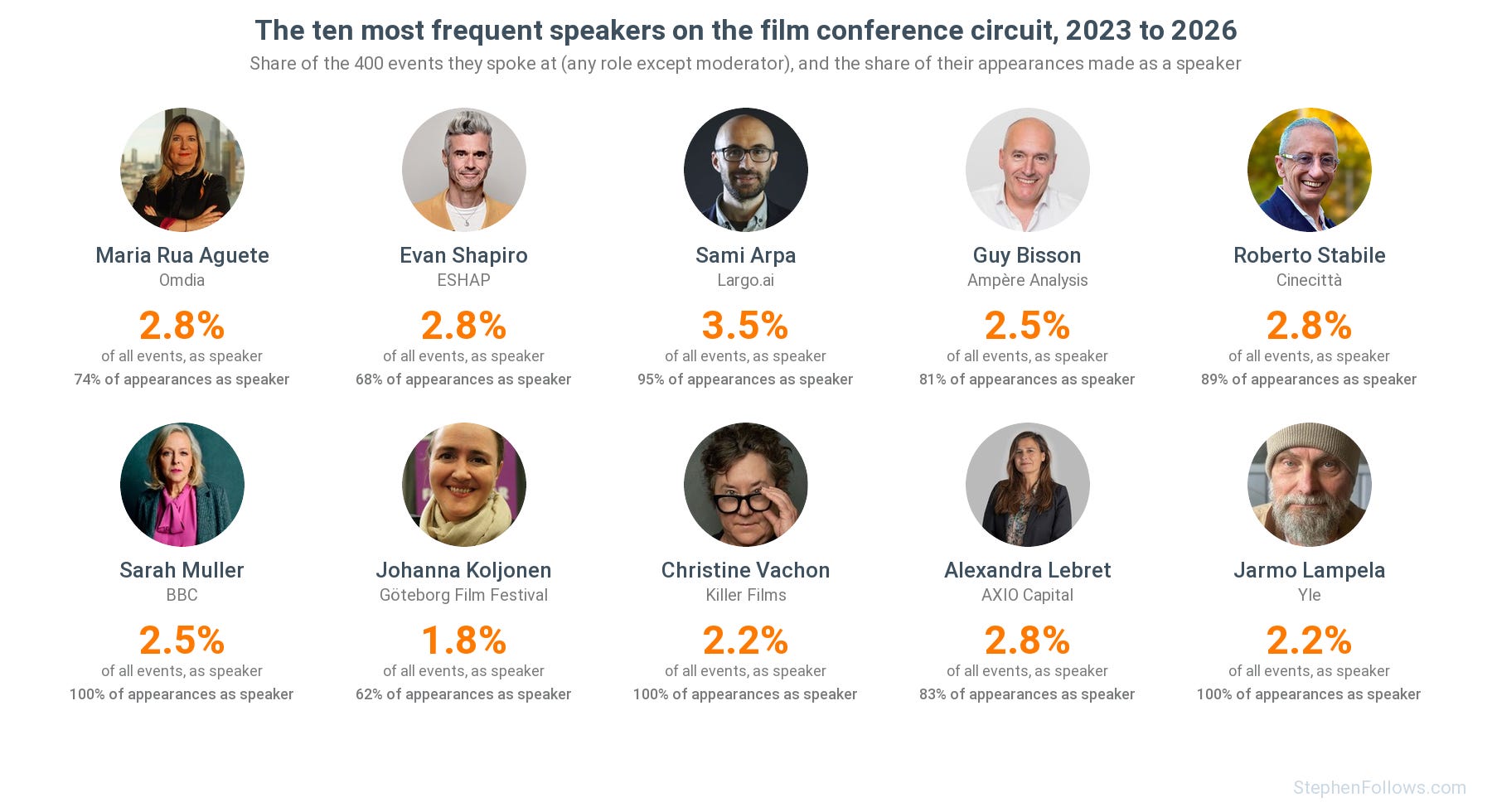
The speakers are a different crowd. Next to the analysts sit public broadcasters (Sarah Muller of the BBC and Jarmo Lampela of Yle), a film financier (Alexandra Lebret of AXIO Capital) and a producer (Christine Vachon of Killer Films).
Managers, not makers
Across all slots, the most common professions were business owners or C-suite level employees. More than a third of the people on stage are there because they run something.
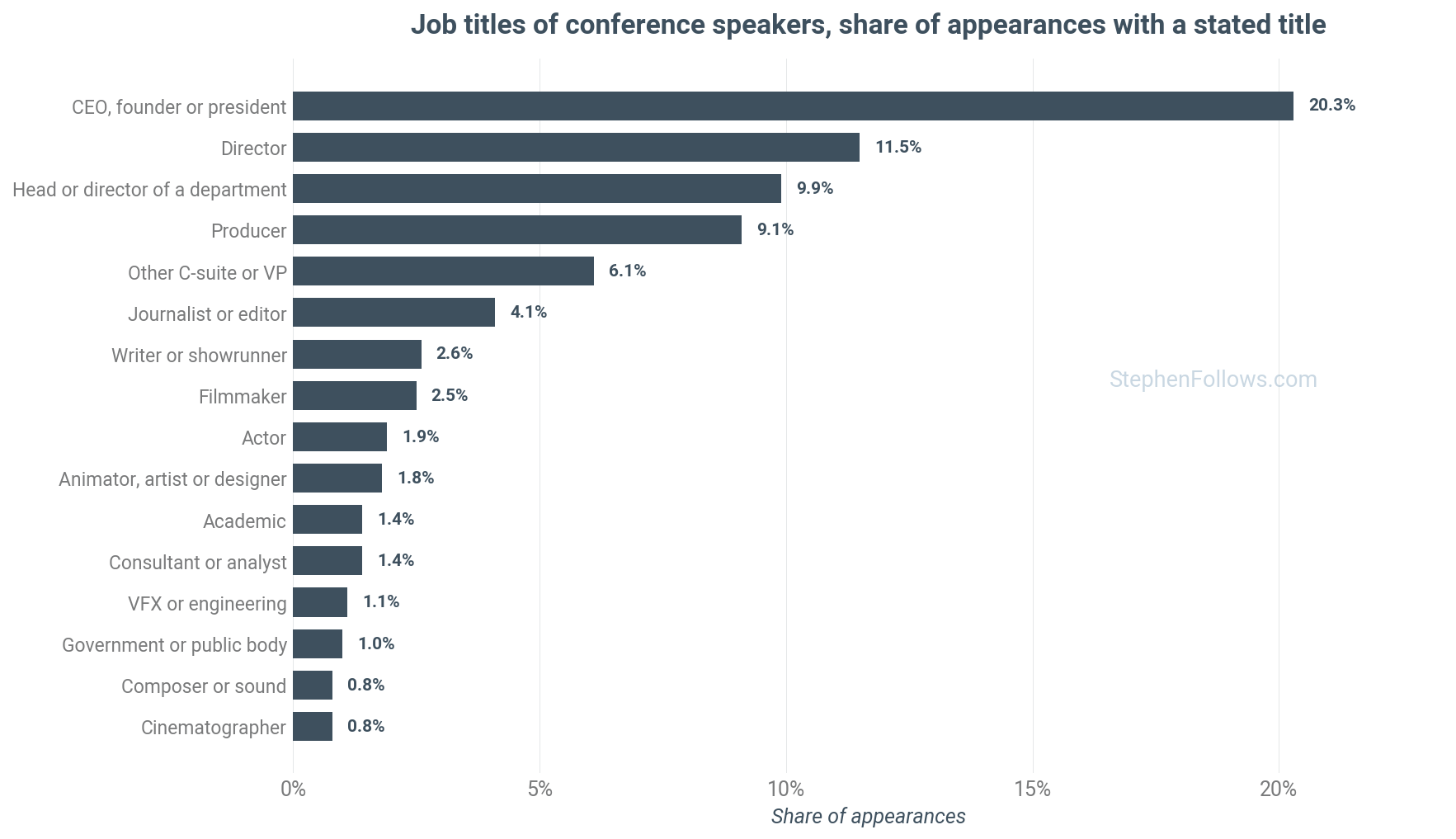
There are two ways you could read this:
The kind view is that this is what the events are for. A market or an industry programme exists to do business, and the people who do the business are the people who run companies.
The less kind view is that the industry’s public conversation about itself is controlled by the people with the least direct contact with the work. When a panel discusses the future of screenwriting, the chances are that nobody on it actually writes for a living.
Where do they come from?
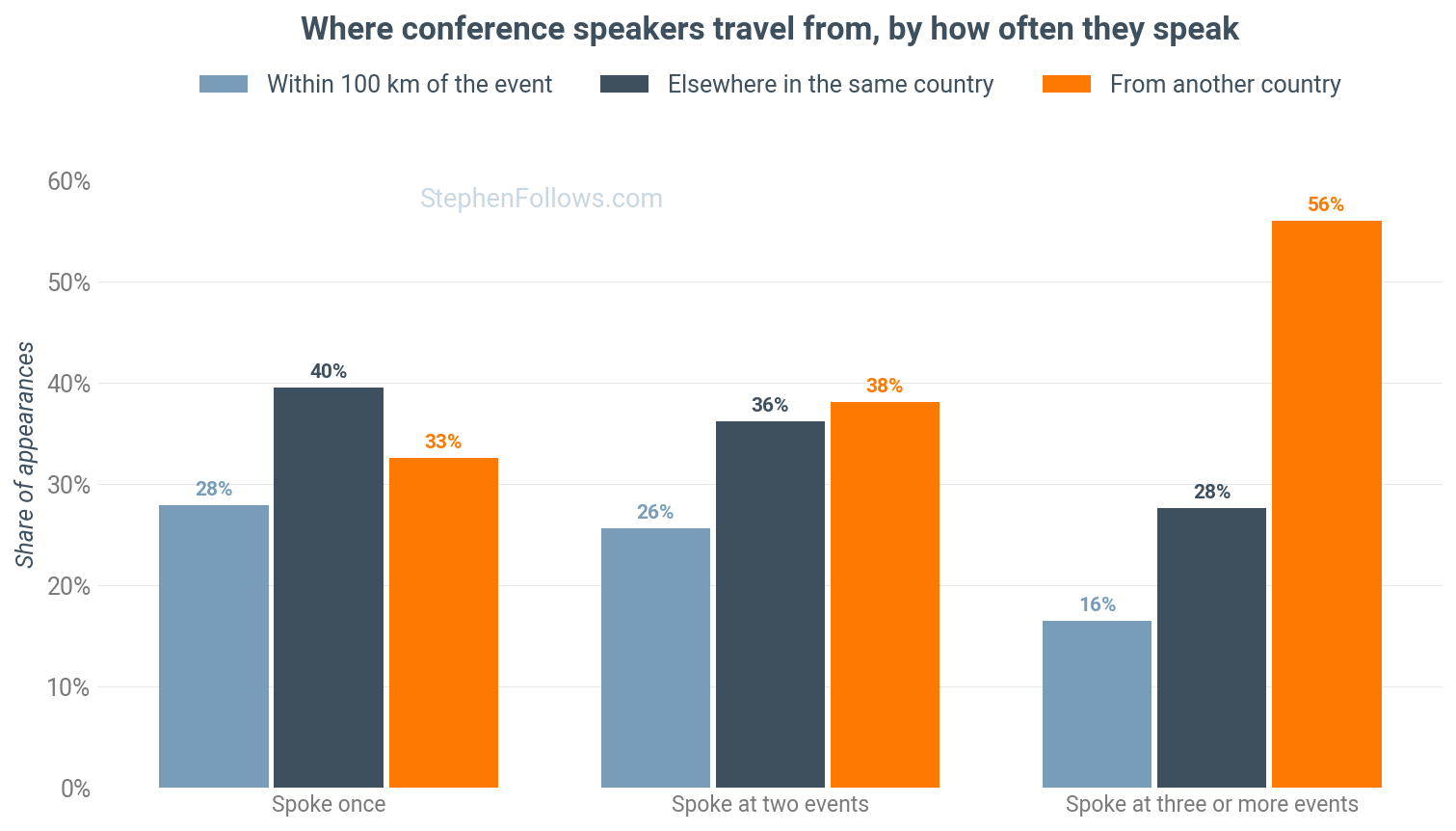
I was interested in how far people travelled to appear on these stages, so I tracked where speakers were based (if their professional biography mentions a location), covering 11,594 appearances.
One-off speakers are typically a national booking. Among one-off speakers, 28% were based within 100 km of the event, 40% elsewhere in the same country, and 33% abroad.
However, regulars have a larger carbon footprint. Among people who spoke at three or more different events, 56% of appearances were from another country and the median distance travelled was just over 1,000 km.
People who give masterclasses travel the farthest (76% from abroad), whereas moderators travel the least (50%).
It turns out that the type of event matters just as much as the type of speaker. Markets are the most likely to fly people in. At the markets where I could locate the speakers, 69% of speakers came from another country (at the Marché du Film it was 83%).
Industry programmes attached to a film festival sit in the middle at 51%, with the festival itself doing some of the pulling.
Standalone conferences and technology shows are more likely to be national gatherings, with 45% of speakers from abroad and (at the technology shows) a median distance of under 400 km. For example, NAB Show draws 81% of its speakers from elsewhere in the United States and SXSW 84%.
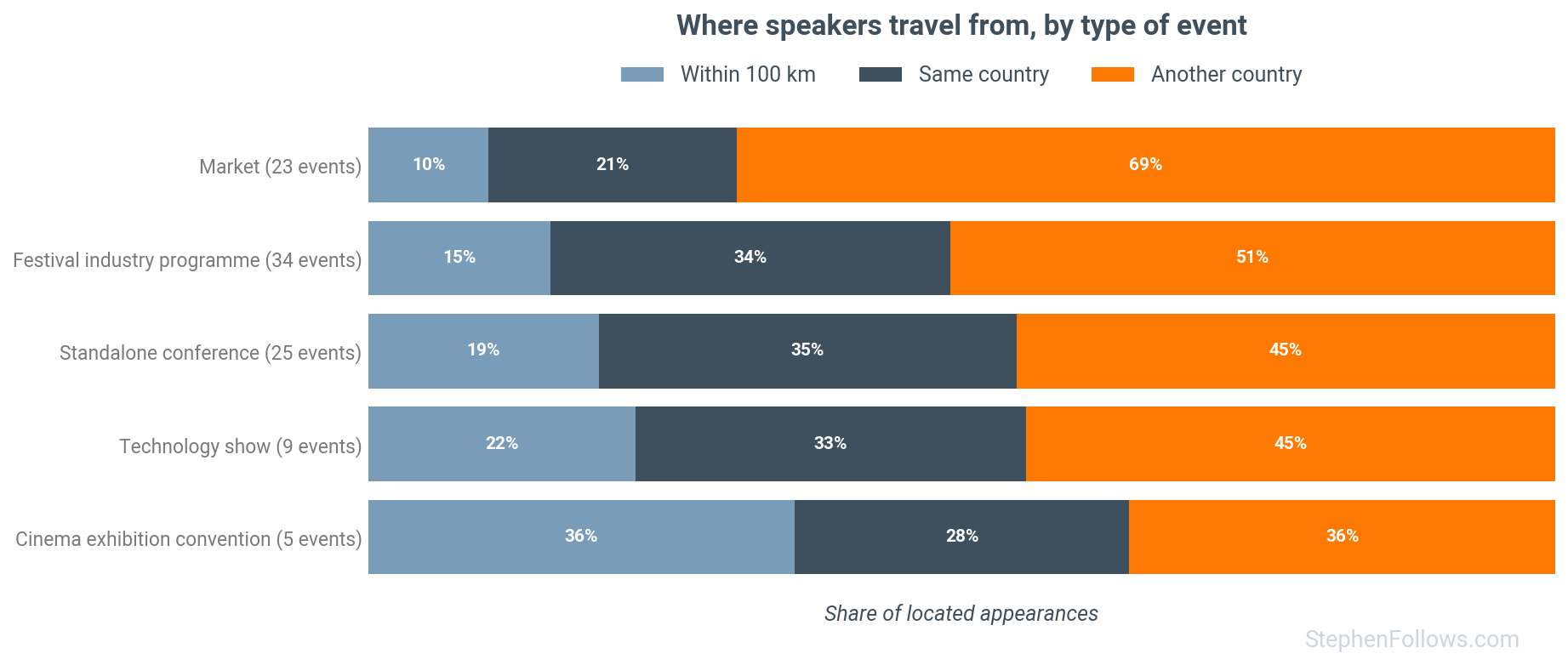
In Europe, a foreign speaker is often a short flight away, so distance is a fairer measure, but the pattern holds either way.
How many of them are women?
By my estimate, 43% of speakers were women - a stat which was consistent across the three and a half years I studied.
(The programmes don’t record gender, so I estimated it from first names and checked that against the pronouns in speakers’ bios, where I had them. It couldn’t classify 15% of appearances and it can never be right about any one person, but across 60,000 appearances it’s a fair guide).
Women make up a larger share of moderators (49%) than of panellists (45%) or keynote speakers (37%).
However, those stats are the averages. When we drill down by topic, we see a clear split along gender lines.
Two-thirds of the speakers on diversity and inclusion panels are women, as are 55% of documentary speakers and 54% of sustainability speakers. At the other end, women make up 31% of AI speakers, 26% of technology speakers, and 22% of VFX speakers.
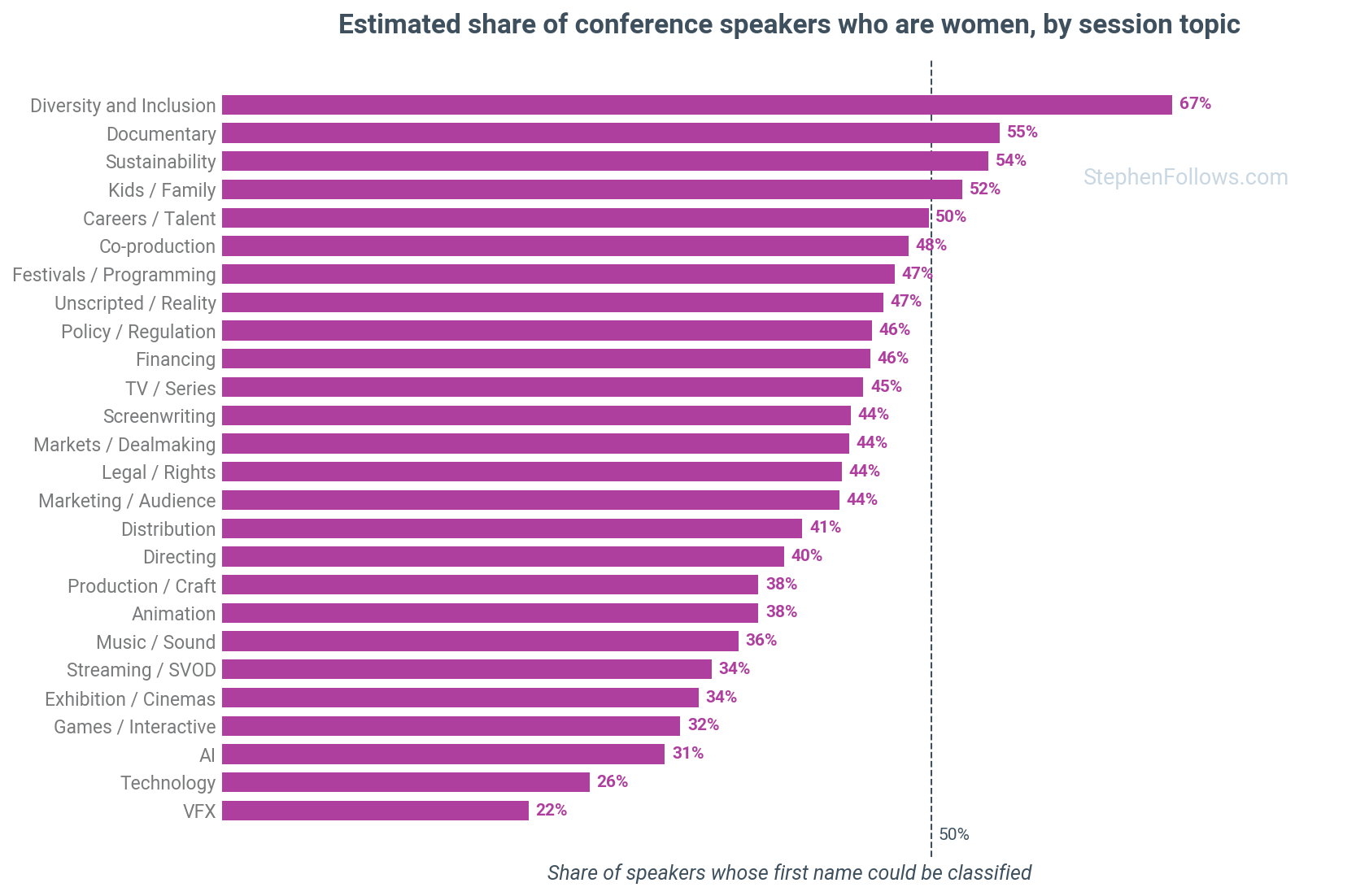
I was surprised how mixed most panels were. Of the 7,734 panels with at least three classifiable speakers, 12% are all-male, and 8% are all-female. However, the averages hide a wide regional spread. All-male panels make up 7% of the total in Europe, 17% in North America, and 32% in Asia.
The companies letting their employees speak
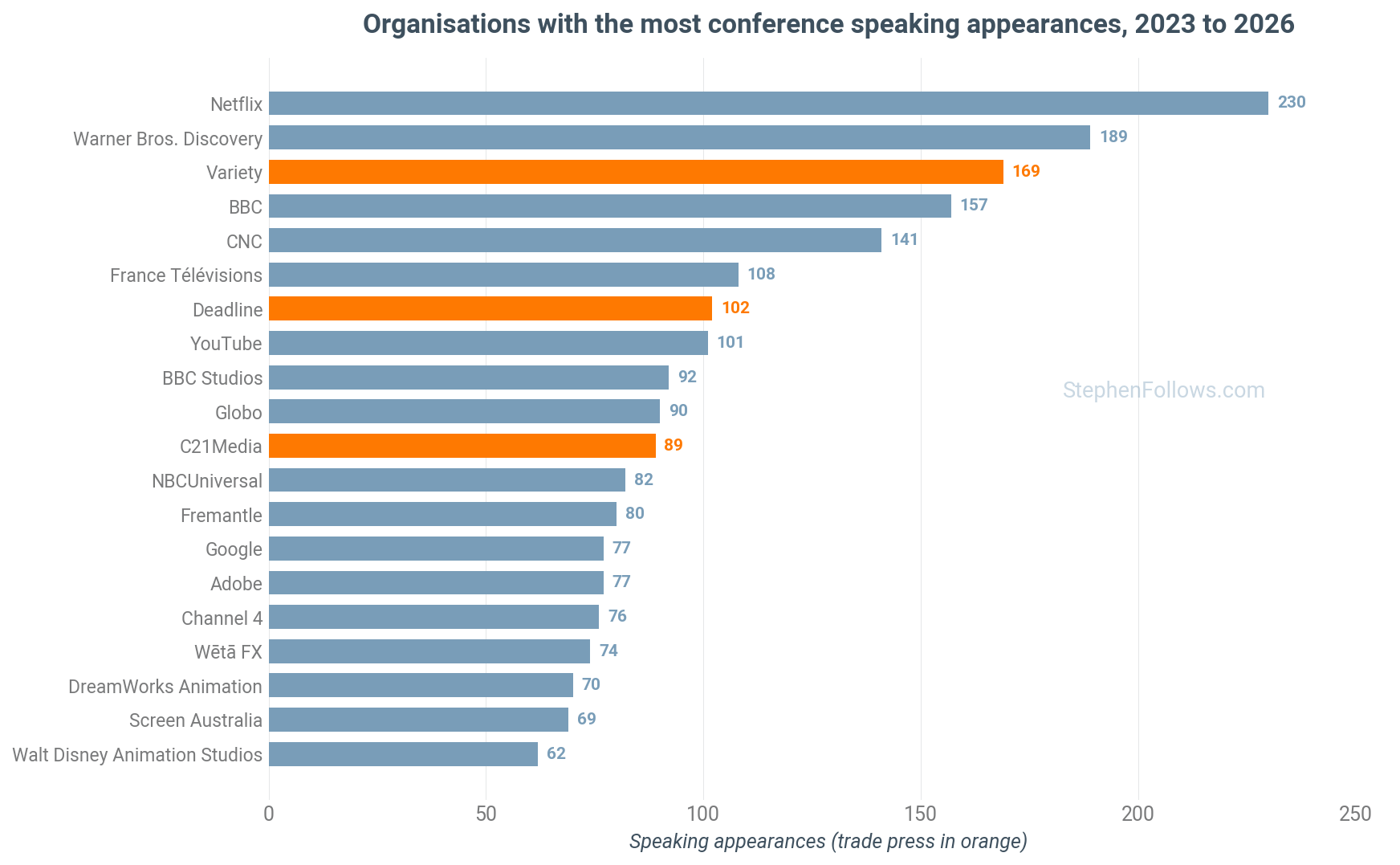
Two-thirds of appearances name an employer, and the most common was Netflix, with 230 appearances. They were followed by Warner Bros. Discovery with 189, Variety with 169, the BBC with 157 and France’s CNC with 141.
However, this is changing as we’re seeing the biggest names pull back from the conference circuit.
To compare like with like, I tracked the same 45 events each year (the ones with a full programme in every year from 2023 to 2025). At those events, the four legacy Hollywood studios (Disney, Warner Bros. Discovery, NBCUniversal and Paramount) went from 6.5% of the appearances naming an employer in 2023 to 3.4% in 2025, and stayed there in the first half of 2026. Netflix and Amazon fell too, from 2.0% to 1.2%, and haven’t come back
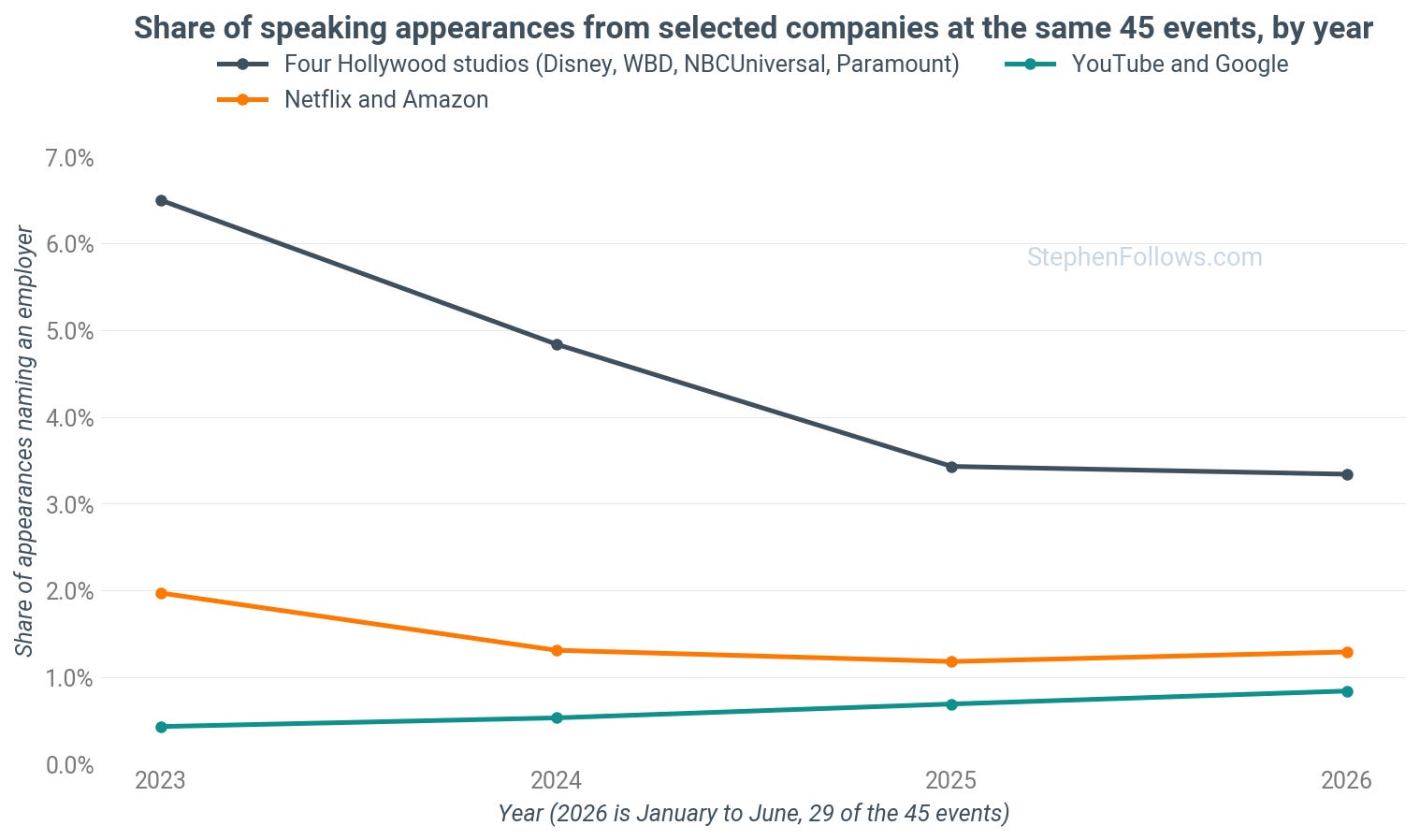
I noticed something similar at Cannes this year, where the streamers had all but stopped turning up. Across the circuit, both studios and streamers are stepping back, and the company stepping forward owns the platform where the audience already is - YouTube (up from 0.4% of appearances in 2023 to 0.8% in the first half of 2026).
What does the film industry talk about?
I tagged all 22,704 sessions by topic based on their titles, and the most common subjects were production and craft, followed by careers and talent.
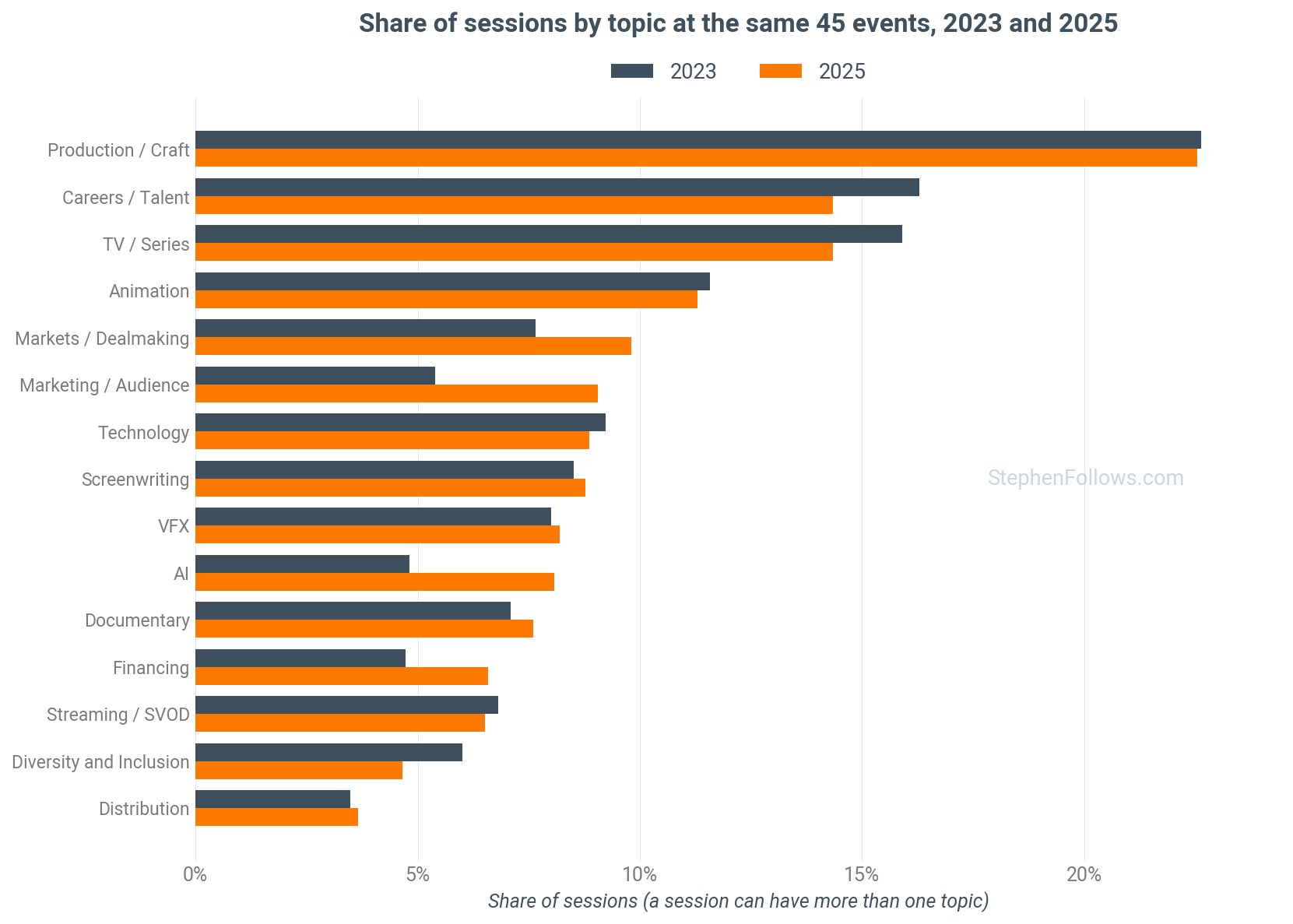
At the same 45 events, the topics that grew between 2023 and 2025 were:
Markets and dealmaking (from 7.7% to 9.8%)
Marketing and audiences (from 5.4% to 9.1%)
Financing (from 4.7% to 6.6%)
AI (from 4.8% to 8.1%).
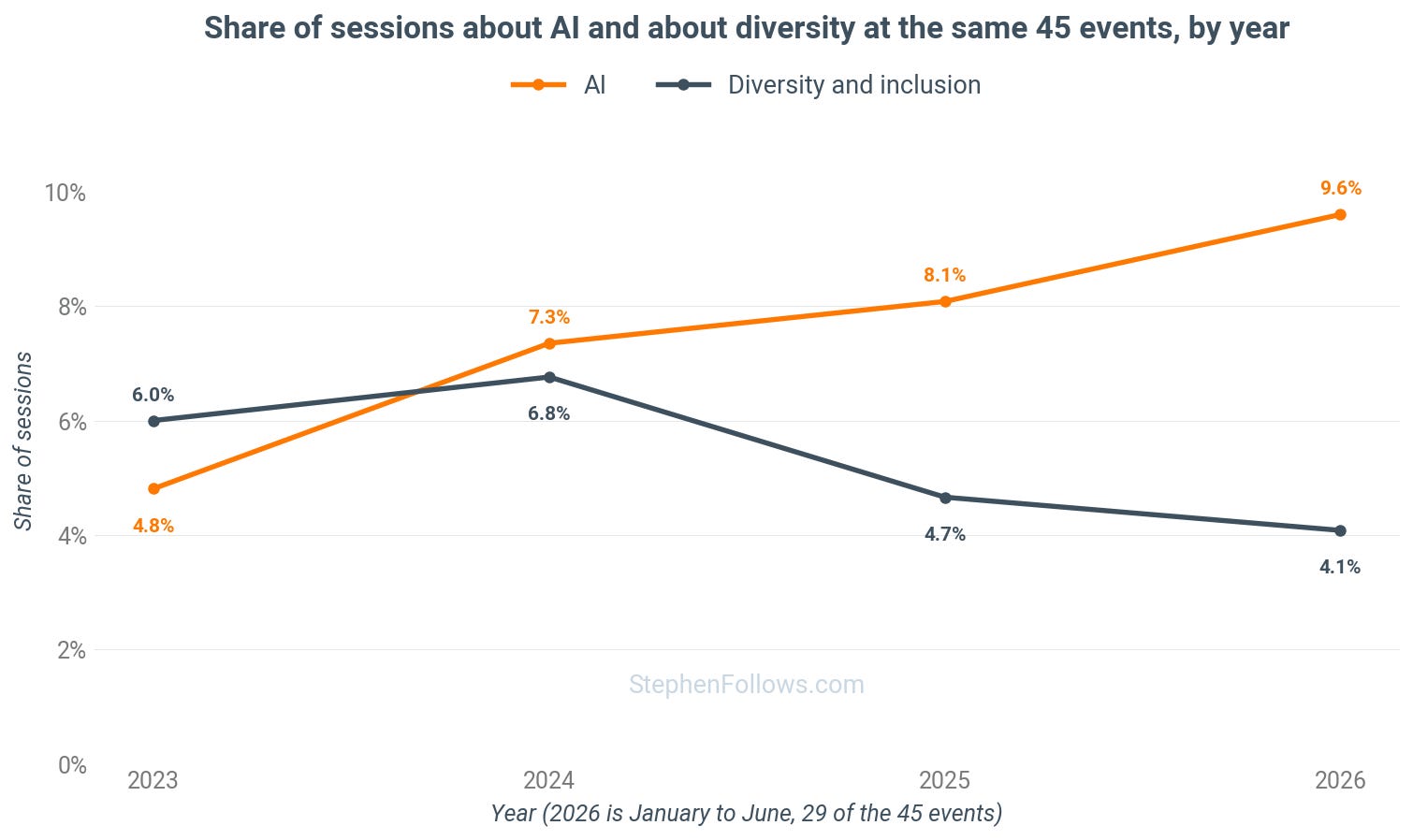
Over the same two years, diversity and inclusion fell from 6.0% to 4.7%. In 2023, diversity and inclusion was the bigger subject of the two, but by 2025 AI was 1.7 times the size of diversity.
The timing of the diversity drop is hard to ignore. From late 2024 a run of large American companies scaled back their diversity programmes, and the 2025 conference season was the first programmed after that.
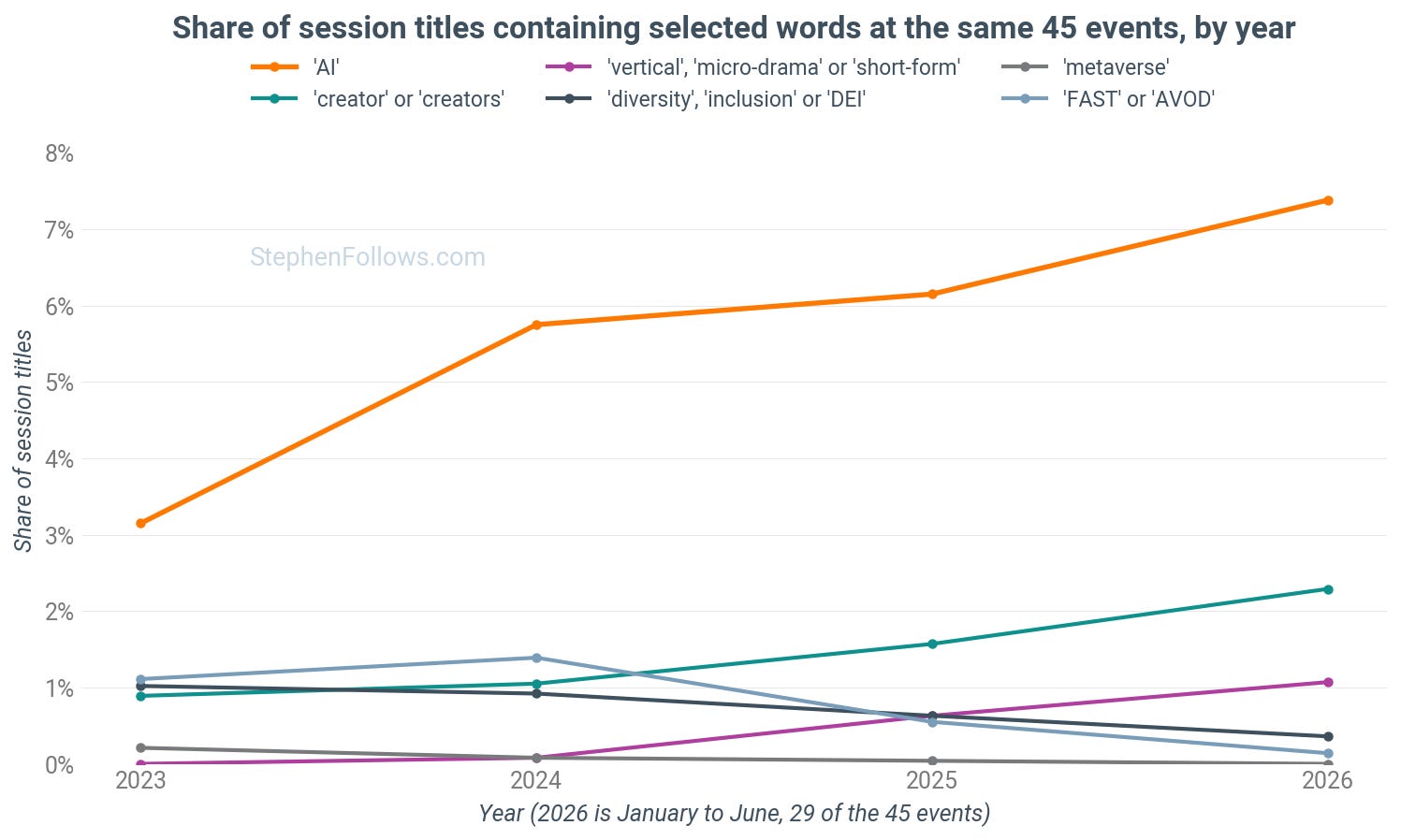
By looking at the words in session titles, we can track the day's hot topics. In recent years, we’ve seen a rise in sessions mentioning ‘AI’, ‘vertical’, and ‘creators’, and a comparable decrease in ‘diversity’, ‘metaverse’, and ‘FAST’ or ‘AVOD’.
What I learned
In the end, I concluded that while the speakers do seem to change, the moderators tend to be drawn from a small pool of seasoned professionals.
I asked some of those regulars what makes for a great film industry event. Two of them, without knowing the other had, started in exactly the same place.
Wendy Mitchell, a podcaster, moderator and film festival curator, told me:
I think what’s most important is knowing who is in the audience. Is it people moving from shorts to features, or is it CEOs? When I curated industry talks for Sundance London, we knew our industry attendees were more likely to be newcomers to the industry so we tried to curate sessions like speed meetings with agents, or talks about how to hire a lawyer for the first time. At San Sebastian’s Creative Investors’ Conference, we know the audience is really top-level, so we curate more discussions tailored to how thought-leaders in the industry are seeing the nuance of the current marketplace and the future of the business.
I also always encourage speakers to offer specific details and numbers, as that always brings the discussion into focus for an audience. Saying ‘we work a lot with debut feature filmmakers’ doesn’t illustrate the point as much as saying ‘Of our development slate, 8 out of our 12 projects are with debut feature filmmakers.’ Talking budgets and numbers (and even profits and losses) also really helps demystify the industry.
And being honest with hard truths is helpful. I recently moderated a great co-production panel at the BFI London Film Festival, and top producer Rodrigo Teixeira (Paper Tiger, I’m Still Here) was asked by an audience member how they should write an email to him pitching a feature by an unknown director -- and he was very candid to say that unless a mutual contact has introduced them, he’s probably not going to read the email or give it much thought. It might be hard to hear but that’s the real world of someone working at his level of Oscar-winning films, and I think that’s the kind of honest talk emerging filmmakers need.
Roberto Stabile of Cinecittà made the same point, and went further:
To make a great industry event, it’s important to choose the topics (new, up to date, not the same discussion already seen everywhere) and the right speakers (a good mix, like in a cocktail). It’s also very, very important to choose the audience. You must know exactly who sits in the audience. The choice of the audience is more important than the choice of speakers.
It’s also good if the speaker keeps their eyes and feelings on the audience. Don’t give a cold lesson like a professor. Empathise with the audience, try to keep their attention awake and make them feel like you’re speaking to each one of them and not to the multitude. They are the protagonists, not you.
AC Coppens, who runs the innovation agency The Catalysts and works across tech and media as well as film, compared a good event to a good film:
A great film industry event works like a great film: find a core narrative hitting the nerve and guide the professionals through a journey. Here are some key points from my end:
NEW, NEWER, NEWEST STUFF: hit the nerve. Program the question everyone talks about at the bar... and not the same topic as last year’s. Book new voices, and especially younger voices if you want to talk about the future… Regulars get rebooked for safety (fair enough). Use the safety net but pair these seasoned voices with new ones systematically.
REAL STUFF. Have the true makers on stage! CEOs bring the market overview of course but the craft people also bring real insights and true stories. Also, from a business perspective, C-level are often men in the industry so going C-1 would help for more diversity with no loss of quality at all.
DIVERSE ANGLES: Diversity everywhere increases richness of perspectives. An AI white manel about business and a diversity panel with 5 women incl. women of color always repeat the same story. Also voices from other industries are interesting as we have a heavy convergence, specifically with AI.
INTERACTIVITY: Involve the audience, heavily! Let them talk, let them come on stage if there’s an empty chair, give time for questions and even more for focussed networking. Mix the formats. Stop the panel-mania with 5-6 speakers plus moderators for a 30mn conversation just because you had to place some of the big names, regulars or sponsors.
CONNECTING THE DOTS: partner with other festivals, and (gladly ;-) book the hosts and moderators keeping the conversations connected throughout the festivals and the year, which makes sense to transfer knowledge.
And Evan Shapiro put the whole circuit in money terms:
The epiphany I had is that all conferences are basically B2B marketing expenditures - and when you add them up, the b2b marketing ecosystem is a lot bigger than anyone realizes.
Notes
I built my database from published programmes of 412 recurring film and television industry events, from official event sites, speaker pages, press releases, and the wonderful Internet Archive. It covers editions held between 1 January 2023 and 30 June 2026.
By type, the events are 192 festival industry programmes, 91 standalone conferences, 68 markets, 22 technology shows, 22 cinema exhibition conventions and 17 summits. A few sit at the edge of ‘film industry’, such as the entertainment track at Cannes Lions or broad creative-economy summits in Cairo and Lagos. They are small and leaving them out changes no figure in this piece by more than a rounding.
An appearance is one person billed in one session. A person billed twice in the same session counts once. By role, 59% of appearances are as a panellist, 14% as a presenter, 14% as a moderator, 4% in conversation, 3% leading a workshop, 3% giving a masterclass, and 2% as a keynote. ‘Speaking slots’ in the concentration analysis means every role except moderator. Names were matched across events conservatively. I kept people with the same name at different employers in the same year separate, and merged spelling differences only when the two records shared an employer or an event.
I’m in the database myself five times, but none as a moderator.