


I would guess most film production professionals think they can quickly gauge a film's budget range from just a few scenes. Tell-tale signs such as sets, crowds, and complicated setups hint at what the production had to work with.
However, there are some limitations to this:
Visual effects make it easier than ever to extend sets, duplicate crowds, change skies, paint out errors, and generally make what appears on screen a poor reflection of what the film crew experienced on the day of shooting.
Creative ingenuity can make the “impossible shot” possible, as can clever use of limited resources. Gareth Edwards made about 250 effects shots in Monsters himself in After Effects on his laptop.
Non-financial support comes in all forms and can include locations, vehicles, and famous names. If one of the producers owns a mansion and is willing to let a film crew trespass through its many halls, the film will look far more expensive than the budget suggests.
Humans are overconfident. I am very sure of this because I’m an expert at this.
So how much can we detect about a film’s budget just from what we can see and hear on-screen?
I set out to find out. I crunched the numbers on 5,219 movies and ended up being able to explain 56% of the differences between budgets.
A longer explanation of what I did appears in the Notes section at the end of the article. The short story is that I measured what a viewer can see and hear for 5,219 live-action features. Visually, this includes edits, shots, faces, locations, and time of day. Audibly, it includes speech, music, gunfire, and explosions. For a narrower group of 1,626, I also have the screenplay, so I could see how much we can learn just from the page.
I adjusted the budgets to 2026 dollars and used all the data points to predict each film's reported cost. By 'share of the differences explained,' I mean how much better that prediction does than guessing the same typical budget for every film. A result of 0% would be no better than guessing, and 100% would predict every budget precisely.
What are the most useful data points?
Let’s start very general. According to my data, if we know only a film’s genre, year and country, then we can explain 30% of the differences between budgets.
We can get a much better prediction of 56% if we look at on-screen elements (more on this shortly). Interestingly, adding a full script to the mix adds only one more percentage point, taking it up to 57%.
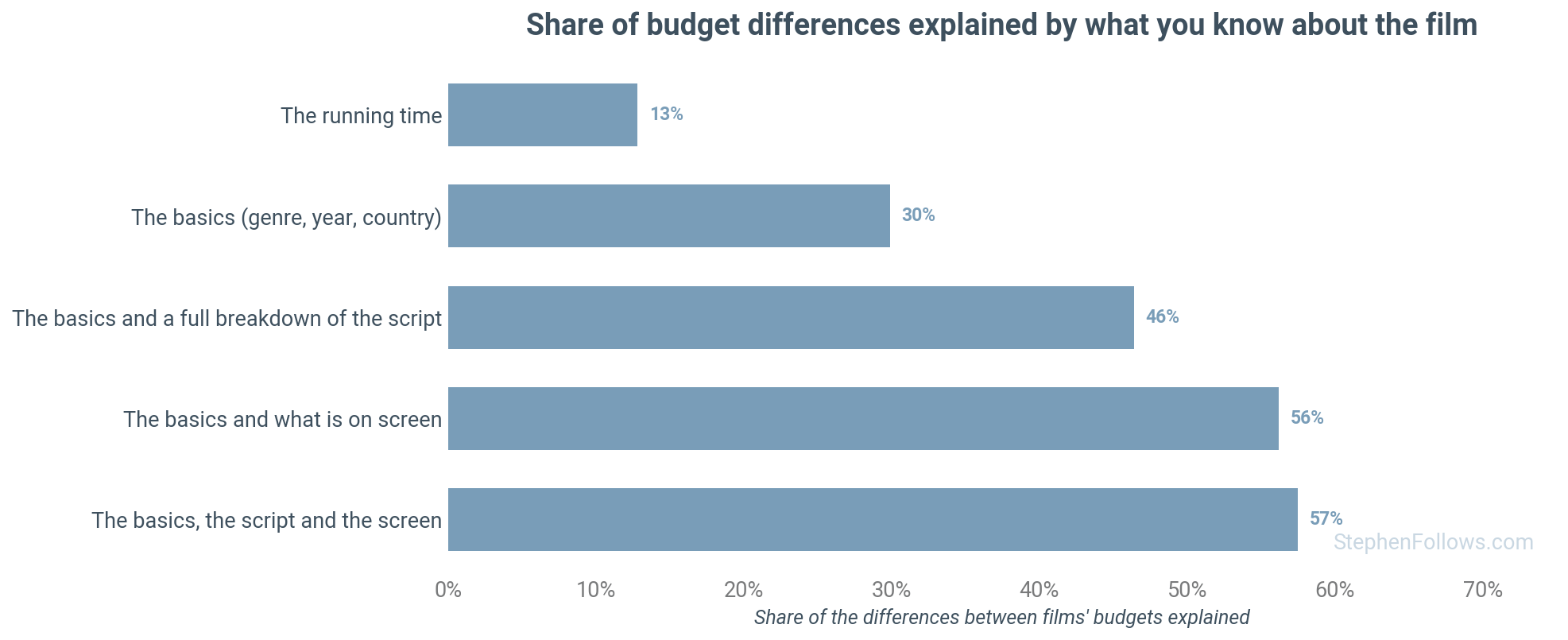
Another way to read this is that even with everything included, more than two-fifths of the differences between budgets can't be seen or heard.
What are the expensive on-screen elements?
To test each element in isolation, I compared a film in the top tenth for it with a typical (median) film with the same basics (genre, country, and year) and script breakdown. This is what you learn from watching the film, in addition to what is already written on the page.
The strongest individual factor was running time. If we compare two movies (a 136-minute film against a typical 109-minute film) with the same script breakdown, then the longer one goes with 54% more budget.
The next most budget-affecting factors were explosions on the soundtrack (they go with 25% more budget), frames crowded with six or more faces (22% more), and wide shots (19% more).
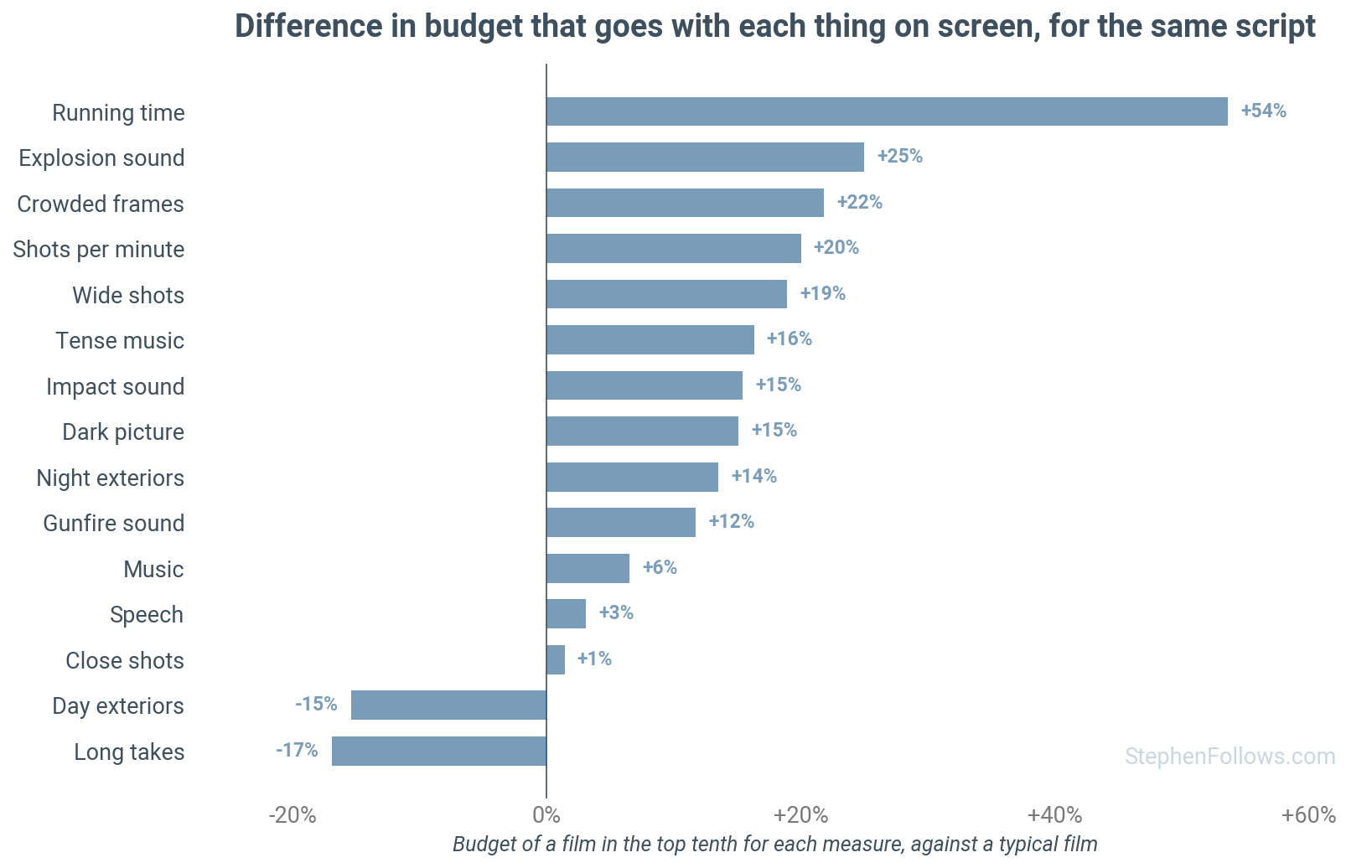
Editing speed tells us something too. Across the 1,626 films, one in the top tenth for shots per minute (19.6, against 12.9 for a typical film) goes with 20% more budget. And films that spend the most time in takes of over 20 seconds go with 17% less. (I looked at the average number of shots in a movie recently).
Darkness shows up as a trackable factor, too. On-screen dark frames are linked to 15% more budget and night exteriors to 14% more, while a movie in the top tenth for day exteriors is linked to 15% less.
How useful are scripts for guessing how the final film will be?
As a byproduct of this research, I measured how much a film script reflects what we see and hear in the final movie.
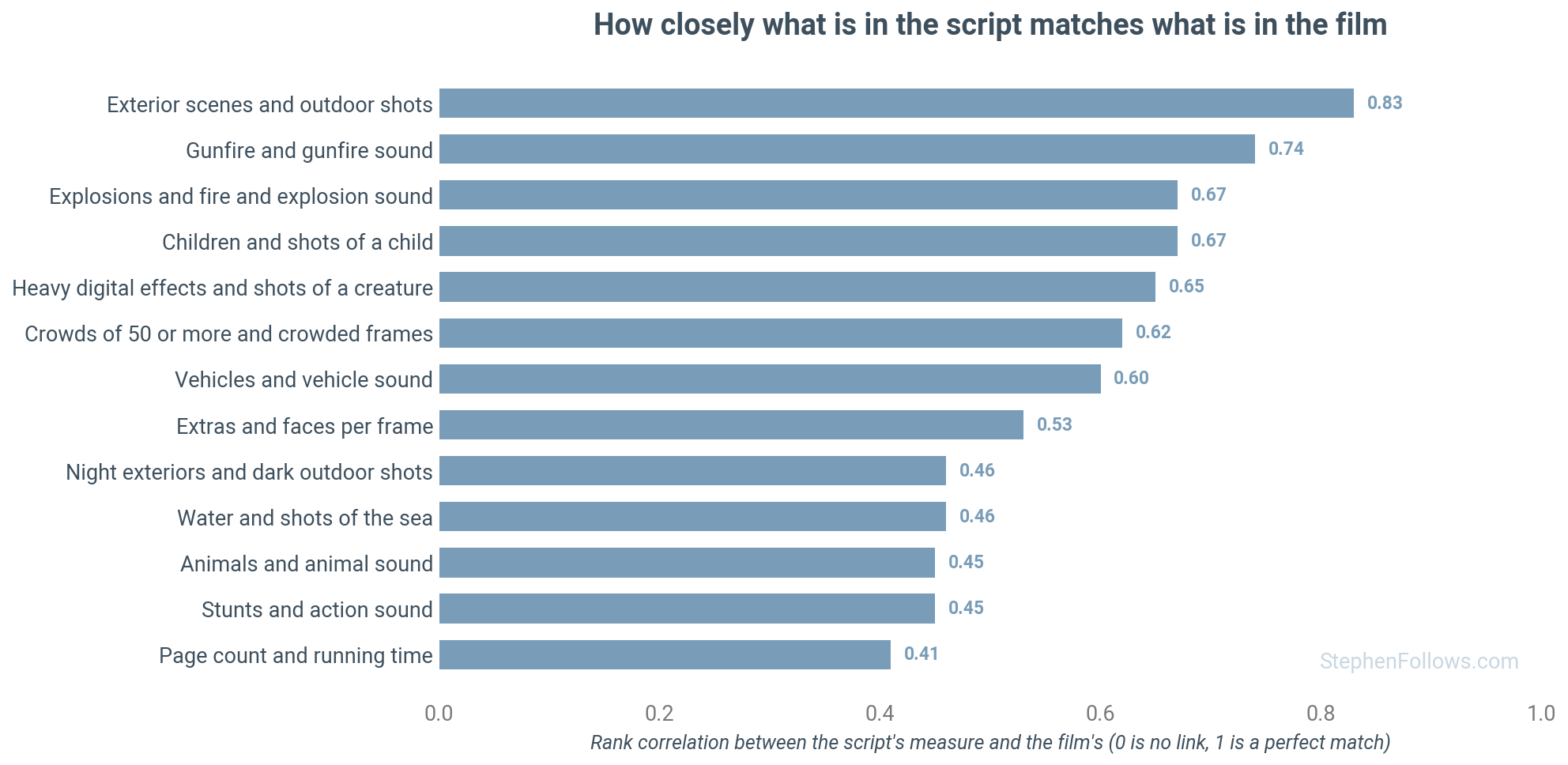
For the 1,626 movies with both a full script and on-screen data, I paired the same factors, measured both ways, such as:
Page count and final running time (I also looked at this in more detail in a past piece called Does one page of a screenplay really equal one minute of screen time?).
Descriptions of explosions and the sounds of explosions in the audio.
Scenes described as exteriors (i.e., EXT) and those that appear to take place outside.
Ten more pairs, all shown in the chart below.
A score of 1 would mean the films fall in exactly the same order on both, so the script would rank them perfectly by how much of each thing ends up on screen. A score of 0 would mean no link at all, so one tells you nothing about the other.
Across those films, scripts and films agree most on where things happen (0.83 for exteriors) and on gunfire (0.74). Explosions, children, heavy digital effects, crowds and vehicles all score between 0.60 and 0.67.
Which films fool the eye?
What breaks this model is as revealing as what the model tells us overall.
If we were to be highly reductive and judgmental, then we might conclude that there are two approaches to how much we want the audience to be aware of the scale of the budget:
The ‘Art’ pov. We don’t want the audience to think about this as a movie but instead be transported into the lives, wants, and conflicts of our protagonist. Therefore, we want “invisible” CGI and no splashy set pieces that remind you they had to do things in the real world to achieve this illusion.
The ‘Commercial’ POV. We’ve paid for these sets and effects, so we want to damn well see ‘em! This prioritises large set pieces, massive sets, and an opulent display of cinematic wealth, all with bright lighting to make sure you’ve seen it all.
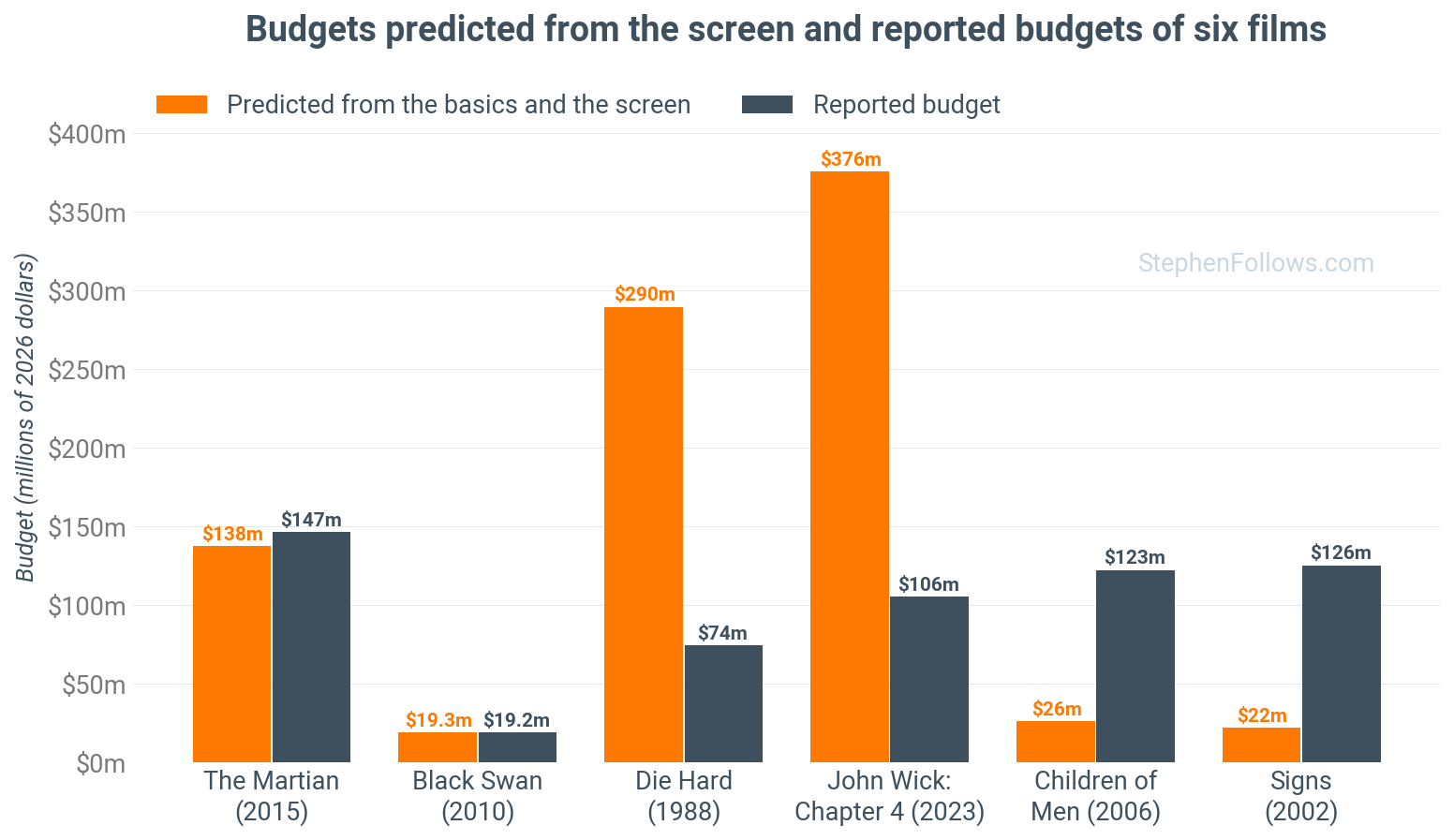
When we look at the data, we can pick out films that fall into either camp. Children of Men used its big budget ($76 million in 2006, or $123m in today's money) to tell a small personal story.

The film has 4.1 shots a minute, fewer than 99% of the films, and spends 58% of its running time in takes of over 20 seconds, which, for most films, is the mark of a small production. Ironically, it was exactly those long takes which added to the cost. VFXWorld reported at the time:
The director also favored extremely long takes - there are no more than 460 shots in the final cut. For lead visual effects vendor Double Negative, London, this approach implied the creation of more than 160 “invisible” effects shots of the highest complexity.
So this very thing that makes it look cheap (by my measures, at least) was hiding some of its most expensive elements. When we track what’s on screen, it looks like a budget of just $26 million, against the $123 million it was reported at (both in 2026 dollars).
On the other hand, John Wick: Chapter 4 takes a similar budget ($106m in 2026 dollars) and delivers what appears to be a movie with three and a half times its budget.

Expensive names
A major cost of making a movie is the above-the-line cost, led by the top acting names. For 3,401 films released since 1999, I looked at how famous the best-known of each film’s first four actors was in the year before it came out.
Films with a top-100 star were reported at 4.6 times the budget of films with no one in the top 1,000, in the same genre, year, and country. On screen, they look only 1.7 times as expensive. So the reported budget is 2.7 times higher than the screen can account for.
And this rises with fame. With a star ranked 101 to 500, the reported budget is 2.9 times as big, and the film looks 1.4 times as expensive. Between 501 and 1,000 it’s 1.8 times and 1.3 times.
In the chart below, each film is a dot. The orange dots show a film starring a top-100 star, the blue ones are ones with nobody in the top 1,000, and the grey ones sit in between.
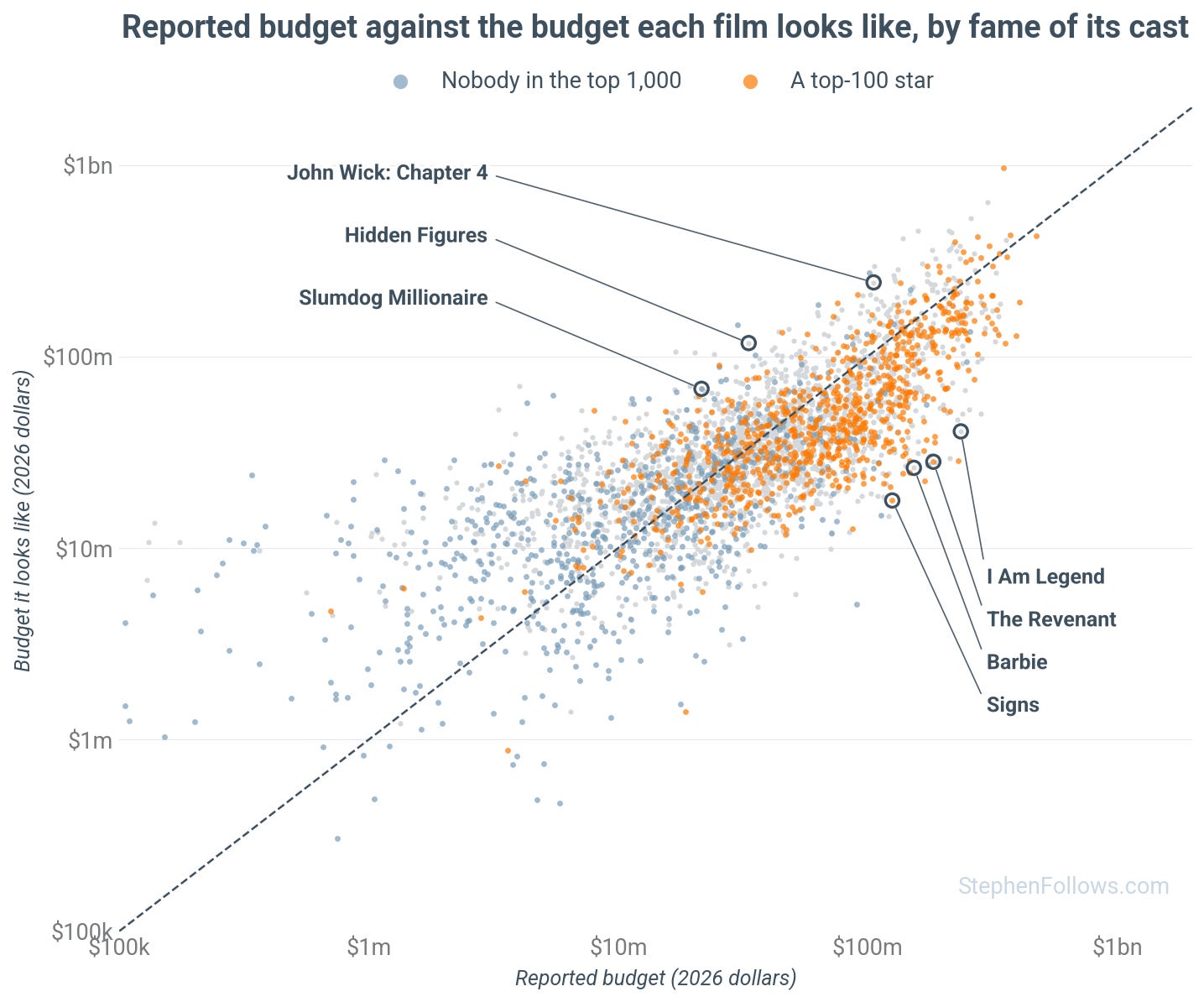
72% of the films with a top-100 star look cheaper than their reported budget, against 39% of those with nobody in the top 1,000. Some of that is just size, since bigger films fall below the line more often, whoever is in them. But the gap holds when you compare films of the same genre, year and country.
The Revenant, with a top-100 star in the cast, looks like a $28m film on a reported $183m. Slumdog Millionaire, with nobody in the top 1,000, looks like $68m on $22m.

What can't the screen tell you?
Many factors that affect a movie's cost are completely invisible to the viewer. These could include:
Tax breaks given for filming in a certain place.
Studio overhead.
The rights to exploit intellectual property.
Development and writing (that’s not to say that spending more time or money won’t help, but just that it’s not visual or audible on the screen.
Music rights
Reshoots, which replace footage we never get to see.
Days lost to weather, illness or broken kit.
Fraud
So the money usually is on the screen. It just isn't all of it, and some films are much better than others at faking the rest.
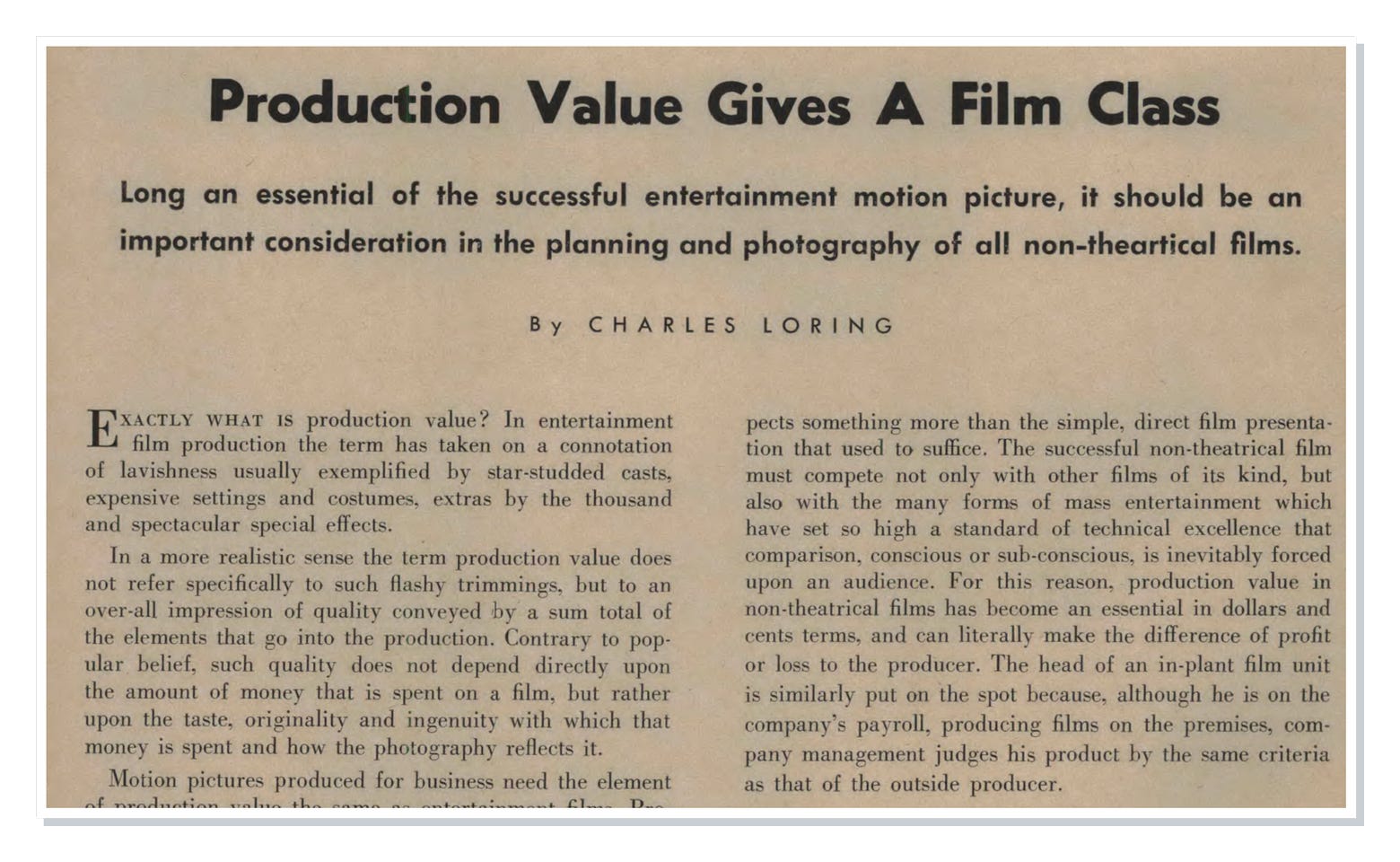
Darrin Scot put it well in a December 1959 piece in American Cinematographer on what ‘production value’ means:
In a more realistic sense the term production value does not refer specifically to such flashy trimmings, but to an over-all impression of quality conveyed by a sum total of the elements that go into the production. Contrary to popular belief, such quality does not depend directly upon the amount of money that is spent on a film, but rather upon the taste, originality and ingenuity with which that money is spent and how the photography reflects it.
Notes
The films I was studying are 5,219 live-action features released between 1916 and 2025, each with a publicly reported budget. Of these, 1,626 also have a produced screenplay matched to them. The scripts that reach the internet lean toward well-known films, and so do the films with a public budget, so we shouldn’t forget this isn’t a random sample of movies.
Budgets come from OpusData, IMDb, and Wikipedia, converted to 2026 dollars. The basics are IMDb genres, a five-year release window, country (US, UK or elsewhere) and whether the film is in English.
For each scene, my breakdown records the location and the characters who speak, whether it is interior or exterior and day or night, and the story elements in it (explosions and fire, stunts, fights, gunfire, vehicles, chases and crashes, aircraft, water, weather, animals, children, extras, crowds of 50 or more, digital effects, practical effects, special make-up and weapons).
The predictions come from regression models on the logarithm of budget. Each film is predicted by a model built without it (five-fold cross-validation, repeated ten times). 'Share explained' is the out-of-sample R-squared. 'Typical miss' is the median ratio between the prediction and the reported budget in either direction.