


Last night I had the absolute pleasure of watching American Graffiti (1973) at the ActOne Cinema in Acton, and then listening to Mark Kermode quiz Walter Murch about how he built its sound.
Murch edited Apocalypse Now and The English Patient, and he wrote In the Blink of an Eye, which is probably the best book there is on film editing. (On American Graffiti he did the sound, and the picture was cut by Verna Fields and Marcia Lucas).
After the session, the three of us chatted, and as Mark had read an advance copy of my article below, he asked Walter to guess how many shots were in American Graffiti.
Walter’s guess was 952. Was he right?
Let’s go down the rabbit hole of editing and find out!
‘How many shots are there in the average movie?’ is a very common question I get asked. So today I’m sharing the results of my studies into the shot counts of 8,770 feature films released between 1930 and 2025.
By the way, some people might say ‘shots’ others may say ‘cuts’. It’s the same thing, in that a sequence with six shots has five cuts between them. Everyone seems to (in some cases strongly) prefer one over another, but whatever we call them, we’re describing the same thing.
How many shots does a typical film have now?
The most commonly quoted industry rule of thumb comes from editor Vashi Nedomansky, who says the average film has around 1,250 shots, and blockbusters often have more than 3,000. His 1,250 is actually a little low for today’s releases, but his 3,000 is about right for the biggest of them.
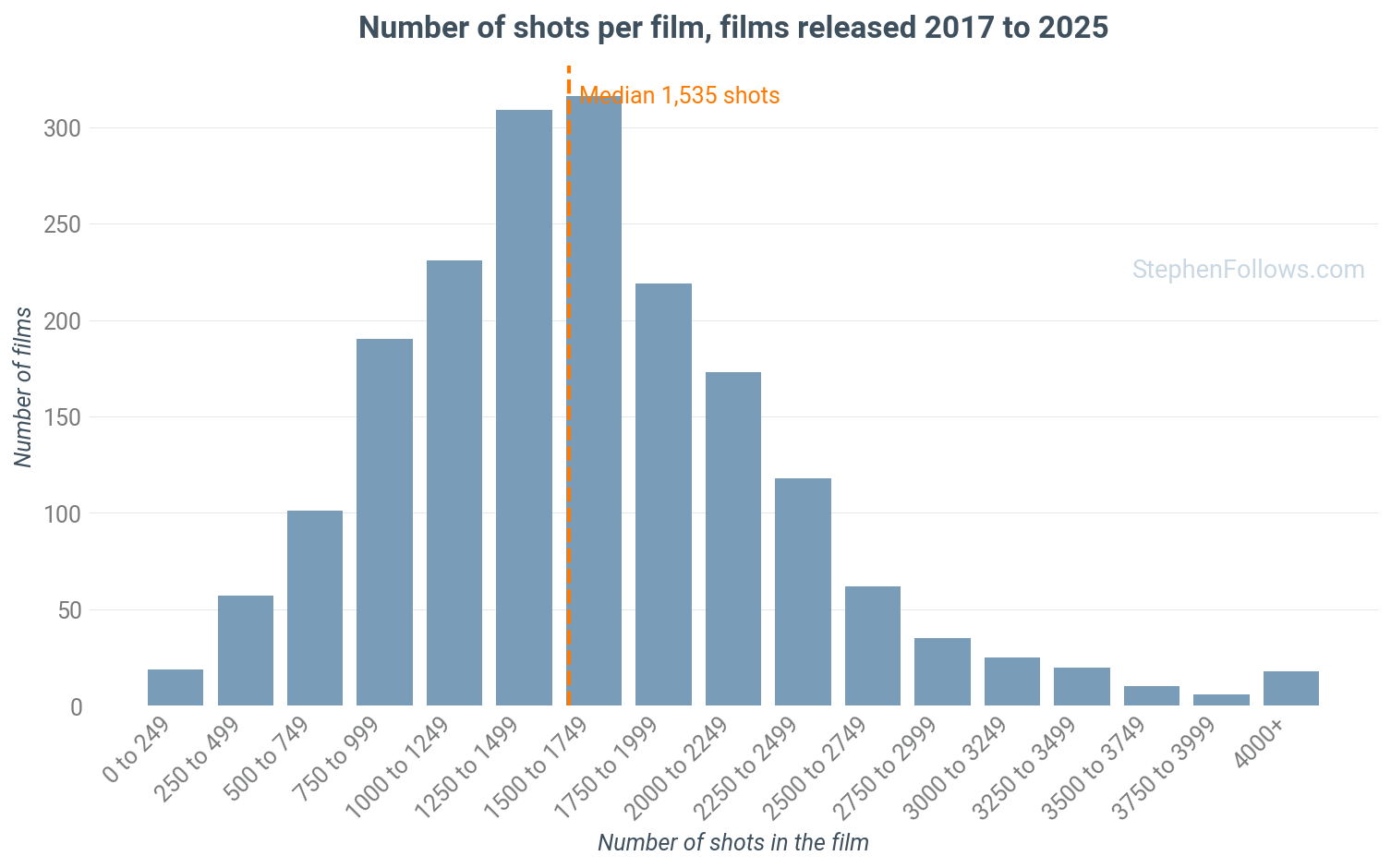
The typical film released between 2017 and 2025 has 1,535 shots. That’s the median (i.e., the film in the middle of the pack), whereas the mean is slightly higher (1,603) because a handful of films with very high shot counts pull up the average.
At a typical length of 111 minutes, that works out to roughly one new shot every four seconds once we take the end credits off. More on the length of movie credits here - Are movie end credits getting longer?
There’s a wide spread around that, as a tenth of recent films have fewer than 770 shots and a tenth have more than 2,460. Put another way, four in five recent films have more than 1,000 shots, and one in four has more than 2,000.
One factor bringing up the average is Indian commercial cinema, which cuts faster than anything else on earth. All fifteen films with the most shots in the last nine years are Indian, led by K.G.F: Chapter 1 (2018) with 6,222 shots in 154 minutes (a new shot every one and a half seconds).
If we leave the Indian films out, then the median for the rest of the world drops to 1,474 and for American films alone it’s 1,515.
So if you want a rough rule of thumb for a typical Hollywood film, then let’s call it 1,500.
How does it differ by director?
You might expect the editor to be the most important factor in the number of shots, but in fact, knowing who directed a film accounts for 70% of the variation in its cutting pace.
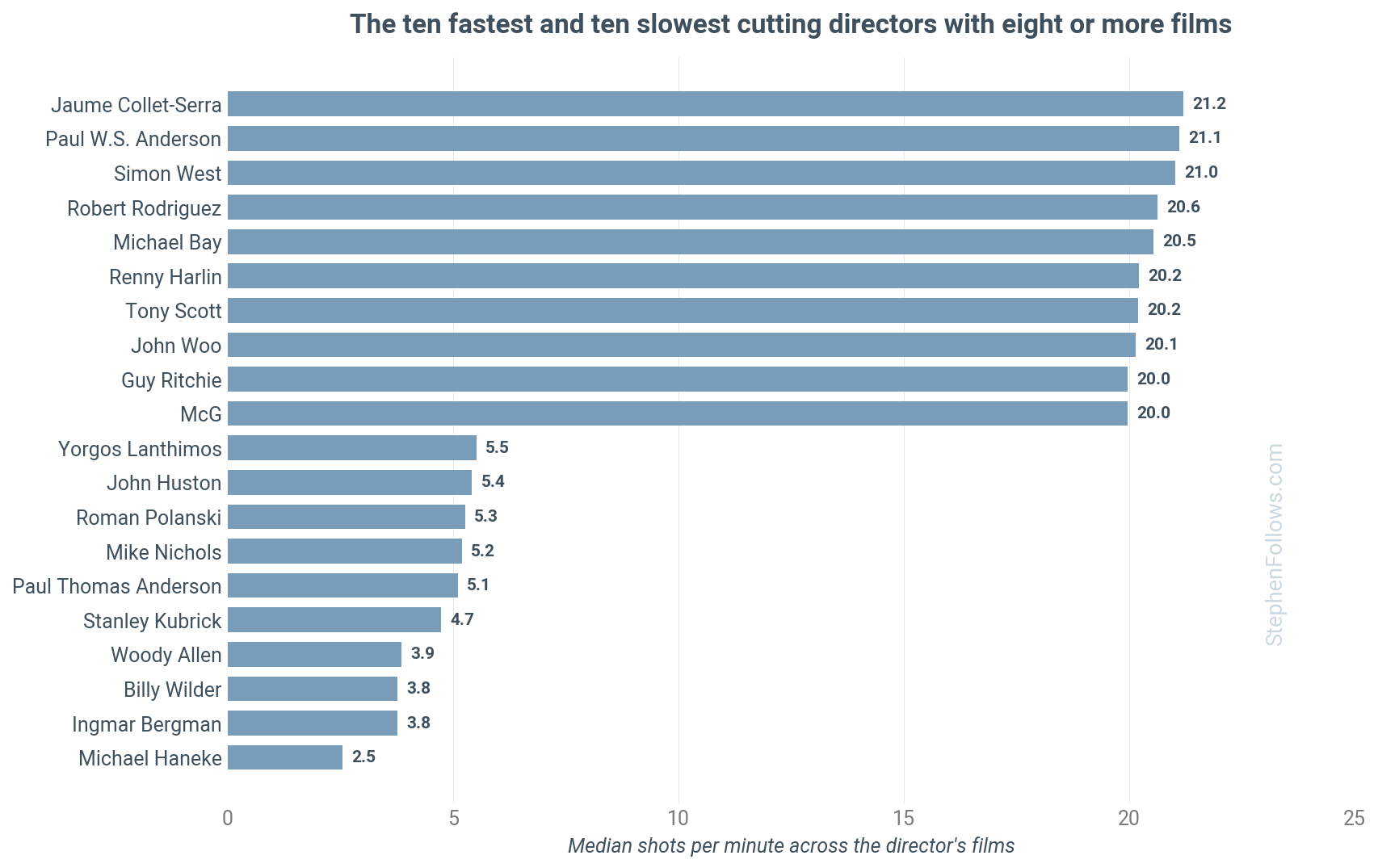
Out of the 120 directors with at least eight films in my data, Jaume Collet-Serra cut the most at 21.2 shots a minute, Paul W.S. Anderson at 21.1, Simon West at 21.0, Robert Rodriguez at 20.6, and Michael Bay at 20.5. That’s a new shot every three seconds, sustained across a career.
At the other end of the spectrum are Michael Haneke at 2.5 shots a minute (i.e. one new shot every 24 seconds), Ingmar Bergman and Billy Wilder (both 3.8), Woody Allen (3.9 across thirty films), and Stanley Kubrick at 4.7.
Do directors know how many shots are in their own movies?
In 2019, Bong Joon-ho told Filmmaker Magazine:
I don’t shoot a lot of shots. Other than Snowpiercer, none of my films have gone over a thousand shots.
He’s absolutely right. His first four features have 580, 772, 891 and 753 shots, and Snowpiercer (2013) has 1,171. After that, he made Okja and Parasite, which come in at 1,000 and 1,001.
Given that my detector is only good to within a few %, I’m calling that a win for Bong. (He has since broken his own rule with Mickey 17, which has 1,323.)
When George Miller launched Mad Max: Fury Road in 2015, he told a press conference:
Mad Max 2 had 1,200 cuts. This has 2,700 cuts, and it’s not much longer.
By my count, the older film has 1,344 shots, and the newer one 2,486, and Fury Road is 25 minutes longer. So Miller’s numbers are a bit off in both directions, but he’s right that the 2015 film had close to twice as many shots as the 1981 flick.
How has the shot count changed over a century?
What happened between those two Mad Max films is a microcosm of the last century of cinema. (Not sure of the plural here - Mad Maxes? Mad Maxima? Mads Max? Maximi Insani? Answers on a postcard, please).
The chart below shows the median number of shots per film between 1930 and 2025, with the shaded band showing where half of all releases sit.
Between the 1930s and 1950s, films averaged between 550 and 580 shots. The median started to climb in the 1960s and didn’t slow until the current century. In recent years, the increase has been minimal, sitting at 1,479 for the 2010s and currently 1,559 for the first half of the 2020s.
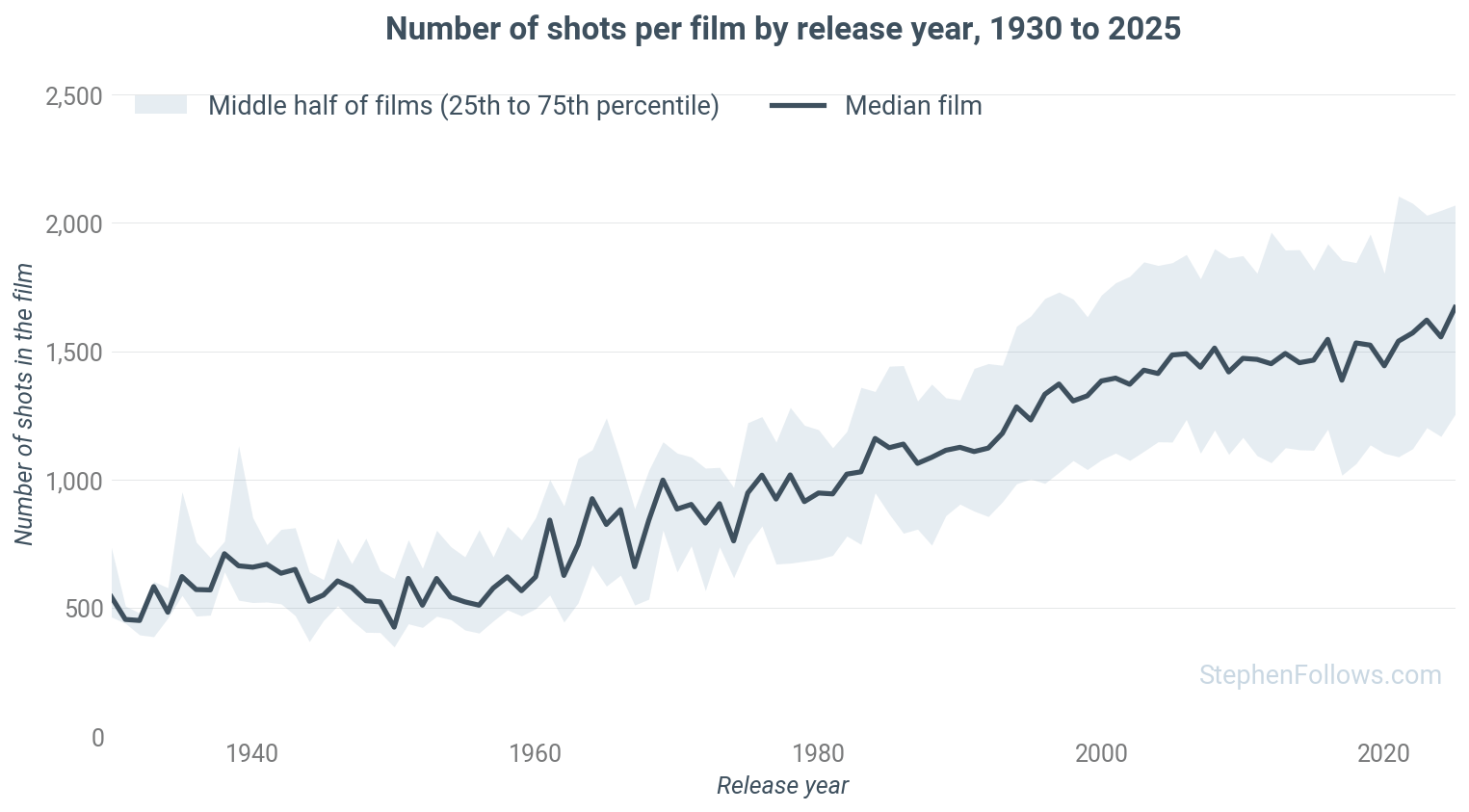
American Graffiti fits neatly on the line. With 906 shots, it’s exactly on the median for 1973 (of the 43 films I have from that year, 21 have fewer shots and 21 have more). If it were released today, 85% of new films would have more shots than it does.
So Walter's guess of 952 was 46 shots off, which is within 5% of my count. Pretty impressive for a film he worked on more than fifty years ago.
So the typical film today has almost three times as many shots as the typical film of the 1950s. However, most of that growth happened between about 1960 and 2005, and the last twenty years look like a plateau with a gentle upward drift.
It’s worth noting that my time series starts at about the slowest moment in film history. As film historian David Bordwell put it in The Way Hollywood Tells It:
In the 1920s, Hollywood films were cut quite fast, averaging four to six seconds per shot, but the arrival of sound put on the brakes.
Some of you may already be thinking - but haven’t movies got longer over that period? Yes, they have (See Are two-hour movies the new normal?) so let’s account for run time.
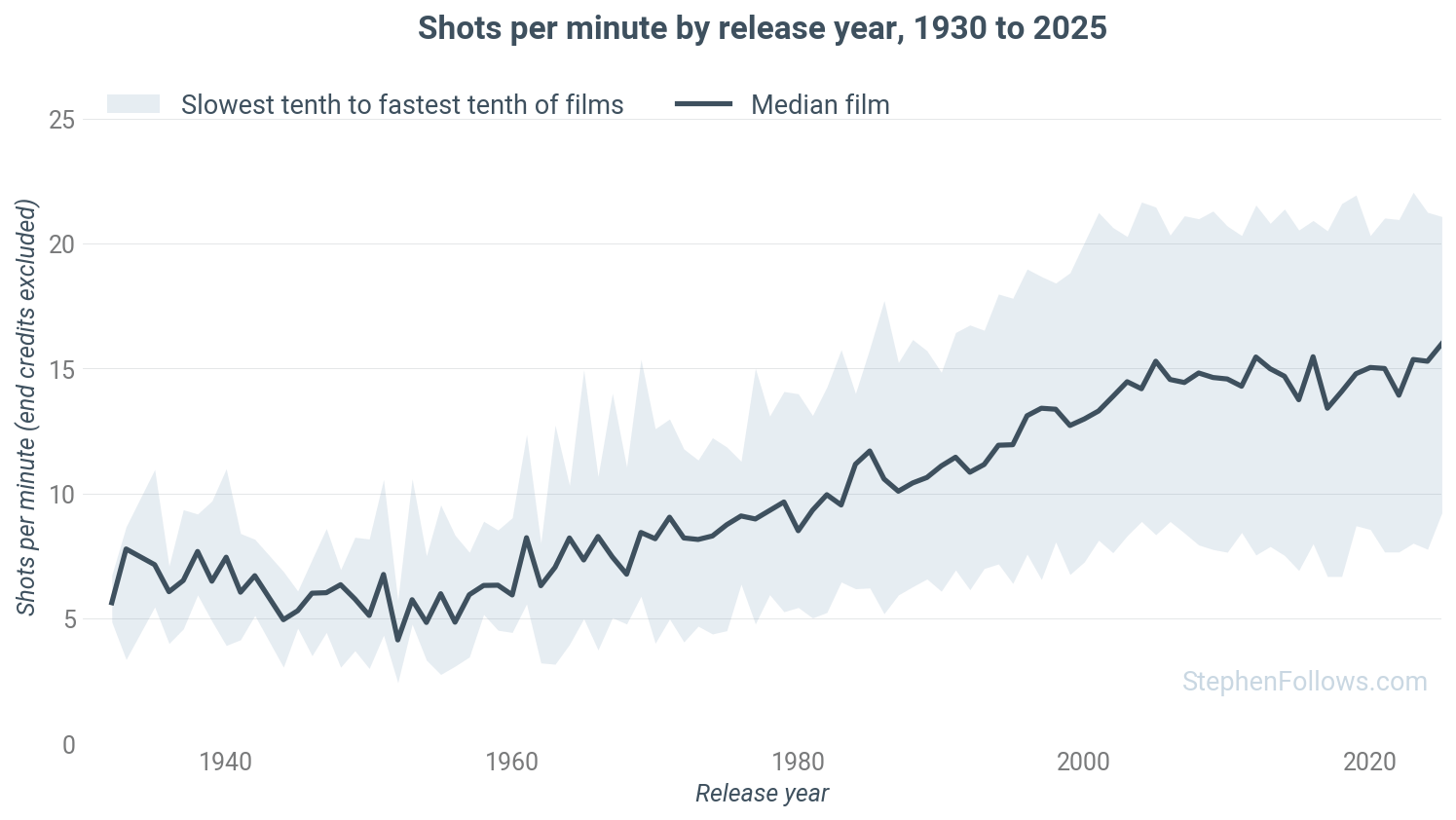
Between the 1950s and the 2020s, the median cutting pace went from under six shots a minute to fifteen. In a 1950s film the average shot lasted about ten seconds, whereas today it lasts a little over four.
Murch has thought about this more than most. In In the Blink of an Eye he wrote:
a convincing action sequence might have around twenty-five cuts a minute, whereas a dialogue scene would still feel “normal” (in an American film) averaging six cuts per minute or less.
Six a minute is where the whole of a typical 1950s film sat. Today the typical film averages fifteen across its full running time, quiet scenes and all.
When Murch was asked in 2015 about the idea that shots keep getting shorter, he said:
I would dispute that concept.
If he was referring to the last twenty years, then he’s right. If he was referring to the much wider period, then the data says otherwise.
Has the gap between fast and slow films widened?
One thing you may have spotted in the previous chart is that the blue band, which runs from the slowest tenth of movies to the fastest tenth, has got progressively wider.
In the 1950s the slowest 10% of movies cut at 3.3 shots a minute and the fastest 10% at 8.6 (a gap of about five shots a minute). In the 2020s the equivalents are 8.1 and 21.1 (a gap of thirteen).
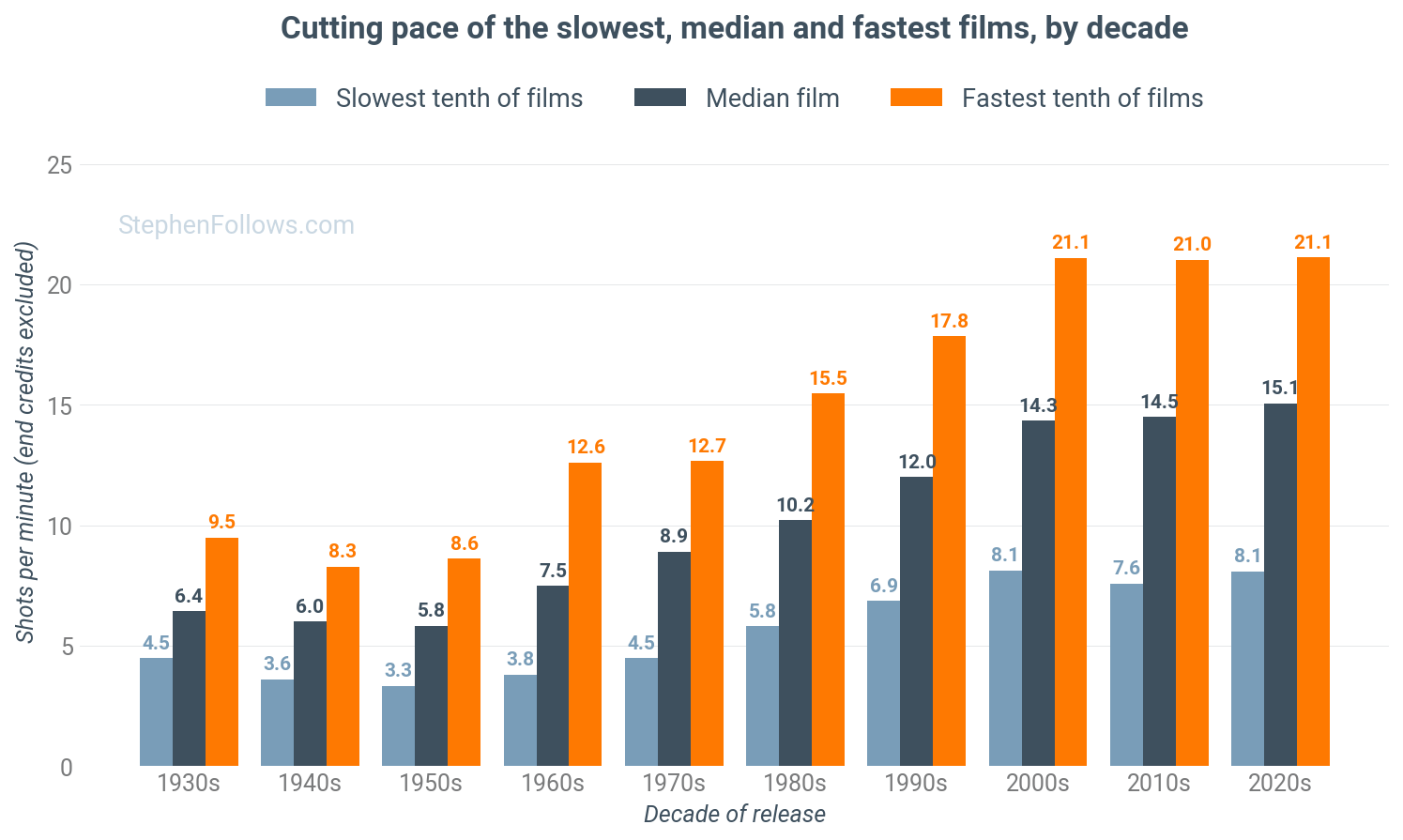
The 2,000-shot film, once a rare aberration, is now a quarter of everything released (27% of films in the 2020s so far, against none in the 1950s).
Which genres have the most shots?
The median action film has 1,927 shots and the median adventure film 1,789. At the other end, dramas have 1,355, horror 1,324 and music films 1,277.
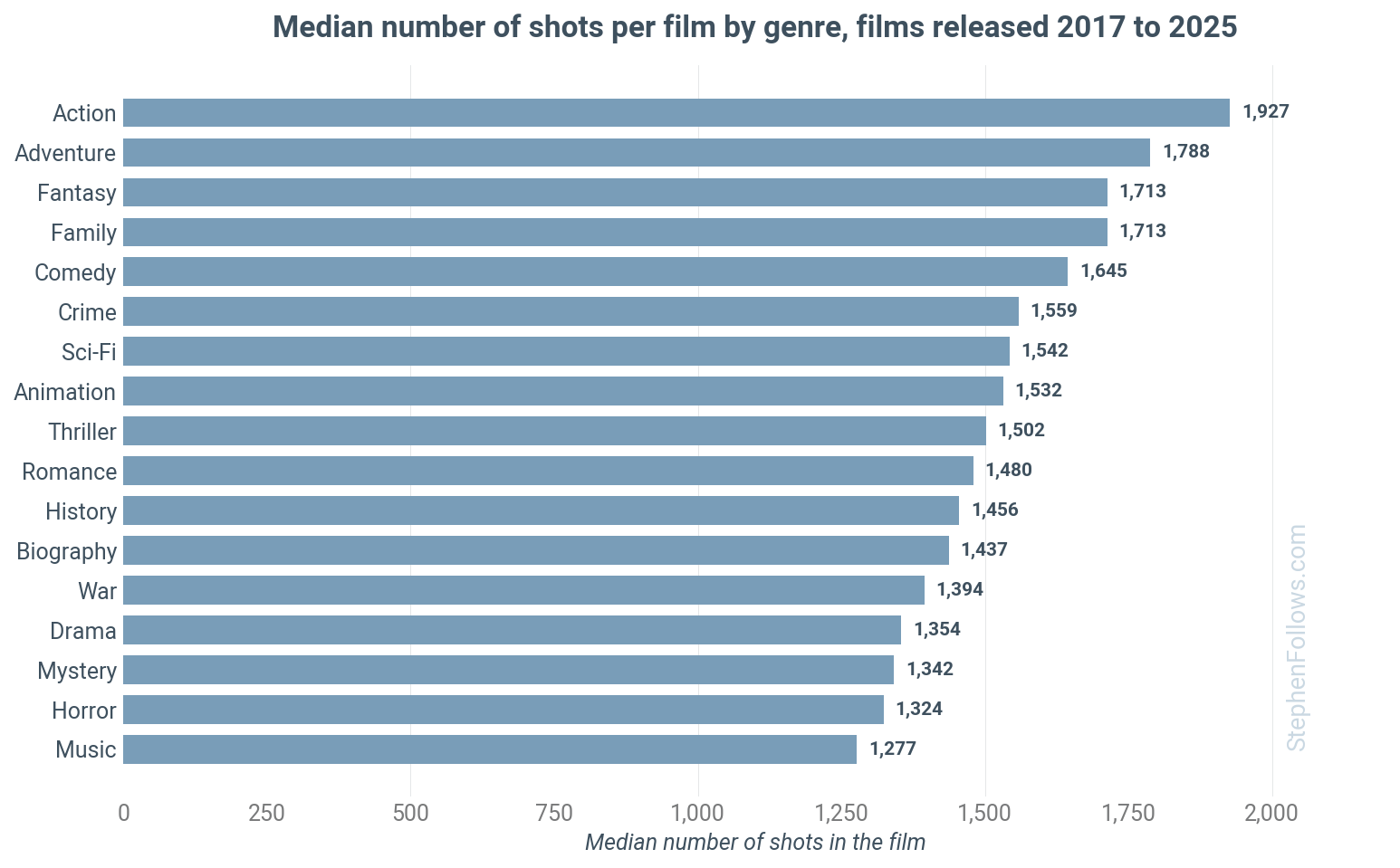
Part of the genre gap is down to length, as action films run longer than horror films. So I’ve redone the same comparison as average shot length (with the credits removed), which is the fairer measure of how quickly the editor is working.
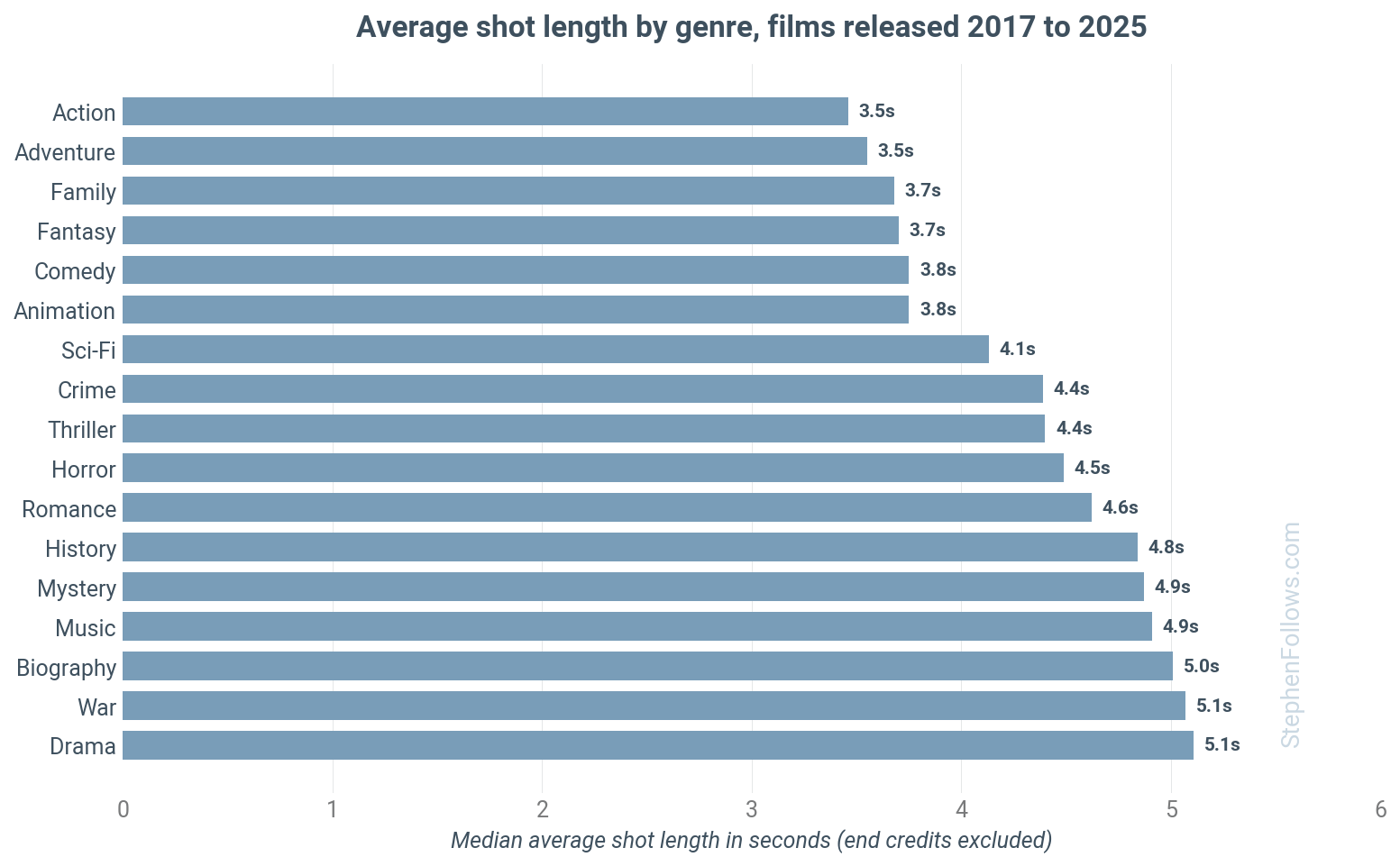
In action and adventure films, the average shot lasts 3.5 seconds, while dramas, war films and biographies hold each shot for about five. By this measure, the genres are closer together than on the raw count, but the order barely changes.
Do longer films have more shots?
Yes, but less than you might think. Across the recent films, running time explains a little over a quarter of the variation in shot count and the rest is style.
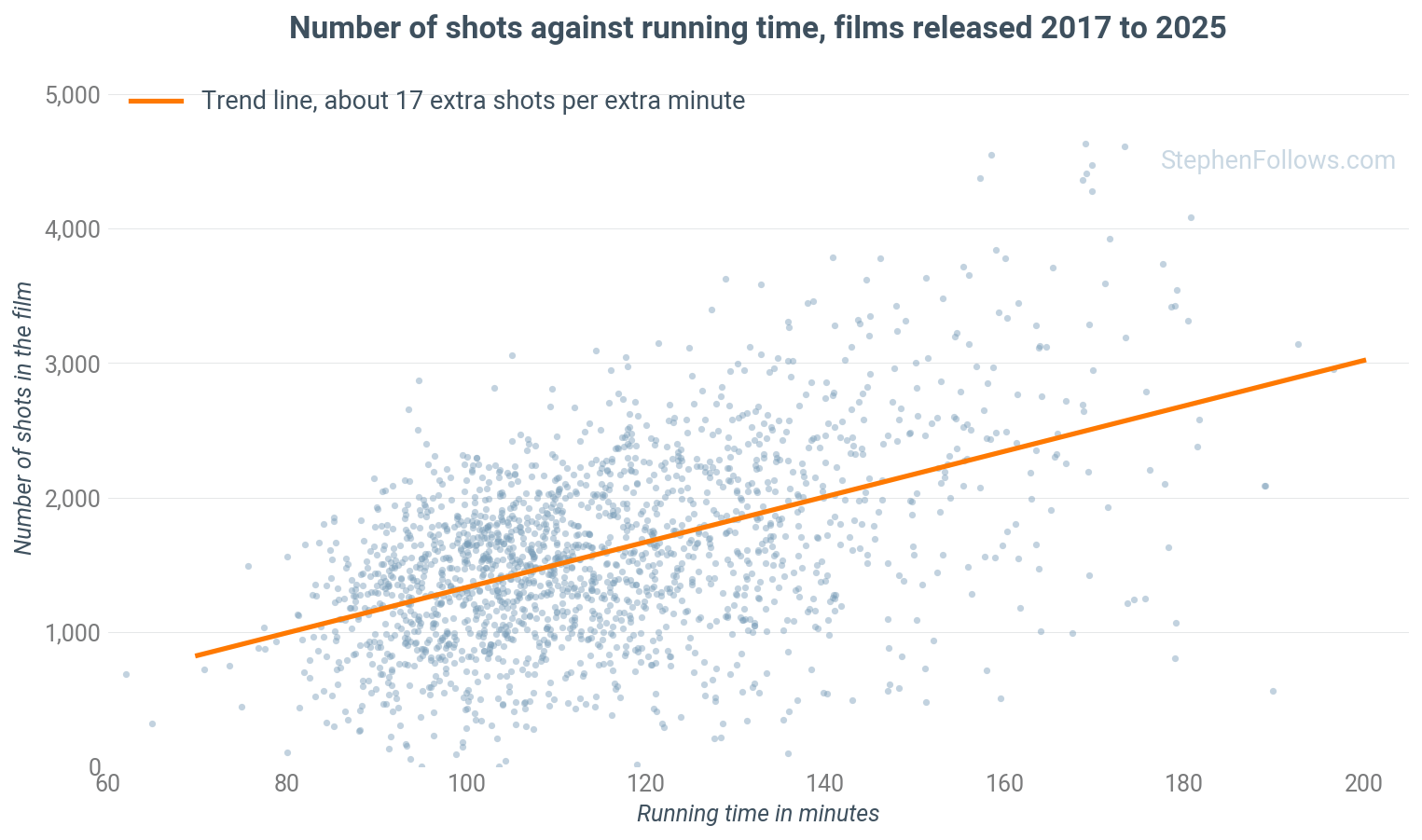
I found that each extra minute of running time brings about 17 more shots on average. A film under 90 minutes has a median of 1,087 shots and one over 150 minutes has 2,549. But look at the scatter at any given length (two films of 110 minutes can have 500 shots or 3,000).
Long films aren’t noticeably cut faster or slower per minute than short ones, and the median pace in every running-time band sits between 12.7 and 15.8 shots a minute. So epics have more shots because they’re longer.
Does money buy more shots?
Yes, and consistently across the 601 recent films I matched to their production budgets. Films made for under $5 million cut at a median of 9.9 shots per minute, whereas films costing $100 million or more cut at 18.0 (almost twice as fast).
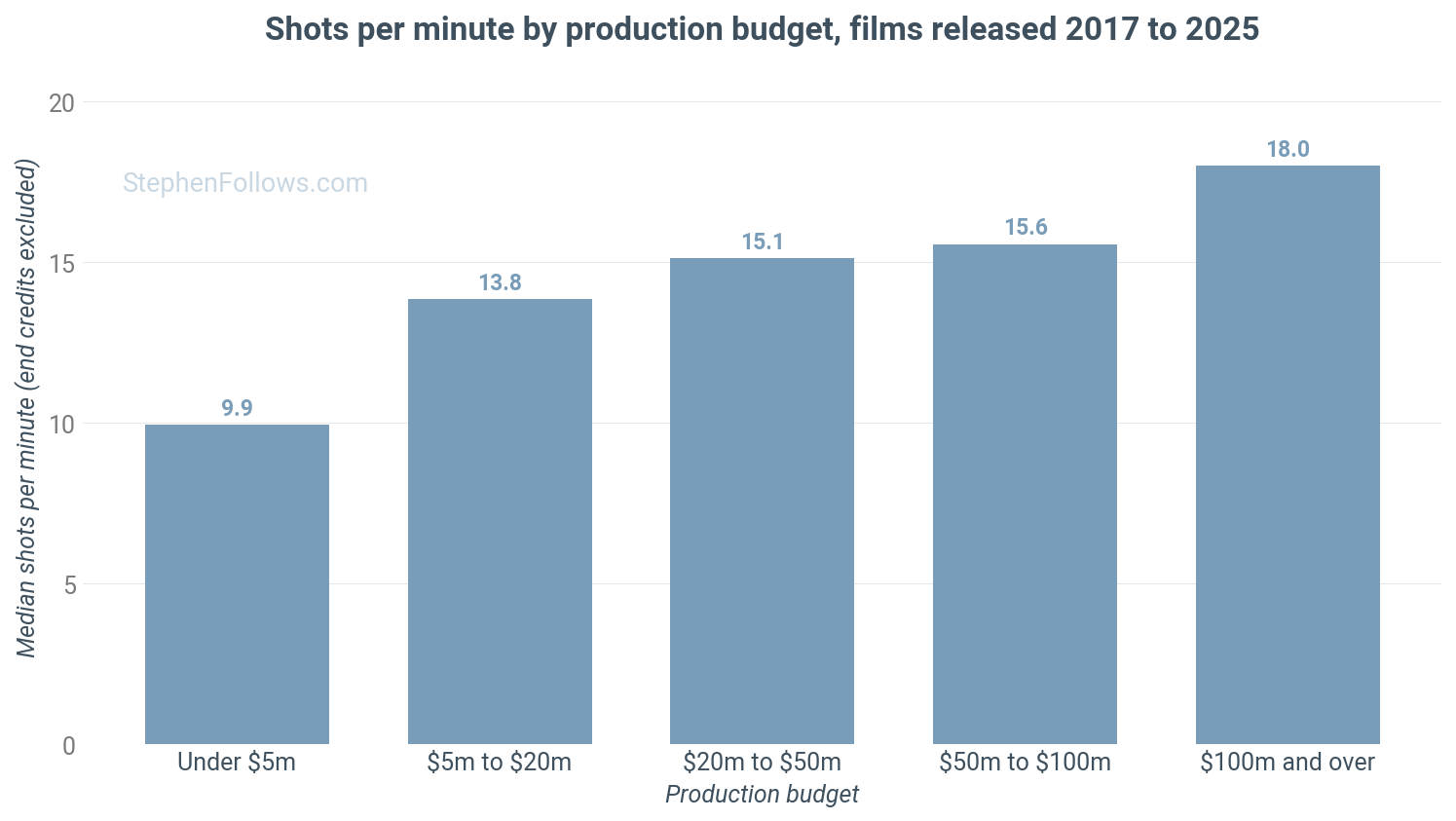
Some of that is genre (expensive films are action films and cheap films are dramas), but that’s not the whole effect. A bigger budget buys more cameras, more set-ups, more coverage, and more time in the edit, and all of that becomes more shots.
Top Gun: Maverick’s editor, Eddie Hamilton, told Deadline that he was handed ‘800 to 814 hours’ of footage, and that on one day in March 2019 there were 27 cameras running at once. Yikes!
The finished film has 2,995 shots and cuts at 24.3 a minute. That’s roughly what Murch said a convincing action sequence needs, but this is the average across two hours!
Do award films cut differently?
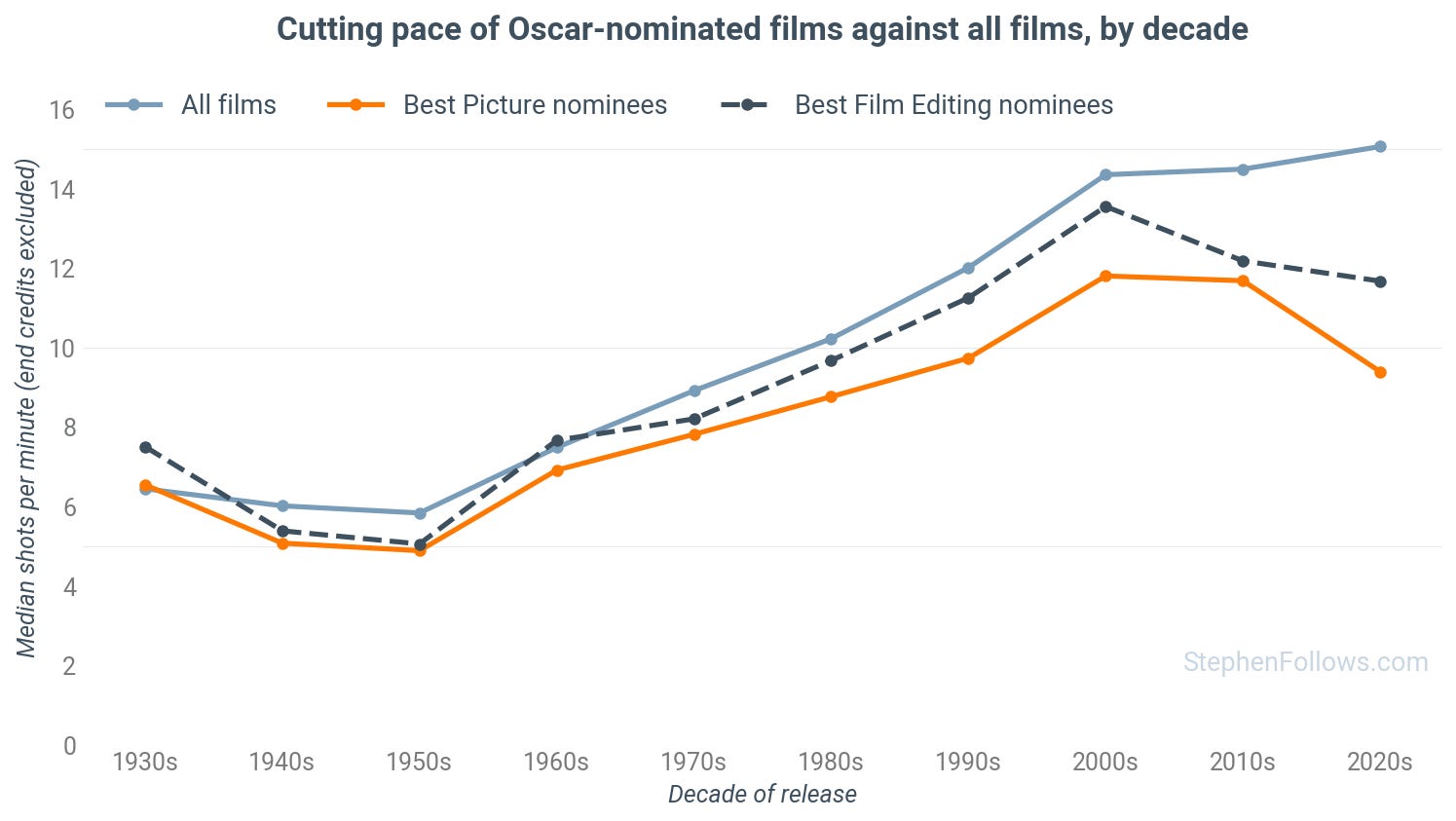
Before we go, one more fun fact - Oscar voters haven’t sped up with the rest of cinema.
In the 1990s, the median Best Picture nominee cut at 9.7 shots a minute, compared with 12.0 for all films. In the 2020s so far, the Best Picture nominees in my data cut at 9.4 against 15.1 for everything else.
The films nominated for Best Film Editing sit in between. They kept pace with mainstream cinema until the 2000s (13.6 against 14.4) and have since drifted back to 11.7 in the 2020s.
Murch’s own verdict on fast and slow cutting, in In the Blink of an Eye, is:
There is no “right” or “wrong” speed, obviously.
I’d go with that. American Graffiti would be one of the slower films in a multiplex today, and at no point last night did I wish for shot number 907.
Notes
A shot here means a continuous run of frames between two edits, so a film with 1,000 shots has 999 cuts. It doesn’t mean a camera set-up, and a scene that returns to the same set-up ten times adds ten shots. Dissolves and fades count as an edit.
I detected shot boundaries for 8,770 feature films using TransNetV2, a neural network built for exactly this job, which its authors report scoring an F1 of 96.2 on the BBC Planet Earth benchmark and 93.9 on the RAI benchmark.
Every figure for the number of shots counts the whole film, credits included, because that is available for every film. Every figure for pace (shots per minute and average shot length) excludes the end credits, using the credits start times I measured for an earlier piece. I have data on 1,276 of the 1,909 recent films and 6,228 of the 8,770 overall, so the pace charts rest on a smaller sample than the count charts.
To check the detector I compared its counts with hand counts from Cinemetrics, the crowd-sourced database in which film scholars and enthusiasts count shots by hand. The detector’s count was within 10% of the human count for 85% of films and within 20% for 96%, with a median ratio of 0.99. It runs very slightly under human counts, by about 1% on films from the 1960s onwards and about 4% on films from before 1960, where dissolves and low contrast cost it some shots. It occasionally overcounts on strobe lighting and very fast camera moves.
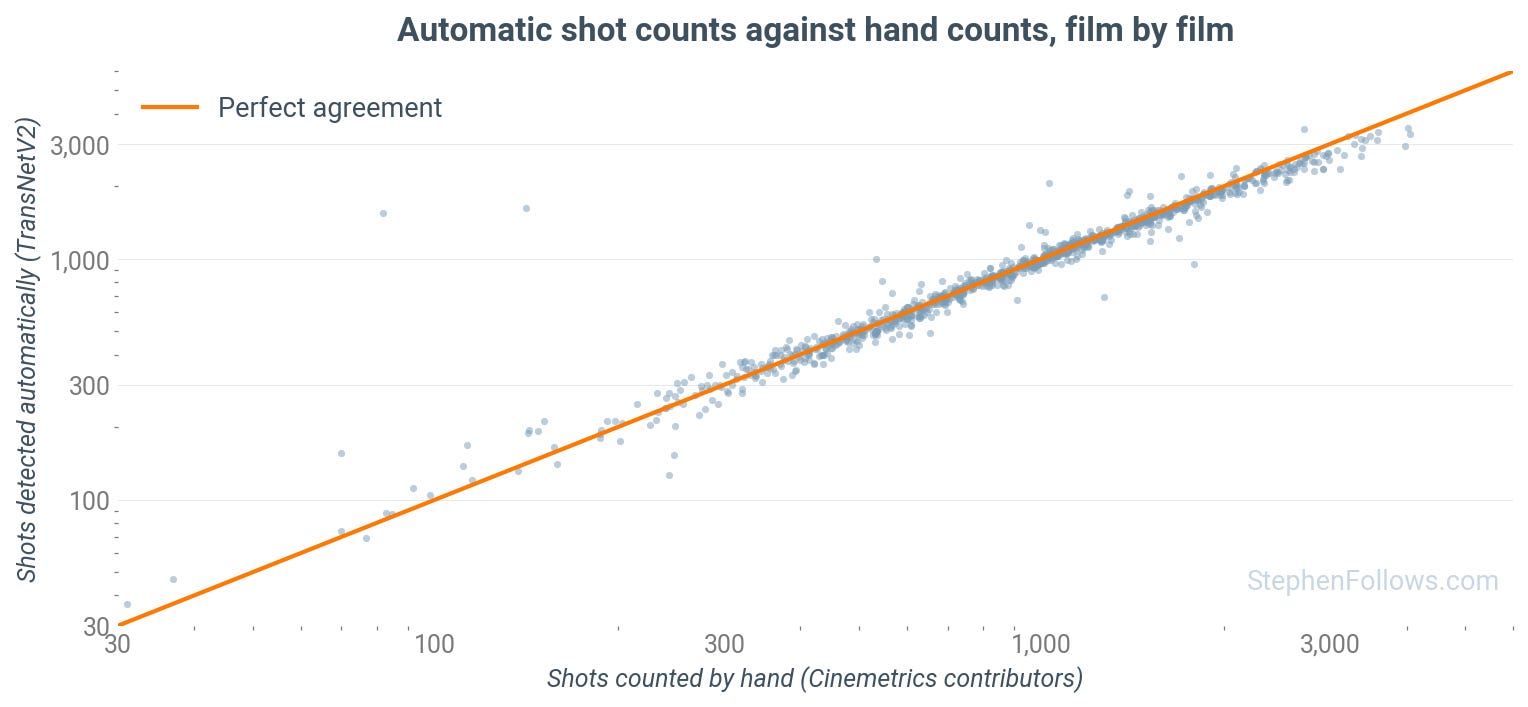
The detector also misses more cuts as films get faster. Against the hand counts it runs about 3% under on films cut at 15 to 20 shots a minute, 7% under at 20 to 25, 10% under at 25 to 30 and 19% under on the eight films above 30. So the figures for the very fastest films and directors are understated, probably by about a tenth. This squeezes the top of the charts but wouldn’t hide a rise, so the plateau since the early 2000s stands.
The comparison with Cinemetrics also says something about who measures films by hand. Its contributors choose what to time, and they lean towards slower cinema. The films they timed cut about 9% slower than the typical film of the same release year in my collection, and 58% of them sit below their year’s median.
Academic samples tend to lean the other way. The studies by Cornell psychologist James Cutting, the most cited in this field, select the most popular films of each year by box office or IMDb rating, so they describe hits, not cinema as a whole. His 2016 study of 210 films puts the average shot at 10.5 seconds for 1930 to 1955 and 4.3 seconds for 1990 to 2015, and says the number of shots per film has roughly tripled since the 1930s. My study, which is larger and less selective, lands in the same place (10.3 seconds in the 1950s, 4.1 in the 2020s, and a count that has grown 2.8 times), which is reassuring for both of us.
Genre comes from IMDb and a film counts under every genre it carries. Budgets and box office come from OpusData, the database behind The Numbers, and the budget analysis uses the 601 recent films with both a budget and a credits time. The director comparison covers the 120 directors with at least eight films in the data as sole credited director. The 70% is the share of the variation in pace across those films that the director accounts for, with no adjustment for genre or year, so some of it is directors choosing their genres.
There's a sweet spot when it comes to concentration/attention. Too many cuts can kill attention just as quickly as too few, because you never get the chance to focus on anything.
I'd love it if more filmmakers attempted the "Spielberg Oner," a one-shot that doesn't call attention to itself and relies on blocking.