


Earlier this year, YouTuber Markiplier released Iron Lung, a $3.6 million horror film he wrote, directed, edited, and stars in. The film went on to gross more than $50 million at the worldwide box office, surprising many in the film industry (and no one on YouTube).
His success reminded me of something I was looking into a few years ago, but dropped the thread on. Namely, how many people have taken on all four major roles in movies before.
I was surprised by the lack of research on the topic so today, I would like to propose a word to describe the phenomenon and take you through the numbers
Meet ‘Egocore’
Here’s my new definition:
Egocore. A feature film where one credited individual is simultaneously a credited writer, a principal producer, the director, and a top-billed on-screen performer (i.e. not a cameo appearance).
My classification was initially inspired by watching movies by the indescribable, incomparable filmmaker Neil Breen. I have seen all of his movies, and I’m still not sure what they’re about or what’s going on. But as outsider art goes, it’s amazing.
To say that Neil takes multiple roles would be an understatement. Across his last seven movies, Neil has received 56.4% of all crew credits.

A few years ago, I attended the packed UK premiere of Cade: The Tortured Crossing at the Prince Charles cinema in London. The audience was so committed to Neil's unique style of cinema that, when the end credits rolled, there were loud cheers for each of Neil’s credits and boos for anyone else.
Neil’s work got me thinking about other filmmakers who were wearing multiple hats on their productions. Few take on as many crew roles as Neil does, so I thought it was best to limit it to people who “just” write, produce, direct, and star in a movie.
I studied 38 million credits across 614,342 movies made since 1940 to find two types of productions:
Strict egocore, where the person took on all three creative roles and was in the top 3 of the cast.
Broad egocore, where they got slightly weaker credits in some respects (e.g., not a full writing credit but ‘story by’, or only an Executive or Associate Producer).
I found 11,827 strict egocore films and 16,492 broad egocore films.
So roughly one in every 37 films qualifies as egocore under the broad definition, or about one in 52 under the strict one. That’s more common than I thought.
The rise of Egocore
Egocore is not a wholly new phenomenon, but it has become dramatically more common.
In the 1940s, about 0.14% of films qualified. By the 2010s, that had risen to 2.19% under the broad definition (i.e. a more than thirteen-fold increase).
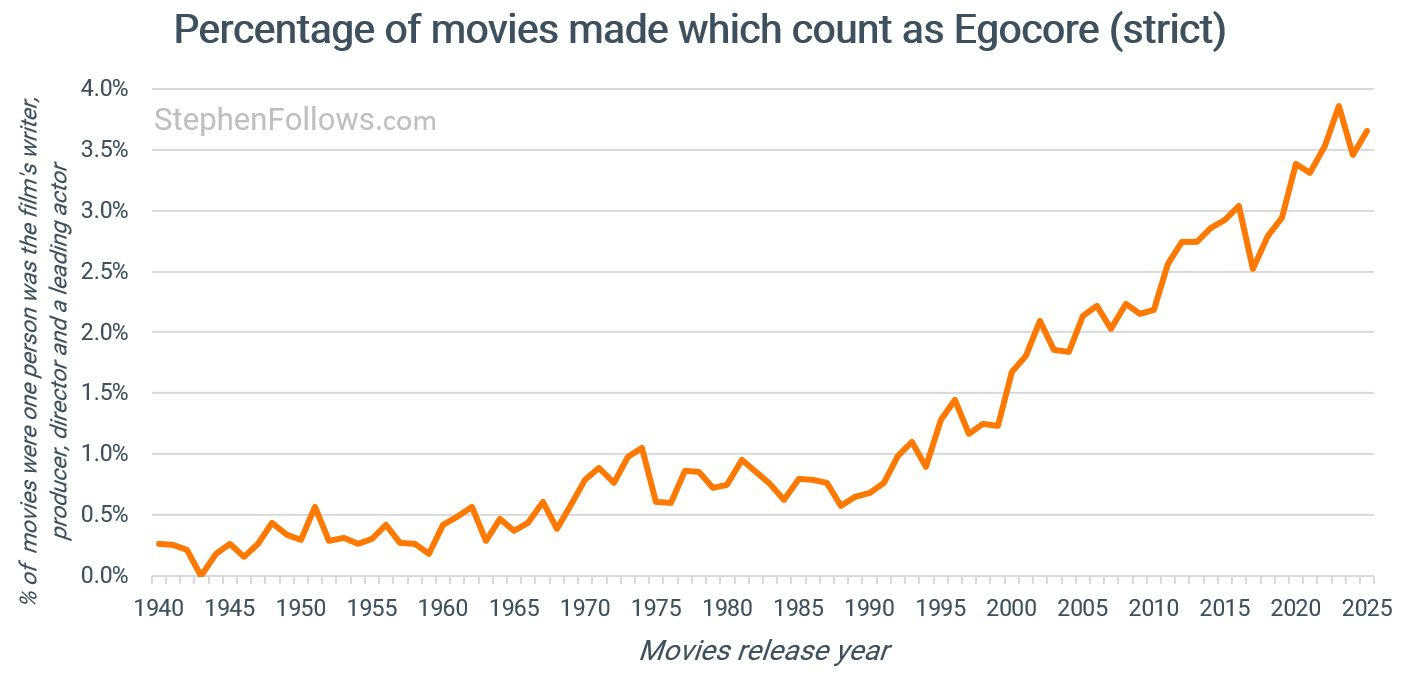
This acceleration aligns neatly with the democratisation of filmmaking tools. Digital cameras, affordable editing software, and online distribution all made it feasible for a single person to fill every role.
Here’s my breakdown of the major Egocore eras:
1940s–1960s - The Chaplin era. Egocore was vanishingly rare, with Charlie Chaplin as its main practitioner. His four egocore films from this period (The Great Dictator, Monsieur Verdoux, Limelight, A King in New York) are among the best-known movies in my dataset. At this point, egocore required genuine industrial clout. You needed to own your own studio or be so famous that nobody could say no - Chaplin had both.
1970s–1980s - The auteur window. New Hollywood loosened the studio system enough for a handful of filmmakers to consolidate control. Mel Brooks wrote, directed, produced, and starred in Blazing Saddles and History of the World: Part I. Dev Anand was building his egocore career in Indian cinema, but overall egocore was still rare, and still the province of established names.
1990s - The indie explosion. The Sundance generation and the rise of affordable 16mm and early digital cameras made independent filmmaking viable for more people. Egocore doubles in size and starts to diversify beyond the A-list.
2000s–2010s - The digital revolution. This is where the curve bends sharply upward. DSLRs, Final Cut Pro, and platforms like YouTube and later streaming services created an ecosystem in which a single person could genuinely handle every aspect of production. The egocore rate climbs from under 1% to nearly 2% of all films. Tyler Perry releases the bulk of his Madea egocore films and Neil Breen emerges as an unlikely cult figure.
Current decade - Unknown future. The rate appears to plateau or dip slightly, though the decade is only half done. The pandemic temporarily disrupted production, and the post-pandemic landscape has been dominated by streaming commissions, in which collaborative production structures are the norm. Whether egocore continues to c
limb or has reached its natural ceiling remains to be seen.
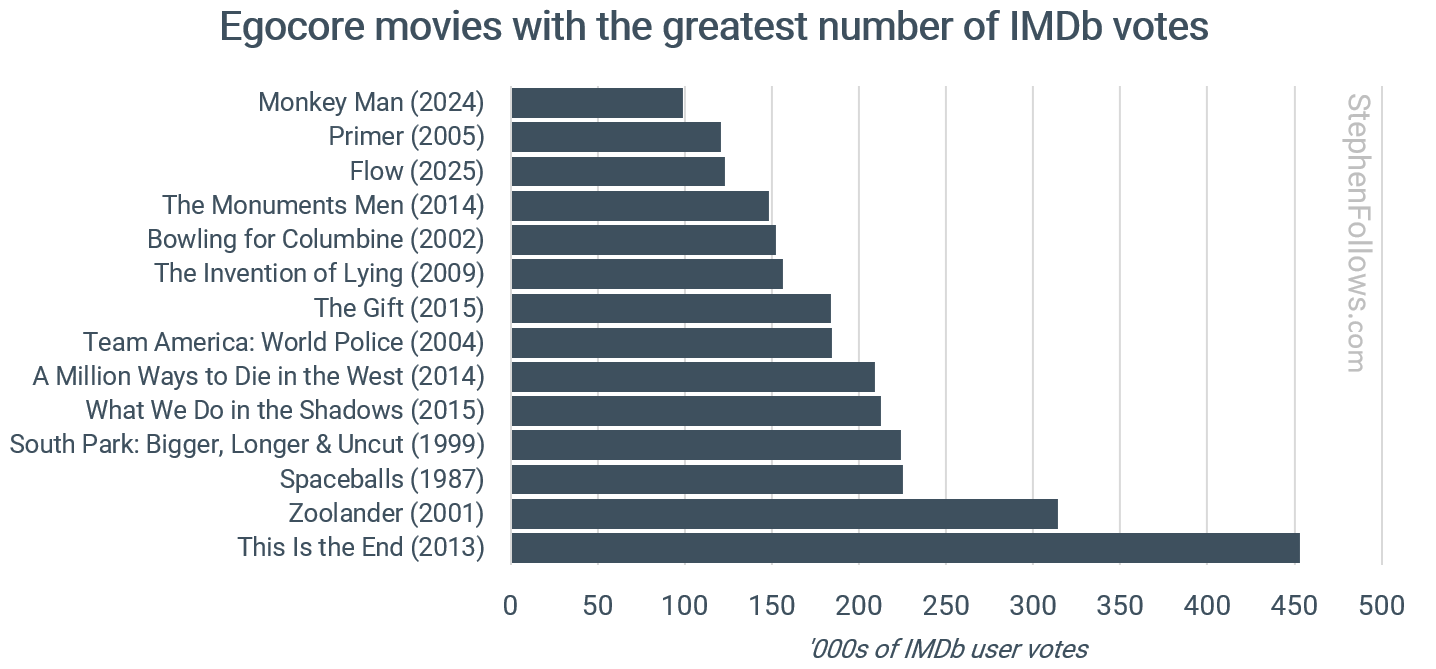
The most-watched egocore films
Statistically speaking, you’ve probably seen a few egocore movies and never even knew it. Zoolander is a great example, where Ben Stiller is firing on all cylinders in each of the four required creative roles to qualify.

Egocore by genre
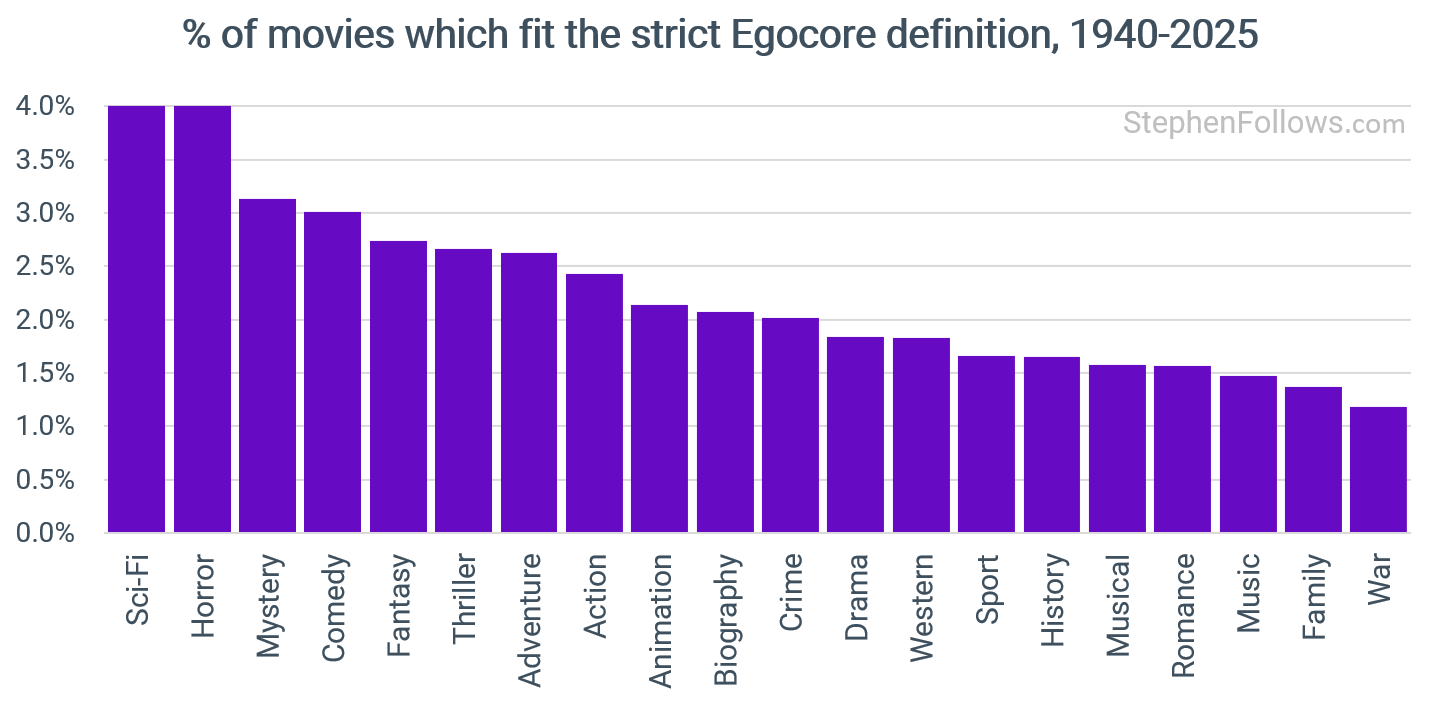
Not all genres are equally prone to egocore. I looked at the egocore rate by primary genre for genres with at least 1,000 films in the database.
While comedy took all seven of the top spots on the ‘most popular’ chart above, sci-fi and horror have the greatest relative production overall.
Egocore is often the choice of the cash-strapped filmmaker
Egocore is overwhelmingly a low-budget phenomenon.
The egocore rate holds fairly steady for films budgeted under $50 million, but then drops off a cliff, with only a couple of egocore movies costing more than $50 million.
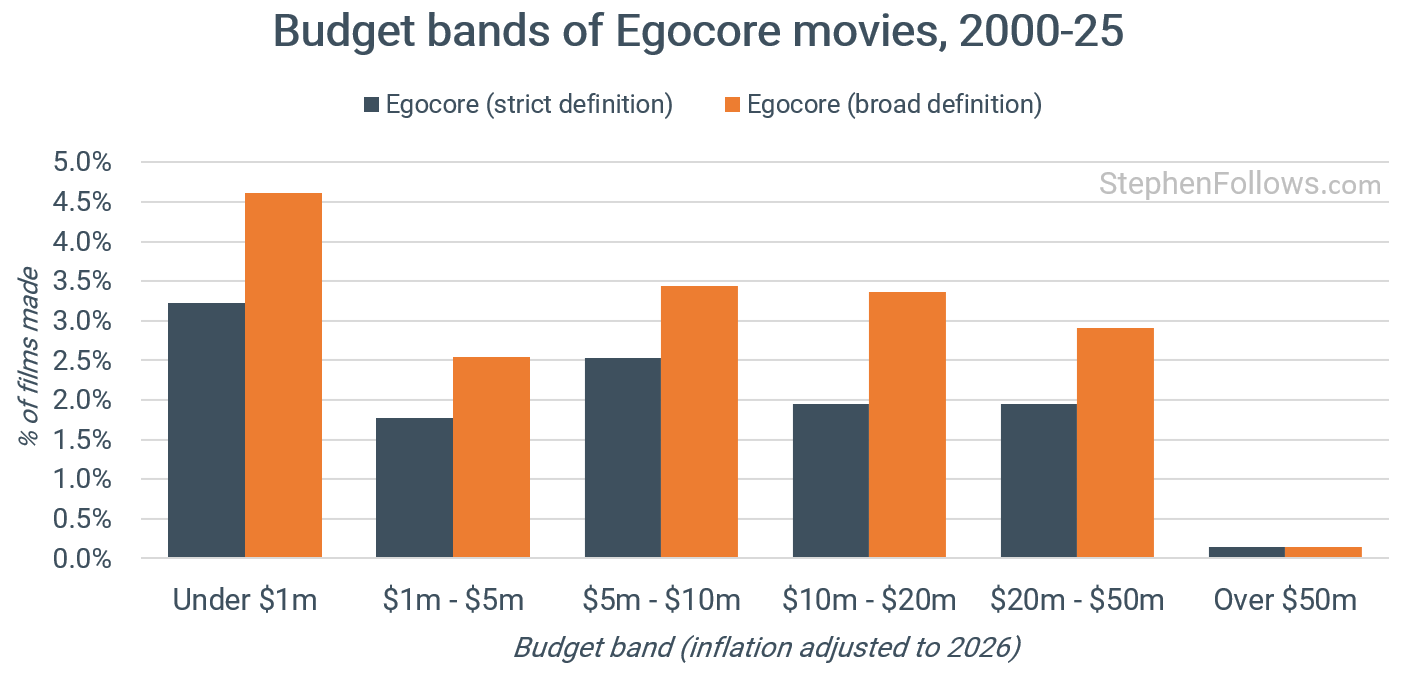
The more money involved, the more stakeholders are involved, and the harder it is for any single person to maintain control of all four key roles.

Who are these people?!
Men. Roughly four to one (82.3% vs 17.7%).
I know what you cynics are thinking - that’s typical of men’s overconfidence in being able to take on any task (46% of men believe they could manually land a passenger airplane if they really had to in an emergency).
But to that I say, you’re not thinking cynically enough. Film has historically been a hugely sexist industry, and so when you combine roles, maybe you also combine barriers.
Over the last century, acting has been the closest to parity at 39.5% women. Among the top creative roles, producing has been 27.1% women, writing 20.2%, and directing (the role most associated with singular creative authority) sat at just 17.0% women.
Full egocore comes in at 15.4% women. That’s almost the same as the directing rate, which suggests that it’s the directing barrier, rather than anything specific to egocore, that’s the bottleneck for women.
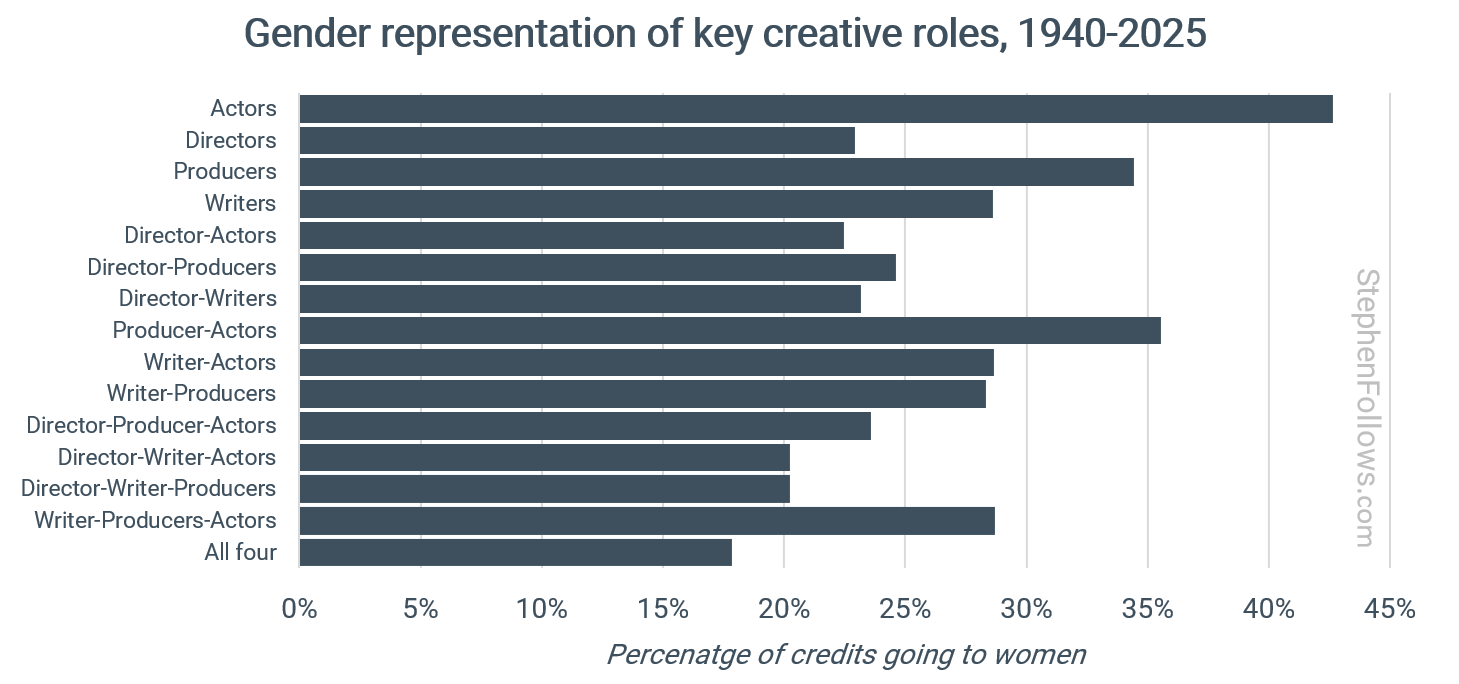
The trend is moving towards gender parity, albeit slowly. In the 1940s, roughly 5% of egocore filmmakers were women. By the 2020s, that figure had risen to about 20.2%.
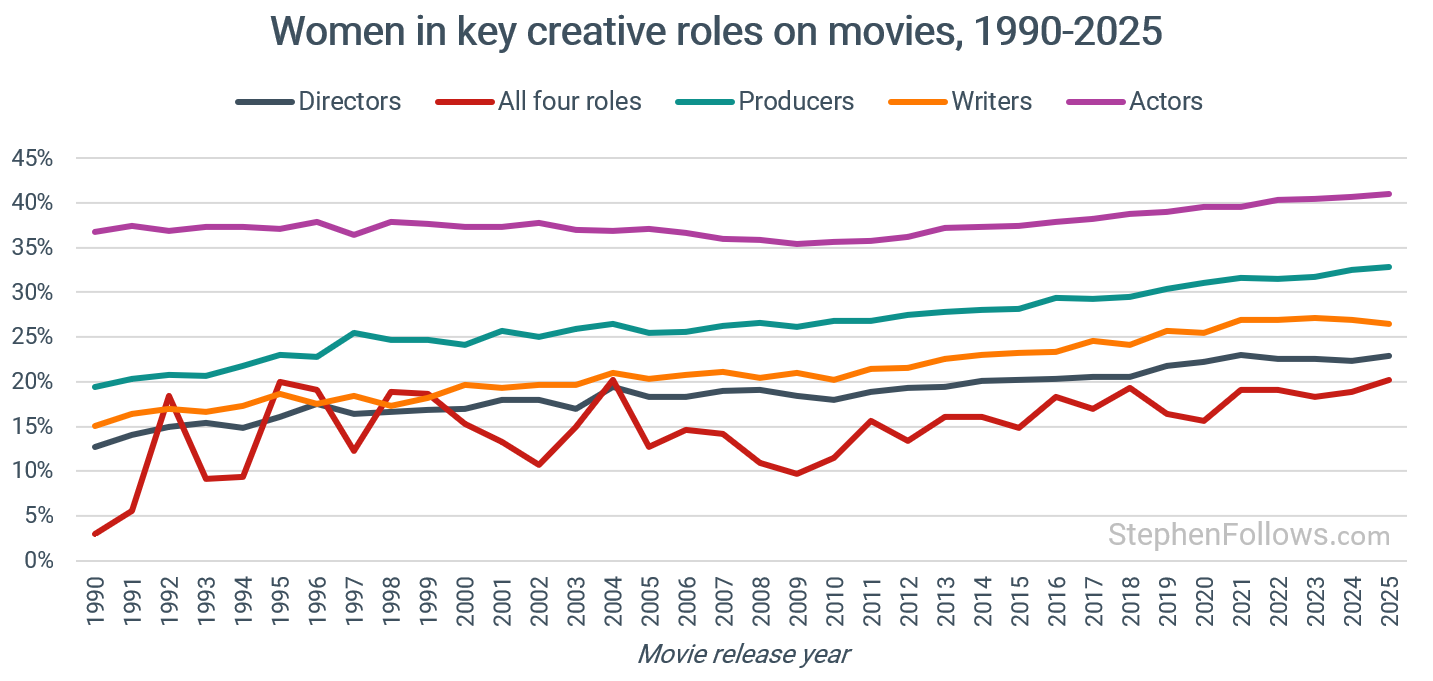
So it’s not that egocore is uniquely male-dominated, but rather that it inherits the gender imbalance of its most male-skewed component - directing.
Egocore’s heroes
I’m not sure what we should call the filmmakers behind such films…
Egoteur?
Egocorists?
Singularists?
Uniplexers?
Polymakers?
Egocorepreneurialists?
Despite the prevalence of the films, of the people who have made at least one egocore film (using the broad definition), the vast majority, roughly 89%, have done it exactly once.
Only about 90 people have made four or more egocore films, and just 19 have made seven or more. Egocore, for most filmmakers, is a one-off experiment.
The serial practitioners are a tiny, prolific minority. These heroes include:
Charlie Chaplin is the original egocore OG, proving that egocore, in the right hands, can produce truly great art.
Tyler Perry is prolific, commercially savvy, and unapologetically populist. His egocore output is remarkable both for its volume and its consistency, meaning that his audiences know exactly what they’re getting, and they keep coming back. (More on Tyler here What filmmakers can learn from Tyler Perry’s incredible self-made empire).
Neil Breen has become a cult phenomenon precisely because of his egocore commitment. On his early classic Twisted Pair, Neil is credited as the film’s director, writer, producer, cinematographer, director of photography, editor, hair stylist, makeup artist, special makeup effects artist, production manager, set designer, sound editor, special effects artist, lighting designer, casting, wardrobe, locations manager, music director, craft service, props, aerial rigging, legal accounting administration, and stunt coordinator. Only two other people received a crew credit on the movie.
Xavier Dolan is perhaps the most critically acclaimed modern egocore practitioner. He burst onto the scene at Cannes aged 19 and went on to write, direct, produce, and star in several films that were taken seriously by the festival circuit.
Dev Anand is a reminder that egocore isn’t just a Western phenomenon. With 12 egocore films spanning decades of Indian cinema, Anand was one of the most prolific egocore filmmakers in any national cinema.
Nanni Moretti represents the European auteur tradition of egocore in which his films are cerebral, personal, and deeply rooted in national identity.
Mel Brooks demonstrates that comedy may be the genre best suited to egocore. When a comedian writes their own material, directs their own timing, and performs it themselves, the result has an internal coherence that’s hard to replicate by committee. Brooks’s egocore comedies are among the most beloved comedies ever made.

Notable near-egocore
Given the tough requirements of fulfilling all major creative roles simultaneously, it’s perhaps not surprising that many of the people we regard as singular auteurs still fall short of the four-out-of-four required to join this elite group.
Well-known filmmakers who are egocore runners-up include:
Woody Allen is arguably the most famous near-egocore filmmaker. He wrote, directed, and starred in numerous films without a formal producer credit on any of them. In practice, Allen exercised a level of creative control that was functionally egocore, but the credits don’t reflect it.
Clint Eastwood shows a similar pattern, with numerous films he directed, produced, and starred in, but never took a writing credit.
Sylvester Stallone wrote, directed, and starred in several Rocky and Rambo films but typically lacked a producer credit.
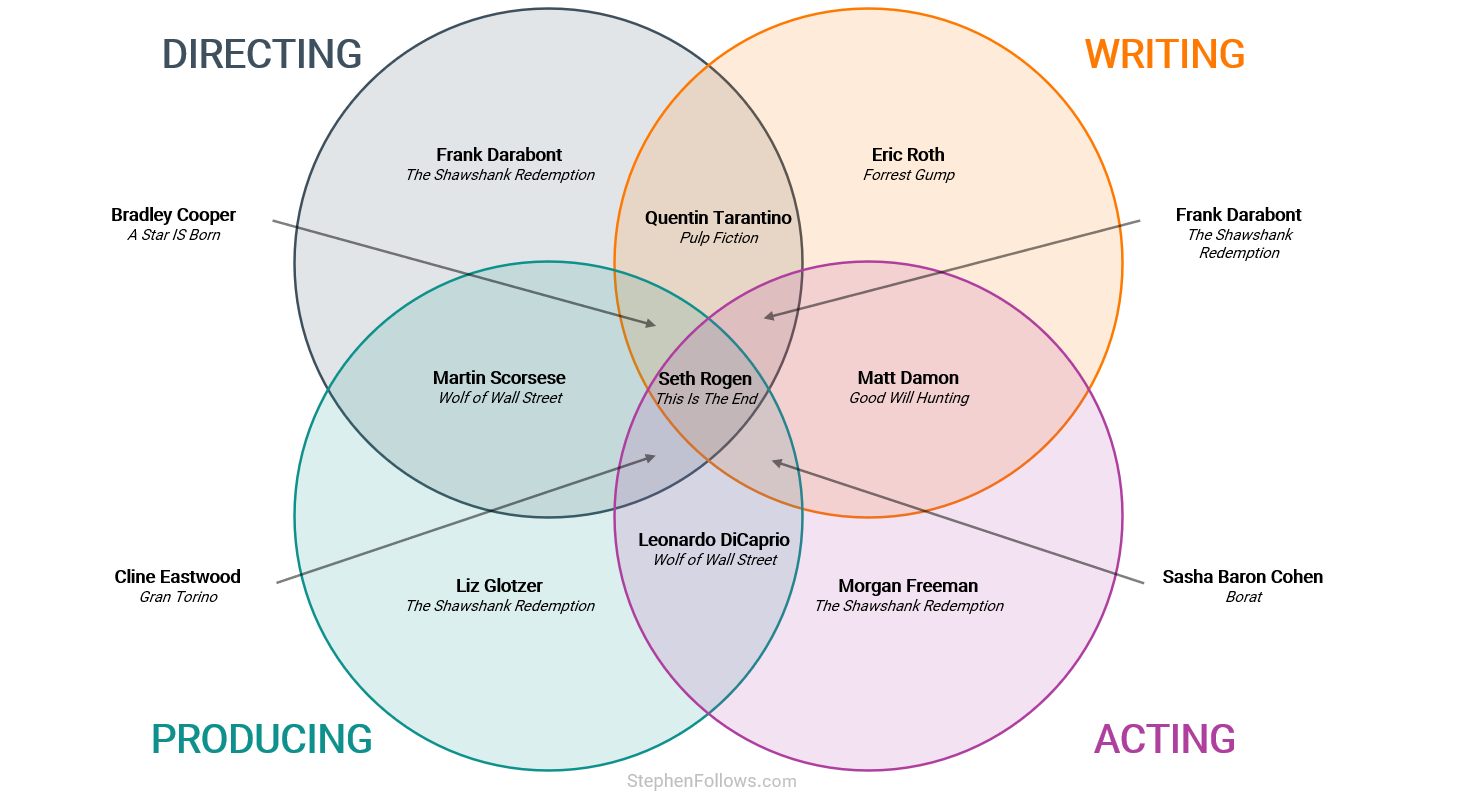
I ran the numbers on job overlap for the four roles.
By far the most common three-role combination is Writer-Director-Producer (missing a top-billed acting credit), accounting for 81% of all near-egocore instances. These are the behind-the-camera auteurs who control everything except providing a performance themselves.
The second most common is Writer-Director-Actor (missing Producer), with 8% of cases. These filmmakers write, direct, and star but don’t take a producing credit, as Woody Allen does.
Writer-Producer-Actor (missing Director) accounts for 6% of near-egocore misses. This is the actor-creator who develops their own projects but hands the directing to someone else. A sensible approach, frankly, as directing yourself while acting is notoriously difficult.
Rarest of all is the Director-Producer-Actor (missing Writer), occurring in just 4% of cases. These are filmmakers who control the production and star in it but work from someone else’s script, such as Clint Eastwood.
The hierarchy makes intuitive sense to me. The ‘easiest’ role to hold onto behind the scenes is producing (maybe the hardest job, but certainly the most liberally credited). While the hardest role to combine with the others is acting, because it requires a fundamentally different skill set and a willingness to be in front of the camera.
Are egocore films any good?
I’m sure by now you’re wondering whether egocore films are worth seeking out or avoiding. Is all that control a recipe for self-indulgent disaster?
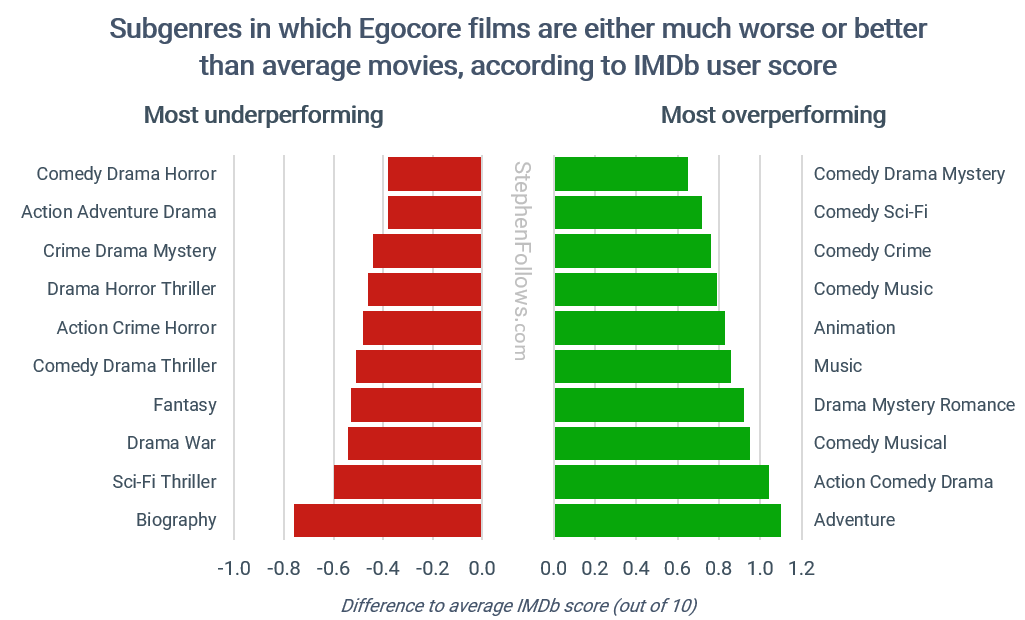
The short answer is that it’s basically a wash. Across most decades, the average IMDb rating for egocore films is within a fraction of a point of non-egocore films. In some decades, egocore edges ahead; in others, it falls slightly behind. There is no dramatic ‘ego penalty’ in the aggregate.
But the genre-level picture is more interesting.
Egocore comedies rate notably higher than non-egocore comedies. The same is true of comedy-dramas. It seems that personal comedic vision benefits from singular control. When the person writing the jokes is also delivering them, there’s an internal coherence that committee-written comedy often lacks.
What have we learned?
Egocore is real, it’s growing, and it’s more nuanced than the caricature of a vanity project suggests.
The data tells us several things worth noting:
Egocore is mostly a micro-budget phenomenon. The vast majority of egocore films are made for under $5 million. The person wearing all four hats is usually not doing so because they have a studio behind them. They’re doing it because there’s nobody else to do it. This is ego-as-necessity as much as ego-as-vanity.
The quality distribution is surprisingly normal. Egocore films aren’t dramatically better or worse than their non-egocore equivalents. The idea that handing one person total control inevitably produces either genius or garbage isn’t supported by the data. Most egocore films are simply... fine.
Genre matters more than ego. Whether an egocore film works well seems to depend more on what genre it’s in than on the fact of its egocore-ness. Personal comedic visions benefit from singular control; complex action sequences and horror set-pieces may suffer.
The near-egocore club is as interesting as the full one. Woody Allen, Clint Eastwood, and Sylvester Stallone are all near-egocore by the formal credits but clearly exercise egocore-level control. The credits system doesn’t always capture the reality of who’s actually running the show.
The pathway to egocore almost always starts behind the camera. The most common three-role combination is writer-director-producer (missing actor), with 99,829 instances. The last step into full egocore (i.e. stepping in front of the camera) is the one most filmmakers never take.
Epilogue
I reached out to a few of the filmmakers I’ve mentioned today to share their perspective. Neil Breen put it like this:
I have done 7 indie ‘B’ theatrical feature films. I was the producer, director, writer and star of each film.
I own the copyrights to the films and scripts. I own 100% of the legal rights to the films. I self-funded my films. Each film was profitable which enabled me to do the next film.
I’m a team player and look forward to collaborating but I live in an area which does not have a pro film community and therefore the film sources and resources are very limited.
My passion is film making. So rather than talk about it or wait for someone to help me, I do it myself. I’m very experienced, creative and skilled in doing the work myself.

Notes
Today’s analysis relies on tracking people’s credits, not the work they did. Some filmmakers exercise egocore-level control without formal credits in all four categories (Woody Allen being the most obvious example). Others may have credits that overstate their actual involvement.
Billing order as a proxy for ‘starring’. I used top-3 billing as the threshold for being a ‘star’ actor. This is a reasonable proxy but not perfect, as some films list actors alphabetically, and billing politics can distort the picture.
The ‘strict’ writer definition counts only screenplay and ‘written by’ credits. The ‘broad’ definition adds story credits. Some filmmakers contribute to the script without a formal writing credit (and vice versa).
Budget information is a mix of confirmed budgets and estimates using a model I’ve been working on for a few years. I have only done this for films made this century, so charts and data are all for 1940-2025 unless they reference budgets, which means they are 2000-25.
Gender estimation is imperfect and could miscategorise some non-Western names and non-binary individuals. The figures here should be treated as directional estimates, not precise counts. But the overall pattern (i.e. heavy male dominance of egocore) is robust to any reasonable error margin.
I haven’t engaged much with writing academic papers over the years due to time constraints. But it strikes me that this is a rich seam for someone to mine. So if you’re an academic who wants to do a paper on this, reach out.
I loved this article, Stephen!
AI superintelligence will be the end of all human ego.
I tried egocore myself with Trouble Is My Business.
It was exhausting but I had a certain vision and certain money and I wanted the film to exist.