


One of the biggest forces in the film industry (beyond familial nepotism) is your professional network. The more people you have backing you and your projects, the better your outcomes are likely to be.
Nowhere is this truer than in the world of major film festivals. If you look at the people and companies behind the films selected and favoured by major festivals over the years, the same names keep coming up.
Some of that is talent (i.e. the festivals are seeking the best new art and artistic talent is not spread equally across filmmakers).
Some of that is down to the type of films (i.e. festivals heavily over-index towards certain types of films and so the people repeatedly making or representing those types of films are likely to be festival regulars).
But some of it is also down to networks.
In order to get a handle on the scale of the effect of the latter, I looked at all 3,037 feature films selected by Cannes, Venice, Berlin, Sundance and Toronto in the five years between 2021 and 2025.
What counts as ‘cold’?
‘Backing’ is quite a vague word, so I broke it into five things that can each be checked against a record.
A public funder, foundation, or broadcaster among the listed companies behind the film. This could include national film funds, regional funds, Eurimages, Arte, the BFI, a Sundance Institute grant, or similar.
A lab or talent programme alumnus among the director, producers, or writers. Such as Sundance Institute labs, Berlinale Talents, the Cannes Résidence, TorinoFilmLab, Biennale College Cinema, etc.
A studio, streamer, financier or distributor as a production company. This was to look for films that were made for or with someone who already planned to release them.
A producer with a prior top-festival film. I defined this as a credited producer (not an executive producer) who had a film selected at Cannes, Venice, Berlin, Sundance, Toronto, Tribeca, SXSW or the BFI London Film Festival on a prior movie.
A sales agent attached before the festival announced its lineup. This is the company that sells a film’s rights to distributors around the world (I have previously studied how few films ever get one here).
I’ve called a film cold at selection when none of the five applies on the day the festival’s programme was announced.

Determining the situation for most films was easy as the data revealed that it had at least one of the above. But there were some vauge fringe cases. These were things like having a sales agent today, but not being able to determine if they boarded the film before or after festival selection. In other rare cases, I just couldn’t find out much about the film or filmmakers.
This means that rather than give a single figure, I’m going to give the low-end and high-end numbers. The lower figure counts only the films I am certain were cold, and the higher includes all the ‘possibly cold’ films, with the truth sitting between the two.
There are more details on my process and criteria in the Notes at the end.
How many films arrive cold at a major festival?
The short answer is somewhere between one film in 43 and one in 23.
Of the 3,037 selected features, 70 (2.3%) definitely arrived with nobody behind them at the moment the festival chose them. If every possibly cold film was in fact cold, that would double to 134 (4.4%).
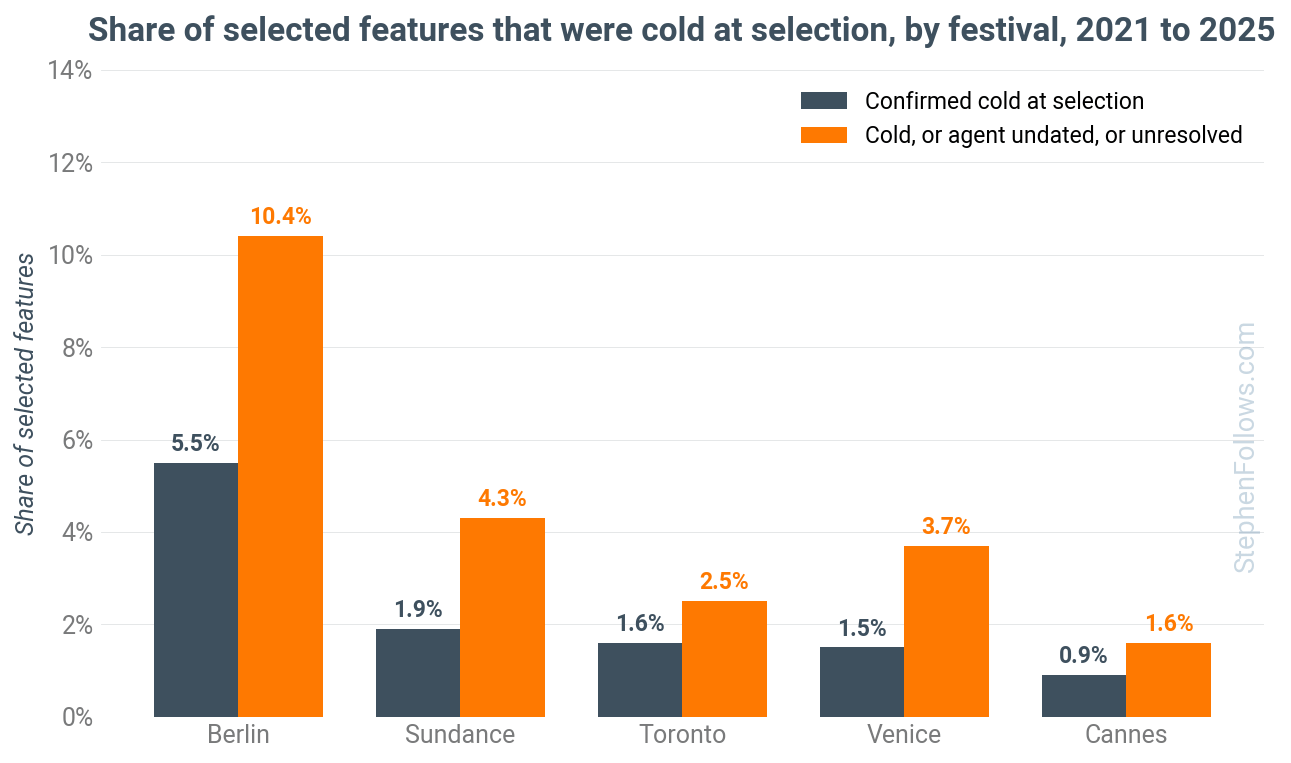
Berlin is the outlier, with between 5.5% and 10.4% of its 617 features arriving cold (34 to 64 films). Sundance sits between 1.9% and 4.3%, Toronto between 1.6% and 2.5%, and Venice between 1.5% and 3.7%.
Cannes is at the bottom, on 0.9% to 1.6%. That’s between five and nine films out of 551 across five years. None of the five definite cases was in Competition or Un Certain Regard. Four played in the parallel sections, and the fifth was Revolution of Our Times, a documentary Cannes added to its Special Screenings in secret.
The ranking of these festivals won’t surprise industry veterans. Berlin has the Forum, a section built for exactly the kind of film that has no network around it, and the Forum accounts for about half of Berlin’s cold films. Cannes has nothing like it, and even its parallel sections are heavily pre-sold or pre-supported.

Which programmes at major festivals select unconnected films?
Over five years, Cannes Competition selected 110 films and not one arrived cold. The same is true of all 122 films in the Venice Competition and all 91 in Berlin's Competition, and of every film in Un Certain Regard, Cannes Critics' Week, Toronto's Galas and TIFF Docs.
Sundance is the one festival where a competition slot went to a cold film. Two did in the U.S. Dramatic Competition and one in the U.S. Documentary Competition, out of 206 competition slots.
For the five years of data I looked at it’s fair to say that the main competitions of the European festivals just don’t take cold films.
But there are routes open to unconnected filmmakers via curated sidebars built for first features and experimental work.
As the chart below shows, Berlin’s Forum is the standout, with 17 of its 131 features (13%) cold. Behind it are Toronto’s Midnight Madness at 9%, then Berlin’s Panorama and Encounters and Sundance’s NEXT at 5% or 6%, and Toronto’s Wavelengths and Discovery at 4%.
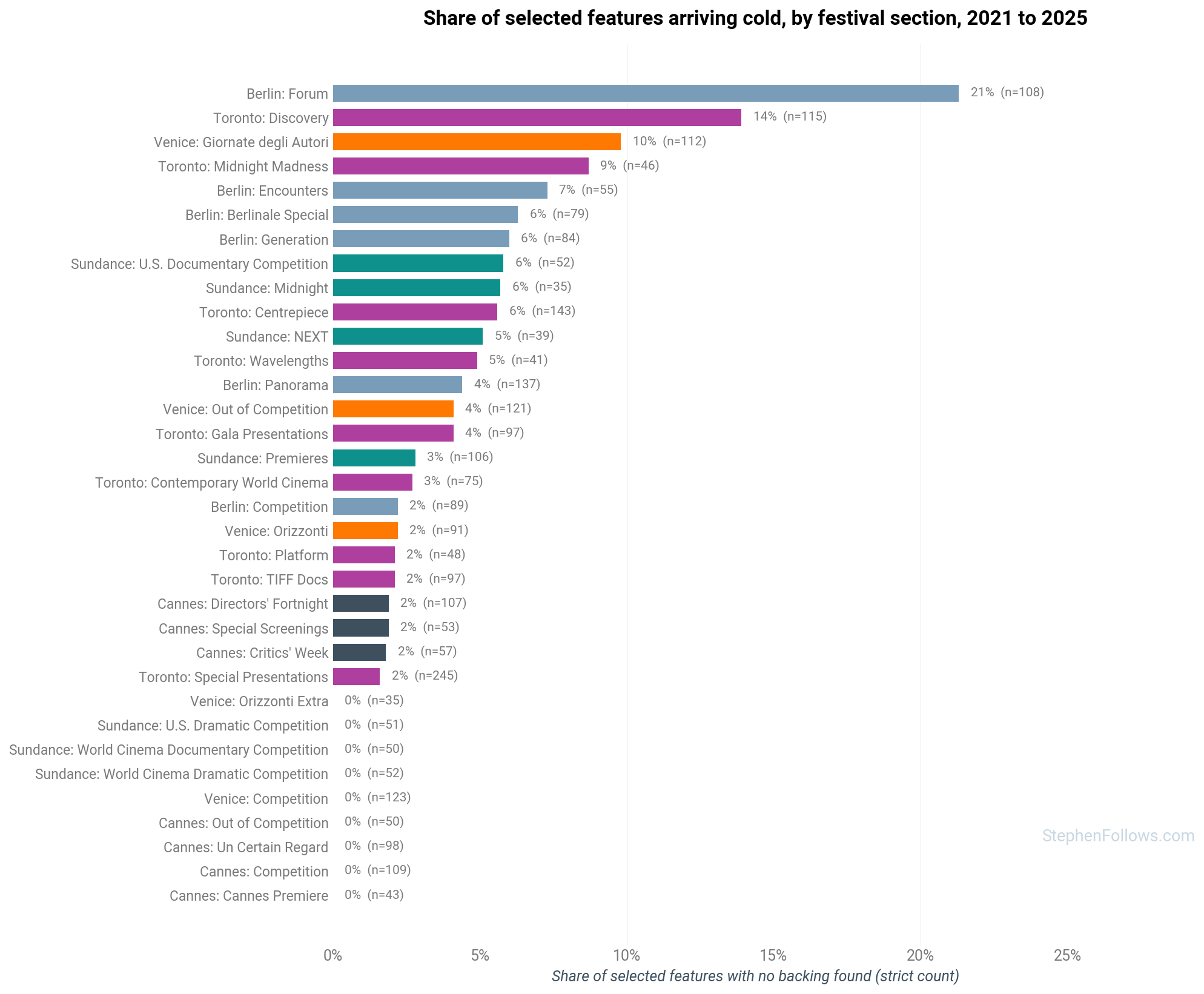
(The chart above is only looking at the confirmed cold films, so you should read it as the low-end, not the full picture).
What is behind a typical selected film?
Across the major festivals I studied, the data reveals that 78% of selected films had at least one producer who’d already had a film at a major festival.
55% had a public funder, broadcaster or foundation in the credits.
31% were made with a studio, streamer or distributor as a production company.
18% had a lab alumnus among the director, writers and producers.
Only 23% had a sales agent named in the trade press before the announcement.
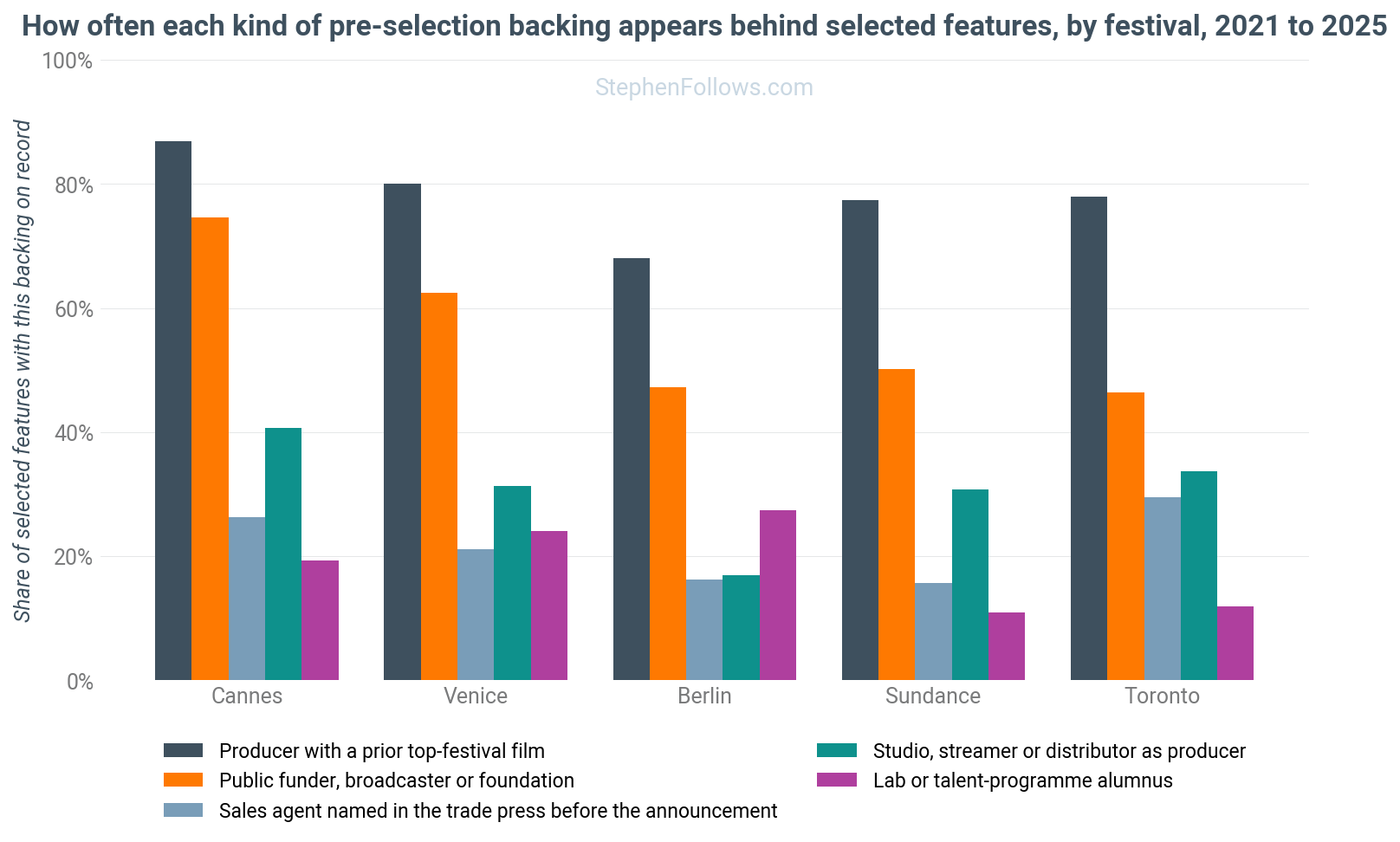
So the typical film in a major festival lineup has already been developed, funded and produced by industry veterans. That isn’t really what most of us would think of when we talk about festivals “discovering” talent. In this case, the festivals are not the first step in a new journey but rather the calculated outcome from a long, laid-out plan.
When does the sales agent turn up?
For every selected feature with a confirmed sales agent (2,091 of them), I looked at when they first linked to the film in the trades (i.e. Variety, The Hollywood Reporter, Deadline, or Screen Daily).
Across the five festivals, the agent was on board before the festival announcement for 33% of films. For 39% of the films, the trades reported the link after news of the selection was released, and for the remaining 28%, the trade press never named the agent and film together (in these cases sites like IMDb, Cinando, CineEurope, etc. confirmed the link).
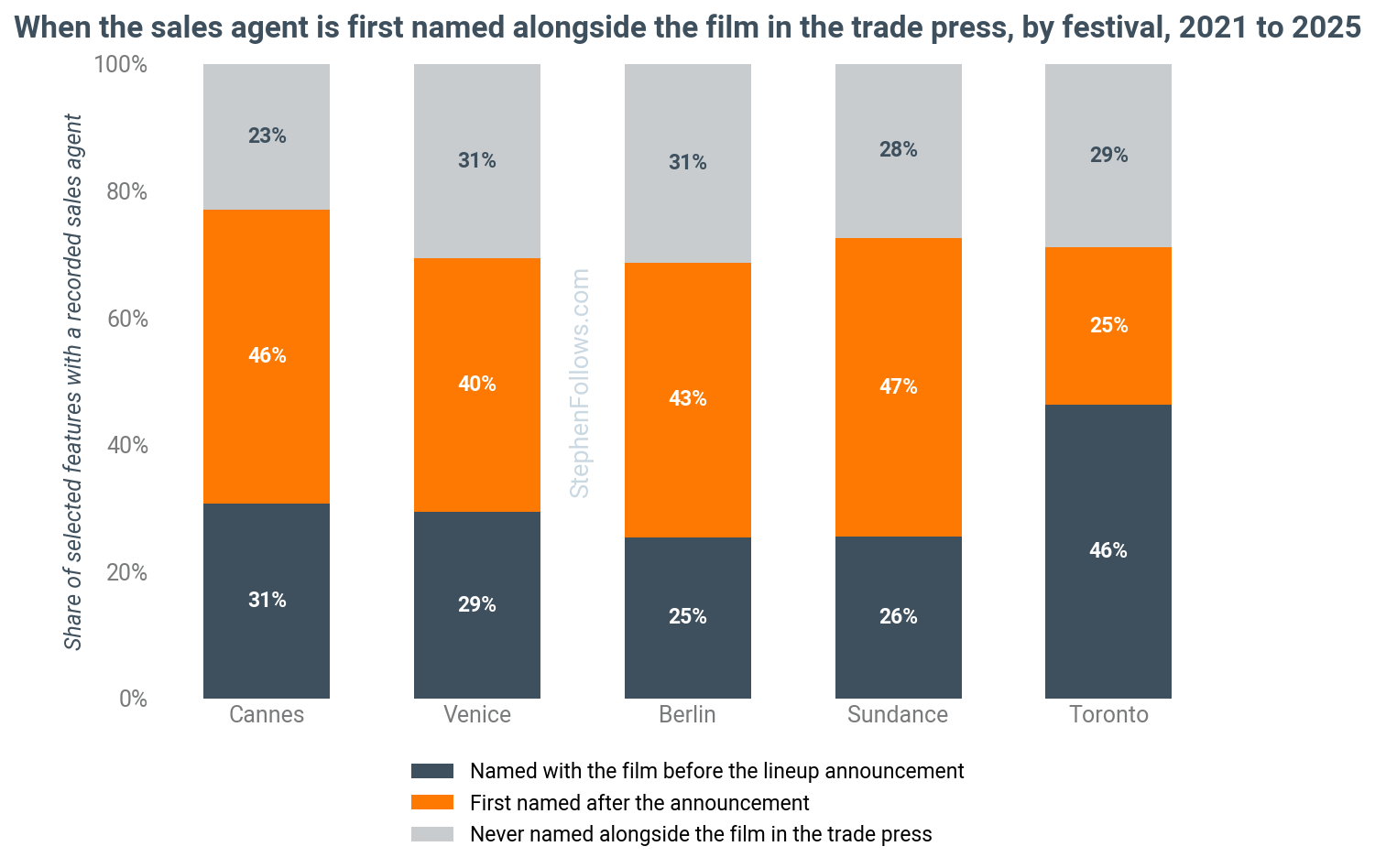
At Toronto, 46% of sales agents were documented before the announcement, which sets it apart from the other four festivals. It announces in late July (i.e. after Cannes and its market have been and gone), so more of its films arrive already sold.
What do the cold films look like?
As I got more familiar with the types of cold films which did manage to break into major festivals, I started to see patterns. They’re self-made, often by one person or a couple, often for very little, and produced outside of co-production systems.
I want to end by quickly highlighting just a few of the great filmmakers who did manage to get festival recognition from the outside. They include:
Ryan J. Sloan’s Gazer (Directors’ Fortnight 2024) was shot at weekends over two years while he worked as an electrician.
Kogonada’s Zi is a cold film at Sundance this year and was made by seven collaborators who paid their own way and own it jointly.
Keren Cytter’s The Wrong Movie (Berlin Forum 2024) is an artist’s film made for USD 25,000.
Rachel Kempf and Nick Toti’s It Doesn’t Get Any Better Than This (Midnight Madness 2024) was made in small-town Missouri on minimal equipment and will never be released online.
Takahide Hori’s Junk World (Midnight Madness 2025) is a stop-motion feature paid for by two crowdfunding campaigns.
Afolabi Olalekan’s Freedom Way (Toronto Discovery 2024) is from Nigeria and was written and produced by Blessing Uzzi.
Nabin Subba’s A Road to a Village (Toronto’s Centrepiece 2023) is a community-funded project from Nepal.
At Cannes 2024, Maisam Ali’s In Retreat reached ACID having passed through the Hong Kong project market as a work in progress and nothing else.
Kiwi Chow’s Revolution of Our Times is the Hong Kong protest documentary that Cannes accepted in 2021 and kept secret until the day before the awards.
Notes
My dataset today includes every feature film in the official selections of the following festivals for the 2021 to 2025 editions, 3,037 films in all after removing shorts, restorations, series and compilations:
Cannes Film Festival (Competition, Un Certain Regard, Out of Competition, Cannes Premiere, Special Screenings, Directors’ Fortnight, Critics’ Week and ACID)
Venice Film Festival (Competition, Out of Competition, Orizzonti, Orizzonti Extra, Venice Spotlight, Biennale College, Giornate degli Autori and the Venice International Film Critics’ Week)
Berlin International Film Festival (Competition, Encounters, Berlinale Special, Panorama, Forum, Generation, Perspectives and Perspektive Deutsches Kino)
Sundance Film Festival (all feature sections)
Toronto International Film Festival (all feature programmes)
My rules for the five types of ‘backing’ were:
A public funder, broadcaster or foundation counts if any production company credit on sites like IMDb, Cinando, or Cineuropa, or the film’s press kit or funder listing, names a public or regional fund, a broadcaster, an EU or multilateral body, a collecting society or a foundation. Tax shelters, SOFICAs and regional incentives don’t count.
A lab alumnus counts if the director, a writer or a credited producer appears in Sundance Institute’s supported-project guides and festival-watch pages, Berlinale Talents’ alumni-at-festival pages (Cannes 2022 to 2026, Venice 2022 to 2025, Toronto 2021 and 2022, Berlin 2021 to 2026), the Cannes Résidence archive, TorinoFilmLab’s films list or Biennale College Cinema’s editions, or in a programme (the Korean Academy of Film Arts, the TIFF Talent Lab, Doha’s Qumra and the Hungarian National Film Institute’s Incubator among them).
A studio, streamer, financier or distributor counts when credited as a production company or named in the press as having financed the film.
A producer with a prior top-festival film counts if a person credited as ‘producer’ (not executive, co-, line or associate producer) had an earlier film selected at Cannes, Venice, Berlin, Sundance, Toronto, Tribeca, SXSW or BFI London.
A sales agent counts only if a Variety, Hollywood Reporter, Deadline or Screen Daily article dated before the festival’s first lineup announcement names the agent alongside the film, or an equivalent dated source.
Wow, important to know. Thanks for doing, what appears to be, super challenging research on this subject.
The part you can't measure, unfortunately, is the "cold" submitter who has a friend of a friend in the selection committee or whatever and did all that self-representation work before even submitting to the festival.