


I’m working on a big project around the Oscars, and it's revealing just how sparse the research landscape is on Oscar voters.
For example, there is only one reliable source for the average age of Oscar voters. In 2012, the Los Angeles Times conducted an investigation and concluded that Oscar voters had a median age of 62, with just 14% being aged under 50.

Fourteen years have passed since then - #OscarsSoWhite, a membership overhaul, and roughly 6,000 new members, recruited in part to make the voting body look less like its “male, pale, stale” stereotype.
Did it work?
So I set about finding out by researching the age of the 11,200 people who vote on Hollywood’s top awards. There’s more detail on my methodology at the end in the Notes section.
The average ages of Oscar voters
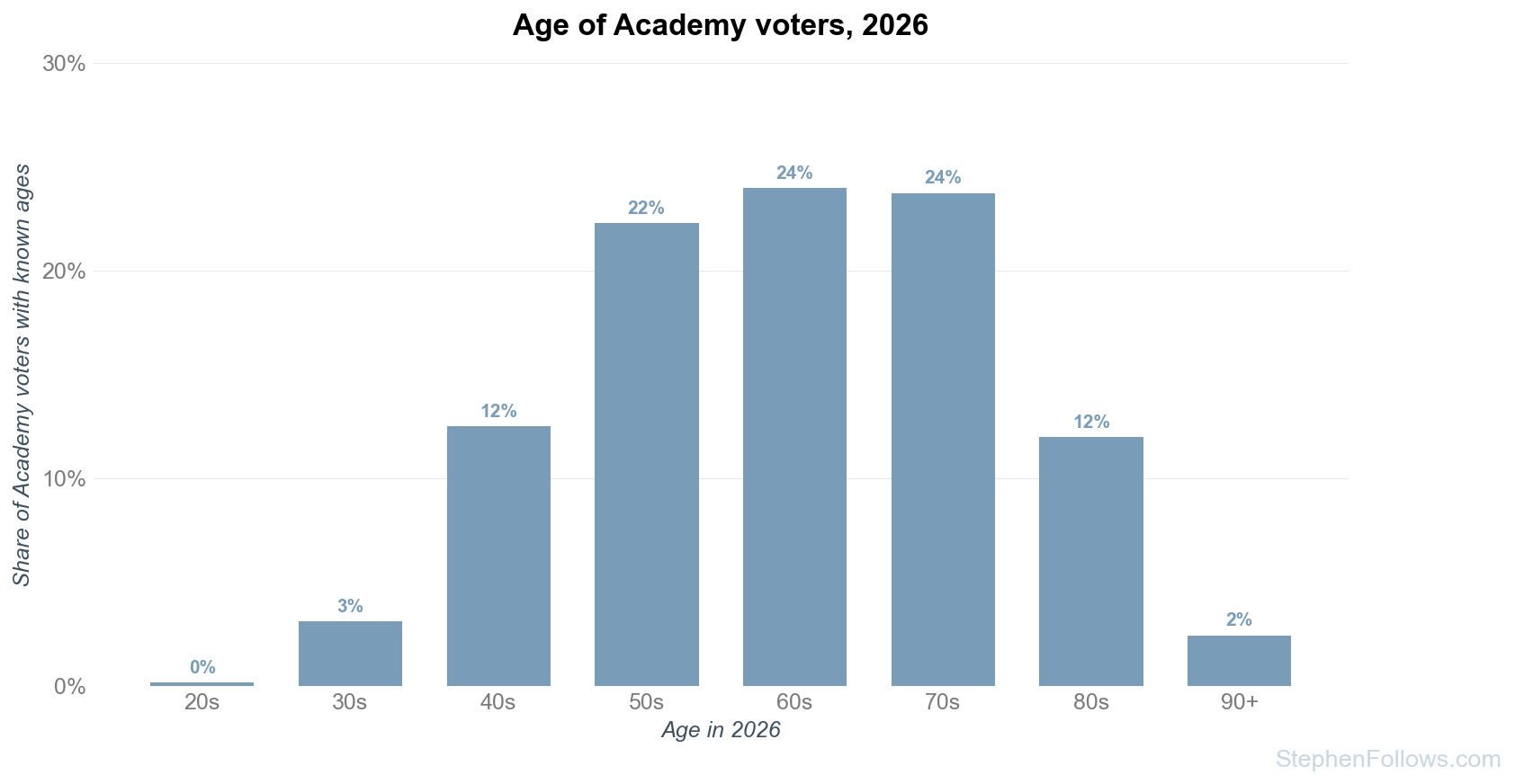
Let’s start with the headline figure. The median Oscar voter is 64 years old, with two-thirds being between 50 and 79 years old.
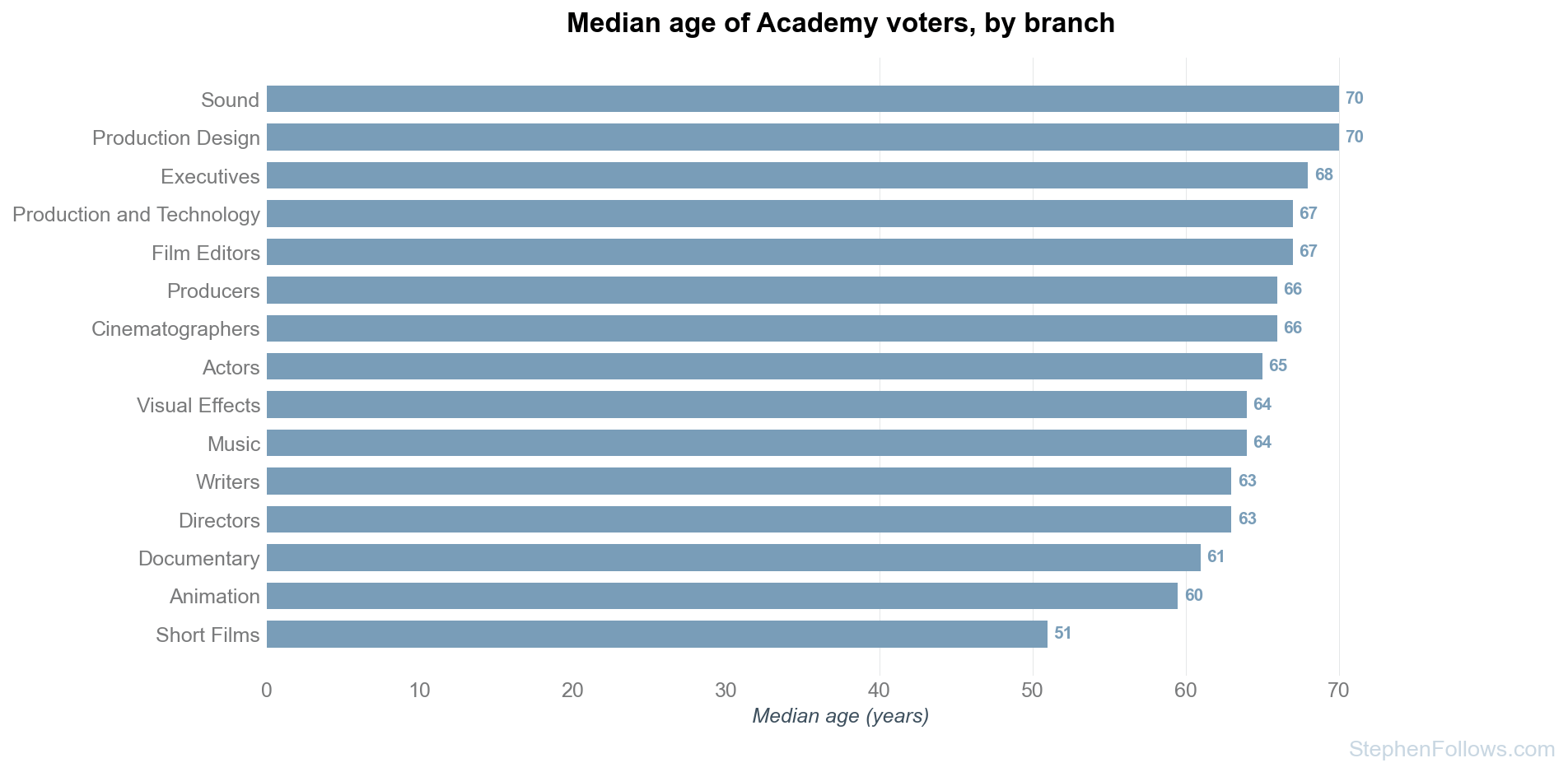
The youngest members are found in the Short Film and Animation branches, with a median age of 50 and 60 years old, respectively.
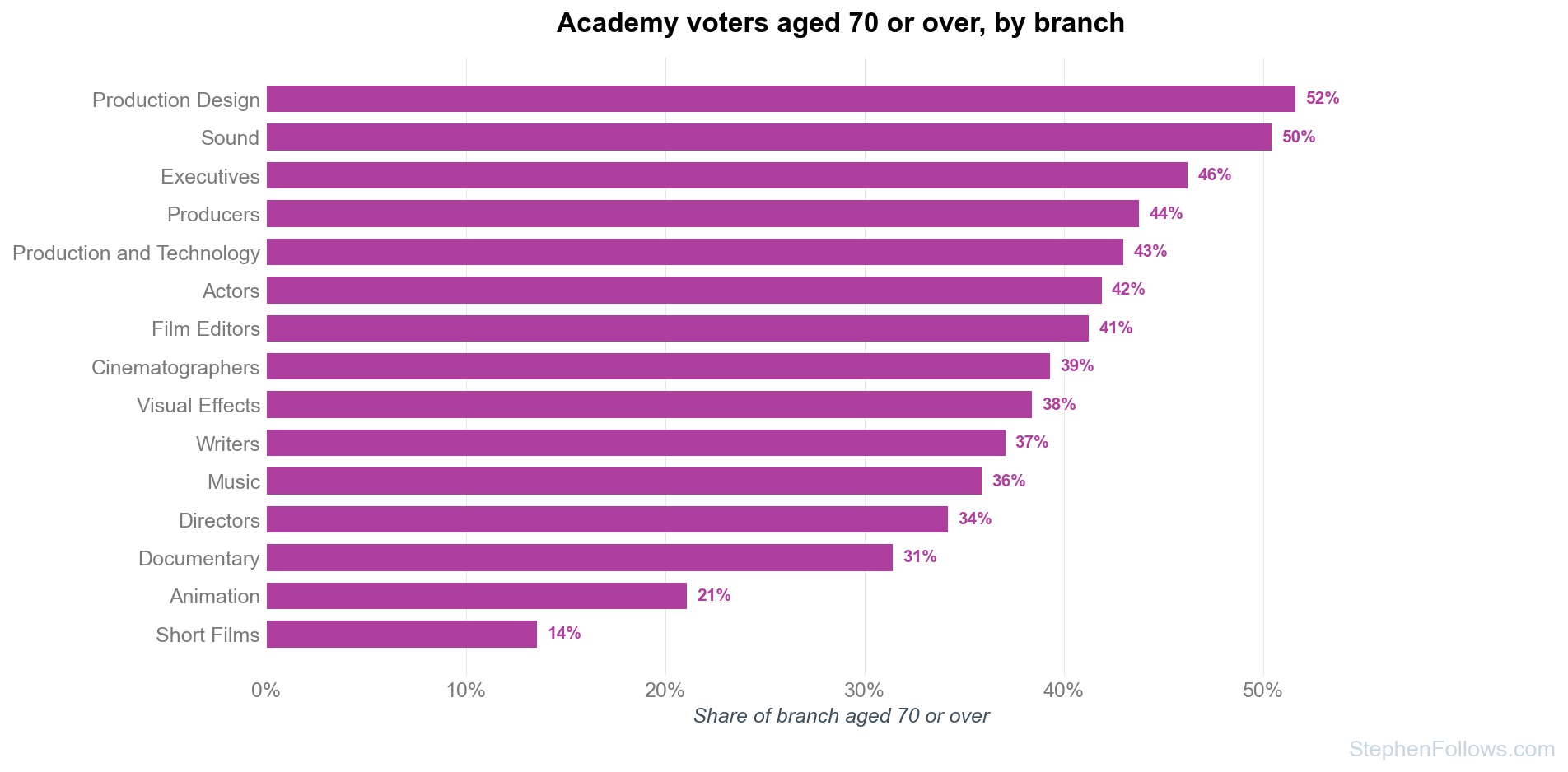
Another way of looking at it is to ask what percentage of each branch is over 70. If you’re printing handouts for members, then the Sound and Production Design branches might need the largest font, given that both have a plurality of people older than 70.
Wait, why hasn’t the average age changed?
We’ve just seen that the Oscars voters are largely the same median age as they were when the LA Times reported in 2012. This might seem strange, for a couple of reasons:
Shouldn’t they be older? People remain members of the Academy until death, and so those same folks who were there in 2012 should be fourteen years older.
But didn’t they just invite a load of younger folks? In the decade, the Academy has made a big deal about inviting a broader spectrum of people to refresh its membership.
Interestingly, the answer to both questions is yes.
It is true to say that there has not been a disproportionate number of people leaving, given that the Academy has not faced the kind of membership exodus the Golden Globes did in 2021.
This means that Academy members are indeed ageing in real time (despite the best efforts of their plastic surgeons and what their publicists will tell you).
But it’s also true that an unusually large number of people have been invited to join in recent years, with the express goal of changing the composition of the voting body.
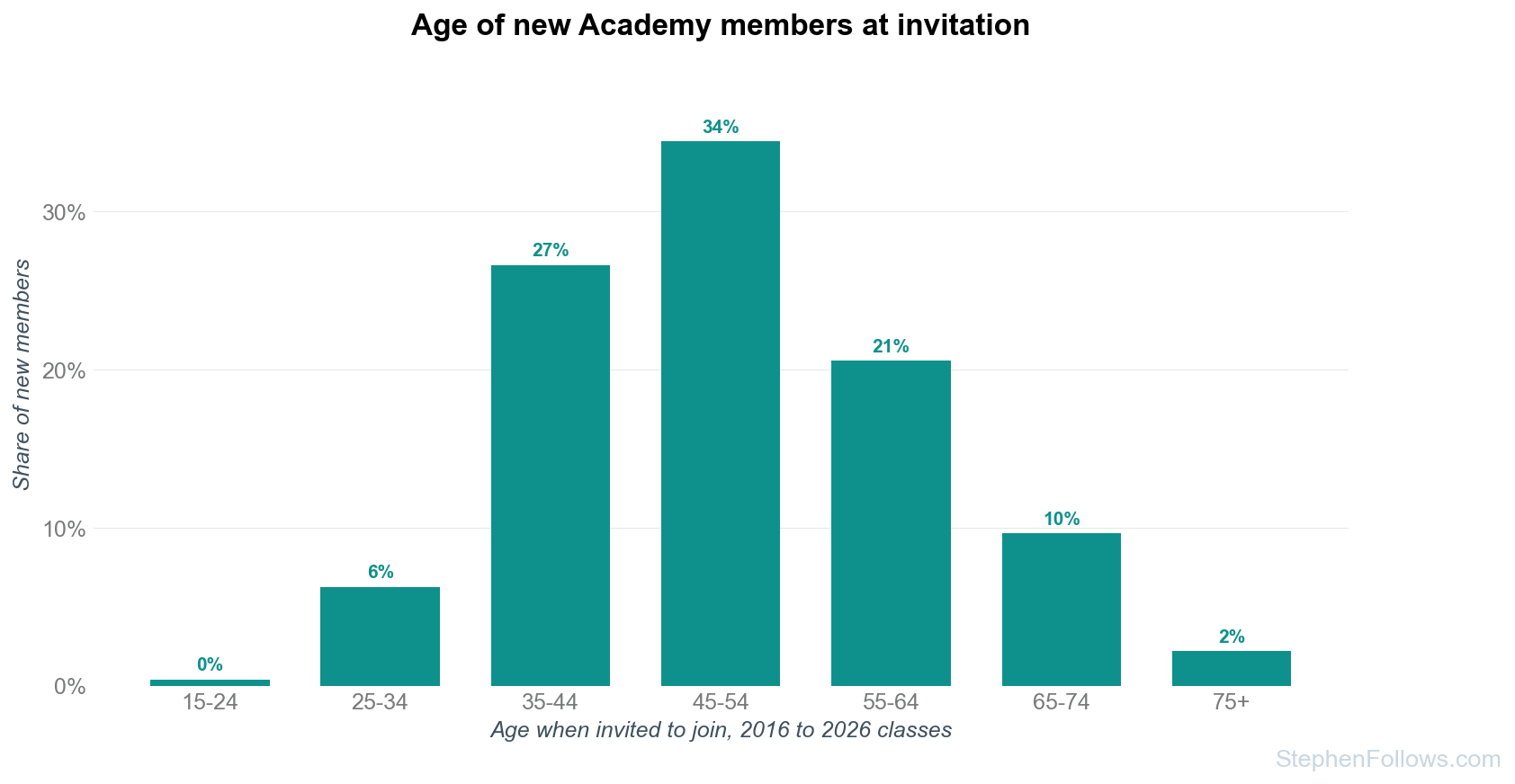
When we narrow into the new entrants, we can see that their median age is a spritly 49 years old.
The youngest member I can verify is Quvenzhané Wallis, who is currently 23 but was invited at 14 after her Best Actress nomination for Beasts of the Southern Wild. Her 2018 class also included the composer Sofia Gubaidulina, then 86, a 72-year spread inside a single year's intake.
But this isn’t some radical new act - the new entrants to the Academy since 2016 have had a median age of between 48 and 51, with the middle half of each intake sitting in the same band, roughly 40 to 57.
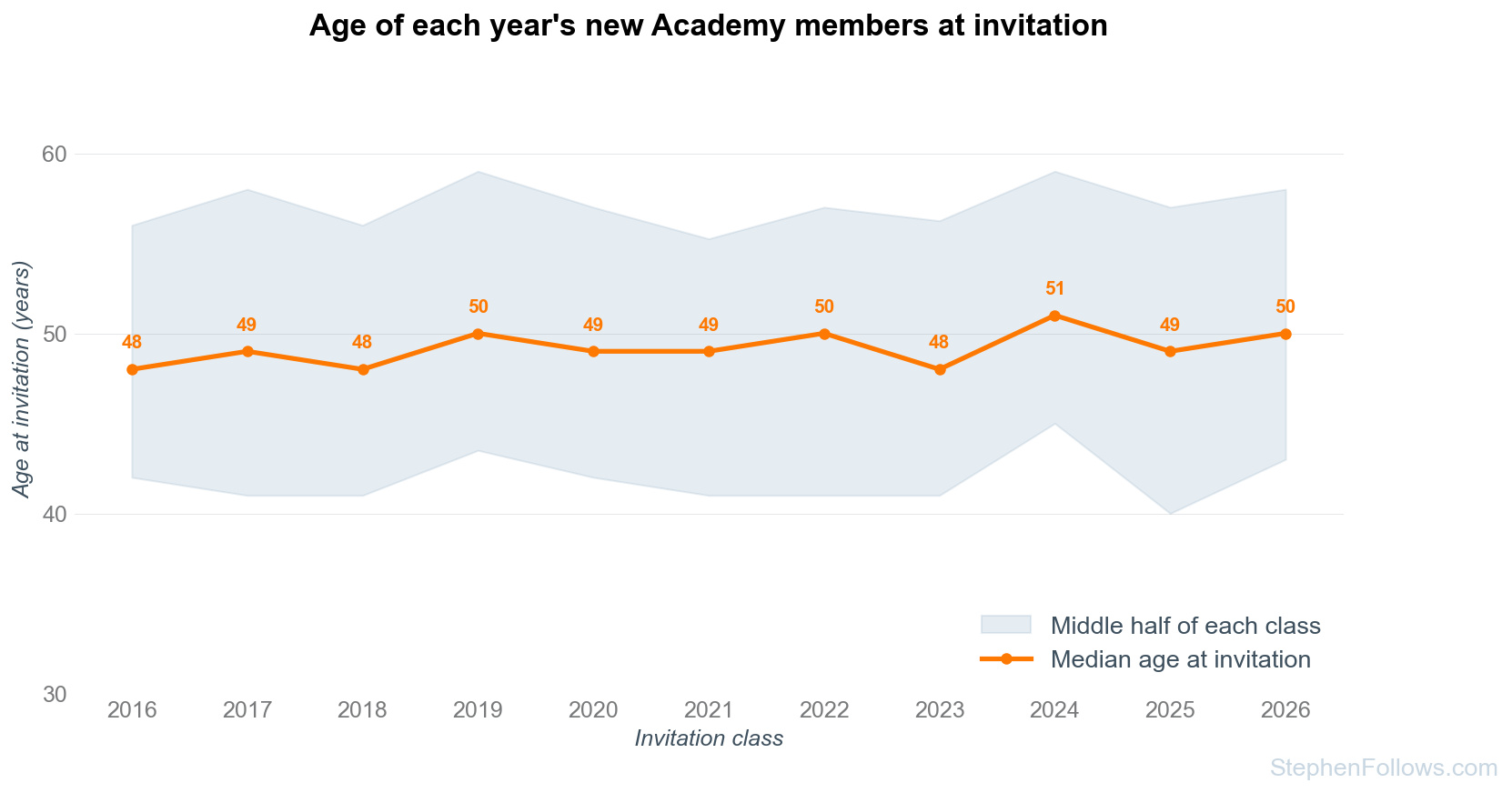
The passage of time and the flurry of new entrants have pushed against each other in order to keep the median age of voters fairly stable since 2012.
Mel Brooks and Dick Van Dyke (both 100), Eva Marie Saint (102) and Jacqueline White (103) pull so hard on the average that the Academy would need to invite ten typical new members just to cancel them out.
Age is a sensitive topic in the film business
Each year, the Academy announces each new class with stats on the gender, ethnicity and background of the new entrants… but not age. Age is the one demographic it does not publish stats on, nor set any targets for.
To some degree, I can see why. Every other dimension of the diversity drive can be fixed by invitation. But because the Academy’s own membership rules manufacture an old-skewing body (i.e. you need to have had a long career to get in, and then you’re offered a lifetime membership), it can’t quickly affect the age of its constituency.
In 2016, as part of the post-#OscarsSoWhite reforms, the Academy began moving long-inactive members to non-voting emeritus status. The backlash was immediate. A 91-year-old screenwriter named Robert Bassing, a member since 1958 whose last credit came in 1977, threatened to sue for age discrimination rather than give up his ballot.
The purge, in the end, was tiny. The Academy’s CEO, Dawn Hudson, said:
It was fewer than 1% of members that were asked to move to this status, and most of them willingly did.
This is, after all, an industry that has litigated the question of whether your age should even be public. In 2011 the actress Junie Hoang sued IMDb for more than $1m for publishing her real birth date, arguing it branded her over the hill; a jury sided with IMDb. California then passed a law in 2016, backed by SAG-AFTRA, forcing IMDb to delete ages on request. The courts struck it down as unconstitutional, and the ages stayed up.
In the end, I was left surprised that the Academy wasn’t older. And there is something fun about an electorate with an 80-year age gap trying to agree on their favourite movie.
Further reading
If you want to read more about the Oscars, you may enjoy:
Notes
The member list comes from the Academy’s 2026 member directory (11,200 members). I matched 92% of members to credit-database identities, then took birth years from IMDb, TMDb, OMDb and Wikidata. After excluding members with recorded deaths, that gives 5,367 living members with a verifiable birth year, 48% of the membership.
Coverage is not uniform, as actors and other prominent members are more likely to have public birth years than, say, publicists. The least-documented members skew towards recently recruited and to younger branches, so the true median age is likely to be slightly lower than I can calculate.
The age-at-invitation figure covers the 2,350 members of the 2016 to 2026 classes with known birth years. The LA Times figures cited are from its February 2012 study (median 62, 14% under 50, 86% over 50, identities confirmed for 5,112 of 5,765 voting members). Their study covered voting members; mine covers all listed members, roughly 91% of whom hold voting status per the Academy’s most recent announcement.
It’s an interesting parsing of the data. people talk about the age of the Academy members, however, people who’ve been in the business for two years and very young, haven’t had the experience to warrant and merit membership.
It’s an invitation to a distinguished membership, that you earn after you’ve shown that you have abilities and dedication and longevity and skill in one of the categories of the Academy,
So it’s going to naturally skew older, because someone who’s 24 years old, it has been in the business for two years, hasn’t really earned the level of career longevity to be admitted to the academy. Of course there are occasional exceptions, but for the most part, it takes time to be considered a career professional, ergo, older membership
Considering how dicey a career in film is, if you do anything substantial whether one or ten times you should probably be let in. I mean substantial, like 'Obsession' or something. It seems to me, you do anything big once, you're gonna get at least three more films out of it. And is Emiritus status really such a step down? You can still say you're a member of the Academy. Is anyone gonna shake you down about who you voted for? But I guess if you're 91, what else you got that really matters to you besides your health? And that IMDB litigation is nuts. You can generally figure out someone's age without much brain drain based on their filmography and the roles they played.