


Technically, the Festival de Cannes has another six days to run, but the business side of the Marche du Film is already over.
I have spent the past week talking with people, walking the Marché, dropping in on panels, and listening. My overall impression was that more is shifting under the surface than the official press releases reveal.
While Cannes 2026 felt a little calmer than last year, it wasn’t for reasons worth celebrating. Film professionals felt more focused, resigned to some changes, oblivious to others, and parts of the industry seemed thinner around the edges.

Here are the nine things I took away from this year’s festival:
Cannes got bigger and quieter at the same time. Record attendance, thinner buzz, fewer parties, shorter stays.
The word “strategic” was everywhere. Fewer meetings, more deliberate ones. Risk mitigation dressed up in a less scary-sounding word.
AI is regarded as an analyst, not an author. And unlike previous tech, it is not going anywhere.
Hollywood and streamers were nowhere. No studio tentpoles, and some key streamers felt less relevant in conversation and the press.
Japan was everywhere. Country of Honour, attendance up around 50% and a new Japan IP Market.
Private money and co-productions are the talk of the town. As pre‑sales have weakened, private equity has stepped in.
Europe is organising to protect itself. 4,700 film professionals signed a letter to the EU, Mubi launched a co‑financing pact, German auteurs revived Dogma.
The market is still trying to understand the kids. Gen Z is the only growth story, and the market is still deciding how to adapt.
And the Marché is trying to understand TikTok. First Creator Economy Summit, the largest virtual production stage at any film market, an AI for Talent Summit in its second year.
Let’s go through each in turn.
1. Cannes got bigger and quieter at the same time
By the headline numbers, this was the biggest Marché yet. Reuters and Variety reported 16,000 accredited participants from over 140 countries, up from 15,000+ in 2025. Deadline counted 1,700 buyers, 600 exhibiting companies, 250 industry events, and a festival‑wide footprint of around 40,000 professionals.
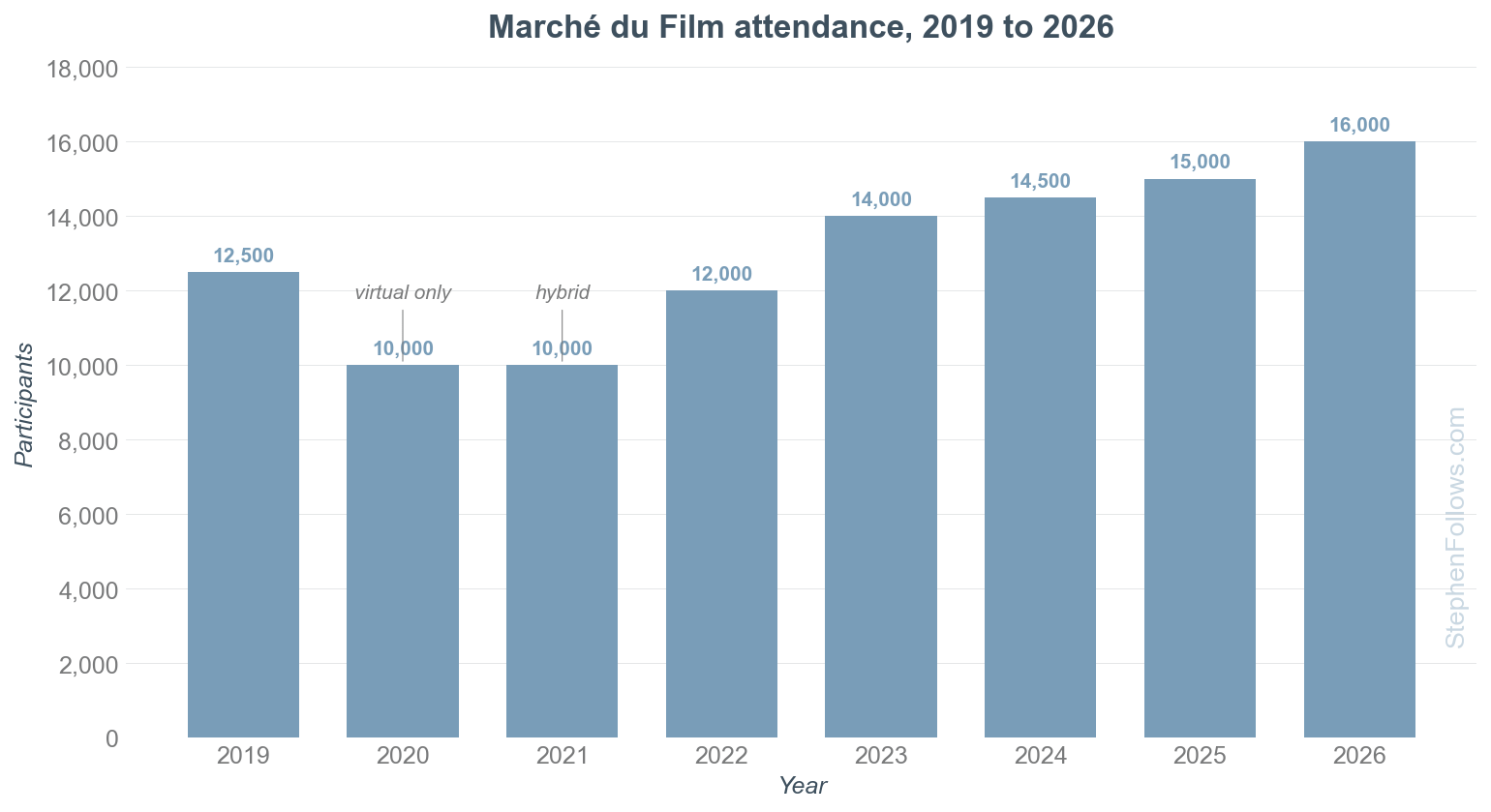
And yet the energy was thinner. I’ve noted in the past how an increasing number of industry veterans are choosing to skip expensive booths and passes in favour of just meeting in hotels and cafés. 2026 only seemed to accelerate this, with the Palais fighting a losing battle to remain the centre of the market.
Stays were shorter, schedules tighter, and the social calendar continued its decade‑long shrinkage with far fewer parties than ten years ago.

As the pandemic began to ease, many asked what would become of in-person events such as Cannes. I think we‘re starting to see the answer emerge. The time‑consuming bits of dealmaking can be handled by email, Zoom and screeners, so Cannes is where humans confirm in person what has mostly already been agreed.
So while I don’t doubt the 16,000 attendance figure, I suspect it doesn't mean the market is healthier, but just that the market has more spectators.
2. The word “strategic” was everywhere
If I had to pick one word that has run through my conversations this year, it would be "strategic." I heard it used by buyers, sellers, financiers, even the festival programmers used it, when describing why they had selected the films they had.
What people mean by it:
Fewer meetings, but more deliberate ones.
Fewer films, but more carefully packaged.
Fewer parties, but the right ones.
A market that has lost its appetite for discovery and instead follows a narrow checklist.
Roeg Sutherland, co‑head of CAA Media Finance, framed it as an opportunity, telling The Ankler:
The market is absolutely disrupted, but in that I always see opportunities. There are opportunities to build distribution companies. There are opportunities to make movies for the right price.
Fionnuala Jamison, managing director of mk2 Films, framed the new buyer brief in a Screen Podcast interview thus:
What we’re hearing from buyers is that they want the best films, great filmmakers on top of their form. Then we have to look at how difficult the subject is potentially and how demanding it might be on the audience in terms of filmmaking style. Then it’s factors like uniqueness, pitch, and whether there is an obvious marketing hook for distributors.
This is risk mitigation by another name, and it tracks with what I picked up at the EFM in February. The default setting for everyone in the room is now caution… even if they don’t use the word.
3. AI is regarded as an analyst, not an author
In Cannes 2025, it felt like AI was everywhere, but nobody knew what to do with it.
In 2026, it seems that people are comfortable saying out loud that AI is being used to analyse projects, such as simulating focus groups, profiling audience overlap, generating storyboards, and suggesting marketing copy, and panels openly discussed how AI agents can provide you with an “unfair advantage”.
Just an aside, I have genuinely lost count of how many people have pitched me their new start-up, which can turn your script into a storyboard or do pre-production work. I was trying to keep count for this article, but I foolishly didn’t write them down, and now all I can say is that it was more than twelve.
What remains unsayable in polite company is AI as creator. Steven Soderbergh’s John Lennon: The Last Interview, which uses Meta‑generated video of Lennon and Yoko Ono for around 10% of its runtime, sparked a lot of debate. Variety reported that Patrick Wachsberger’s Legendary‑backed sales company 193 has boarded the film, with Meta listed as the film’s technology partner. The Meta partnership at the festival itself, including the “Meta House” at the Majestic and Ray‑Ban smart glasses on a brigade of influencers, prompted a backlash captured by nss magazine.
Weeks before the festival opened, around 4,000 French actors signed an open letter in Le Parisien, including Bérénice Bejo, Léa Drucker and Swann Arlaud, describing AI as a “devouring hydra” engaged in “organised plundering”.
Demi Moore told Variety:
AI is here. To oppose it is to engage in a battle we are likely to lose.
Peter Jackson, accepting an honorary Palme d’Or, told The Hollywood Reporter AI was”
…just a tool like any other…no different from other special effects”.
The strangest case study sits just outside the festival. Gossip Goblin, the kitchen‑table AI filmmaking outfit run by Zack London from a Stockholm apartment with a team of eight, has clocked over 500 million views on its short satirical AI films. The Hollywood Reporter reported that LA agents, producers and studios are now flying to Stockholm to meet him (note that they are not coming to Cannes to pitch their wares).
Cannes often sees technologies come and go (3D, VR, NFTs, Metaverse, blockchain, etc.), following the same hype-to-bust playbook. But AI is not like others
I tracked mentions of new technologies in the Cannes trade‑press daily from 2019 to 2026 (Screen Daily, The Hollywood Reporter and Variety) and noted how often each technology was mentioned (my methodology is at the end of this article).
This reveals that AI is not just a new fad, neither in scale nor fleeting nature.
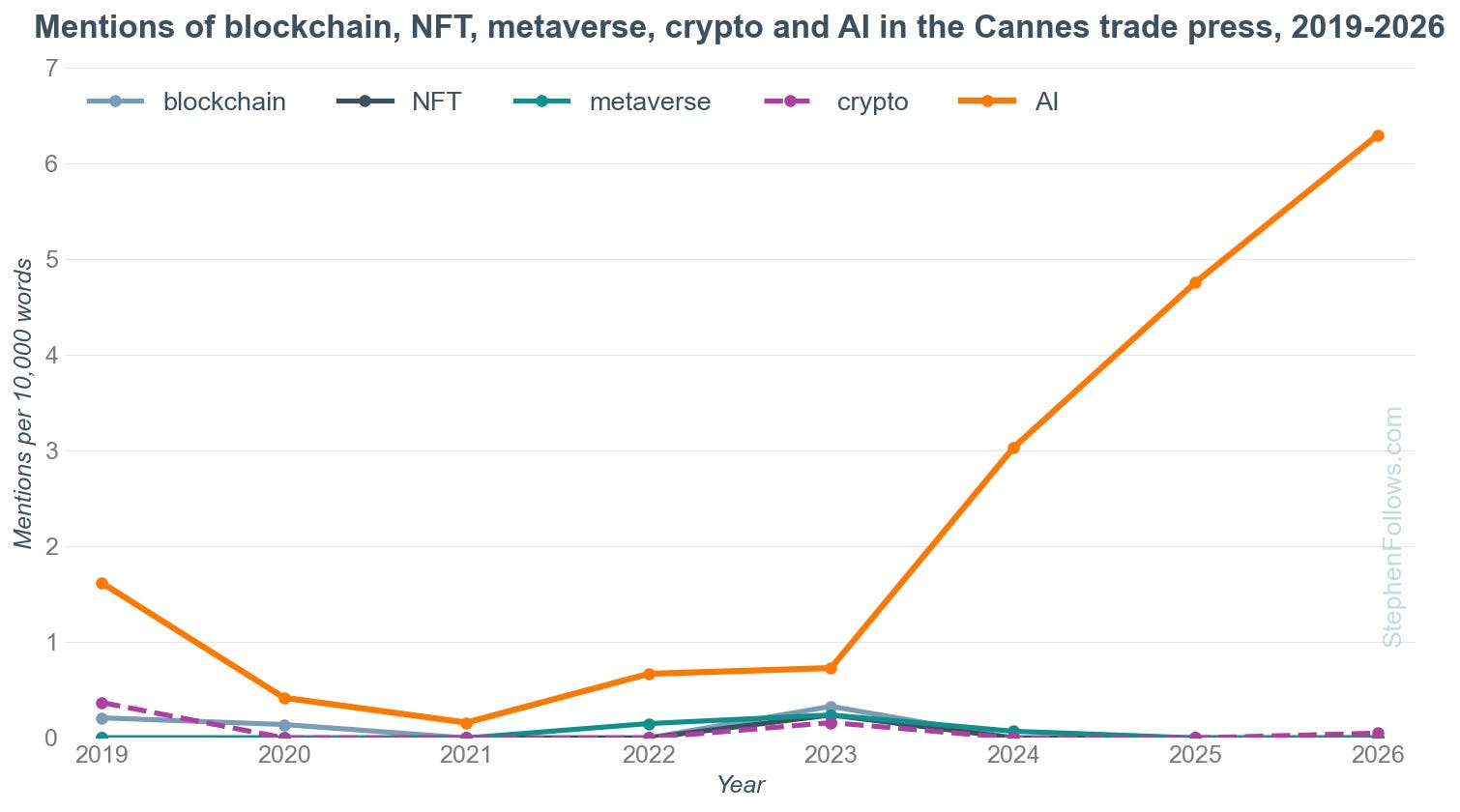
It’s worth noting that not all the ‘blip’ new techs are the same. While NFTs and VR are genuinely absent, blockchain technology is powering many of the startups in Cannes. It’s that the people have learned not to use certain words, and instead focus on the benefits, not the underlying technology.
4. Hollywood and streamers were nowhere
For the first time since 2017, no major Hollywood studio brought a tentpole to Cannes. In another life, we might have expected to see Cannes premiere Spielberg’s Disclosure Day, Nolan’s The Odyssey, the Cruise/Iñárritu Digger.
