


A few weeks ago I published the first half of my conversations with the people who read cold scripts for a living. I spoke to 38 agents, managers, assistants and junior execs on which credentials actually get a script read.
We learned that getting your script on the annual Black List or winning the Nicholl Fellowship can turn heads, but that few other competitions or laurels help.
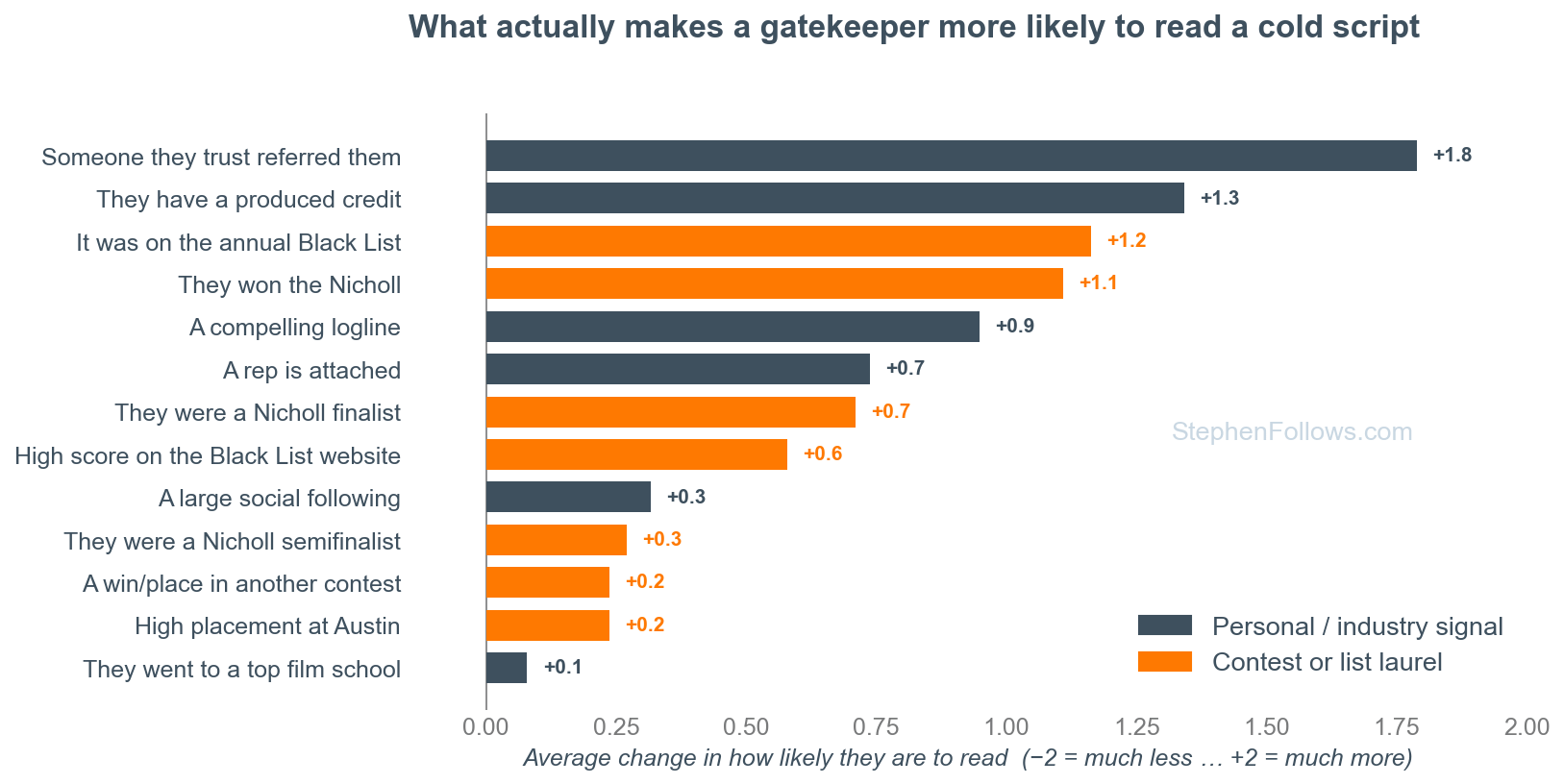
So let’s say you’re not one of the lucky few who have achieved those rare accolades - how else can you get an agent to read your script?
Today I’m sharing the advice these same people gave to aspiring screenwriters.
Overall, the sentiment was not warm towards cold approaches. One put it like this:
I pretty much delete all cold emails automatically unless I’m bored, which is rare.
Yikes. But just because it’s hard doesn’t mean it’s impossible. In fact, if we look at the numbers another way, we can see that, like Jim Carrey’s character in Dumb and Dumber, I’m saying there is a chance.
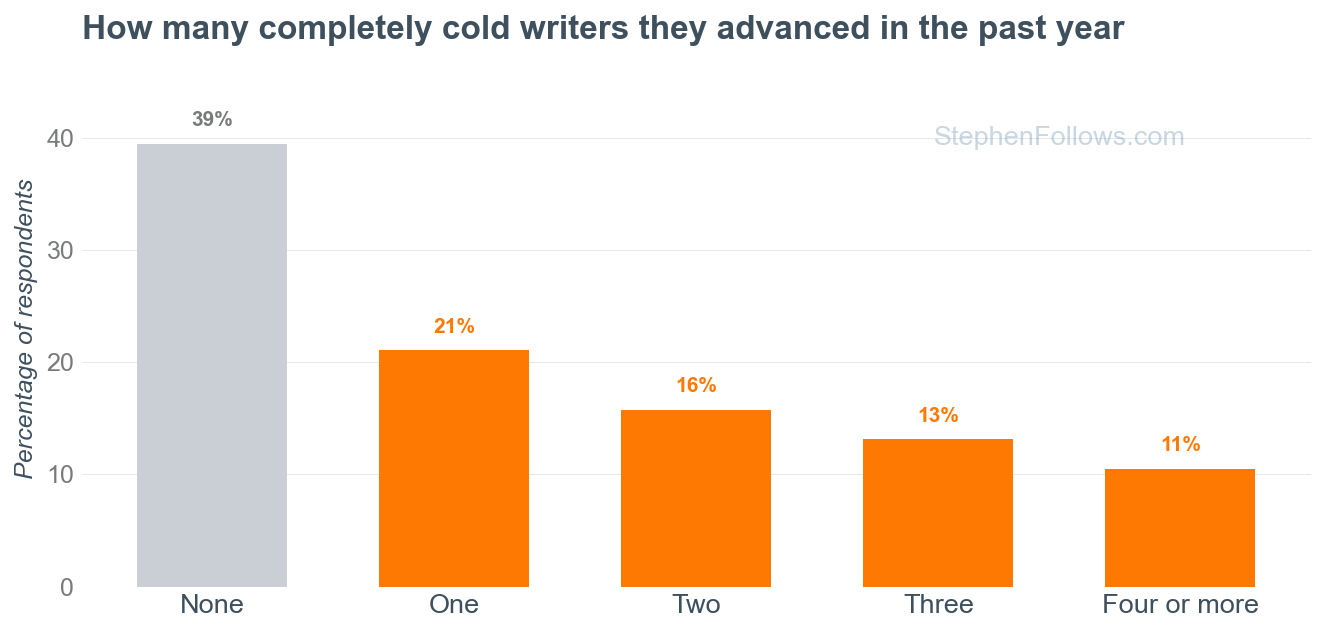
So what can you do in your cold approach to be one of the select few? In my interactions with these gatekeepers, a number of actionable steps emerged.
Personalise, because they can tell
Do your homework
Never use AI
Hook ‘em fast
Do not oversell - they check
Make it short, professional, and polite
Tell YOUR story
Let’s look at each in a little more detail.
Rule one: Personalise, because they can tell
The most common theme by a distance was personalisation, or the lack of it. A cold query that could have been sent to anyone gets deleted on sight.
Immediate pass if there is zero customization to me personally, ie I can tell someone has sent the exact same query to myriad reps and they’re throwing spaghetti at the wall.
And they really can tell. The mechanics of the mass-blast betray the sender in ways writers may not realise:
Please don’t copy and paste the same email to every manager... we can absolutely tell (especially when our names and companies are in different fonts than the rest of the email).
Some described wanting a genuine point of connection, a mutual professor, the same festivals, a shared former colleague, and added a detail that should give any name-dropper pause. If a writer claims to know one of their clients, they will sometimes text the client to check.
Rule two: Do your homework
Know who the company is and what it does, include the logline, a short synopsis and the practical details, and be clear about what you are actually asking for.
They need to do research about what we do.
One assistant even offered a workaround for companies that officially take no cold queries at all:
If the person put the work in to find my personal email address NOT JUST LINKEDIN I will at least read a logline and go from there.
Several also said the smartest queries arrive with more than a bare script. As one expert put it:
You always love to see a short sizzle or something extra, before I just commit myself to 120 pages of a stranger’s script... at the minimum showing that there’s more of a vision beyond the pages usually helps.
Rule three: Never use AI
I would hope this one was obvious, but just for the avoidance of doubt - don’t use AI. Anywhere, ever.
I’m not anti-AI, but if you’re saying you’re a professional writer, then even a whiff of generative AI in “your” writing or emails is a killer. (And the suspicion of AI use can even lose you a $2 million book deal, as we saw last week).
As one person put it:
And never ever use AI to write your cover note. One can pick that a mile off.
Rule four: Hook ‘em fast
Even a perfect email only buys you a few pages of attention. We already learned that just 8% read the whole script. 13% have decided by page five, and two-thirds have decided by the end of page ten.
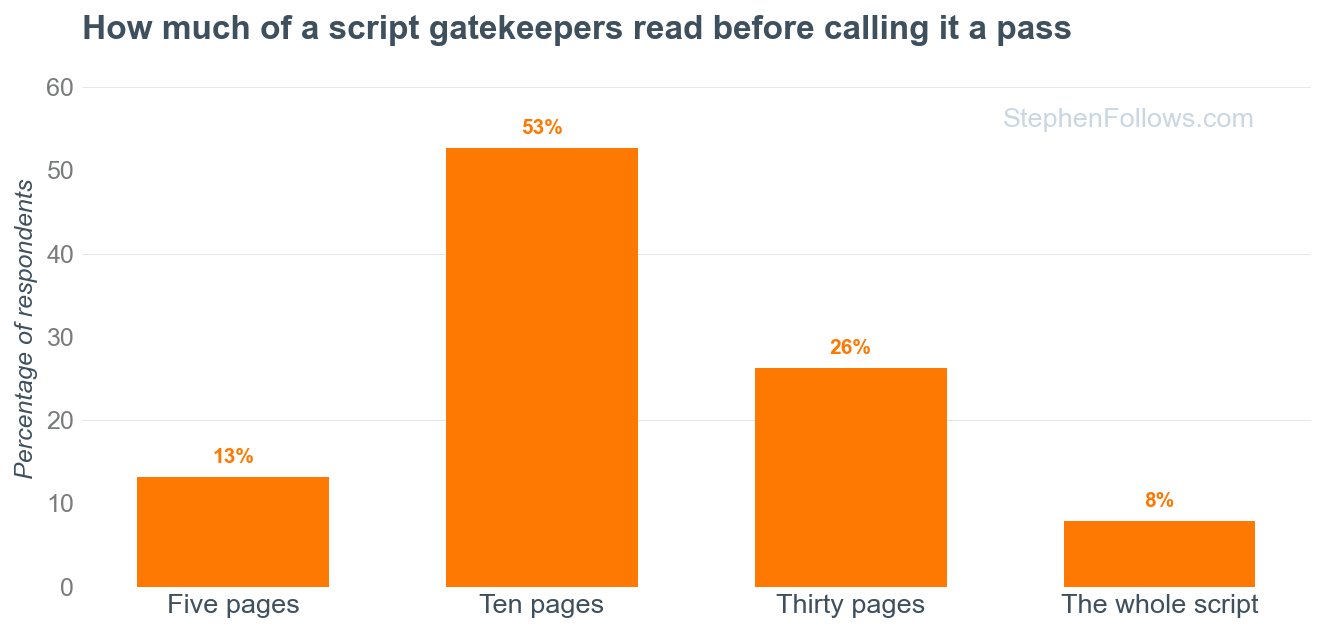
So the opening pages have to do what your email did and earn the next minute of their time. One agent with more than ten years in the business went further than any page count:
I read the first line. Not so good is lots of description to start the script. Less is more!
And a junior exec made the same point about the query itself:
I rarely respond to cold queries, if at all. If anything an undeniable logline can get me interested.
It’s a layered approach - the logline earns the click, the first line earns the first page, and the first ten pages earn the rest. You’re fighting uphill at each stage.
Rule five: Do not oversell - they check
Inflating a minor credential reads as naivety, the opposite of what the writer intended.
Bigging up more low key prizes, or interest from irrelevant producers, too much... it shows a naivety or lack of industry understanding.
And the checking is not hypothetical. One manager described their own diligence:
What turns me off is if the query says they’re “in development” on a number of projects and easy research shows those projects are, at most, optioned.
Rule six: Make it short, professional, and polite
This is a lesson we should all apply in our everyday lives, but it applies even more when cold-calling industry gatekeepers with your script. As one put it:
A long, verbose, cryptic query letter is an immediate pass. Concise and professional, and material-forward!
Long emails with typos, loglines that strain to be funny, flowery begging, all named as instant passes.
One exec boiled the ideal email down to a formula:
Short and concise is good. Pitch the hook, why this project is UNIQUE, relevant attachments and background, and a very short reason the writer is compelling as well.
This etiquette does not stop at the first email. One agent, a generous reader who gets through whole scripts and advanced three cold writers last year, drew a single hard line:
I will immediately pass if I get a rude chase up.
There was even a warning for writers who do have representation and query anyway. More than one reader said an already-repped writer reaching out alone is a red flag rather than a plus. As one agent put it, the first question in their head is simply:
Why doesn’t their rep reach out?
And several respondents added that their company will not read genuinely cold queries at all, often for legal reasons, and route everything in through a referral instead.
Rule seven: Tell YOUR story
Many of the respondents said that the query needs to tell them where you are going, not just what you have written. One said they wanted writers who have:
…achieved momentum on their own and know why they’d now want an agent.
That word momentum came up in different forms across the answers. It does not have to mean much. One manager with over a decade in the business set the bar at:
I will read if they’ve been recommended by a producer or have produced something (even if only a short film, taster, etc)
Another put the same idea in the past tense:
My default is to pass immediately - the few I have responded to were because they had some level of success already with produced credits or competition wins.
This matches the numbers from my previous article, where a produced credit was the second-strongest signal of all, behind only a referral. A short film, a taster, a staged reading, a web series: anything.
The headline here is that the writers who get read arrive mid-journey, whereas the ones who get deleted arrive asking someone else to start the journey for them.
Other tidbits
One of the POVs I personally file as “unfair-and-wrong-but-also-I-kinda-get-it” was:
Do not send a feature script longer than 110 pages.
I have previously shown that length of screenplay is not a good measure of the final movie. (see Does one page of a screenplay really equal one minute of screen time?). That said, if the perception is shared by whoever the gatekeeper will later have to share the script with, maybe it has merit.
Not all the advice was depressing. One said :
The only thing that could ever get me to read a cold query is an amazing log line.
Epilogue
At the end of the day, as dispiriting as it can be to have to write cold emails that are endlessly ignored or rejected, remember that the people at the other end are passionate industry professionals like you.
They are dealing with a deluge of hopeful strangers who are swamping their inboxes, and making it hard to tell who’s good and who’s not.
But if you have the right talent and work ethic, these people DO want to hear from you. They DO want to champion good writing and to build a career alongside you.
You just need to work extra hard at the start to show that you exist and that you stand out.
Good luck!
imagine if we had this kind of stringent gatekeeping to the actual making of the films, imagine how many more of them would have a coherent third act
I can vouch, they do phone up to check on the details. I had a big UK agent phone me up to give me what for because "we don't have liars on our books". When I explained that what I'd written in my enquiry letter was true, their tune change (along with the warmth of their voice). "By all means, send us your script!" Me: Hmmm, nah.