


Kane Parsons has just become the youngest person to direct a film that reached number 1 at the US box office with his smash hit Backrooms.
Rather than celebrate this achievement, some have decided that it’s just not possible and have built a fringe conspiracy theory that he did not actually direct the film. What a world we live in, eh?
Kane himself seems amused by the patently false rumour, and commented on it exactly how you might expect a 20-year-old to - via a pinned YouTube comment in which he said:
This is actually all true. They don’t tell you this, but 96% of all movies released in North America and Europe are actually directed by the same person. They call him ‘The Older Gentleman’. He has had all of Hollywood in a chokehold for decades now.
I looked at the directors’ ages behind 4,690 credits to see how old they were when their movie was released.
Rather than looking at all movies made, I focused on those with at least 50k votes on IMDb. This enables meaningful coverage (many early-stage directors have biographical data available) and lets us focus on professional, working directors.
For those wanting a sense of how famous a film has to be to be included, this filter just about includes the 1998 Very Bad Things starring Cameron Diaz, the 2007 horror film Teeth, and the 1995 Jackie Chan beat’em up Rumble in the Bronx.
Forties for the win
Across the dataset, the median director age at the time of release is 45. Half of all credits fall between 39 and 52. The distribution is right-skewed, which is a data nerd way of saying a few very old men are pulling up the average.
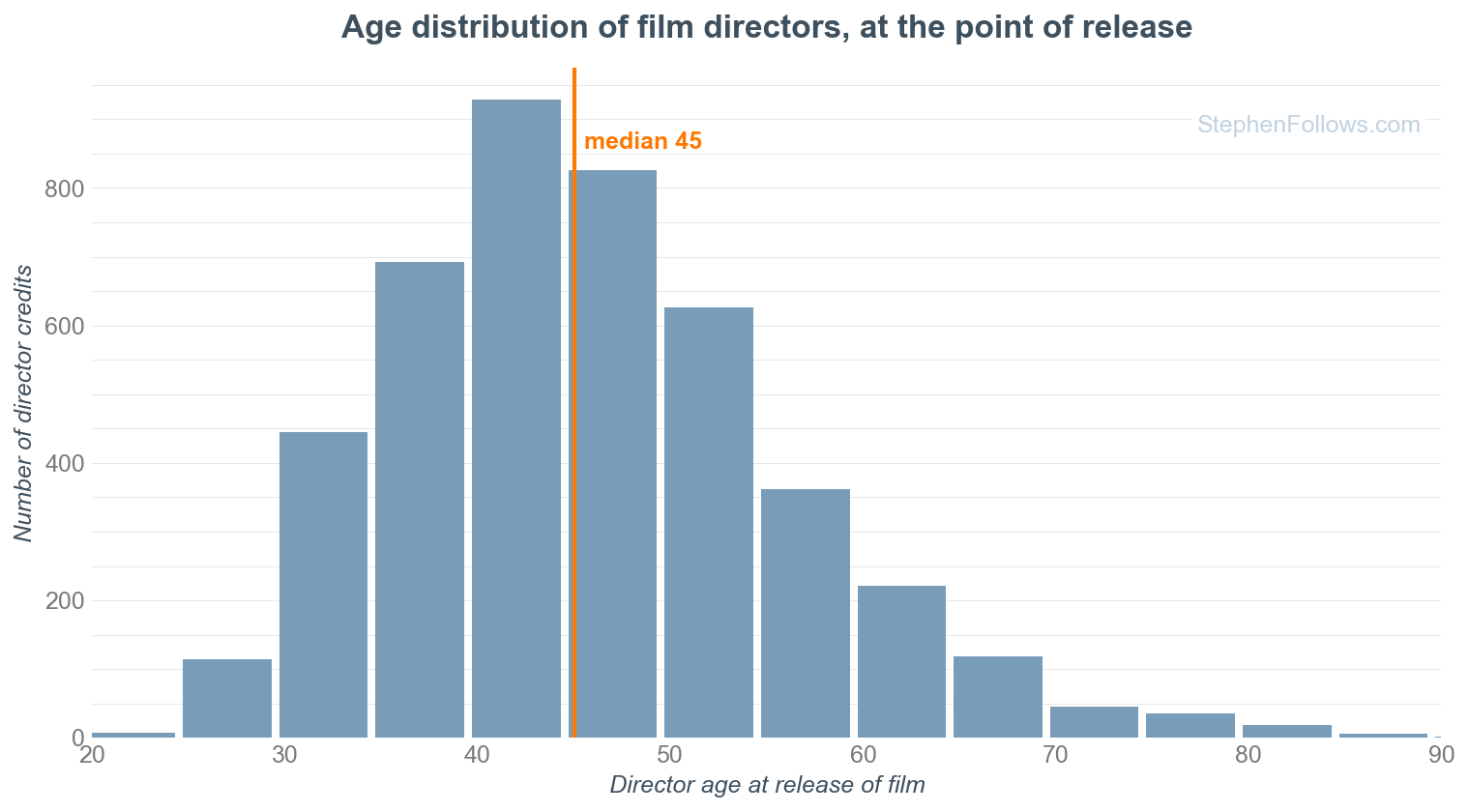
While this is interesting already, what's under the surface of these numbers is even more revealing.
Have directors always been this age?
You might have expected the headline average to have slowly drifted upwards, given that the UK and US working populations have aged over the past forty years, and many creative industries have aged with them. But that’s not what we see in the data.
The second-highest decade for directors’ ages was the 1950s, when the median age was 47. This is the tail end of the studio era, when the people running widely-seen films were largely those who had been running them since before the war. Alfred Hitchcock, William Wyler, John Ford and George Cukor were all in their 50s and 60s, and Cecil B. DeMille was directing into his 70s.
Between the 1950s and the 1980s, the median fell five years, from 47 to 42. This is the studio system’s collapse, the French New Wave’s influence on the Americans who noticed it, the rise of film school as a career route, and a New Hollywood generation who broke in early. Peter Bogdanovich, Martin Scorsese, Francis Ford Coppola, Steven Spielberg, Brian De Palma and George Lucas were all directing widely-seen features in their 20s and 30s. Directors got younger because the gates opened.
This century, we’ve seen a reversal of the trend, and by the 2020s, the median director of a widely-watched film is seven years older than their 1990s equivalent.
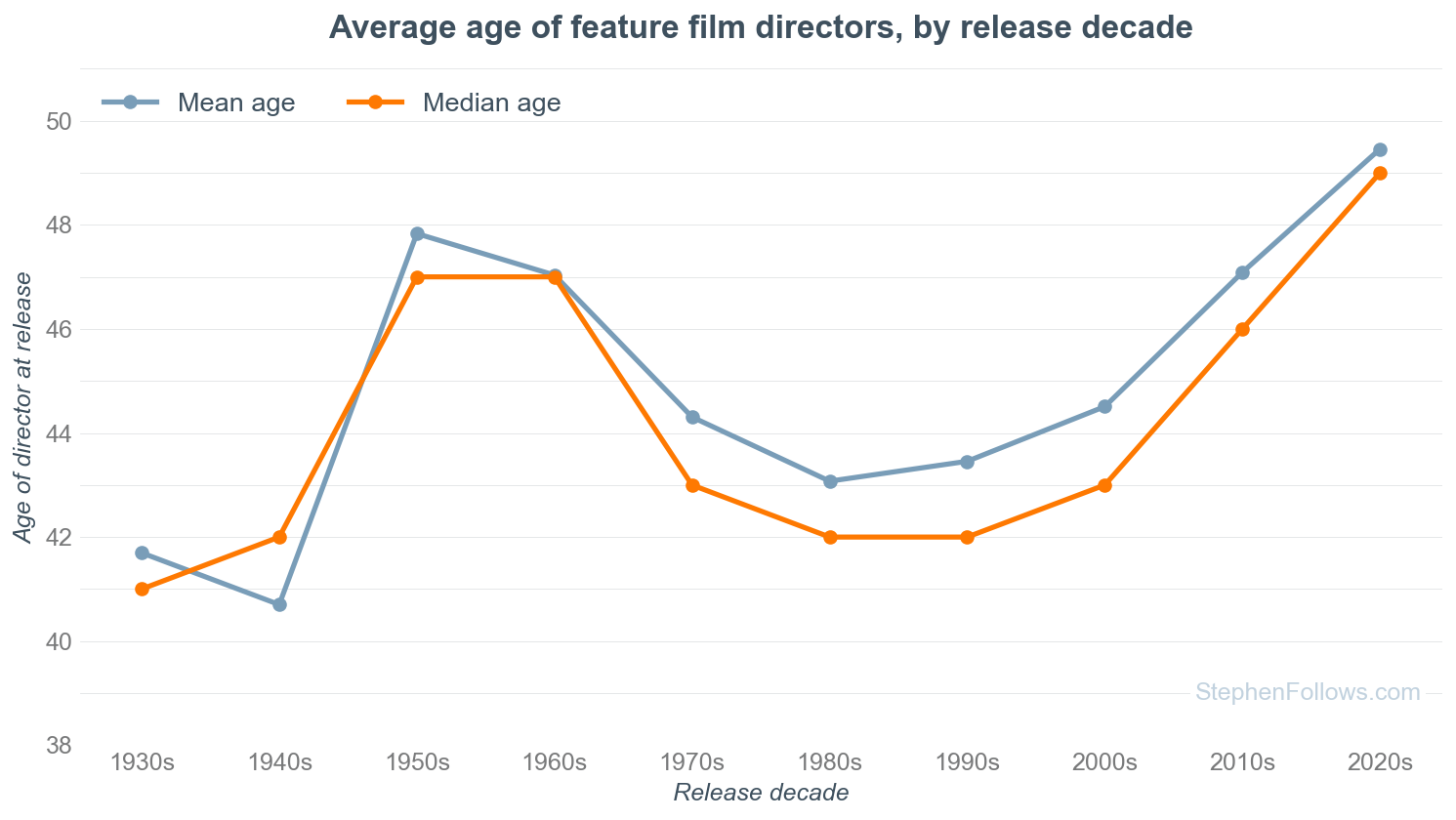
So it’s true to say that film directors are getting older… but only if you compare now to thirty years ago. And we’ve now edged just past the old 1950s high, the oldest the director’s chair has ever been
The changing faces of film directors
As new types of people were being given command of commercial films, we have seen the director’s age change. But while one aspect evolved (i.e. ‘hippy types’ took over from the studio old hands), another did not - they were still mostly men.
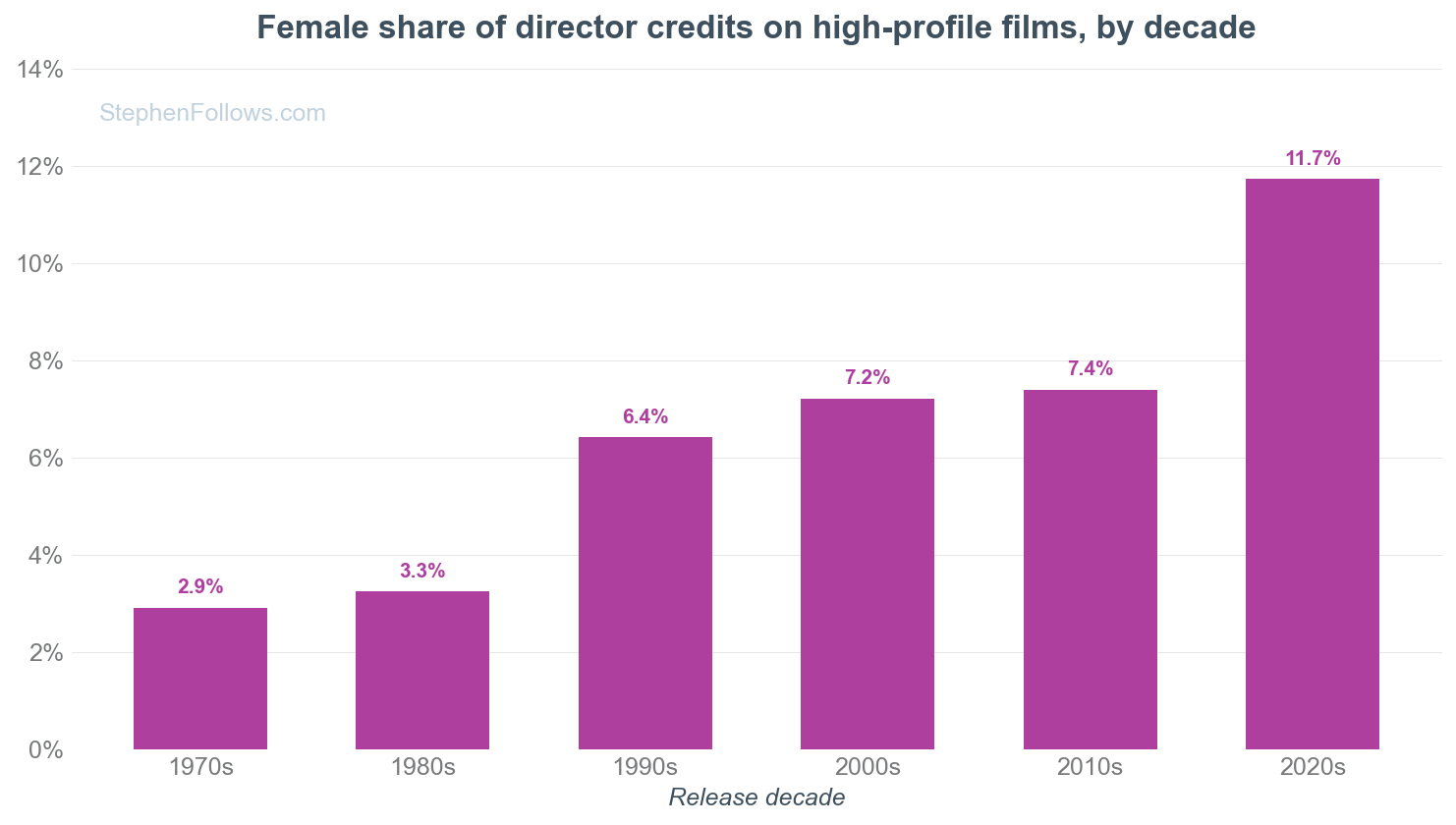
The 1990s saw an increase in female directors, and in more recent years, we’ve seen another increase in diversity (albeit far from parity). You might reasonably ask how this change affected the average age of directors.
Male directors have got much older (from a 1980s mean of 43 to 50 today), but the average age of female directors has barely moved, hovering around 44 for the past two decades
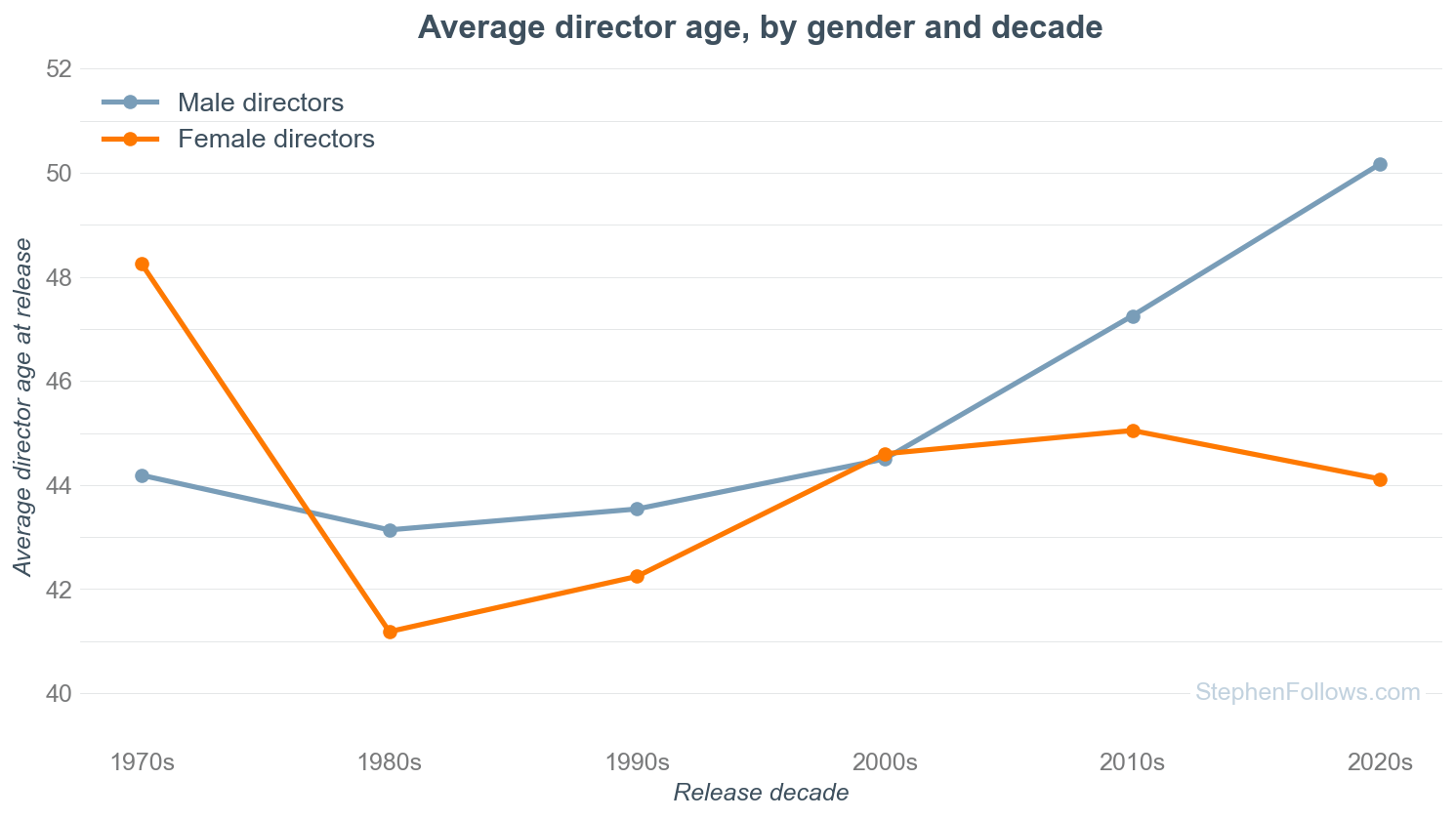
This means we need to update the finding we stated earlier in the article. Rather than concluding simply that “Film directors are getting older”, we need to say instead that “male film directors are getting older”.
Women are pulling the overall trend down, not up. Without the male credits, the 2020s mean would sit at 50 rather than 49.
Are old people hoarding all the cash?
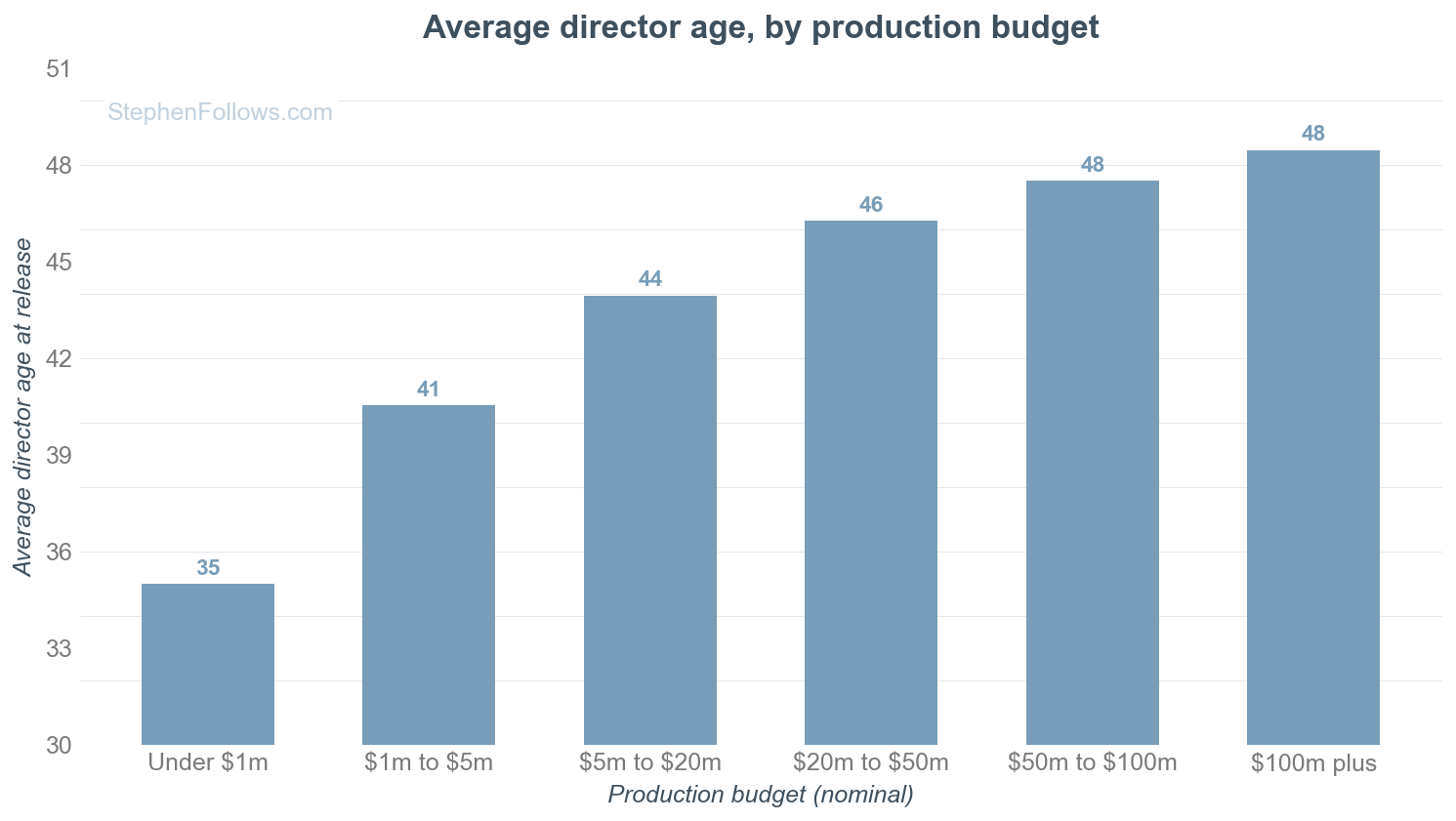
As with wider society, it is indeed true that most of the money is given to, and held by, the most age-challenged folk.
Joking aside, this actually makes sense. Bigger budgets are generally given to people who have proved their capabilities on previous projects, so they are more likely to be older. In addition, the types of films that can raise the biggest budgets are also those that tend to pick their key creatives from established networks.
Which genres are run by younger directors?
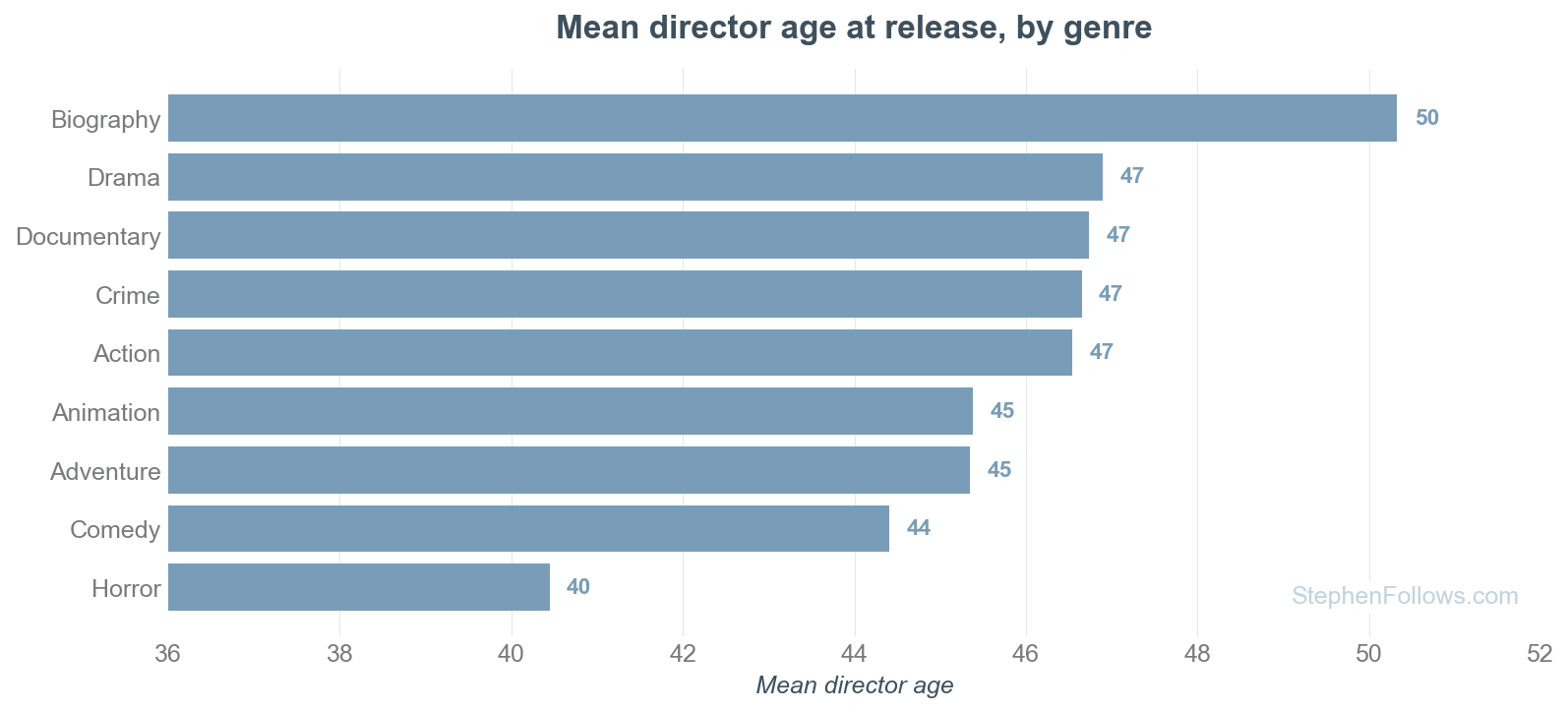
As well as Backrooms, last month also saw the release of box-office smash horror movie Obsession, directed by 26-year-old Curry Barker. This is a slightly more common sight, as horror has the youngest average director age of all genres, at just 40 years old.
Some of this is a function of lower budgets, and it mirrors the audience demographic, in which horror has the youngest adult audience, whereas biographies and dramas have among the oldest.
Further reading
Here are other projects I’ve conducted on age demographics:
Notes
Today’s research examined every feature film with at least 50,000 IMDb votes that was released theatrically since 1930. That gave me 4,690 director credits across 4,203 films, of which I could find reliable birthday years for 95%.
I worked out the age by subtracting the year of birth from the film’s release year. This is coarse (i.e. a director born in December releasing in January will be out by one year) but at decade-scale trends this does not matter.
Production budgets are from OpusData (The Numbers) and are nominal, not inflation-adjusted.
For the avoidance of doubt, this is directors and co-directors, not the second-unit, assistant, art, and casting directors.
For most of film history, people publicly identified with one of two genders, so I have mirrored this binary approach in reporting the numbers. The number of people this excludes is a rounding error, so not relevant to today’s topic.
All true Stephen and I was trying to support Raquelle's point. But like Lindsay Brigman said in 'The Abyss': 'Don't be on my side!', ha!
My biases didn't help. What I consider 'serious' film to be that would greatly improve women director numbers would not be 'Clueless' or 'Sleepless in Seattle'. That's on me. I simply should have wrote what you did: women just aren't getting enough chances.
But then what needs to be done? Bigelow did 'Point Break' in what, '91? 'Hurt Locker' got her the Best Director nod. Did those decades of Bigelow films and Oscar improve the ranks? Her stories are male centric with a strong woman sprinkled in, leading or otherwise.
And what if 'Obsession' had been written and directed by a woman? Is the film stil received as a great scary movie or is it just 'women whining again about men just wanting women as sex slaves'?
I saw both 'Portrait of a Woman...' and 'Promising Young Woman' in the theater. I don't recall much of 'Portrait' and in 'Promising' Carey Mulligan's character died in her quest. Killed by a man.
Let me leave off with this: I am currently in film school (Miami Dade College). When my Film Production 1 class was asked what role we aspired to, none of the girls wanted to be directors. They all wanted to be cinematographers or writers. Huh?!
At least women are being given projects that have hundred million dollar budgets. Slow and steady I'm afraid.
Interesting article, but I do think the takeaway here isn’t really age. It’s why women directors have consistently worked on such few films over long stretches of time in Hollywood without meaningful improvement. I just published an article about this. In 2025 women directed films hit an ALL TIME LOW at 8.5% which means that male directors are getting hired 11 times more often than a women.
Surely age isn’t that big of a factor when we’re looking at 51 percent of the population?