


A few weeks ago I went to a screening of American Graffiti at the ActOne Cinema in Acton, followed by a Q&A in which Mark Kermode chatted with Walter Murch. Murch built the sound for American Graffiti, as well as for the seminal 1974 thriller The Conversation.
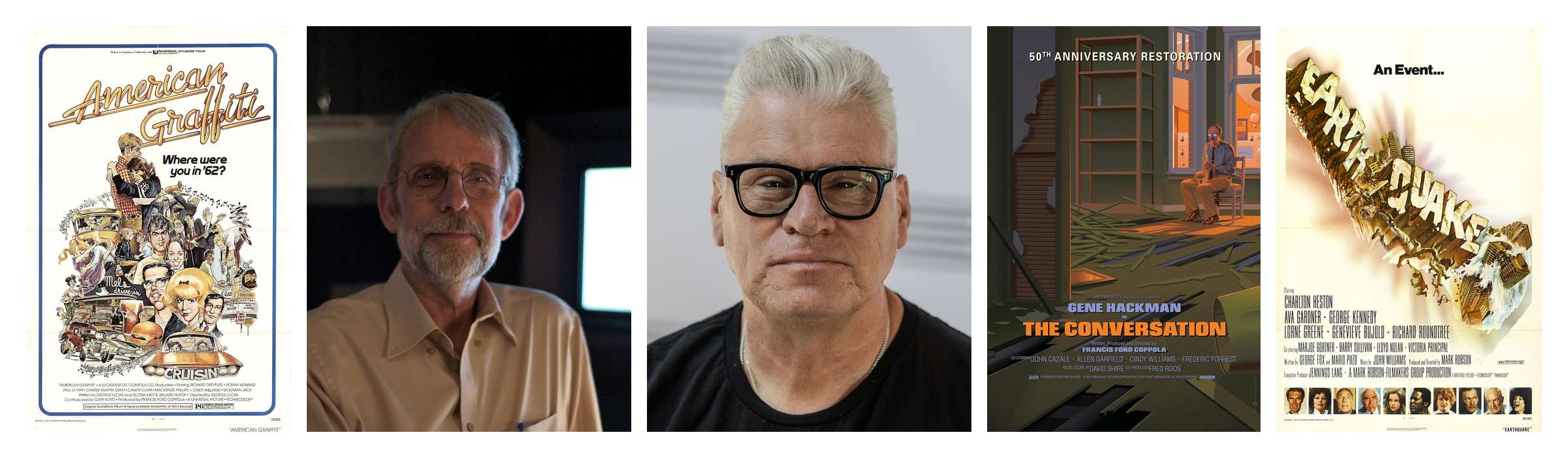
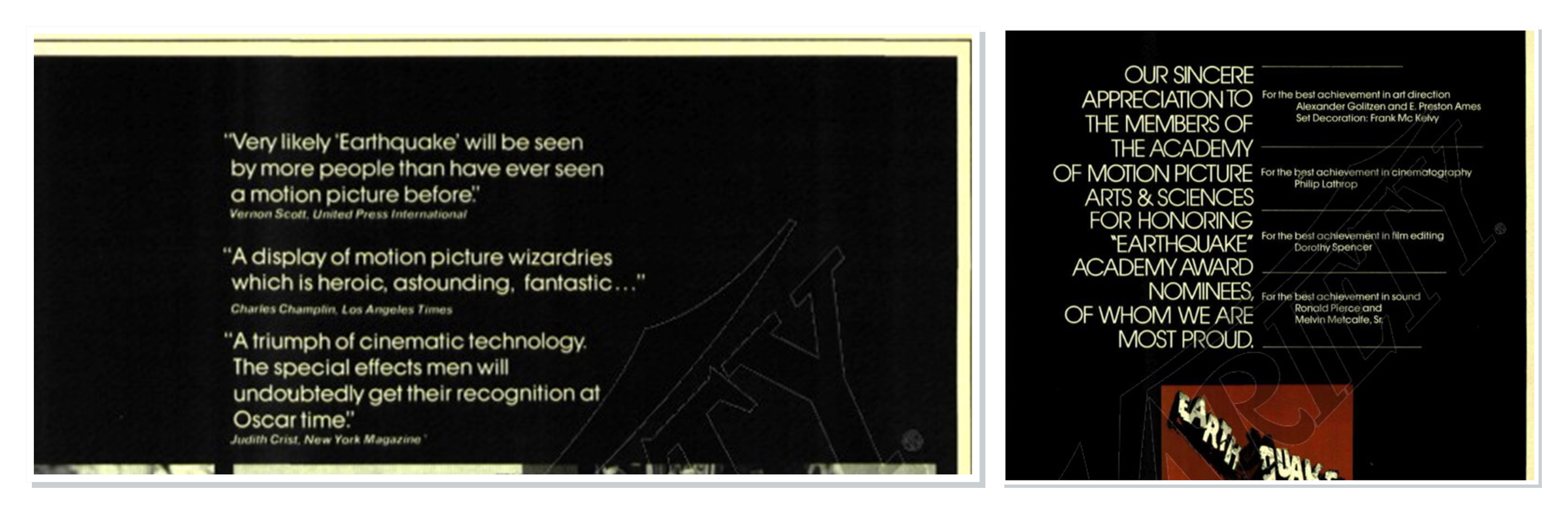
Kermode pointed out how strange it was that The Conversation lost out on the Oscar for Best Sound in 1975 to the disaster movie Earthquake. Murch laughed and said that, in his experience, the sound Oscar goes to whichever film has the most ordnance.
It’s a good line, but is it true?
To get to the bottom of this, I ran a sound-recognition model over 1,423 movies, tracking gunfire, explosions, and other sound elements (I used this previously to look at how action movies are changing).
It turns out that Walter is on to something, although if you do want to win the Oscar for sound, there’s one more thing you need to add as well as the explosions.
Do explosions get you nominated?
Yes, and they have done for a long time.
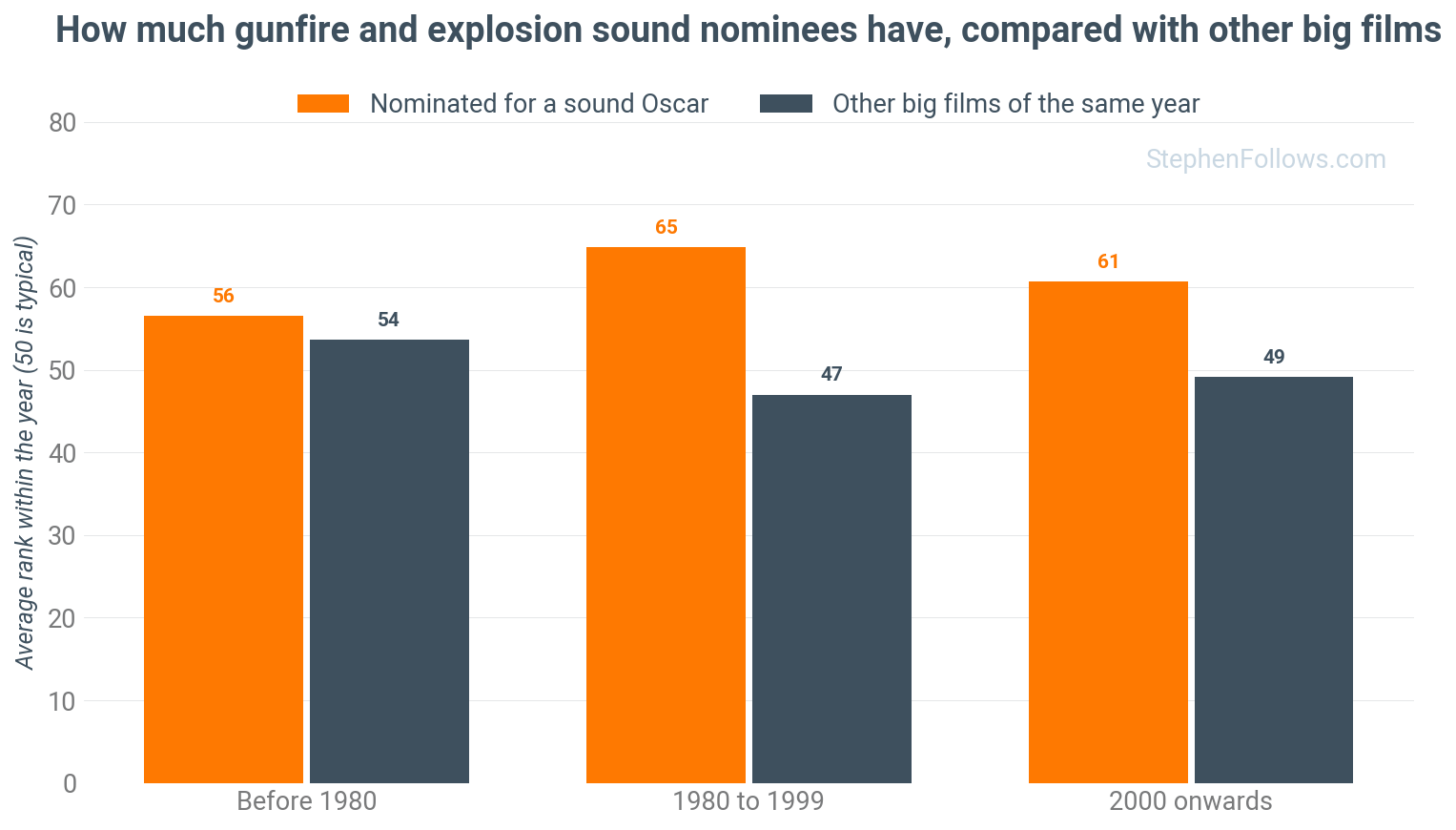
Each year I ranked the big films (every Best Picture nominee plus the previous year’s top 10 grossers) by how much gunfire and explosions they contain. Scoring 0 were the quietest movies, the noisiest scored 100, and the typical film got 50. The chart below compares 478 films ever nominated for a sound Oscar with the big films that were passed over.
Since 1980, the sound nominees have averaged 62 for gunfire and explosions, compared with 48 for the films that missed out. The gap was widest in the 1980s and 1990s (65 against 47), while before 1980 there was barely a gap.
So if your film is loud, low and violent, your chances of a sound nomination go up. This seems to be an open secret in the sound community. Oscar-winning sound designer Randy Thom told Animation Magazine in 2018:
A very high percentage of films that get nominated for sound Oscars are films with lots of battle scenes. We think loud sound, lots of sounds, that must be good sound.
And when director Taylor Hackford accepted an award from the Cinema Audio Society, he told the room of sound mixers:
When I watch the Academy Awards, the Oscar for Best Sound always goes to the ‘boom!’ movies. Boom! Boom! The sound effects that win always have the loudest explosions.
But a subtle difference between those quotes is the rub. Thom is talking about nominations and Hackford about winning. While it’s true that the level of explosions is a good indication of which films get nominated, but the test does not predict which one wins.
Within each year’s Oscar race, I ranked the nominees against each other, so the winner can score anywhere from 0 (the quietest film in its field) to 100 (the loudest). If the soundtrack's content made no difference, winners would average 50.
On gunfire and explosions, they come very close. Across the 46 Oscar sound races since 1980 the winner averages 54, which is well within what chance produces, and since 2000 it’s 49.
To pick winners from losers, we need another audio signature - bass. I tracked how often the low end of the soundtrack (below 120 Hz, the range you feel as much as hear) is nearly as loud as the film ever gets.
Since 1980 the winner averages 68 on loud bass, and in 21 of the 46 races the winner had more loud bass than any other nominee, when chance alone would give about 9.
In the 1980s and 1990s both measures pointed upwards, with gunfire at 61 and loud bass at 71. Since 2000 gunfire has fallen back to chance, while loud bass has stayed high at 66.
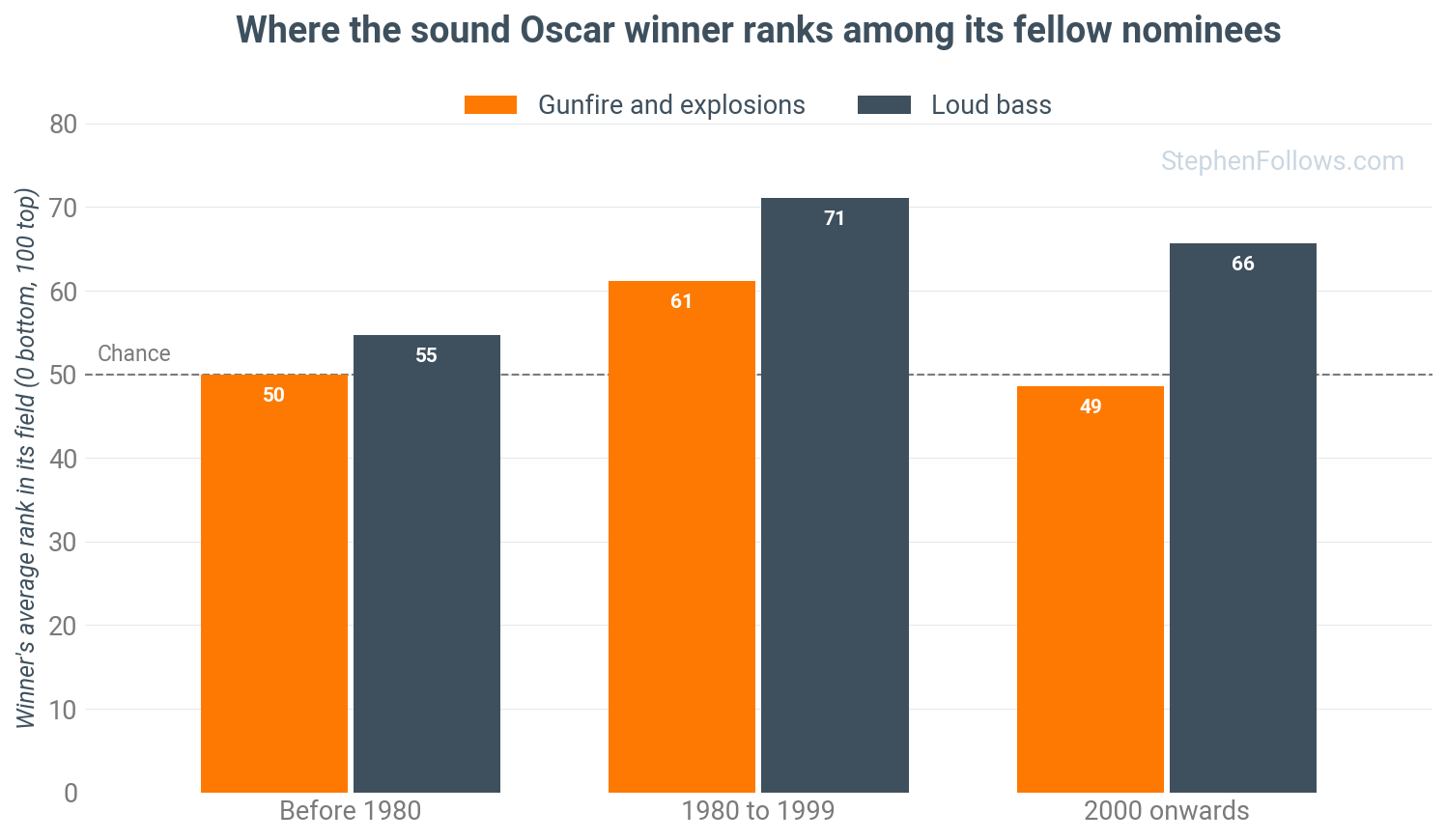
Before 1980, neither made any difference, which suggests that older ceremonies were a different contest, judged on very different soundtracks.
What does a winning soundtrack sound like?
The next chart shows every race since 2000, with each nominee as a blue dot and the winners as orange dots. The further right a dot sits, the more loud bass the film has per minute.
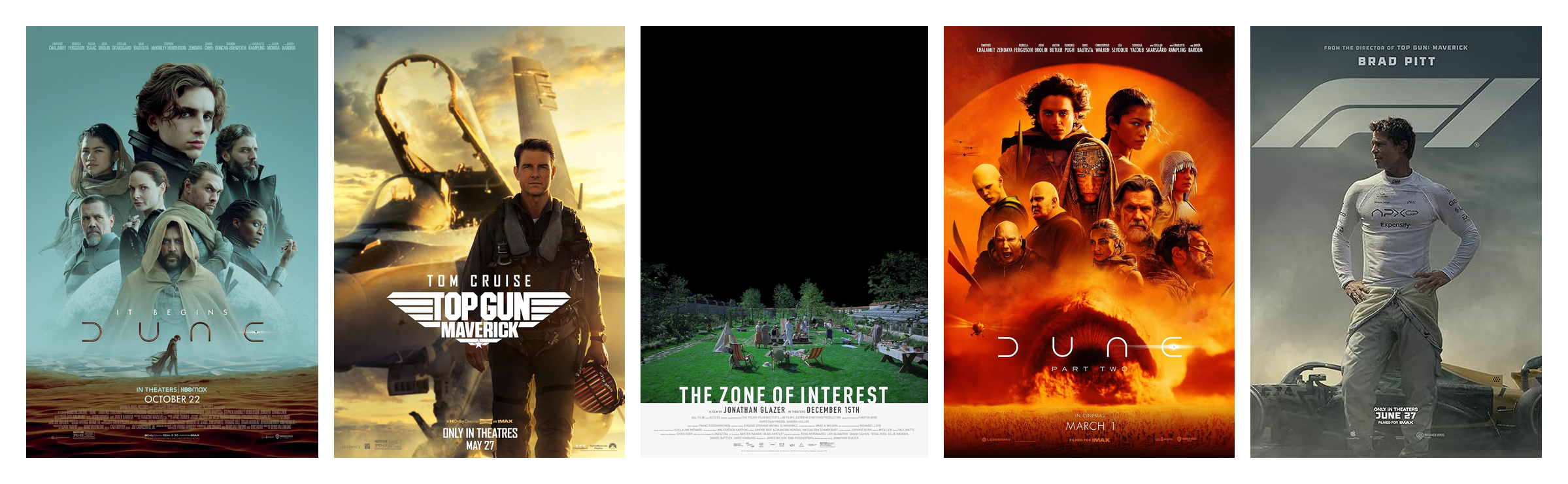
The winners lean right, and lately they sit at the far edge of their fields. Four of the last five winners had more loud bass than any film they beat (Dune: Part One, Top Gun: Maverick, The Zone of Interest and Dune: Part Two), and the fifth, F1, came second.
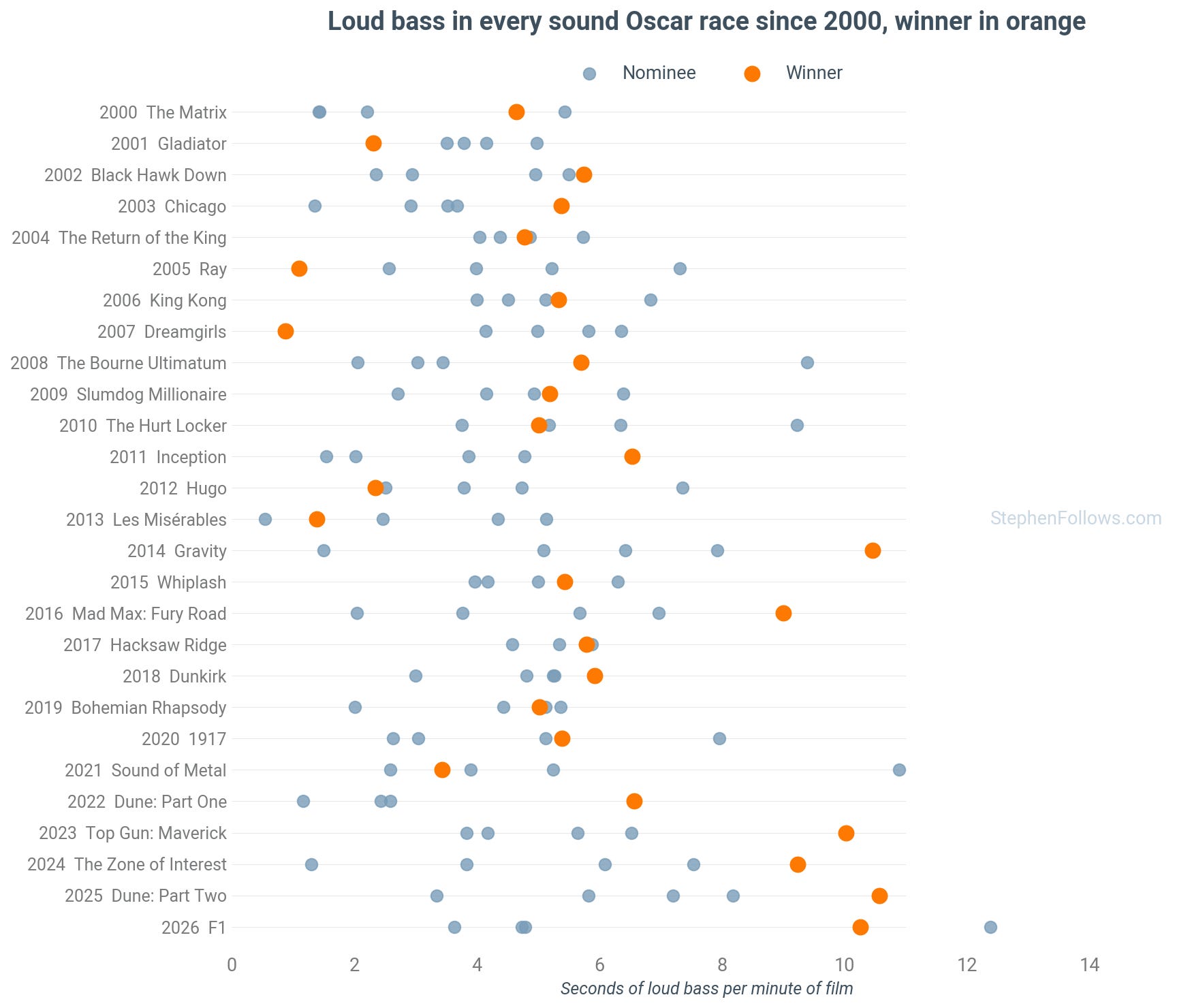
You might assume this effect basically rewards war films in disguise, but The Zone of Interest and F1 have no gunfire on my measure, and neither does Gravity, which had 10.5 seconds of loud bass per minute, while the next film in its race had 7.9.
When the winner is the film with the most gunfire, it usually has the most bass as well (10 of the 15 times this happened since 1980). But 11 winners topped their field on bass without topping it on gunfire.
Before the 1991 Oscars ceremony, The Academy sent members a booklet called Notes on Voting. It includes this wonderful quote:
The sound award should not necessarily go to:
The loudest or most spectacular film, or
The picture with the most popular music.
In summary, the sound award should go to the picture that most successfully integrates the dialogue, sound effects, and music to tell the story.
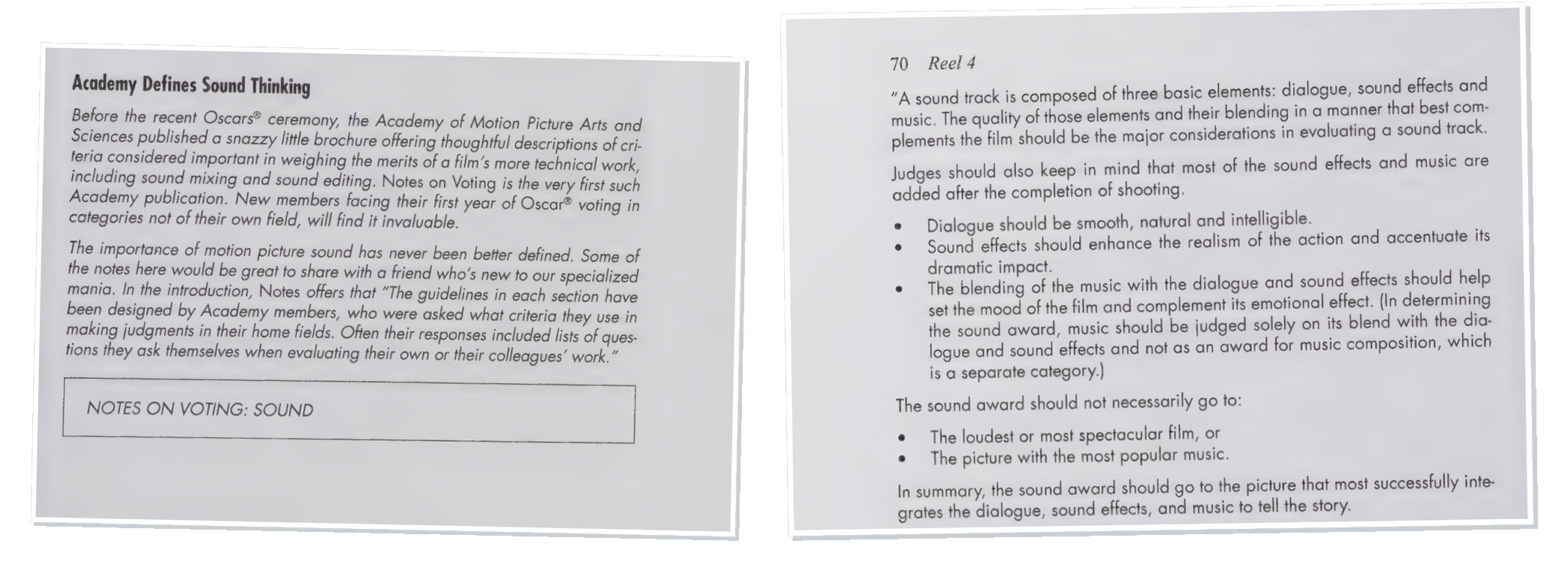
The fact they had to say that is interesting, and more so is that it seems that everyone ignored it!
One plausible reason for the split between nominating and winning is who votes. The sound branch picks the nominees, but every voting member of the Academy picks the winner (in 2016 that was 505 sound specialists against 6,856 voters in all).
Mark Mangini, who won for Mad Max: Fury Road, told Variety:
We fear we give away an award for most sound, not best sound.
My guess is that a cinematographer or an actor watching the nominees is less likely to count the gunshots than to notice which film made the room shake.
So why did The Conversation lose the Oscar?
The Conversation did well on the measure that predicts winners. It had 2.3 seconds of loud bass per minute, far more than Chinatown, The Towering Inferno or Young Frankenstein (between 0.2 and 0.5).
But it came second, because the race also had Earthquake. It was the first film released in Sensurround, a process MCA-Universal engineers developed for it, which added extended-range bass to the sound effects so cinemas rumbled along with Los Angeles.
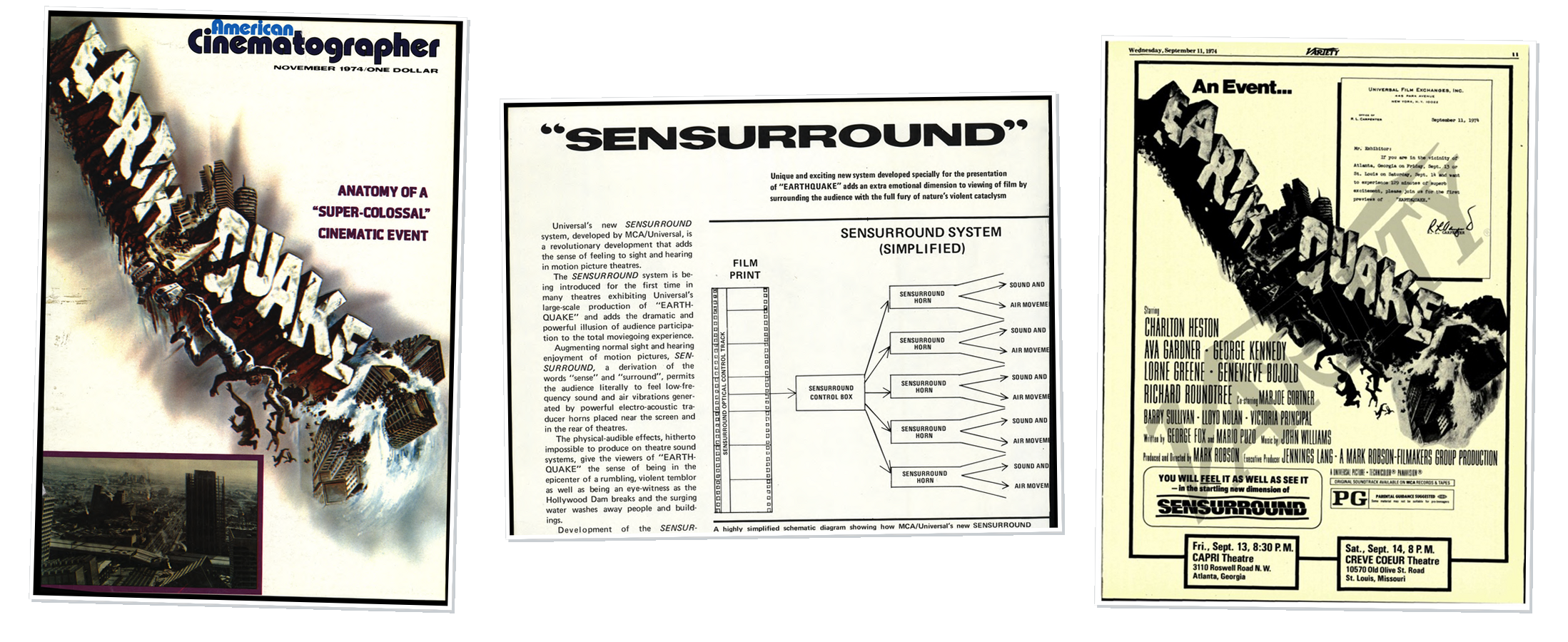
American Cinematographer gave the film its whole November 1974 issue, and described the system like this.
... “Sensurround” system (patent pending), designed to give moviegoers the sense of being in the epicenter of a major earthquake.
Earthquake had 3.5 seconds of loud bass per minute, the most of any nominee that year.
The movie Murch was up against had literally been engineered to shake the room, and there’s no competing with that.
Notes
The sound-recognition model is PANNs (CNN14, trained on Google’s AudioSet), which scores 527 types of sound many times a second. I kept the highest score for each sound in each second of every film.
A second counts as gunfire or explosions if explosion, gunshot, machine gun, fusillade, artillery, cap gun, eruption or boom scored 0.3 or more, and no engine, aircraft, vehicle, water, rain, thunder or static sound scored 0.2 or more (those were the commonest false alarms).
A second counts as loud bass if the energy below 120 Hz reached within 6 dB of the film’s own 95th percentile loudness.
Quiet scenes can’t qualify, and the volume of a particular copy makes no difference.
Each soundtrack was mixed down to a single channel, and the standard mixdown leaves out the separate subwoofer channel that surround-sound copies carry. (Only 102 of the 1,423 copies had one, and re-measuring every film with the subwoofer included gives the same result).
The first 60 seconds of every film (studio logos) and everything after the end credits begin were left out. Credit start times come from my end credits study. For movies I didn’t already have end-credit data for, I dropped the final 6% of the running time, which is more than the credits take up in three quarters of the films with known times.
I calculated ranks within each race (or within each year, for the nomination comparison), so films are only compared with others of the same era.
From 1983 to 2020 the Academy also gave a separate award for sound editing (sound effects editing until 2000), until it merged them into a single Best Sound award in 2021. My main figures use the main sound award, one race per ceremony (Best Sound, or Sound Mixing from 2004 to 2020). Adding the Sound Editing races from 2005 to 2020 gives the same answer, but the effects editing races from 1983 to 2004, which usually had only two or three nominees, show no lean either way.
Sources for the quotes. Randy Thom, Animation Magazine, February 2018, pages 27 to 28. Taylor Hackford, Variety, 26 February 2011. Lon Bender and Mark Mangini, Variety, 12 February 2016. Notes on Voting, as reprinted in the April to May 1991 issue of the Moviesound Newsletter and in David E. Stone and Vanessa Theme Ament’s Hollywood Sound Design and Moviesound Newsletter (2017), page 70. American Cinematographer, November 1974, page 1287.