


I have been on a bit of a mission in recent months to identify how movies are creatively changing. So far, I’ve shared how…
Movies are becoming more simplistic with less sex.
The pacing has become more intense, with less quiet time and more dialogue
We’re teaching different moral lessons and romantic love is giving way to other forms of connection
Today we’re going sonic. Not, not that one - we’re moving on to the audio of movies.
I built a system to identify every sound event from almost 2,000 action movies made over the past 75 years. We’re tracking gunfire, vehicles, music, speech, explosions, animal sounds, impacts, and more.

I was a little surprised by what I found. Let’s start with perhaps the easiest to guess…
Action films are getting audibly busier
The total number of detected sound events per minute in action movies has been rising steadily.
A modern action film packs in roughly 15 distinct sound events per minute. In the 1970s, it was closer to 13. That might not sound like a dramatic shift, but it adds up. Over a two-hour film, that’s about 240 extra sound events competing for your attention.
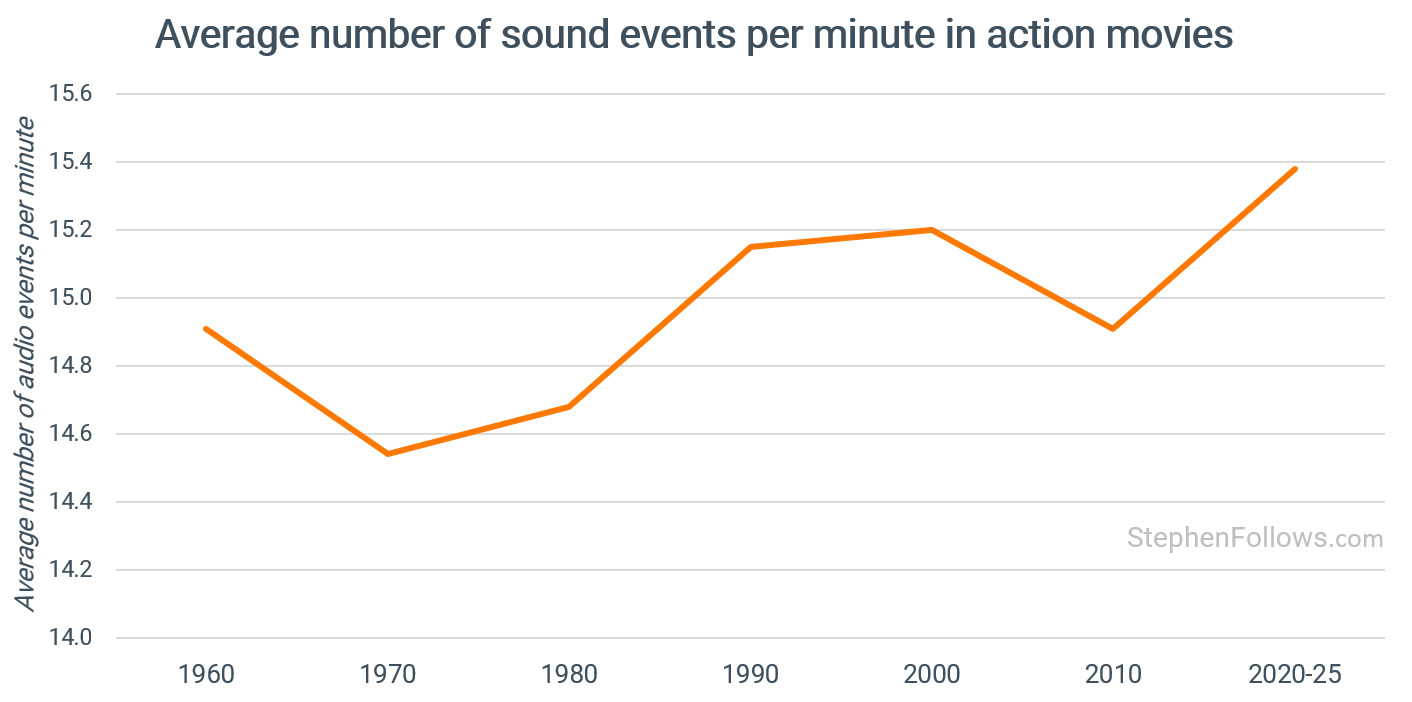
This is partly a technology story. Multi-track digital recording, surround sound, and modern DAWs make it easier to layer sounds.
But it also reflects a shift in audience expectations. Modern action films are denser, faster, and louder because audiences have been trained to expect that. A mid-1970s-era soundscape in a 2026 action film would feel eerily sparse. (I wrote about having exactly this feeling when I watched The Conversation (1974) last year in Has the way movies use dialogue changed?).
Gunfire is up 44%
A major finding is that gunfire events in action films have increased by 43% since 2000. Pre-2000, a typical action film averaged 0.196 gunfire events per minute. Post-2000, it’s 0.280.
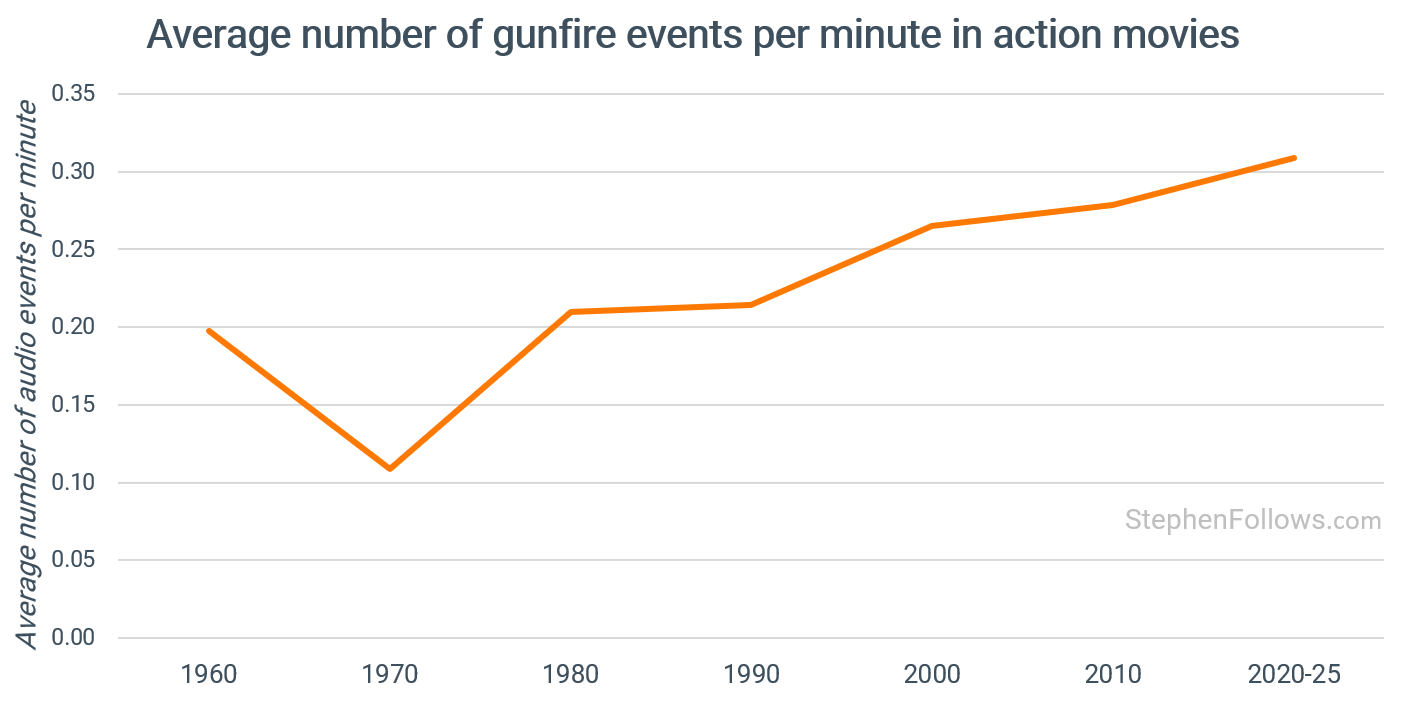
I broke gunfire down into subcategories: single gunshots, automatic weapons fire (machine guns and fusillades), explosions, and artillery.
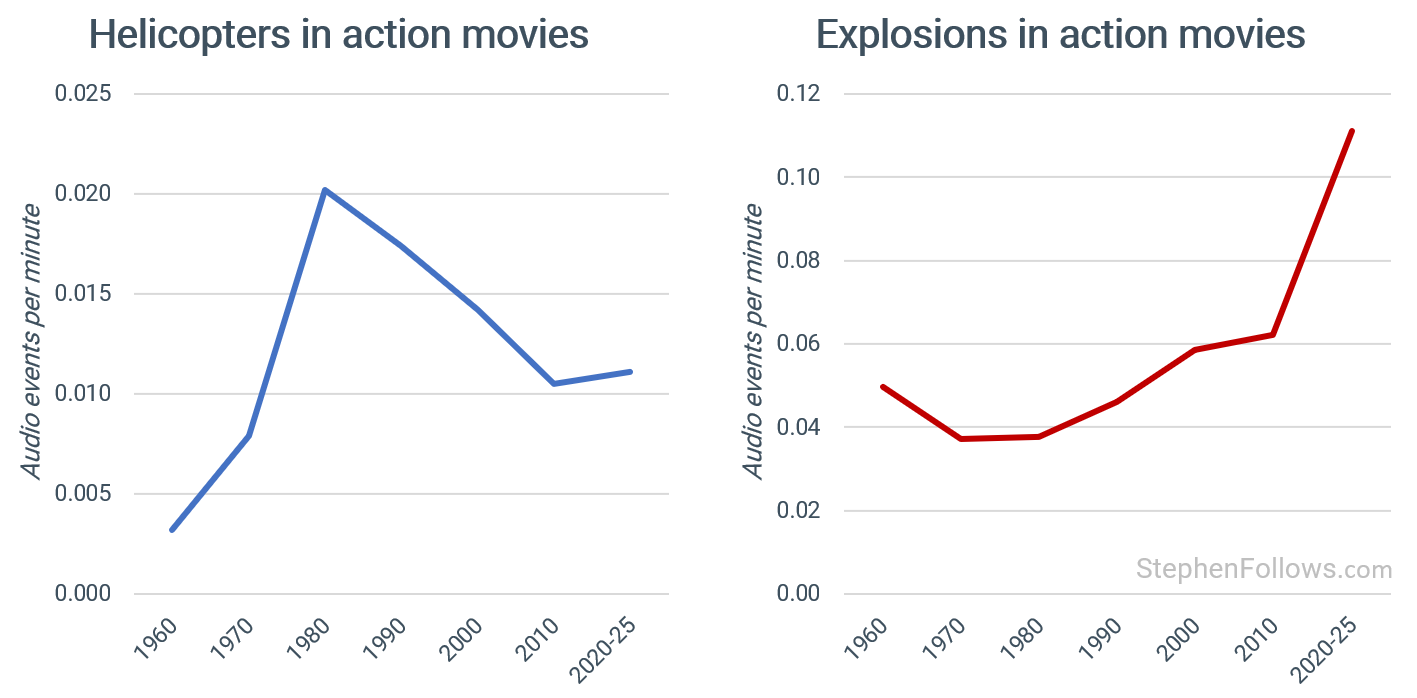
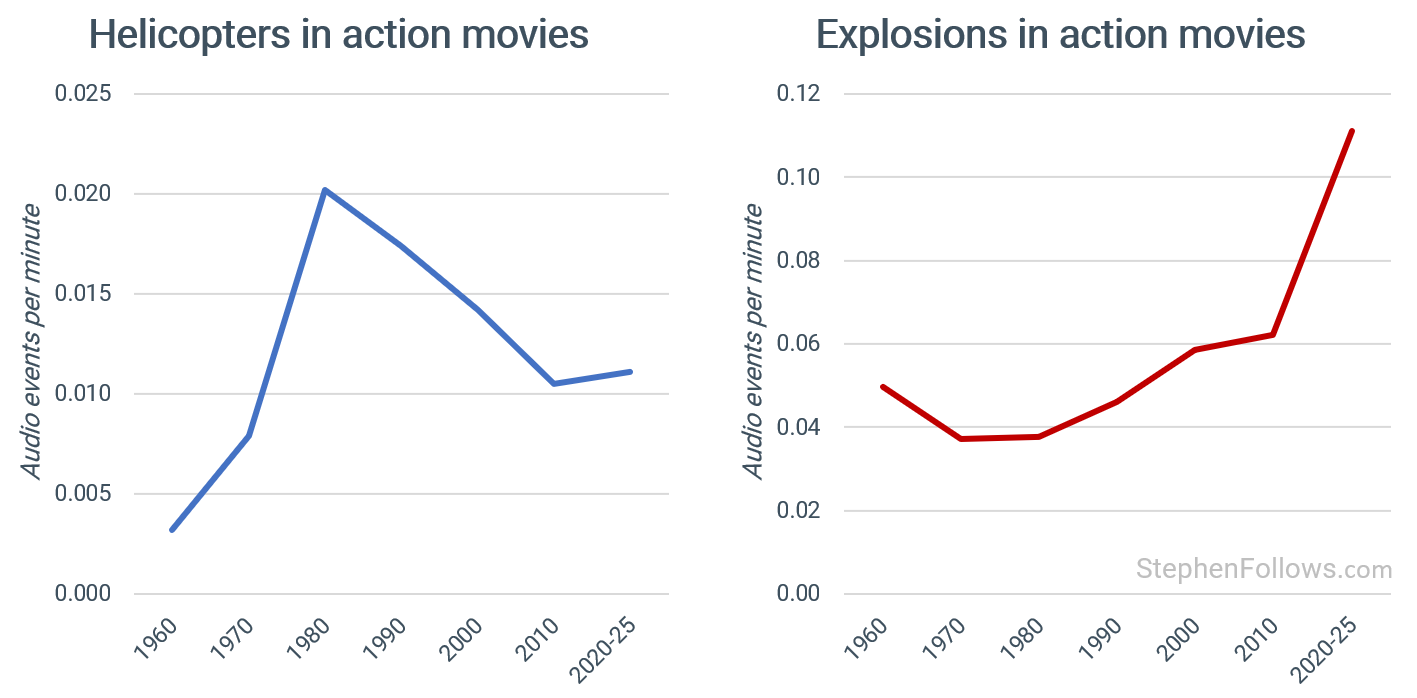
This shows that explosion events have nearly doubled since the 2000s, rising from 0.059 per minute to 0.111 per minute in the 2020s. Automatic weapons fire has been rising steadily since the 1970s, as have single gunshots (i.e. the classic revolver or rifle shot), albeit more modestly.
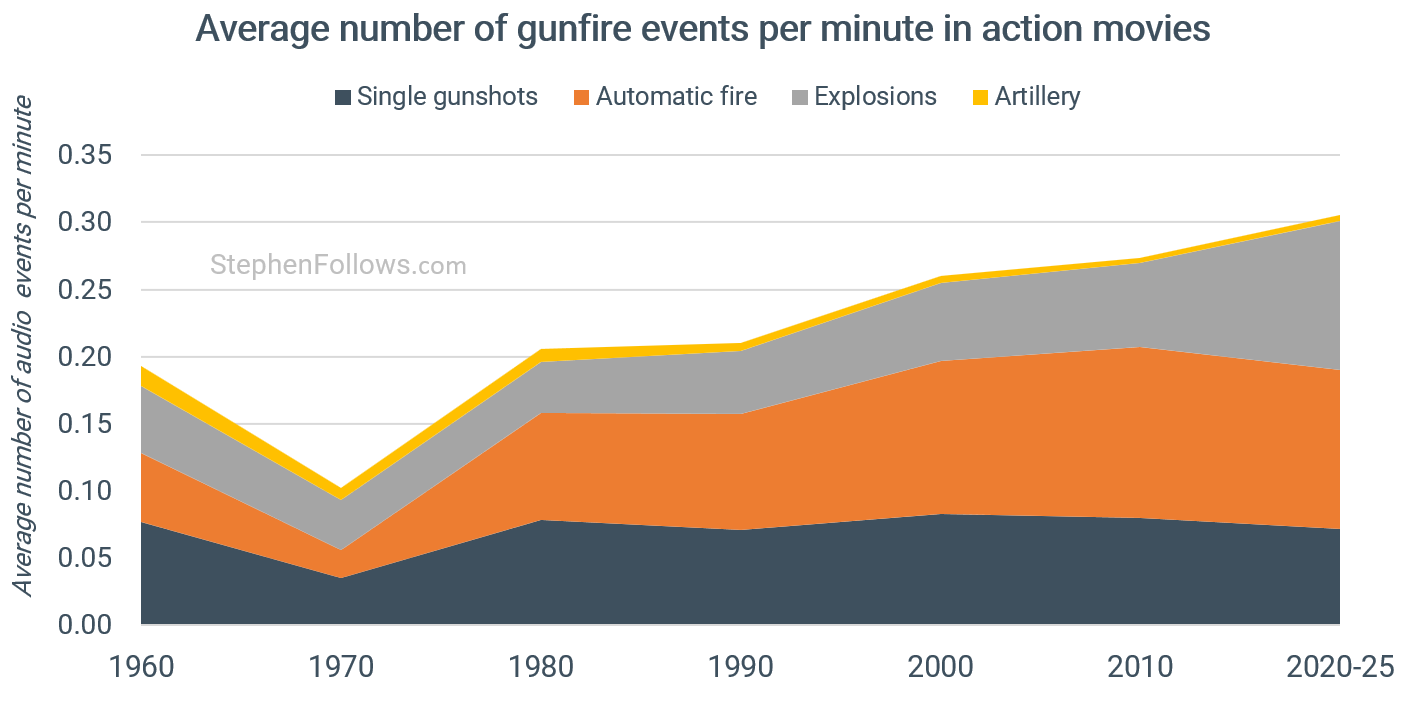
What’s happening here is an escalation of intensity. The modern action film has both more gunfire and more sustained gunfire. The deliberate, spaced-out gunplay of a 1970s thriller has given way to the continuous barrage of a John Wick or Extraction.

My first thoughts as to why this might be happening are:
Video games. Many modern action sequences are structurally similar to first-person shooters, with continuous fire and constant explosions.
Economics. Digital muzzle flashes and CGI explosions are vastly cheaper than practical effects, making it easy to extend and intensify action sequences.
Franchises. Sequels demand escalation, with each needing to top the last.
The list of the most gunfire-heavy action films is dominated by war films. This makes sense as war films are essentially extended combat sequences. But the presence of films like Olympus Has Fallen, Extraction II, and Rambo (2008) shows that non-war action films are approaching war-film levels of gunfire density.
Only one of the ten ‘most gunfire-heavy action films’ was made before 2000 - Hamburger Hill whcih was the most gunfire-intensive film I tracked.
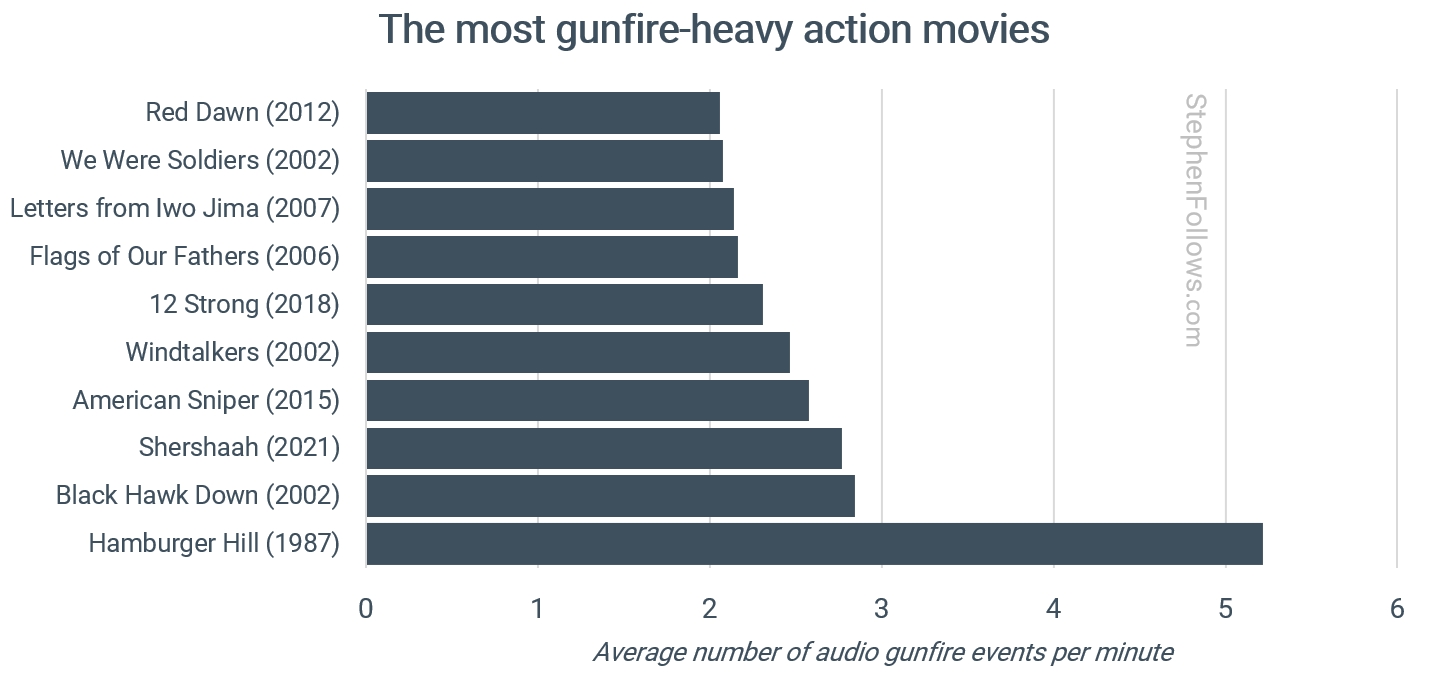

What’s very interesting is that last year, I discovered that fewer lead characters are dying of gunshots. The only logical conclusion is that the aim of action movie villains is getting considerably worse.

Music is the biggest single change
If I had to pick the single biggest shift in action film sound, it’s the music.
Music scoring in action films has risen by 9% since 2000, from 5.04 to 5.48 events per minute. That’s the largest absolute change of any sound category (+0.44 EPM).
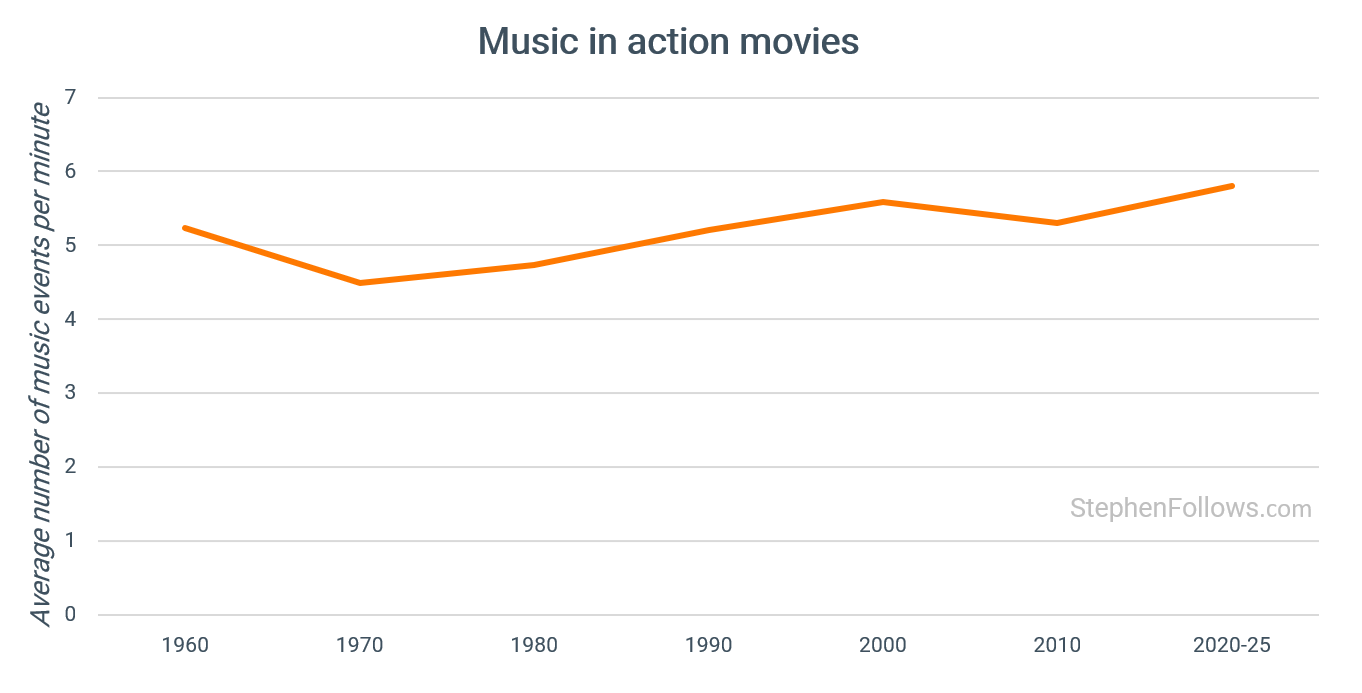
My take here is that the franchise era demands wall-to-wall scoring. Marvel films, DC films, and their imitators use continuous orchestral underscoring to maintain emotional intensity. The 1970s approach of long stretches of diegetic sound punctuated by targeted musical cues has been replaced by a model where the score rarely stops.
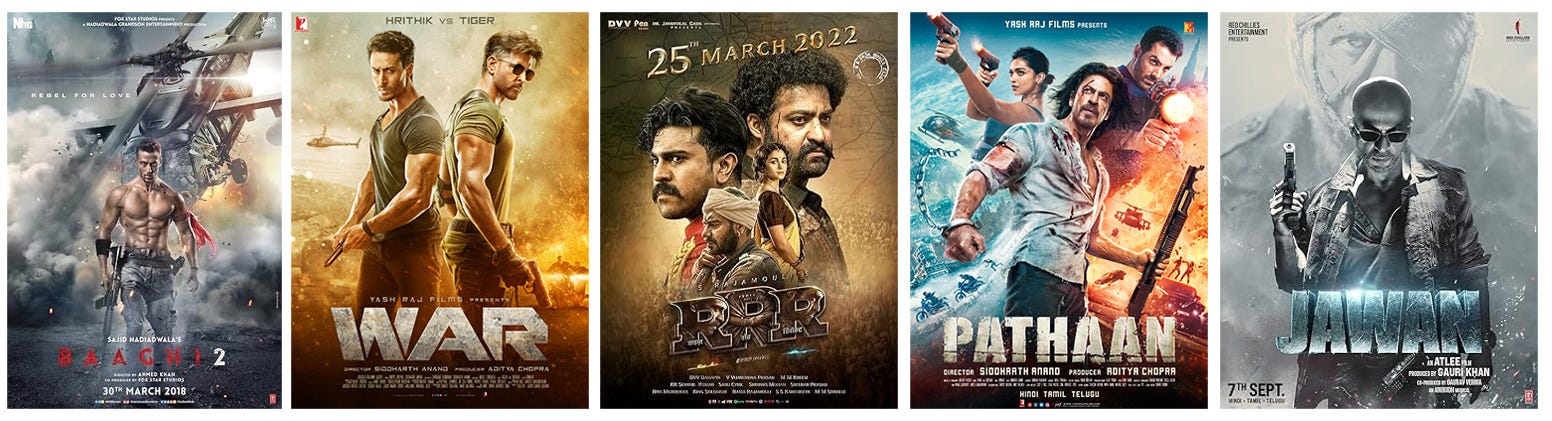
Modern action films are, in a very literal sense, more like musicals than their predecessors. It is perhaps no surprise that some of the most exciting action films of the past few years have come from Bollywood cinema (RRR, Pathaan, Jawan, War, Baaghi 2, etc), which is taking more cues from musicals than Hollywood action films.
There’s also a loudness dimension here. Music events that register on the classifier tend to be prominent in the mix. The trend toward louder, more compressed masters (i.e. the ‘loudness war’ that started in music and migrated to film) means music is more likely to be detected even in scenes that are nominally dialogue-driven.
The car chase is dying
Here’s one I didn’t expect. Vehicle sounds in action films have declined by 16% since 2000. This neatly tracks with my past research showing that the fastest declining cliché in movies is “Follow that [vehicle]”.
In the 1970s, action films averaged 1.68 vehicle events per minute. In the 2020s, it’s 1.13.
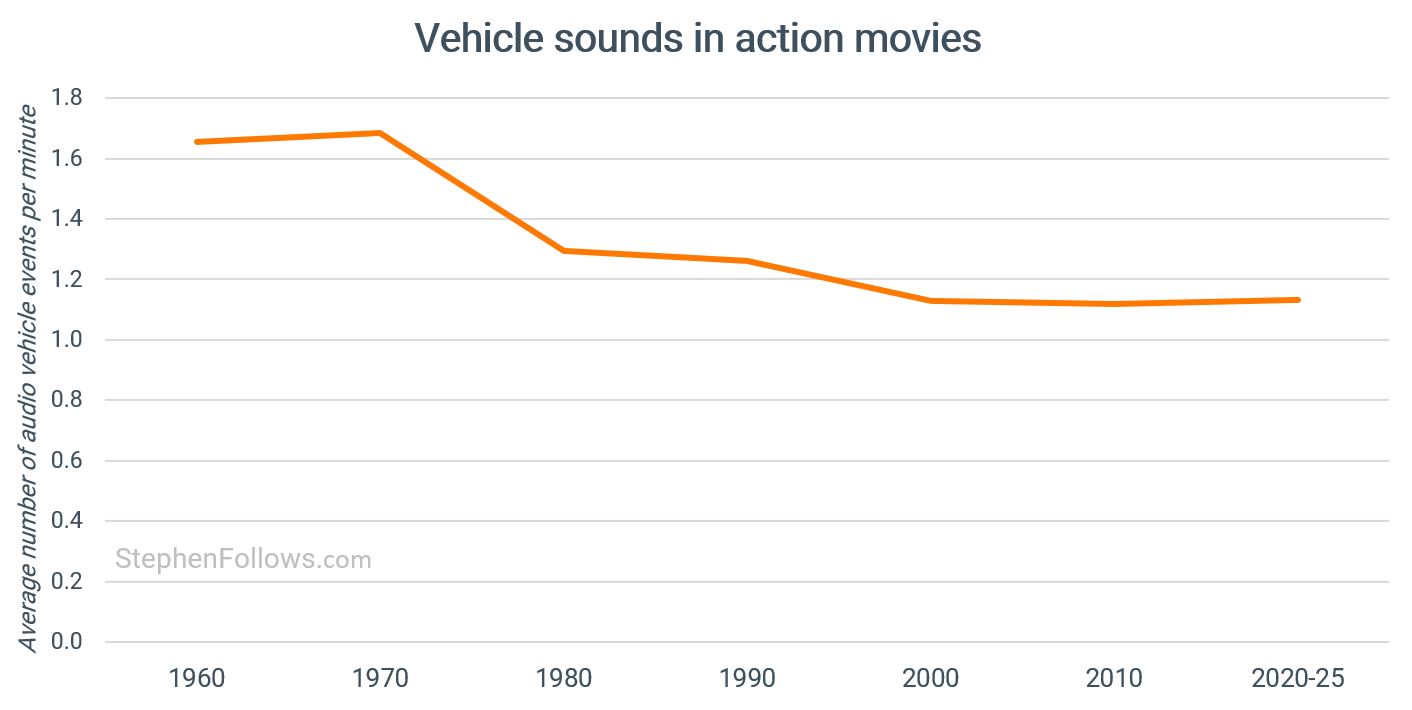

Digging into the data, we can see that fewer cars are a major cause of this decline.
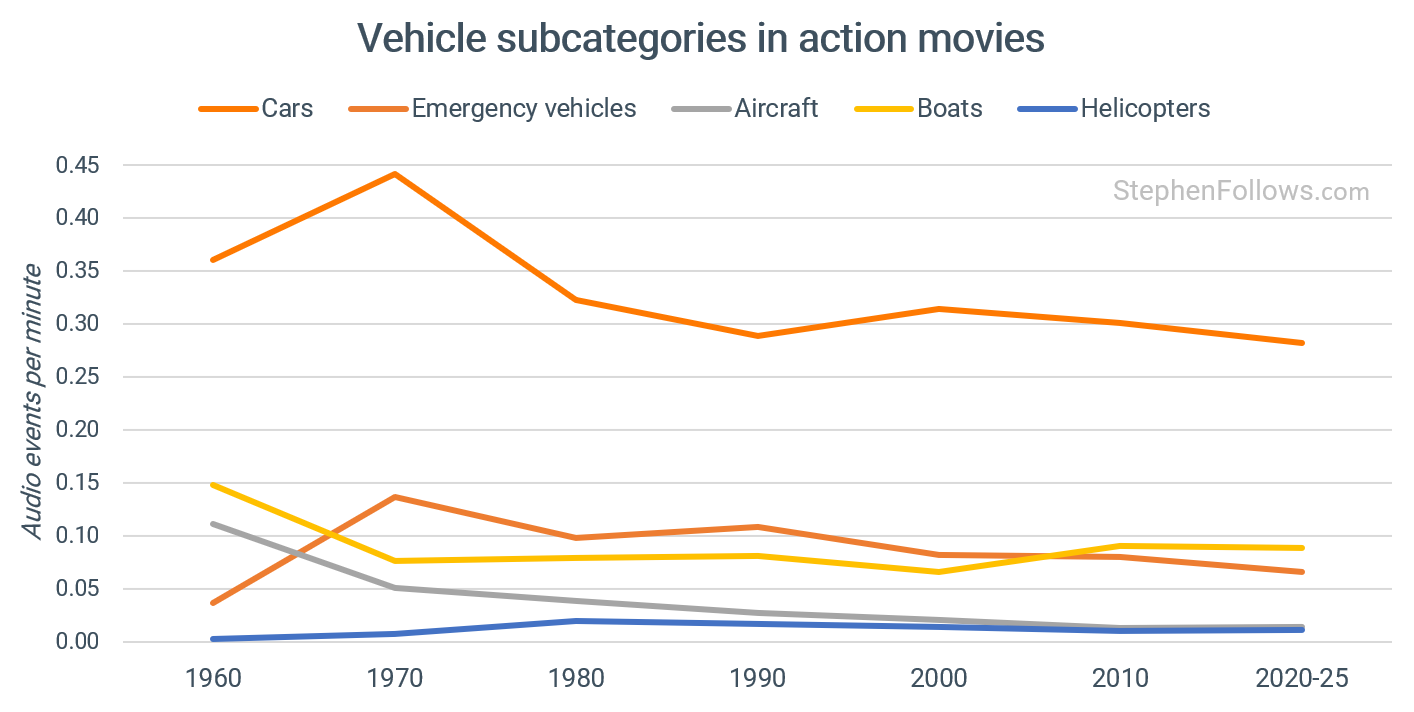
Cars still remain as the dominant vehicle sound, but two specific subcategories tell a fascinating story.
Helicopters peaked in the 1980s at 0.02 EPM and have been declining since. This is almost certainly the Cold War and Vietnam War’s influence on 1980s cinema, with Apocalypse Now, Blue Thunder, Rambo, and their imitators filling the soundscape with rotors. Modern action has replaced the helicopter with drones (which are sonically quiet) and CGI spacecraft.
Emergency vehicles have declined as the cop thriller migrated from cinema to television. The kinds of films that once filled multiplexes with sirens and screeching tyres (e.g. Dirty Harry, The French Connection, Lethal Weapon) are now eight-episode prestige TV series.
The broader story is a shift in the grammar of action cinema. The car chase was the centrepiece of 1970s and 1980s action, whereas modern action films centre on hand-to-hand combat, gunfights, and superhero set pieces.
Fast & Furious is the exception that proves the rule, and even that franchise has moved increasingly toward absurdist spectacle rather than traditional car chases.
Four sounds that tell a story
Zooming in on specific sound events reveals stories that the broader categories mask:
Helicopters are a Cold War sound. They peaked in the 1980s and have steadily declined. Today’s filmmakers have replaced them with drones (quiet), CGI spacecraft, and ground-level action. The helicopter was the signature vehicle of the Vietnam War film and the 1980s military thriller, but that era is over.
Explosions have nearly doubled since the 2000s. The Marvel Cinematic Universe and the ongoing escalation of franchise third acts are driving this. Modern climaxes are essentially continuous sequences of explosions.
Automatic weapons fire has been rising steadily, reflecting a shift from revolvers and rifles to fully automatic weapons. John Wick fires more rounds in a single scene than Dirty Harry fired in an entire film.
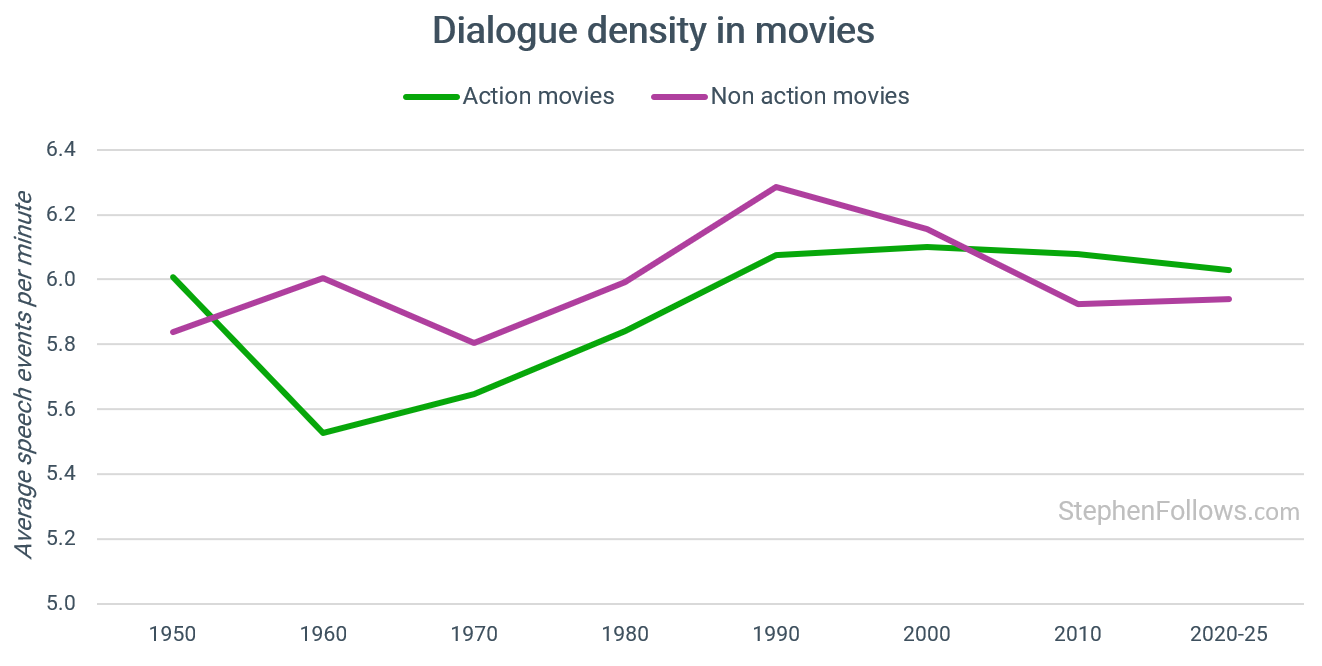
Speech is remarkably stable. Action heroes talk about as much now as they did in the 1970s, roughly 6.0 speech events per minute. Despite the increase in gunfire and explosions, dialogue density hasn’t been squeezed out. Modern action heroes simply talk between the explosions rather than instead of them.
Is this just an action film thing?
I ran my detection system on all types of movies, allowing us to see how many of the changes we’ve seen are action-specific.
Interestingly, the average action movie now has more dialogue events than non-action films. Both cohorts have seen more spectacle in the past few decades, but action movies have been the more talkative of the two over the past ten to fifteen years.
The rise in gunfire is also seen in other genres. Fantasy films have seen a marked increase this century, as the genre shifts from Middle-earth to the Marvel Cinematic Universe.
Only romantic films have seen a massive decline, and as the romance genre has been disappearing from our screens (from 34.8% of releases in 2000 to just 8.6% in 2024), our cinemas are increasingly filled with gunfire.
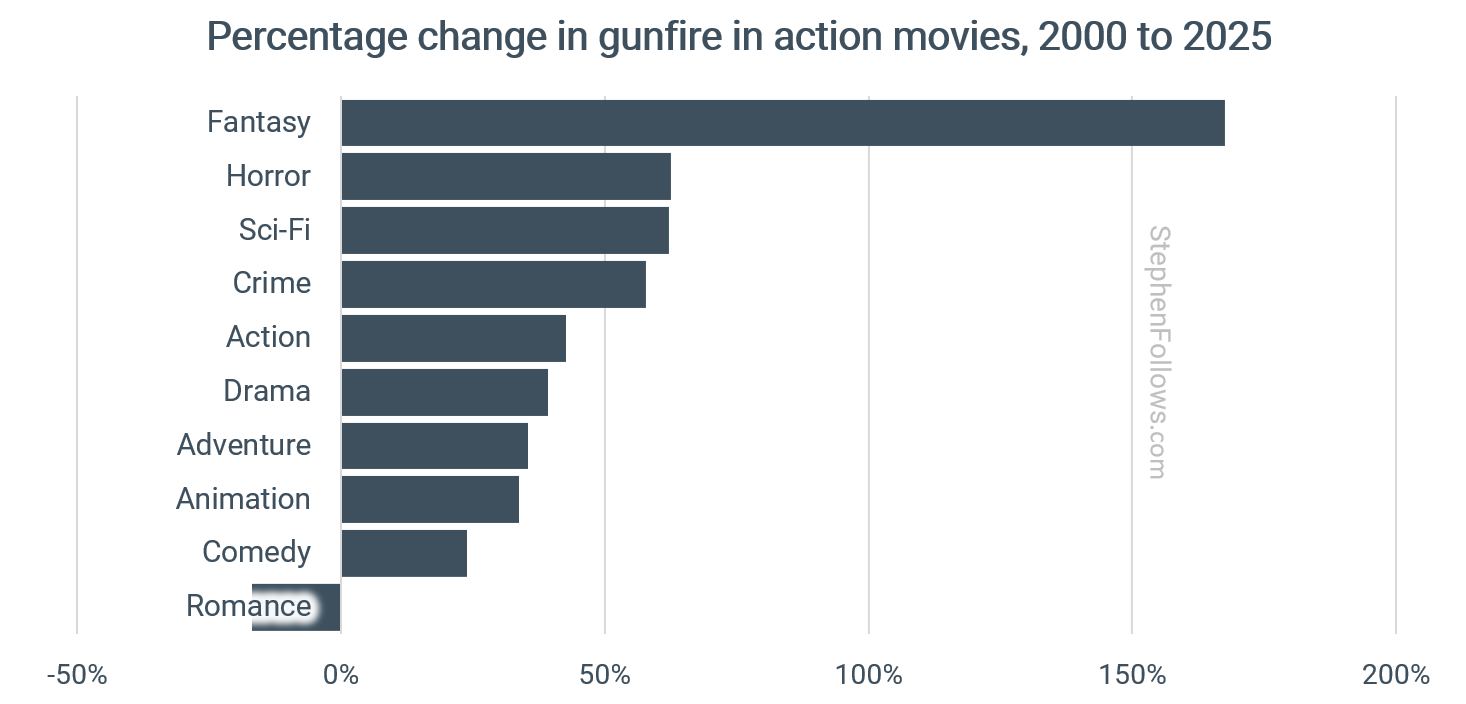
Despite the rise in fantasy and horror gunfire, action still tops the list of gun-heavy genres.
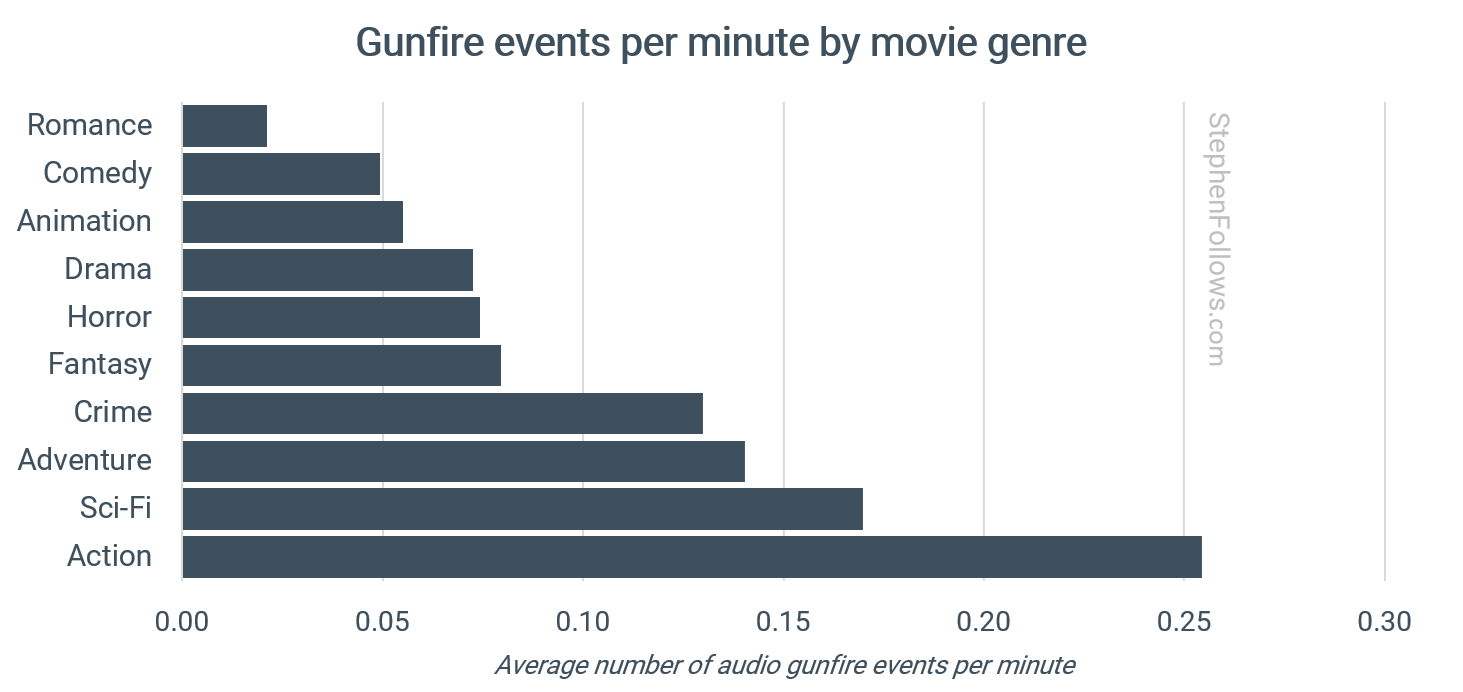
Action set pieces have infiltrated comedies (21 Jump Street), dramas (Sicario), and even animation (Spider-Verse). The boundaries between genres are blurring, and the sound is blurring with them.
So what’s changed?
If you could listen to the average action film from 1985 and the average action film from 2026 side by side, the differences would be clear but probably not what you’d expect.
The modern film would be sonically denser, with more events competing for your attention every minute.
It would have more gunfire, and specifically, more sustained automatic fire and explosions.
It would have significantly more music, nearly wall-to-wall.
It would have noticeably fewer vehicle sounds, car chases, helicopters, and sirens.
And yet the amount of dialogue would be almost identical.
The human voice, it turns out, is the constant. Everything else (i.e. the gunfire, the vehicles, the music, the explosions) is the variable.

Sound designers and directors have been reshaping the audio landscape of action cinema for decades, but they’ve done it around a fixed point of around six events of the human voice per minute.
Notes
Today’s research is based on the audio from 1,797 action feature films released between 1950 and 2025, identified by their IMDb genre tags.
I used a PANNs CNN14 neural network trained on Google’s AudioSet taxonomy (527 sound classes). The classifier processes audio in 10-second windows with 2-second overlap, detecting and categorising sound events which are then aggregated into 10 broad categories.
I calculated events per minute (EPM) as the count of detected events in each category divided by the film’s total audio duration in minutes. This gives an absolute measure of sound density independent of other categories.
Vehicle subcategories were grouped from AudioSet classes:
Cars (car, racing, skidding, tyre sounds)
Emergency vehicles (police/fire/ambulance sirens)
Aircraft (helicopters, planes, jets)
Boats
Gunfire subcategories:
Single gunshots
Automatic fire (machine gun, fusillade)
Explosions (explosion, boom, eruption)
Artillery
The classifier is not perfect. It can misidentify sounds, particularly in dense mixes where multiple sources overlap. Results should be treated as indicative of broad trends rather than precise measurements. All statistical comparisons use Spearman rank correlation; changes described as significant meet p<0.01.
Films must have a minimum audio duration of 10 minutes to be included. Genre labels are from IMDb and are non-exclusive (a film can be Action, Adventure, and Sci-Fi simultaneously).
Your research is always so fantastic. I was wondering if there were key films that 'reset' the standards as later films compared themselves in intensity/action/sfx to that film. Did the changes to audience expectation tend happen after certain films set a new bar (like John Wick or The Matrix) and popular comparisons or is there an incremental increase over time of those things. I hadn't thought about the changes to helicopter sounds or car chases (Baby Driver was incredible) until your article, thanks!
This is an outstanding article that has societal implications. You should hype it more — maybe it explains why Trump is on the Dept of Warpath