


On Monday, I published a piece on whether a famous lead actually pays off at the box office.
A few readers reached out to ask whether I had taken the films’ quality into account. I had, but what stuck with me was how many people clearly assumed that a famous cast meant a better film. The cynic in me assumed the opposite!
Let’s briefly consider the two perspectives, and then see which the data reveals to be correct.
Fame = quality?
You can see why someone might think that famous actors would be in better films.
Famous actors are, on the whole, richer and far better supported than those still on the way up. They have readers, managers and agents whose job is to find good scripts. Not only can they seek them out, but they will also be constantly offered more of them because most filmmakers want/need a famous name in their film.
They also have power - Tom Cruise can pretty much star in almost any film he wants (if he is willing to be flexible on his fee, of course).

So it might be reasonable to conclude that more famous actors tend to make better films.
Fame ≠ quality?
But there is a counterargument that famous actors are not trying to make good films. They are trying to make films that are good for them. This can be a very different thing, tied to their brand and money.
When asked about his role in panned Jaws: The Revenge, Sir Michael Caine famously said:
I have never seen the film, but by all accounts, it was terrible. However, I have seen the house that it built, and it is terrific.
It’s a reasonable assumption that the more famous the cast, the bigger a film’s budget will be, but I doubt many people instinctively believe that bigger budgets automatically mean better scripts.
Then we have to consider that the biggest stars tend to work on films with the most competing forces around them, such as marketing, release-date strategy, and merchandising.

None of these forces aims to improve the film, and some directly pull against it.
Scores ≠ quality?
One thing to note upfront is that we cannot actually measure whether a film is good. We can only measure whether people liked it. Today I’m going to be using two quick proxies:
Metacritic score, which averages professional critics’ reviews into a number out of 100.
IMDb user rating, which captures the general audience’s verdict out of 10.
So in truth, we’re tracking reception rather than art, but they are the best signals we have of how a film landed. At the very least, they let us see which factors correlate and which do not.
I crunched the numbers on 2,756 feature films released over the past quarter-century to see if there is a connection between how audiences and critics rate them and the cast’s star power. The details of my methodology are in the Notes section at the end.
A famous cast is a weak sign of quality
The core finding is that fame is a pretty bad proxy for whether a film is likely to be any good.
Films led by a top-tier name score ever-so-slightly higher than those led by a non-famous actor, with both audiences and critics, but the gap is small and only with the most famous names.
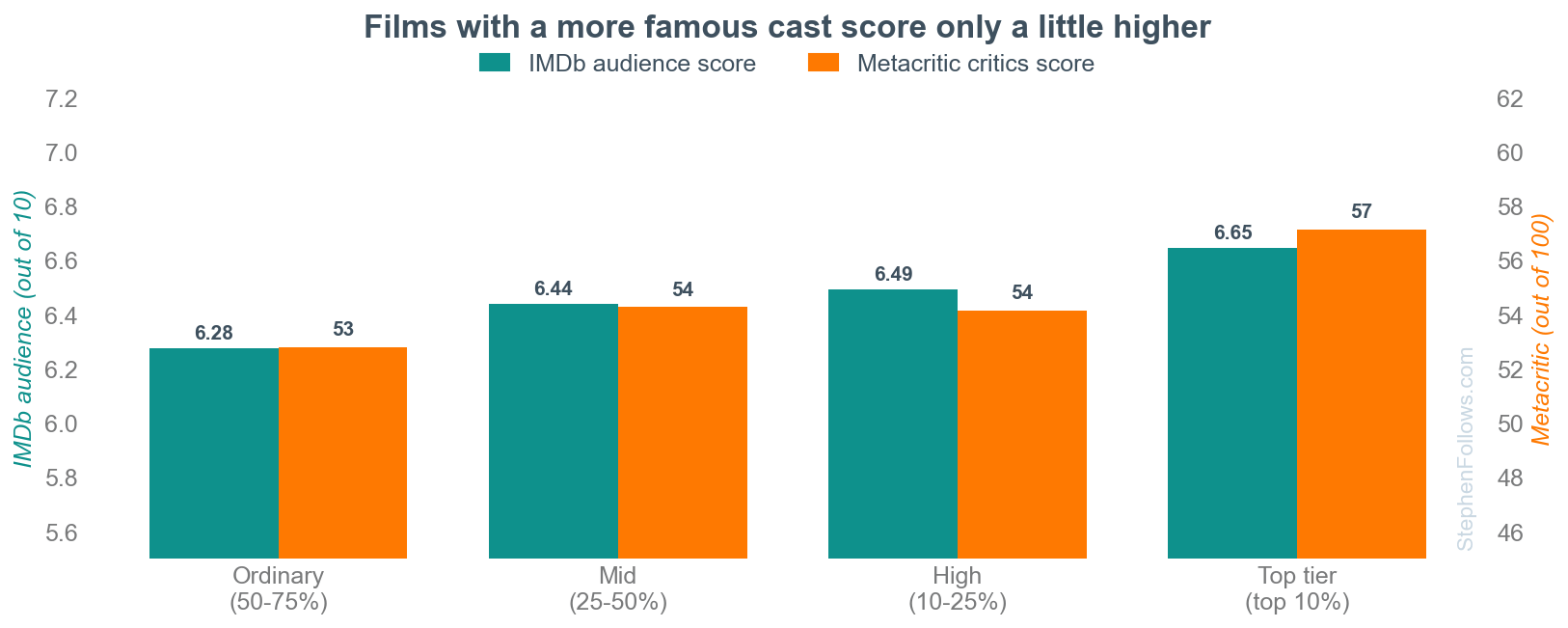
Top-tier-led films average 6.65 out of ten with audiences, compared to 6.28 for ordinary-led films, and a similarly modest step with critics. Once you account for the film’s budget, genre and era, the famous cast still helps, but only barely.
It depends heavily on the genre
That faint average hides a sharp split by genre. A famous cast is a meaningful hint of quality in some kinds of film and no hint at all in others.
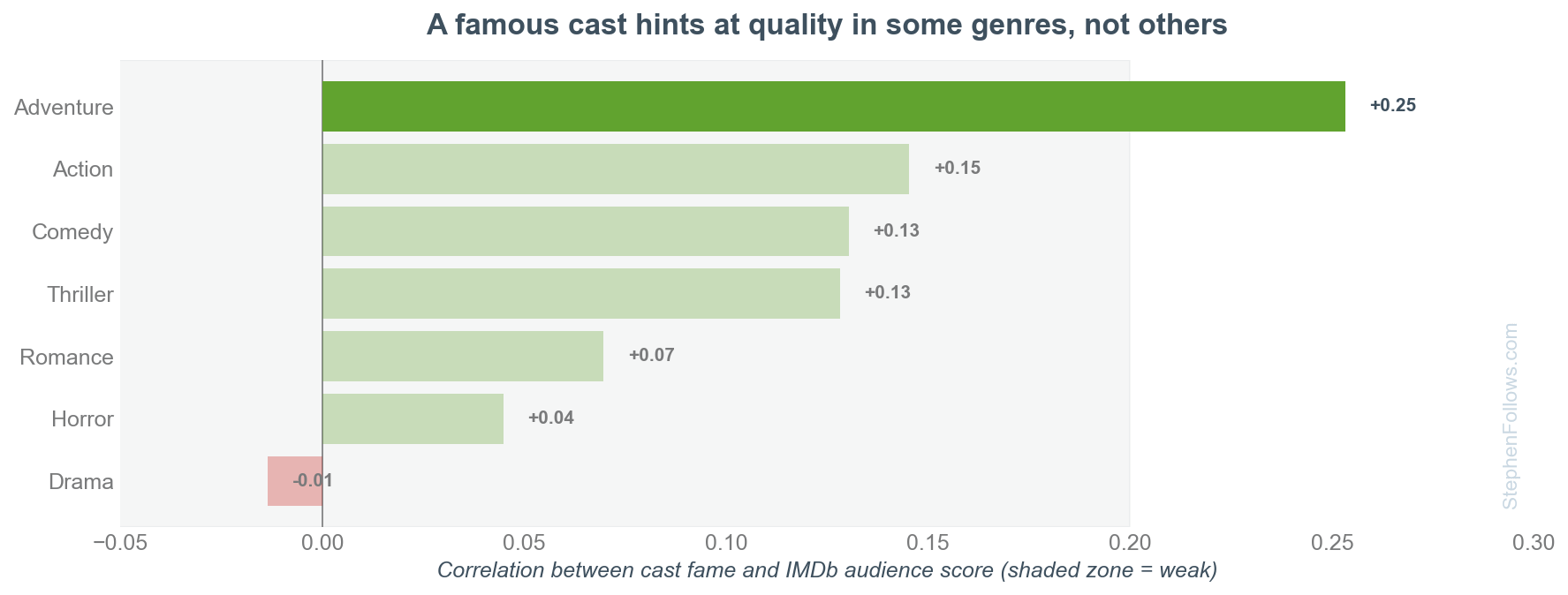
In adventure, a more famous cast tends to go with better-reviewed films. Everywhere else, the link is weak, and in drama, romance, and horror it is essentially zero, even tipping slightly negative among critics. These are exactly the genres that live on concept, script, and word of mouth, where a familiar face adds little and can even raise suspicions that a film is relying on its casting.
Over the entire period, the cast-quality link has remained weakly positive, neither strengthening nor collapsing, hovering between +0.08 and +0.22 across eras.
Which actors are a good sign of quality?
The link is much stronger with some actors than with others. Some actors appear, again and again, in films that audiences and critics both rate highly. Others have built long careers in films that neither does.
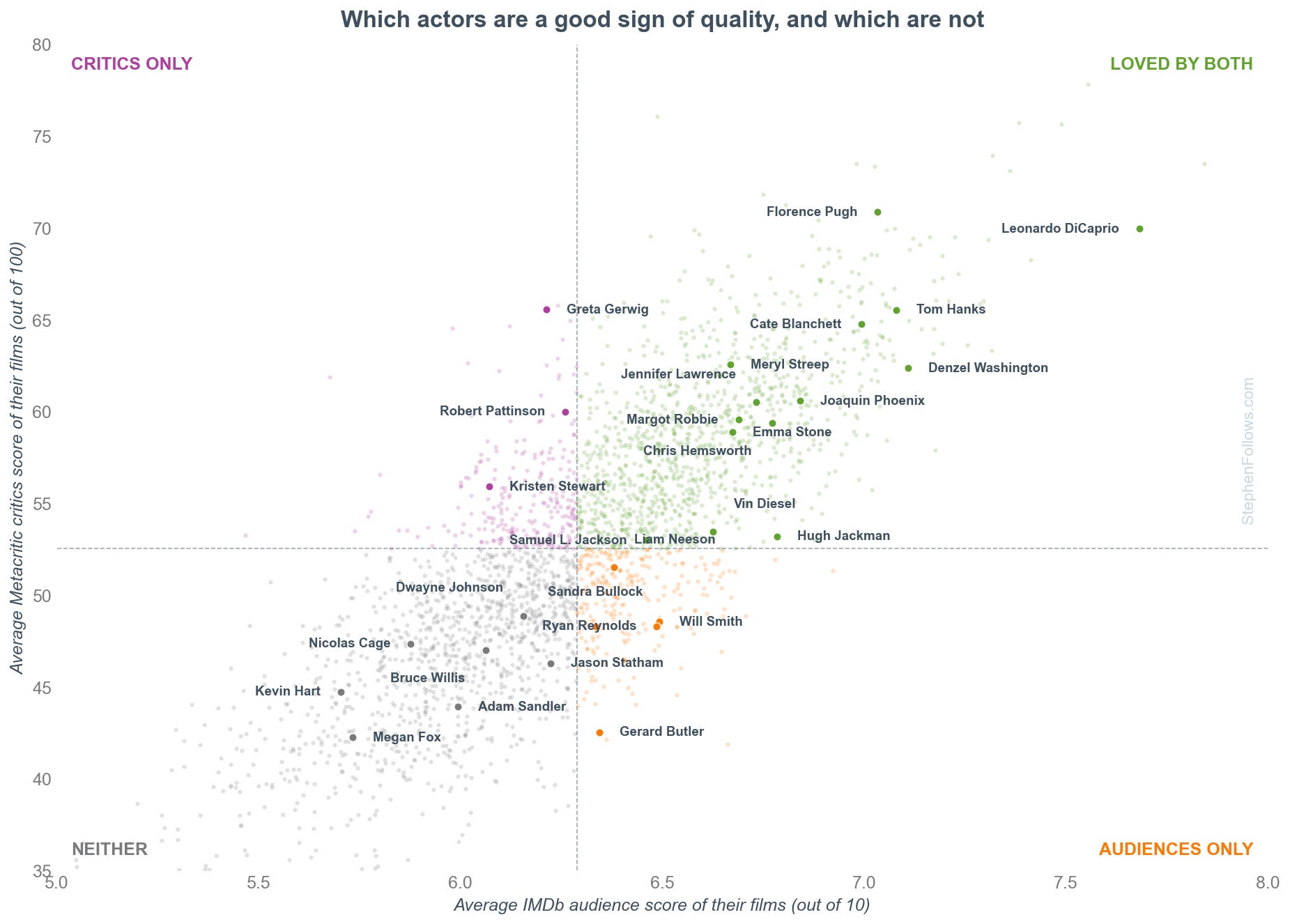
The scatter plot below places each of the 2,730 famous actors I looked at on a chart of average IMDb and Metascore for their past films. They fall into four camps:
Everyone’s favourites are in the top right, including Leonardo DiCaprio, Tom Hanks, Cate Blanchett, Denzel Washington, Christian Bale, and, among newer arrivals, Florence Pugh.
Critical darlings are in the top left, and include Greta Gerwig, Robert Pattinson and Kristen Stewart, whose choices lean towards the kind of film reviewers admire more than the multiplex crowd.
Crowd-pleasers sit in the bottom right, containing actors whose films are appreciated by audiences but much less so with critics, such as Will Smith, Ryan Reynolds, Sandra Bullock, Liam Neeson and Gerard Butler.
The… er… others. In the bottom corner, we have actors whose films are poorly rated by both audiences and critics, such as Adam Sandler, Nicolas Cage, Bruce Willis, Dwayne Johnson, and Jason Statham.
Adam Sandler appears completely unbothered by how his movies are reviewed, saying in 2013:
I didn’t get into movies to please the critics. I got into it to make people laugh and have fun with my friends.
Others in that final quadrant draw a clearer distinction between the film and their contribution to it. When IndieWire asked Nicolas Cage about the run of films he made to pay off a multi-million-dollar debt, he said:
Even if the movie ultimately is crummy, they know I’m not phoning it in, that I care every time.
If you do want to seek out good films based only on the famous names starring in them, below are the people with the famous names who have the highest correlation with quality:

Bonus Finding
As I had the data to hand, I took a quick look at what factors do seem to matter.
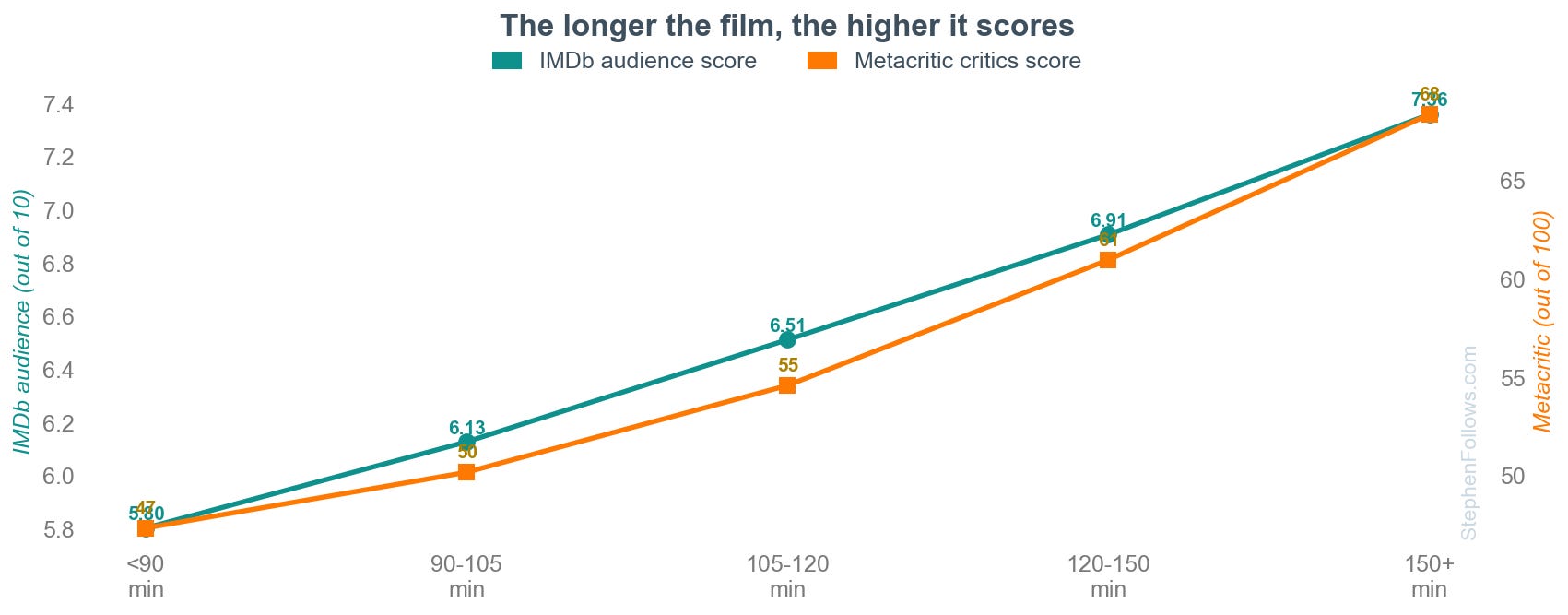
The strongest single signal is the film’s runtime, albeit we’re still not in a ‘usefully predictive’ space. R-rated, adult-aimed films score higher than gentler ratings, and films where the director also wrote the script score higher, especially with critics.
Everything I looked at sits in the shaded zone, where the effect is small. I have sorted them by signal strength, meaning that the cast’s fame is among the least predictive.
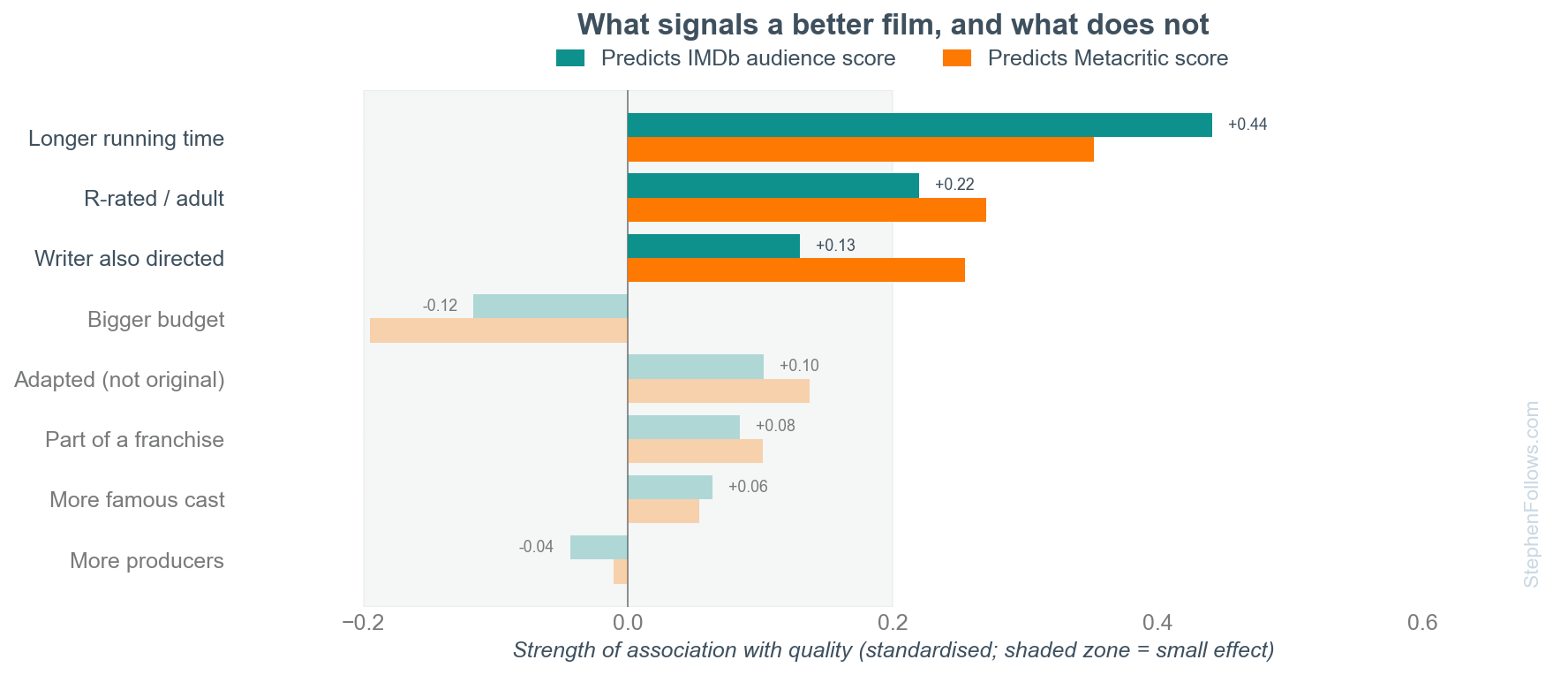
The fact that longer films score higher is pretty consistent, rather than just the average being pulled up by the canons of Christopher Nolan and Martin Scorsese.
Notes
Today’s research looks at 2,756 feature films released between 2002-24 with:
A budget on record,
A worldwide box office figure
A lead whose fame could be measured before release
Both an IMDb user rating and a Metacritic score.
The actor chart uses a broader set of 2,730 prominent actors, each with at least fifteen rated theatrical films released since 2000.
Cast fame is a relative score for each film’s lead, built from publicly visible popularity signals gathered across several websites in the year before release, ranked against films of the same era.
Quality is the IMDb audience score (out of 10) and the Metacritic critics’ score (out of 100). Both are gathered after release, so they describe how a film was received rather than some inherent quality fixed in advance.
To be featured on the scatter plot, the actors had to have been among the 1,000 most famous actors at some point and to have appeared in at least 15 films released since 2000 that had both an IMDb audience score and a Metascore.
The signals chart shows a regression of each score on cast fame, budget, runtime, producer count, franchise status, adaptation, rating, whether the director also wrote it, animation, genre and era. Bars show each factor’s strength on a standardised scale, allowing them to be compared directly. With several thousand films, even small bars are statistically real rather than chance, so the shaded zone simply marks effects small enough to matter little in practice. Runtime and budget are associations, not proven causes.
The actor chart leans towards prominent, mostly English-language leads with enough films to be measured. Films that neither audiences nor critics have scored are absent, which skews the set towards titles that got a real release.
The list of the highest correlated stars at the end focuses on actors (not pure voice actors) and the more famous names.
Further reading
I’ve written on the topic of quality a few times over the years, including:
Not necessarily. There have been quite a few films with an All-Star cast that have ended up being ‘duds’.
The fact that your list of famous names who have the highest correlation with quality are all White is discouraging.