


Five years ago, 7,000 Hollywood writers fired their agents over a practice called packaging and won.
That fight, though, was almost entirely about television, not film. The most pernicious version of packaging lived in TV series, where an agency could earn as much as, or even more than, the very people who created the show, and where the agency had little reason to push for higher writer pay, because its money came from the package fee rather than the writer’s salary.
Packaging fees may have ended (at least for television writers), but today I want to look into two questions:
How prevalent was/is packaging among movies?
Did it really end?
What is packaging, and how do we track it?
Despite being carried out by a small number of well-known agencies that represent the world's most famous people in the biggest movies ever, packaging is relatively hard to study.
For today’s research, I have built a fairly good proxy, but before I reveal the numbers, I need to explain a little more about what packaging is and how we might detect it.
Formal packaging is a specific deal talent agencies make with Hollywood studios. Rather than take its usual 10% commission from each client, an agency assembles the talent and charges a fee paid by the studio. In television that settled into the “3-3-10” structure, which broke down as:
3% of each episode’s licence fee, paid up front as episodes are made (roughly $15k–$75k an episode).
3% of the licence fee, but deferred until the show hits “net profits”. Due to Hollywood accounting, this would often not be triggered.
10% of the back end (syndication and foreign sales) over the life of the show. This is where the real money for the agencies was, as even a small number of mega hits could pay a lot for decades to come.
Here is a helpful Hollywood Reporter article which explains more.
The whole notion of packing fees skewed the incentives for agencies, and many writers felt it meant they were working against the best interests of the very clients they were meant to represent.
In his usual measured, calm style, David Simon of The Wire wrote:
Packaging is a lie. It is theft. It is fraud. In the hands of the right U.S. Attorney, it might even be prima facie evidence of decades of racketeering.
A slightly more measured came for the estimable John August:
When your agent is also the buyer, that's the clearest conflict of interest imaginable.
In response, the agencies didn’t have much more of a defence than “We like the money packaging gives us, and we want to keep doing it”. Jeremy Zimmer, CEO of UTA, said in a letter to their writer clients:
Over the past couple of decades the complexity of the business and the opportunities that have been presented have allowed agencies to decide on a path and pursue it…. We aren’t saints. We are tough businessmen and businesswomen who happen to love artists.
Karen Stuart, executive director, Association of Talent Agents told Deadline:
This development is ironic given that the Guild itself has agreed to the legitimacy of packaging for more than 43 years.
In April 2019, the Writers Guild told its members to fire their agents in protest, and over 7,000 did. After a bit of bluster, the agencies caved and signed new franchise agreements one by one. Packaging fees on Guild-covered projects were switched off from 1 July 2022.
Searching for packaging-like behaviour in film
Packaging fees were overwhelmingly a television business, built on the long tail of syndication money that almost all films lack. The Writers Guild calculated that 87% of scripted series in 2016-17 were packaged, but there has never been an equivalent figure for film.
Film packaging also works differently. It tends to live in the independent film world rather than the big studio system, and it almost always starts with a script. A writer takes that script to their agency, which then tries to attach a director and a star, and the resulting package goes out to raise financing at markets like Cannes and the American Film Market.
And it is not only agencies that put these bundles together; independent producers and production companies assemble the same script-director-star packages too.
I don’t have inside knowledge of all the deals conducted between agents and studios, neither the official ones nor the murky world of favours and influence trading. But I can look for patterns in the data.
I built a database of every movie released between 2010 and 2025 with at least 50,000 IMDb votes. I then narrowed in on the film’s core creatives, which I have defined here as the director(s), writer(s), and the top three credited cast members.
I excluded producers, not because I don’t think they’re creative, but because (a) there are a large number of empty producing credits (see more on that here), and (b) producers are more likely to represent themselves.
Finally, I sought to determine which talent agency represented each creative 18 months before the film's release. If three or more of those key creators shared a single agency, I flagged it as a “One-agency Film”.
Sharing an agency doesn’t automatically mean the film was officially packaged. This research has a lot of fiddy details and caveats, which are in the Notes section at the end, along with my methodology.
Have one-agency films increased?
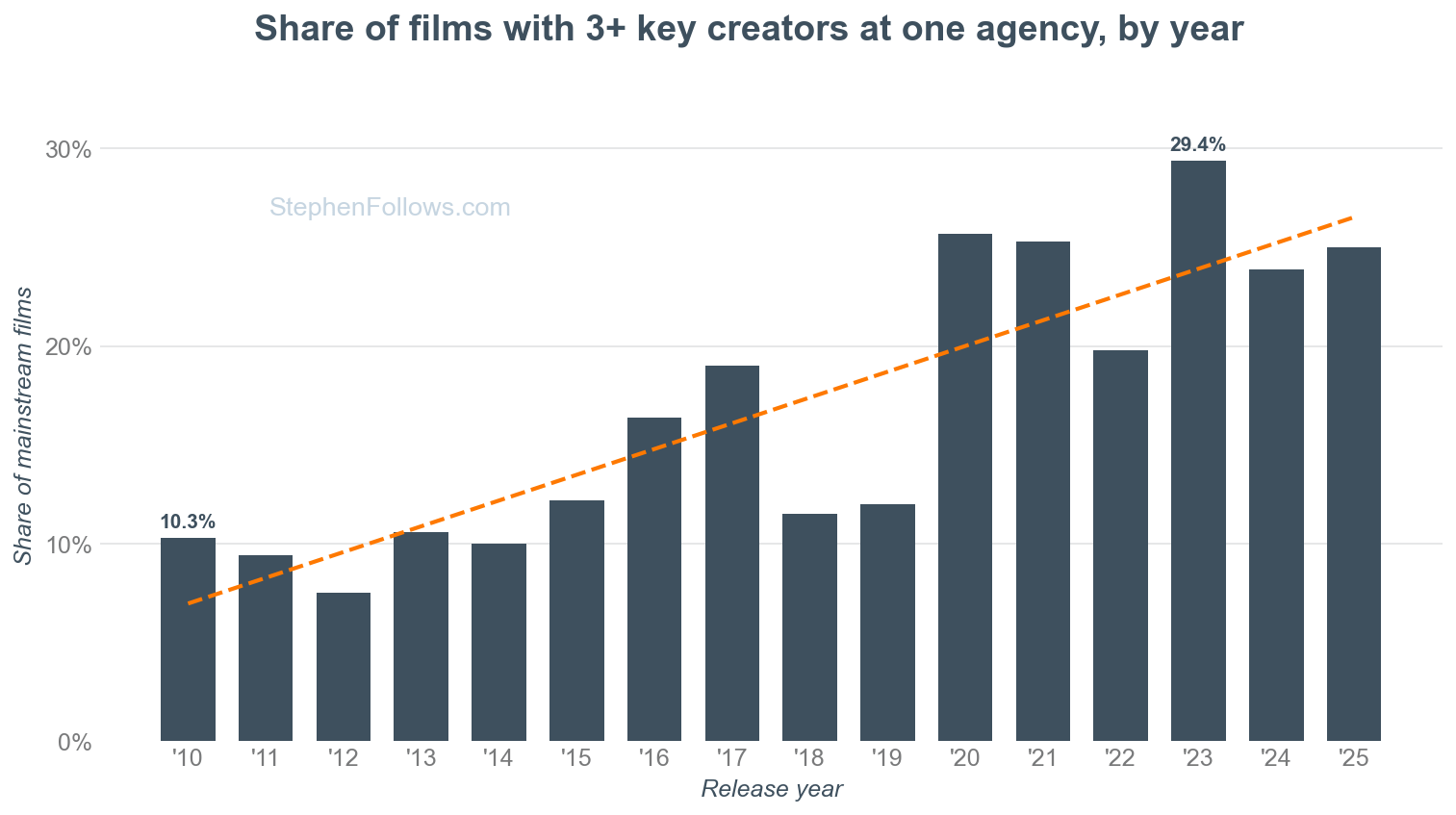
One-agency films have grown dramatically, from around 10% of mainstream films in 2010 to around a quarter in the current decade.
The single highest year is 2023, when nearly three in ten big films had three of their key creators at one agency.
A rising line on its own does not prove agency action on its own. Last year, I looked at which Hollywood agencies dominate the representation of film directors and actors and found that just over half of the top actors and a third of the top directors are with one of just four agencies.
If the big agencies simply represent more people than they used to, you would expect more of the one-agency film pattern we’ve just seen to emerge through chance alone.
Could this be a coincidence?
For each year I took the actual market share of each agency among that year’s creators, then calculated how often a random four-person team would land three or more people at the same firm purely by chance.
Put simply, if everyone picked their agent out of a hat, weighted by how big each agency really was that year, how many one-agency films would you get?
The chance line sits between 7% and 11% for the whole fifteen years. The agencies did grow, and that lifts the baseline a little, but only a little.
This leads us to conclude that almost all of the rise in the observed rate is due to deliberate actions by some people.
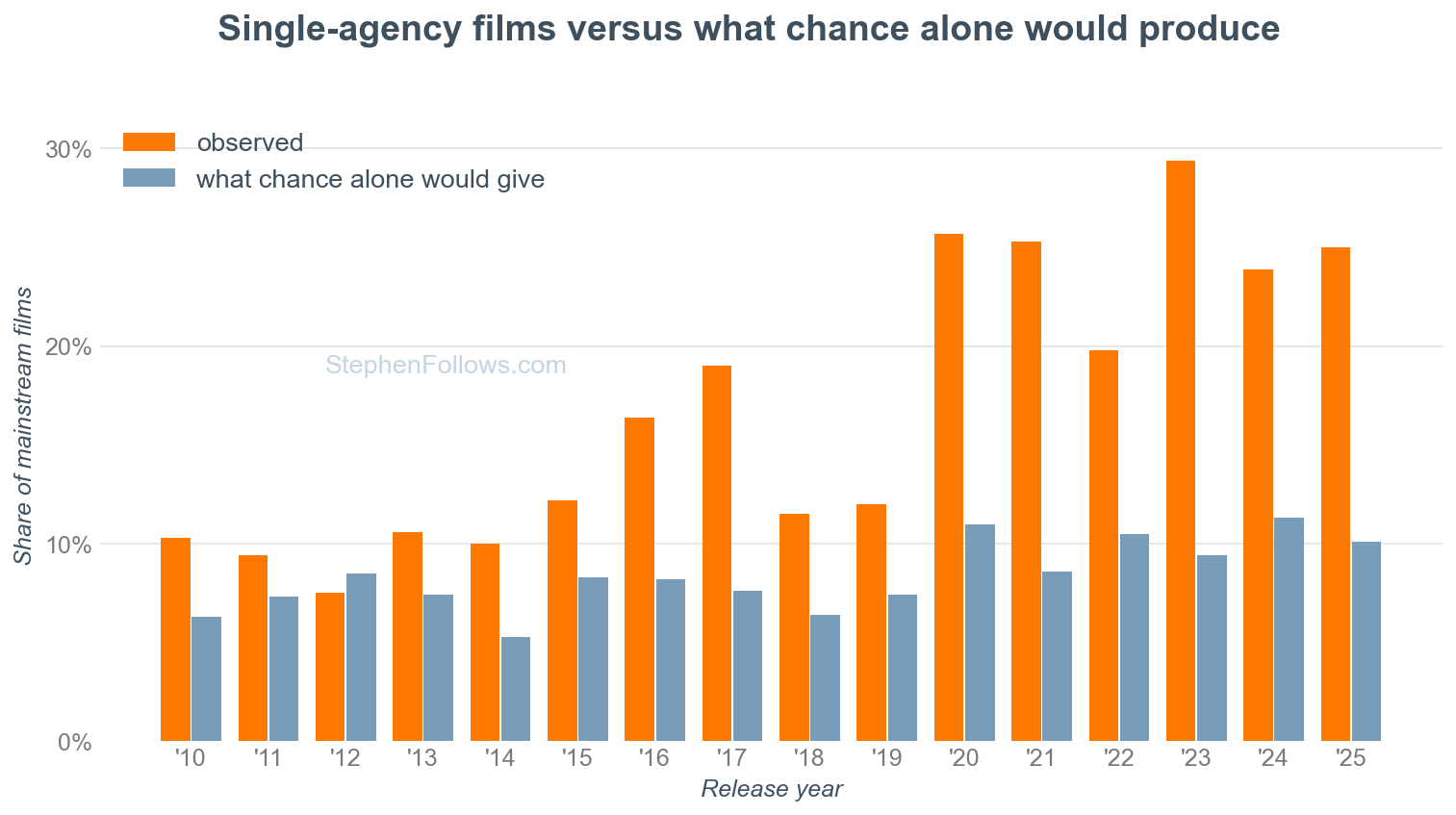
In the early 2010s, one-agency films had about a 1.4-times the chance level. Today, they run about 2.6 times higher.
So the concentration is not only larger, it is harder to explain away as a coincidence than it used to be.
Which agency?
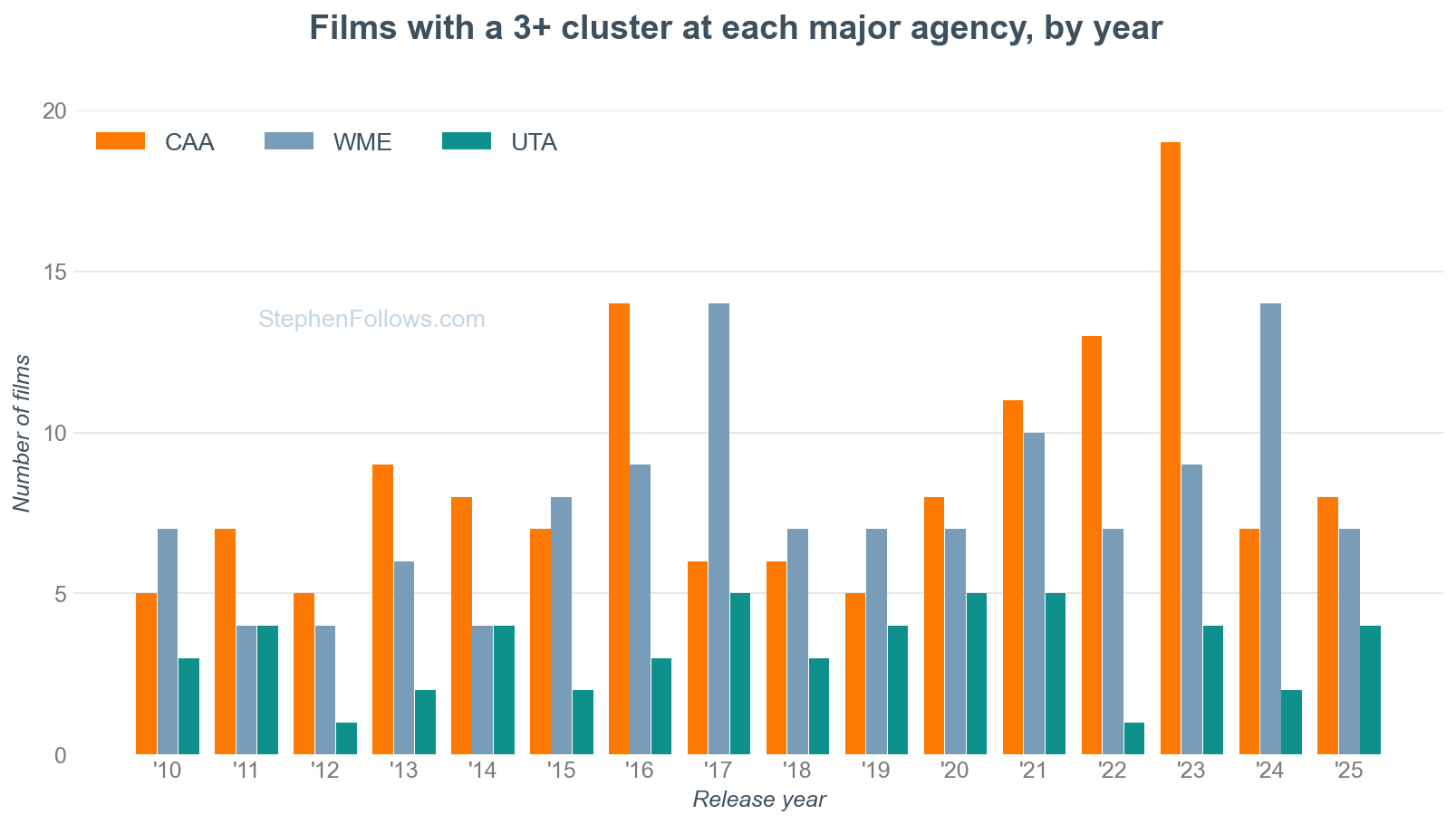
Almost all of the clustering comes from three firms: CAA, WME and UTA. The rest (Gersh, APA, Verve, Paradigm) turn up on a film or two a year at most.
Two things stand out to me:
The first is CAA’s 2023 spike, at nineteen one-agency films, the highest for any firm in any year of the window. That is almost certainly the CAA-ICM merger landing: CAA absorbed ICM Partners in June 2022, and a slice of what would have been ICM clusters a year earlier became CAA clusters once the books combined. By 2024-25 CAA settles back to seven or eight a year.
The second is that WME wins more years than that single CAA spike suggests. It tops 2017 and 2024, among others. Across the full fifteen years, the two are much closer than 2023 alone implies, with CAA on 138 cluster-films and WME on 117. UTA holds a steady third, strongest in animation and family-franchise work.
All three have changed hands during this period. CAA went to François-Henri Pinault’s Artémis, and WME to Silver Lake, which rebranded it the WME Group.
The writers, not the stars
When I split the overlap rate by role (how often a director, a writer or a top-billed actor shares an agency with at least one other key creator on the same film), writers cluster most, rising from 47% in 2010 to 61% in 2025.
If you want to find a one-agency film, look at who wrote it rather than who is on the poster.
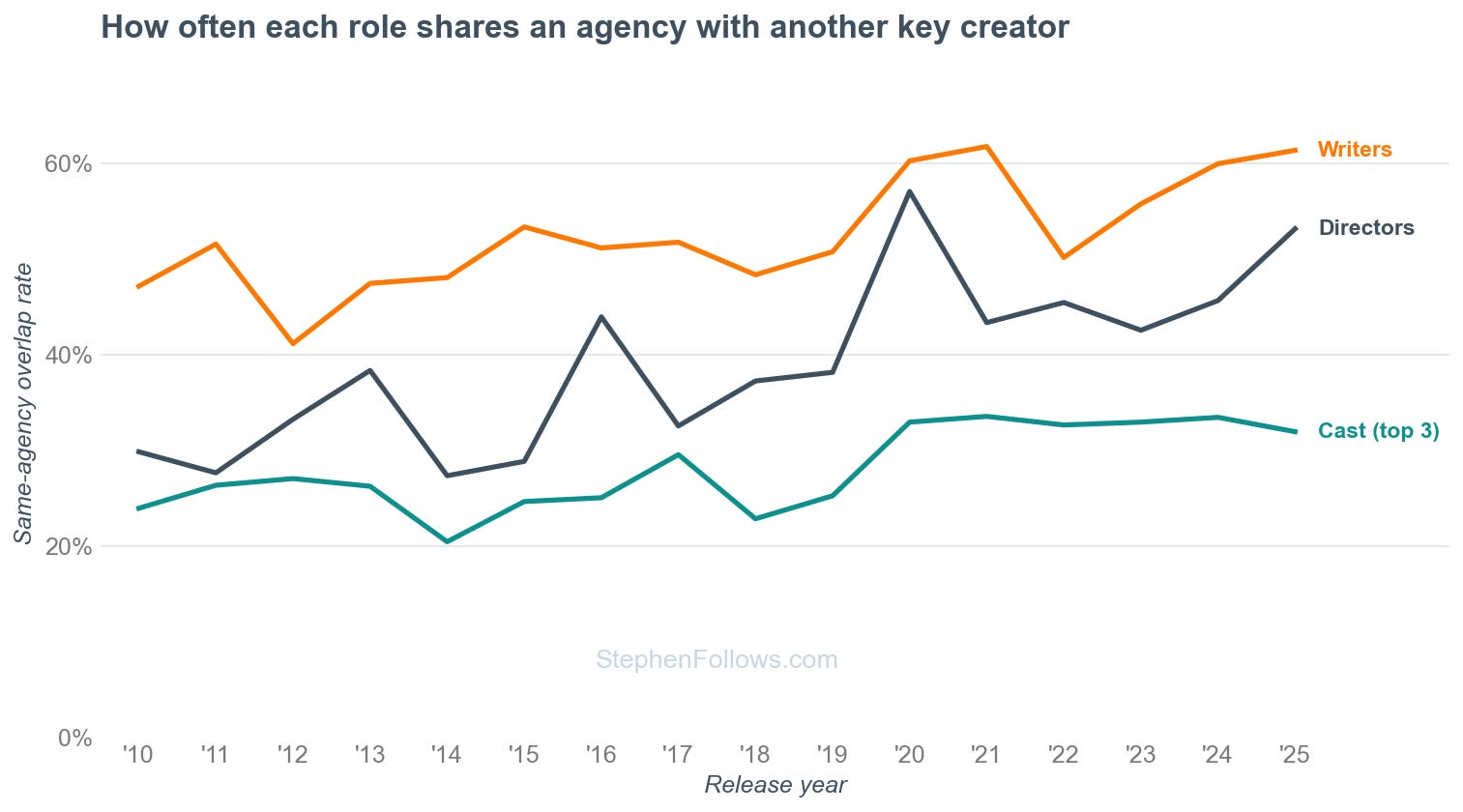
This is exactly what we would expect if feature packages really do begin with a script. If the writer is the first element in the room, they become the anchor around which an agency builds the rest of the film.
The Writers’ Guild fight shows up here too, faintly. The writer line dips and stalls around 2019-21, exactly when the action was live, and a chunk of the writing population had no agent at all. Then it climbs again, and by 2023 it is at a fresh high.
This is what happens when you target just one aspect of a problem. It’s like when you say to a kid, “Don’t let me catch you doing that!” and they reply, “Ok, I won’t let you catch me”.
In this instance, the Writers’ Guild said, “You shouldn’t be charging a fee for not working against the best interests of your clients” and the agencies replied, “Ok, we’ll stop invoicing”.
Notes
Today’s research examines 2,058 films released between 1 January 2010 and 31 December 2025 that received at least 50,000 IMDb votes. Of those, 1,989 had at least one key creator whose deal-time agent could be resolved. The films that drop out are mostly international productions whose creators have no US agency footprint, or films whose entire teams were first-timers not yet on the signing record.
The tracked ‘key creators’ were the credited director, all credited writers, and the top three billed cast.
I also dropped anyone whose recorded date of death predates the film’s release, which removes source-material credits such as Bram Stoker for Nosferatu or Mary Shelley for Frankenstein.
I use the release date minus eighteen months as the proxy for when a film was assembled. My per-person agent timeline behind it contains 47,562 records of (person, agency, date range) across 18,757 people, built from trade-press signing announcements in Variety, The Hollywood Reporter, and Deadline dating back to 2010, then overlaid with a May 2026 representation snapshot.
In today’s research, the term ‘agency’ refers only to talent agents. People often have separate representatives for commercials, voice, theatre and literary work, plus separate managers, lawyers and publicists. Counting all of those would multiply the clusters without telling us much.
The chance baseline is calculated using a binomial distribution. For each agency, take its share of all deal-time-repped creators in the cohort that year, work out the probability that a four-person team would land three or more people at that firm by independent choice, then sum across firms. It is recomputed every year, so the growth of the big agencies is already accounted for.
It’s worth repeating that sharing an agency is not automatically the same as being packaged. This measures single-agency concentration at deal-time and the odds that it is a coincidence. It does not, and cannot, confirm a packaging deal or fee on any individual film. Historical and corporate context comes from the trade-press record and the Writers Guild’s own agency agreements.
Thank you, as always, for your detailed and insightful reporting @StephenFollows
Very informative and well researched @StephenFollows