


When I was making short films twenty years ago, it seemed really important to carefully curate which film festivals you gave your premiere status to (i.e. the first time your film is screened to the public anywhere).
I haven’t thought about it for a while but I recently received the following question on the topic from MarBelle, the Editor-in-Chief of Directors Notes:
I was wondering if in your data travels you have compiled any stats on the number/percentage of film festivals that still require premiere status.
I have not been at the coalface for a while, so I decided to find out whether that thinking still holds true.
To test this, I studied the official rules of 10,549 film festivals to see how many required some form of premiere status. Where a festival did specify premiere status, I noted whether it required a world, national, or local premiere.
Do the vast majority of festivals require premiere status?
In short, No. The overwhelming majority of festivals do not care whether your film has been screened at another festival.
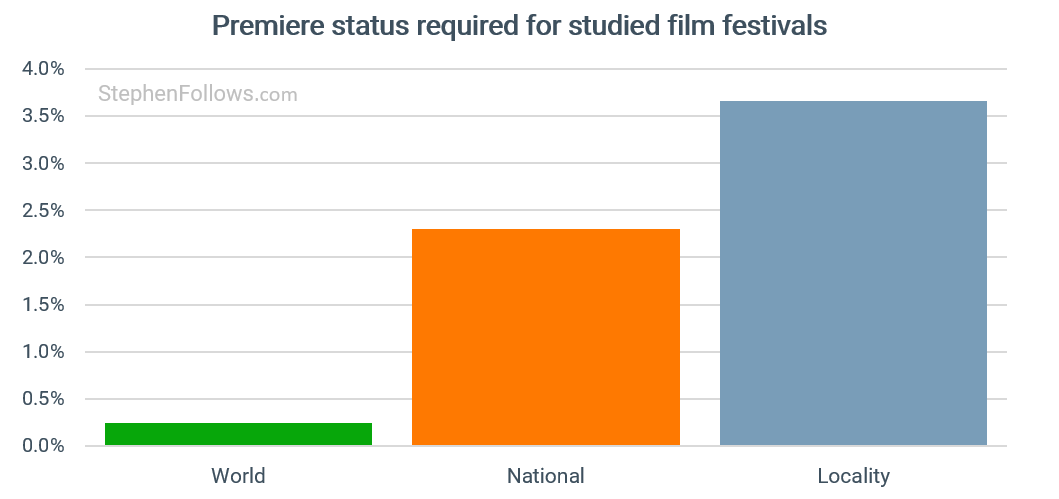
Out of the full dataset, 9,894 festivals (93.8%) placed no restrictions at all. Only 26 festivals required a world premiere, 243 required a national premiere, and 386 asked for a local or regional premiere.
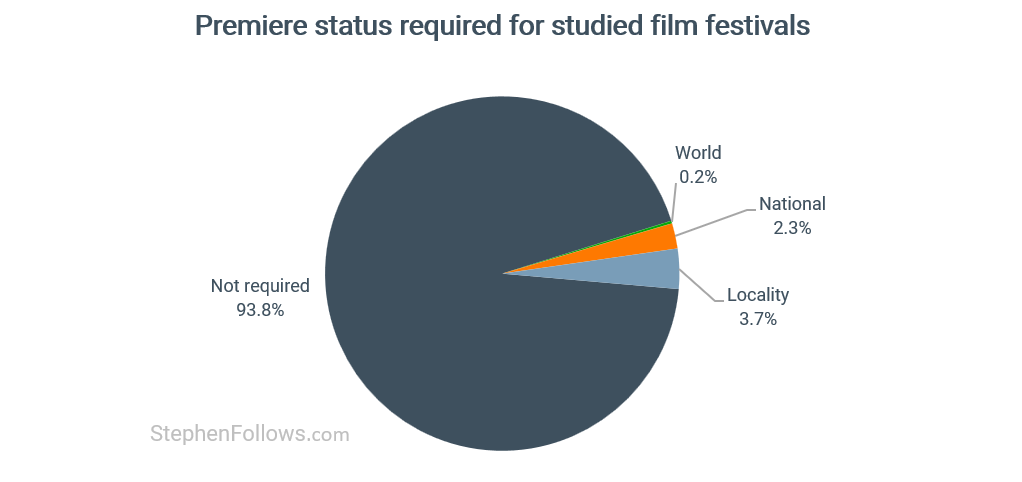
Given how small the percentages are, maybe it would be clearer if I show the same data as a bar chart.
So… premiere status doesn’t matter?
Not quite. The data above is just counting the number of festivals that require premiere status. It’s not taking into account the scale or importance of the festivals. I suspect that most filmmakers would prefer to win at “just” the Cannes Film Festival than 100 tiny locals festivals.
Events such as Cannes, Venice, Berlin, Sundance, Toronto, and Tribeca rely on exclusivity to generate press attention and attract distributors. Their programming depends on being the first to reveal new work and festivals like these do not want to programme films that have already circulated online or on the circuit.
But these top-tier events represent a tiny fraction of the overall landscape. Over the past two decades, the growth in film festivals has come almost entirely from the lower end of the scale, i.e. regional, genre, and community festivals that are run on tight budgets and rely on entry fees, volunteers, and local audiences.
In practice, this means that the traditional emphasis on premiere status still applies at the very top, but is not relevant everywhere else.
Why you might still target who you give your premiere to
Even though almost all festivals no longer demand a premiere, there can still be good reasons to offer one. Festivals, like filmmakers, respond to small gestures of recognition. Telling a programmer that your film will have its first screening with them might help your submission stand out from the hundreds they receive. It signals that you value their event and want to give them something special to promote.
A local or national premiere can also make your screening feel like more of an event. Festivals are more likely to schedule a Q&A, invite local press, or highlight it in their marketing if they can describe it as a premiere. That extra attention can help you meet other filmmakers, attract a larger audience, and create a better atmosphere in the room.
There’s also a practical advantage when it comes to audience awards. Viewers are often more engaged when they know they are among the first to see a film. The energy of a “first screening” can translate into stronger reactions, more votes, and better networking opportunities afterwards.
Further reading
If you’re a filmmaker on their festival journey then here are some of my past articles you may find useful:
Epilogue
I chatted to MarBelle after I finished the research to see what he thought of the results. He said:
As the editor-in-chief of Directors Notes, my position is no secret: I advocate for releasing your short film online early to maximize its reach as a core part of your festival strategy. The outdated belief that a film must be held back until the very end of its festival run is not only limiting but, as Stephen’s data confirms, largely unnecessary.
Having worked with countless filmmakers, I’ve seen first-hand how an online presence helps a film find a wider viewership than the festival circuit alone can provide. Crucially, it can lead to more festival selections, not fewer.
This data powerfully dispels the pervasive myth of the premiere requirement, confining it to the exclusive tier of festivals where it truly matters.
It's an interesting post. As someone who's managed two festivals (Haunted House FearFest and Berlin Sci-fi FilmFest), both niche and mid-to-lower-tier. I can confirm that premiere status isn't a requirement for most festivals.
However, presenting a film as a world, European, or national premiere can actually boost its appeal. This exclusivity often helps gain more attention from both audiences and media. In my experience, screenings labelled as premieres can create a novelty value and attract a larger audience - There's nothing like seeing somethng first.
Major festivals like Cannes, Venice, and Berlin prioritise premiere status which align with studio and distribution deals. The majority of festivals (93.8% according to a recent study) place no restrictions on prior screenings, it isn't beneficial to the festival when you are looking to screen the best films possible.
Nonetheless, offering a premiere is sometimes a good strategic move to enhance a film's visibility and audience engagement, assuming that it is offered to a reputable festival with a guaranteed audience.