


On Friday, two new films opened in US cinemas. Verity, the Anne Hathaway thriller, went straight to number one with an estimated $32.6m over the weekend. Digger, starring Tom Cruise, took $8m, which Deadline says is his lowest opening since 2007.

So Verity took four times as much money, and opening-night audiences liked the two films equally, as both got a C+ from CinemaScore.
But as of right now, Digger has 14,000 votes on IMDb, and Verity has just 6,900. In other words, the film that took a quarter of the money has twice the votes, and a better score too (7.3 against 6.1).
Deadline reports that 79% of Verity’s audience were women, which matches a pattern I have noticed for a while.
This is nothing new.
A Bad Moms Christmas and Alien: Covenant were released six months apart in 2017, and they did almost identical business.
Film data supplier Numero provides Movio data tracking loyalty-card members at 12 US cinema chains, and they log 161,520 visits for A Bad Moms Christmas and pretty much the same for Alien: Covenant (160,184).
At the US box office, the two movies took $72.1m and $74.3m, respectively.
Their audiences were a similar age, too.
They differed in who bought the tickets. Women made up 63% of the cinema audience for A Bad Moms Christmas and 28% for Alien: Covenant. And on IMDb, Alien: Covenant has 349,692 votes and A Bad Moms Christmas has 63,000, which is 5.6 times as many for the same number of people in cinemas.

This weekend’s example spurred me to investigate it properly.
I matched audience data for 1,608 films released in US cinemas 2015-25 with their IMDb votes and found that for every 10 extra percentage points of women in a film’s cinema audience, it gets about 40% fewer IMDb votes per cinema visit.
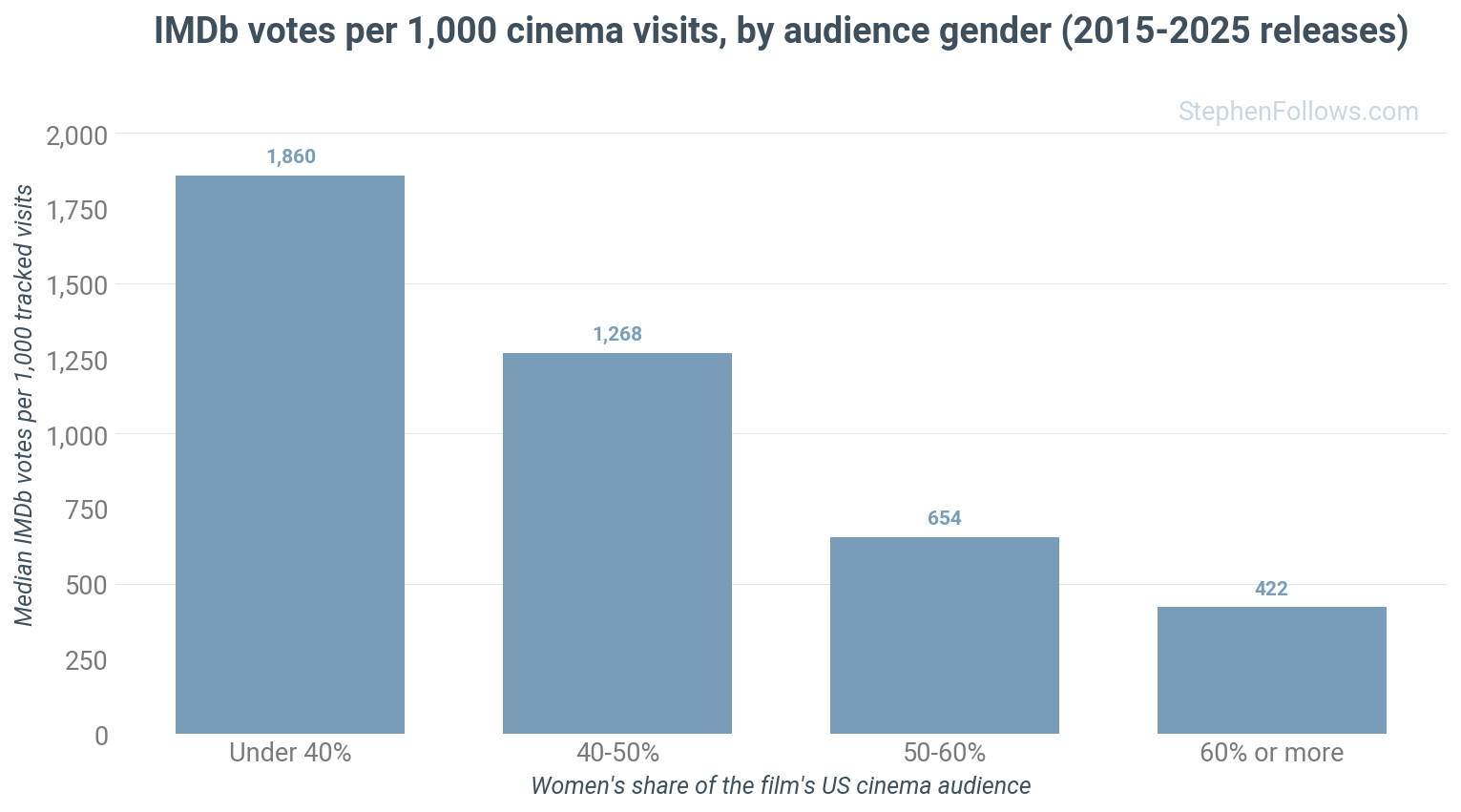
Among films whose audiences were mostly men (i.e, men at least 60% of the cinema audience), the typical one got 1,860 IMDb votes per 1,000 tracked visits, versus 422 for the typical film whose audience was 60% or more women.
That’s a gap of 4.4 times.
Who votes on IMDb?
IMDb used to show how many votes came from men, women, and four age bands but removed that feature in 2023.
Thankfully, archived copies survive on the Wayback Machine, allowing me to build a dataset of 955 films.
The fact that IMDb is so male-skewed is not new:
Luis Aguiar found that 79% of a typical film’s IMDb ratings come from men, across 12,657 films.
Bryan Stroube and David Waguespack put it at 80% of 383 million ratings.
In 2016 Walt Hickey at FiveThirtyEight found that 70% of IMDb’s TV raters were men.
But no one seems to have tracked how this compares with the people who actually bought the tickets.
Thanks to the wonderful folks at Numero, I have this.
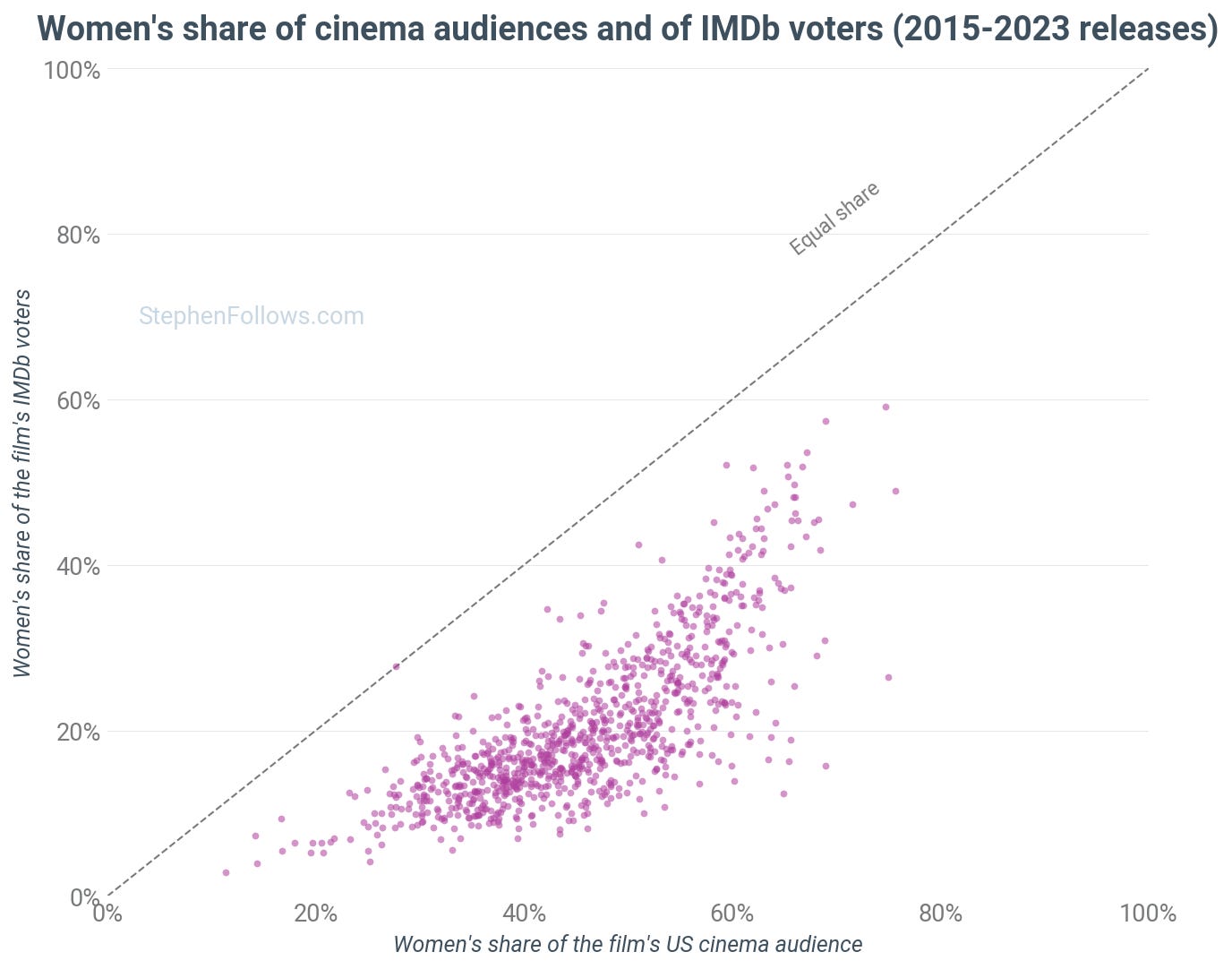
On the chart below, each dot is a film, with the share of its cinema audience who were women along the bottom and the share of its IMDb voters who were women up the side. If voters matched audiences, the dots would sit on the dashed line.
Only one film matches: Captive State (2019), with women making up 28% of both the cinema audience and the IMDb voters. In every other case, men make up a higher percentage of the voters than they did of the cinema audience.
How big is the gap?
Overall, women made up 46% of cinema visits but just 18% of the votes.
In the chart below, I’ve grouped the films by the share of their cinema audience who were women and shown the median number of IMDb votes each group received per 1,000 tracked visits.
As you can see, the fall is steep and steady. Films whose audiences were 40-50% women got about two-thirds of the votes per visit of mostly male films, and the most female films got less than a quarter.
At this point you may be wondering if genre has a role to play. Women make up more of the audience for romance, musicals and faith films, and those genres might collect fewer votes for reasons that have nothing to do with gender. I wondered that too, but genre doesn't explain it. When I held genre constant, the gap barely moved.
Is it just IMDb?
IMDb is the biggest and best-known database of film ratings, but it’s far from the only one. Every platform I could check showed the same gap.
For every 10 extra percentage points of women in a film’s cinema audience, the film gets this much less activity per cinema visit:
MovieLens: 45% fewer ratings
Wikipedia: 41% fewer pageviews
IMDb: 40% fewer votes
IMDb: 40% fewer written reviews
IMDb, US users only: 31% fewer votes
Letterboxd: 25% fewer ratings
TMDb: 20% fewer votes
Each thin line shows the range the true figure probably sits in (a 95% confidence interval).
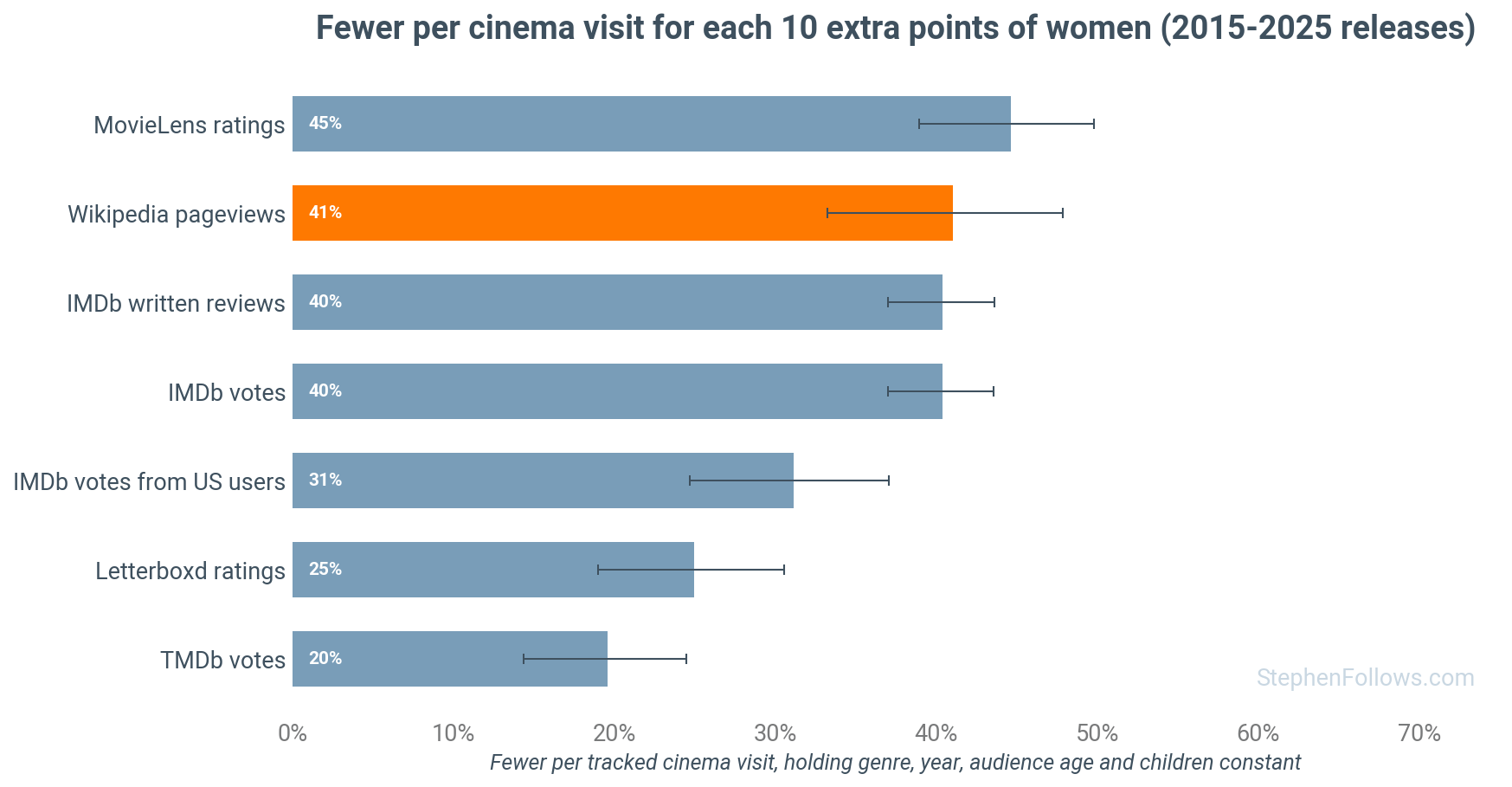
The Wikipedia figure is the striking one, because nobody has to sign up or rate anything to read a Wikipedia page.
Who rates films online matters, and so does attention. For each person who saw them in a cinema, films with mostly female audiences get a lot less online attention of any kind.
Is it only that women vote less?
I expected the explanation to be that women vote less often, but that's only part of the story.
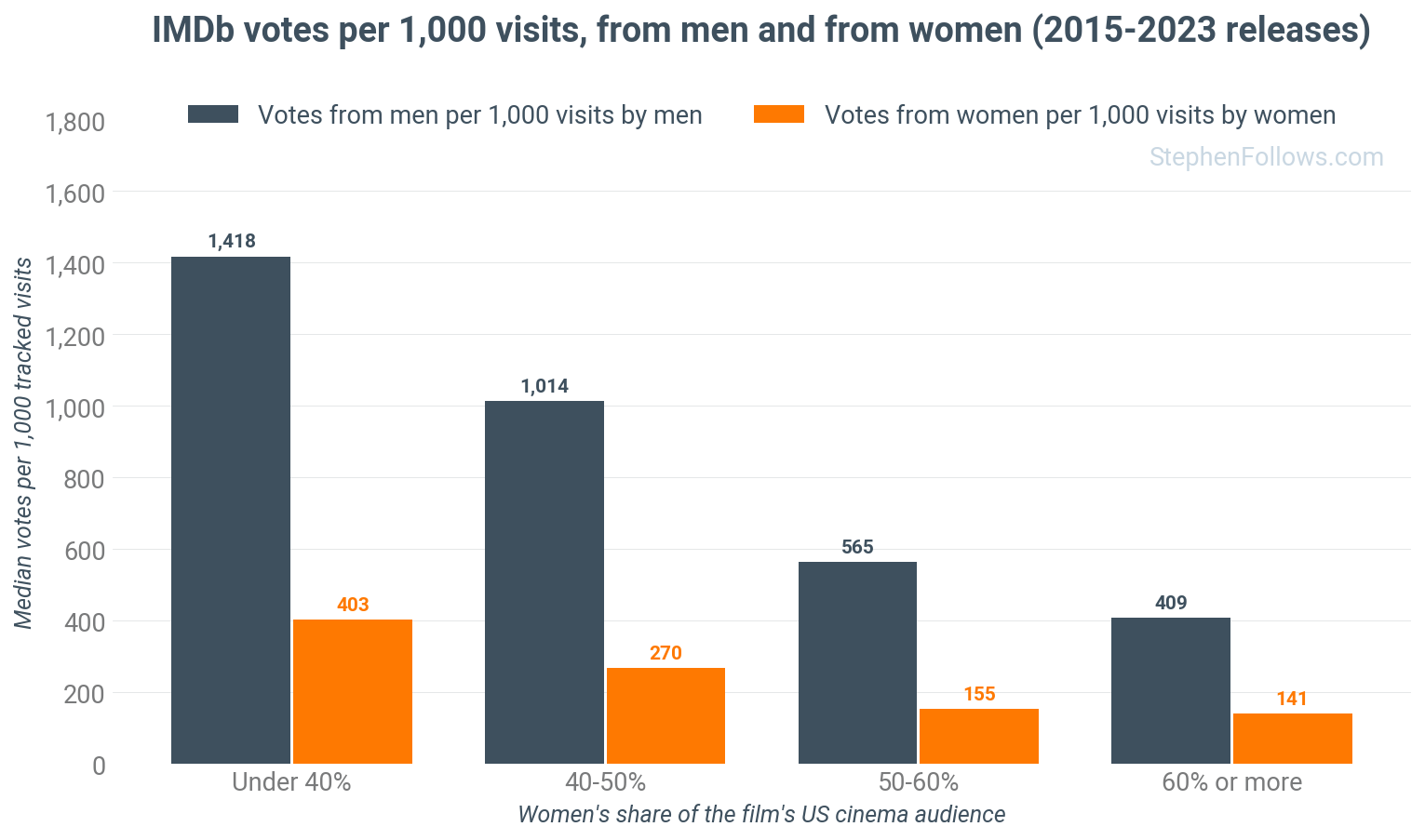
If men simply rated films more often than women, a man who saw A Bad Moms Christmas would be as likely to vote for it as a man who saw Alien: Covenant. He isn’t. For each group of films, the chart below shows how many votes came from men for every 1,000 visits by men, and how many came from women for every 1,000 visits by women.
In every group, men vote more often than women (about 3.5 times as often for the typical film), but both sets of bars fall. Each extra 10 points of female audience means 40% fewer votes per visit from men and 39% fewer from women.
This means two things are happening at once:
Women are much less likely than men to rate films on IMDb.
Films that women go to see in large numbers get less online activity from everyone who sees them, men and women alike.
Given there are no gendered barriers to rating, I'm happy to put the first down to taste. The second is harder to explain. A few possibilities fit:
These films may have smaller lives after the cinema, so fewer people see them at home and fewer votes arrive later (a vote can come from any viewing, in a cinema or at home).
The men and women who go to films with mostly female audiences may simply be less likely to use IMDb, Letterboxd or Wikipedia at all.
Online film culture (fan communities, lists, arguments) may gather around some kinds of film more than others, pulling in votes from people who never saw the film in a cinema.
All three fit the Wikipedia data, but the data alone cannot tell us the level (if any) of effect from each.
Bonus question - Does it change the score?
Before we go, I thought I’d look at a follow-up question from today’s findings.
Fewer voters is one problem. A different mix of voters could give a different score.
On IMDb, women rated the median film 0.2 points higher than men did, and rated it higher for 76% of the films. So if the voters looked like the cinema audience, most ratings would actually go up. I re-weighted each film’s rating so votes from each gender and age band counted in proportion to the real audience. For the typical film the change is small, with the median film moving up by 0.08 points and films with audiences 60% or more women moving up by 0.18.
For some films it’s much bigger. In all, 144 of 835 films moved by 0.2 or more, and 14 by half a point or more.
Nearly all of the films that move most are faith-based. Women made up 52% of the cinema audience for God’s Not Dead 2, yet men cast 78% of its gendered IMDb votes. Women on IMDb gave it 6.2 and men gave it 3.8, so re-weighted to the people who went to see it, its rating rises from 4.2 to 5.4.
So the mix of voters matters a lot for a few films and a little for most.
CinemaScore polls audiences on opening night and turns their verdict into a letter grade, making it a decent measure of how much people in the cinema liked a film. So if IMDb and the cinema audience agreed, two films with the same CinemaScore grade would get about the same IMDb rating, regardless of who was in the audience.
To test that, I took the 1,055 films with a CinemaScore grade. Below, I’ve compared the average IMDb rating at each grade for films whose audiences were mostly men (under 40% women) and films whose audiences were mostly women (60% or more).
At every grade, the films watched mostly by women get the lower IMDb rating. Among films graded A or A+ on opening night, the mostly male films average 7.5 on IMDb and the mostly female films average 6.7. Opening-night audiences liked them equally. IMDb doesn’t.
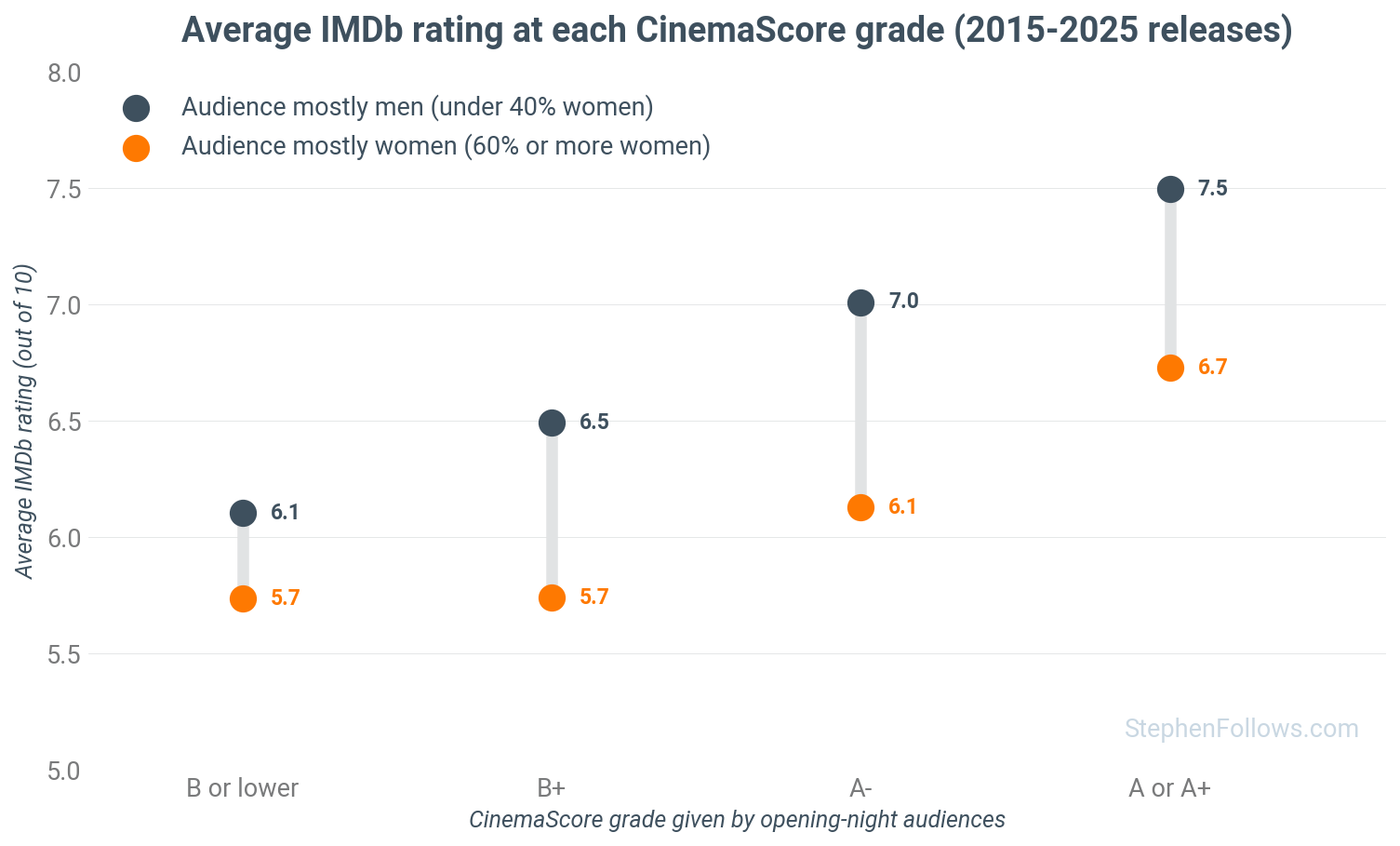
This weekend’s pair fits the pattern. Verity and Digger both got a C+, and Verity sits 1.2 points lower on IMDb.
It’s not just these two films. Across all 1,055 films with a CinemaScore grade, the more women there were in the audience, the lower the IMDb score compared with how much the opening-night crowd liked it. Every 10 extra percentage points of women knocks about a third of a point off a film’s IMDb rating. Women do this on IMDb too, just less than men do.
There are two ways to read that:
Opening-night audiences of mostly women may grade more generously than other audiences.
Or the people who rate films online (women included) may judge these films more harshly than the people who paid to see them.
I can’t separate the two with this data, but either way, an IMDb score and an opening-night grade measure different people.
Can you correct for it?
If you use IMDb votes as a stand-in for how many people saw a film, as I have, you should adjust for the audience mix. I’ve built a simple way to do that, which I’m calling “Audience Adjusted Votes”.
Multiply a film’s IMDb votes by the factor below, set by the share of women in its cinema audience. The reference point is a film whose audience is 45% women (the median across all these films).
30% women in the cinema audience = multiply IMDb votes by 0.53
40% women = multiply by 0.81
45% women = multiply by 1.00
50% women = multiply by 1.23
60% women = multiply by 1.88
70% women = multiply by 2.86
80% women = multiply by 4.36
Why does it matter?
IMDb votes and ratings get used as a shorthand for how many people saw a film and what they thought of it. On the evidence here, that shorthand short-changes the films women go to see.
Per person in the cinema, a film with 60% or more women in its audience gets less than a quarter of the IMDb votes of a film with mostly men in its audience, so it looks smaller than it was. At the same CinemaScore grade, every 10 extra points of women in the audience means an IMDb rating 0.32 lower, so it looks worse than its audience thought.
Those films also drop out of any sample built on vote counts. Among films with 50,000 or more tracked visits (about half of the films here), a 50,000-vote floor would remove 51% of those whose audiences were 60% or more women and 2% of those whose audiences were mostly men.
I’ve done it myself, more than once. My recent articles on directors’ ages and on packaging in Hollywood both kept only films with at least 50,000 IMDb votes. My study of nepo babies used a 10,000-vote floor, and the piece on what gets a director a second film used 1,000 votes as a sign that a debut had been seen. Samples built that way lean towards films that men and IMDb users have heard of, which is narrower than films people have heard of.
So what is an IMDb vote count measuring?
Online engagement, mostly.
A film’s IMDb vote count is a fine measure of how much it matters to people who rate films online. It’s a poor measure of how many people saw it.
By IMDb’s count this week, Digger is twice the size of Verity. At the box office, Verity was four times the size of Digger.
Notes
The audience data covers new releases in US cinemas between 1 March 2015 and 31 August 2026 with at least 5,000 tracked visits, and comes from loyalty-card members at 12 US cinema chains, about 5% of US box office. Numero weights each film’s audience to match a survey of US moviegoers by age and gender. Every audience figure is a share of visits, not a count of people.
IMDb votes come from IMDb’s public data files; MovieLens ratings come from the MovieLens 32M dataset; Wikipedia pageviews cover the 24 months from each film’s release month, for films released by March 2023. The voter breakdowns by gender and age come from archived copies of IMDb ratings pages on the Wayback Machine and cover only voters who gave IMDb their gender, about two thirds of votes for the typical film.
The Verity and Digger figures are not part of the study. Their IMDb votes and ratings are as shown on IMDb on the morning of Monday 5 October 2026, three days after release, and will have moved since. The weekend box office figures are Deadline’s estimates for the US and Canada, and the 79% figure and the CinemaScore grades are as reported by Deadline. IMDb votes come from every country, so the two measures don’t cover quite the same audience.
Votes measure engagement from every kind of viewing, at home and abroad as well as in US cinemas. Votes for these films aren't growing faster for male-audience films now (between June and October 2026 they grew at the same rate regardless of audience mix), so older male-audience films pulling ahead over time can’t account for the gap by itself.
I tested the audience-adjusted votes factor by fitting it on films from odd-numbered release years and applying it to films from even-numbered years, and it removed about three-quarters of the gap.
I wonder if Rotten Tomatoes has a similar bias.
A a Gen Z woman, most of my friends are on letterboxd and TMDB! That’s probably why the gender gap is smaller on those platforms. Still, most of my followers on those are my film bro friends.