


Over the past year, I’ve been digging into the state of the film finance sector, and a quote from the late 1940s keeps coming to mind. British film producers John and Roy Boulting said the film ecosystem protected financiers, but the producers bore the brunt of any failures. They put it like this:
Guarantees exist for the strong, and not for the weak. The armour of ‘orthodox’ finance envelops the mighty. The humble stand naked and are expected to feel ashamed.
A lot has changed over the past 75 years, but I suspect that the average modern film producer will hear that quote and feel seen!
So when I came to write a piece about ‘everything that’s wrong with film finance’, I was struck by just how many of the complaints people have are as old as the invention of film itself.
This is all in preparation for a series of projects I’m doing with the legendary Phil Hunt. Phil lends to and invests in independent films and has executive produced more than 300 features, but financed almost 600
Phil and I are doing three things together:
We’ve co-written a paper entitled ‘Where film money will come from in 2027’ which you can download here.
On 8 December, we’re hosting a free webinar entitled ‘What you can’t look up about film finance’, where we’ll take a finance package apart line by line, live. Sign up here.
The main piece is our live online course, Advanced Film Financing, which runs as six live sessions from 12 to 28 January 2027 and ends with a meet-up at the European Film Market in Berlin on Friday 12 February. Find out more and book your place here.
All three projects are here to help you finance your film. As part of that, it’s time we were honest about the issues and shortcomings in the film financing sector.
Some of these are inherent in the nature of the beast, rather than failings of the people involved. The way I see it is that there are two types of people involved with film financing:
People trying to make money
People trying to make films
As much as they might not like to admit it, they need each other. And each is willing to do a bit of the other's job to get what they really want (producers learn to talk about returns and financiers learn to talk about cast).
But almost everyone knows which camp they're in, and most problems happen where the two meet but cannot agree.
With that in mind, below are 20 ways I think the film finance system is flawed - ten of which are new and ten which are as old as time.
1. Nobody pays the asking price
When a sales agent prices a film for a lender, each territory gets two numbers. The ‘ask’ is where the agent opens negotiations, and the ‘take’ is what they expect to settle for. Across 1,120 territory estimates I studied, the median ask was exactly twice the take, and 27% of all asks were precisely double.
The chart below shows the 40 territory deals I could match to an estimate, and what each one closed at for every $100 the agent asked.
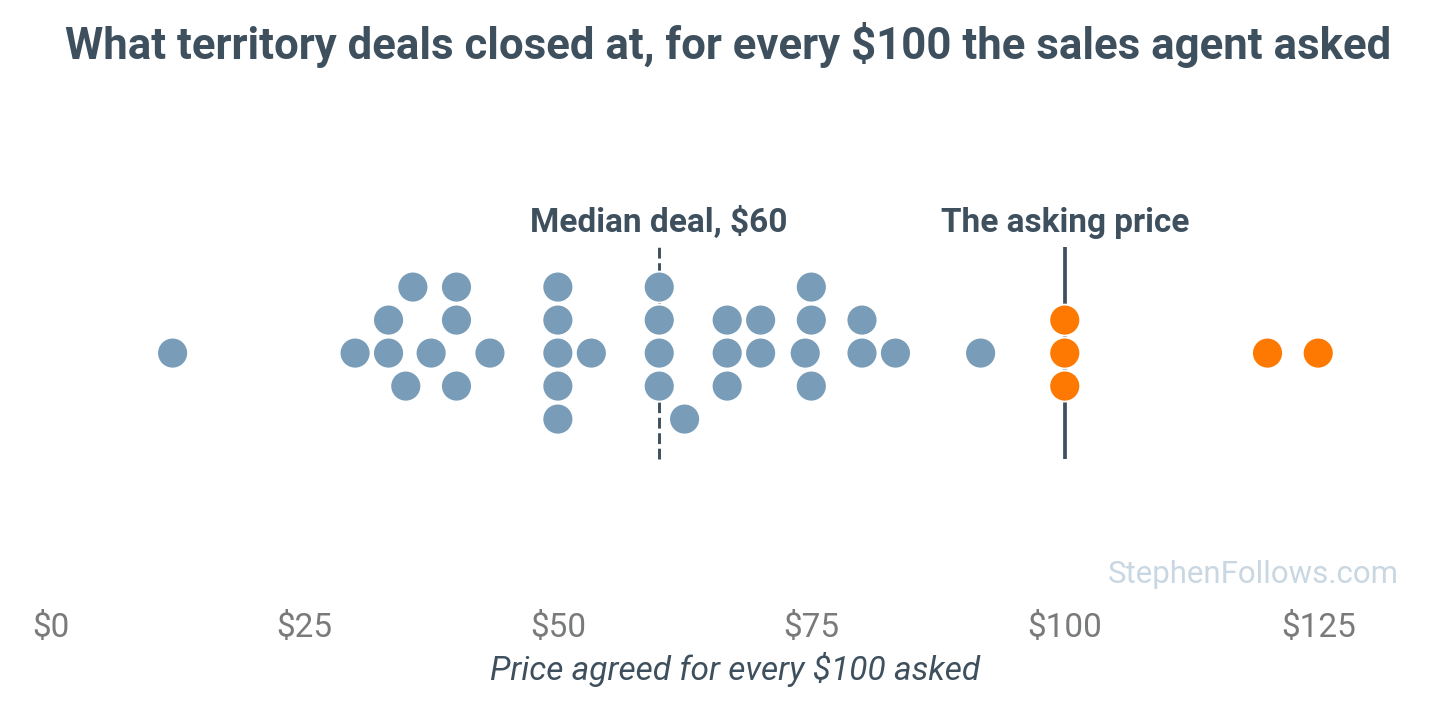
The median deal closed at $60, and only 5 of the 40 reached the ask. Measured against the take, the same deals landed almost exactly on target. So the take is a fair guess, and the ask is an opening bid. Lenders lend against the take.
The trouble starts when a producer builds a plan on the bigger number, and when I spoke to Phil about it, he described how that happens:
Quite often the producer asks the sales agent to nudge the estimates up a bit, because that’s how they make the numbers close. Everyone knows the ask is optimistic. The lender’s job is to work out what’s real.
2. Investors only win on hits
After tracking almost a billion dollars of investments across a number of major films, I calculated that investors got $0.77 back for every dollar invested. And that's before we account for inflation, opportunity cost, or risk.
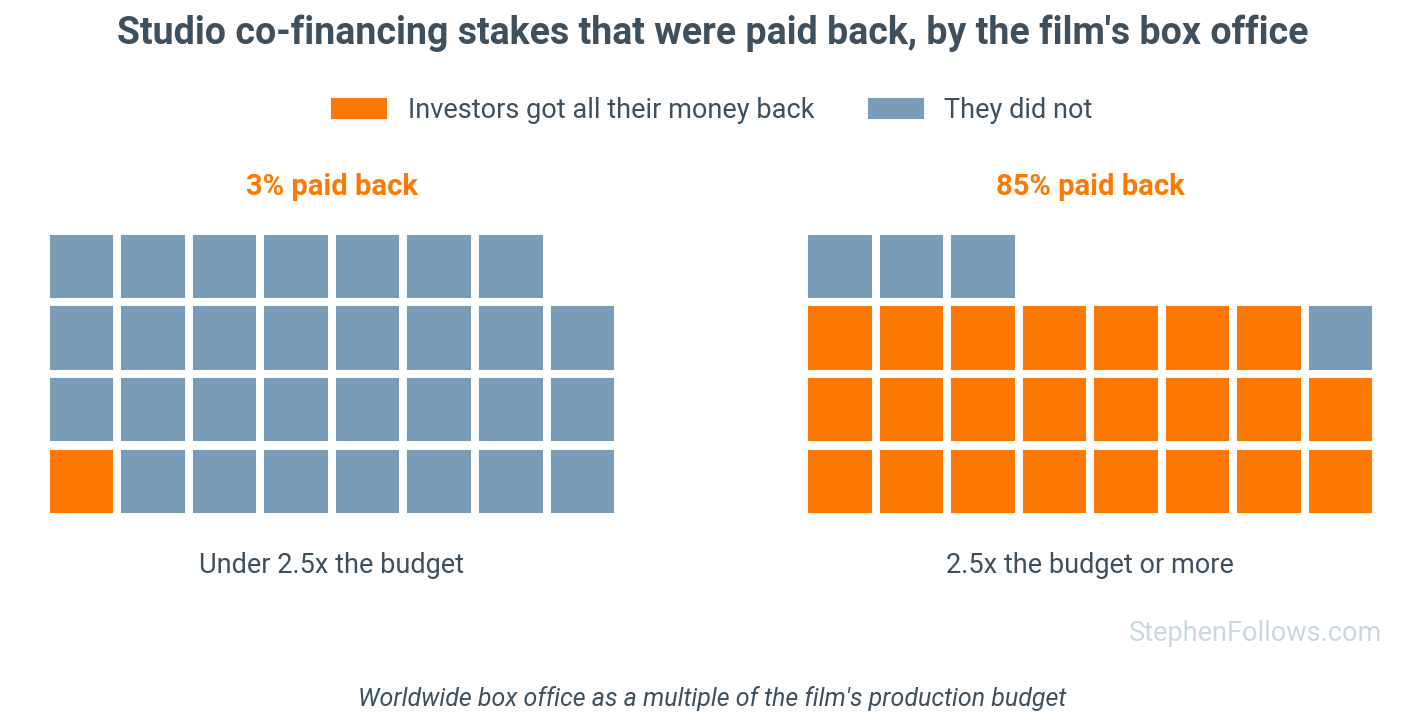
For films that grossed under 2.5 times their budget at the box office, investors got their money back in 3% of cases. Above that line, it was 85%.
About 5 cents of every box-office dollar reached investors.
3. A few films earn all the money
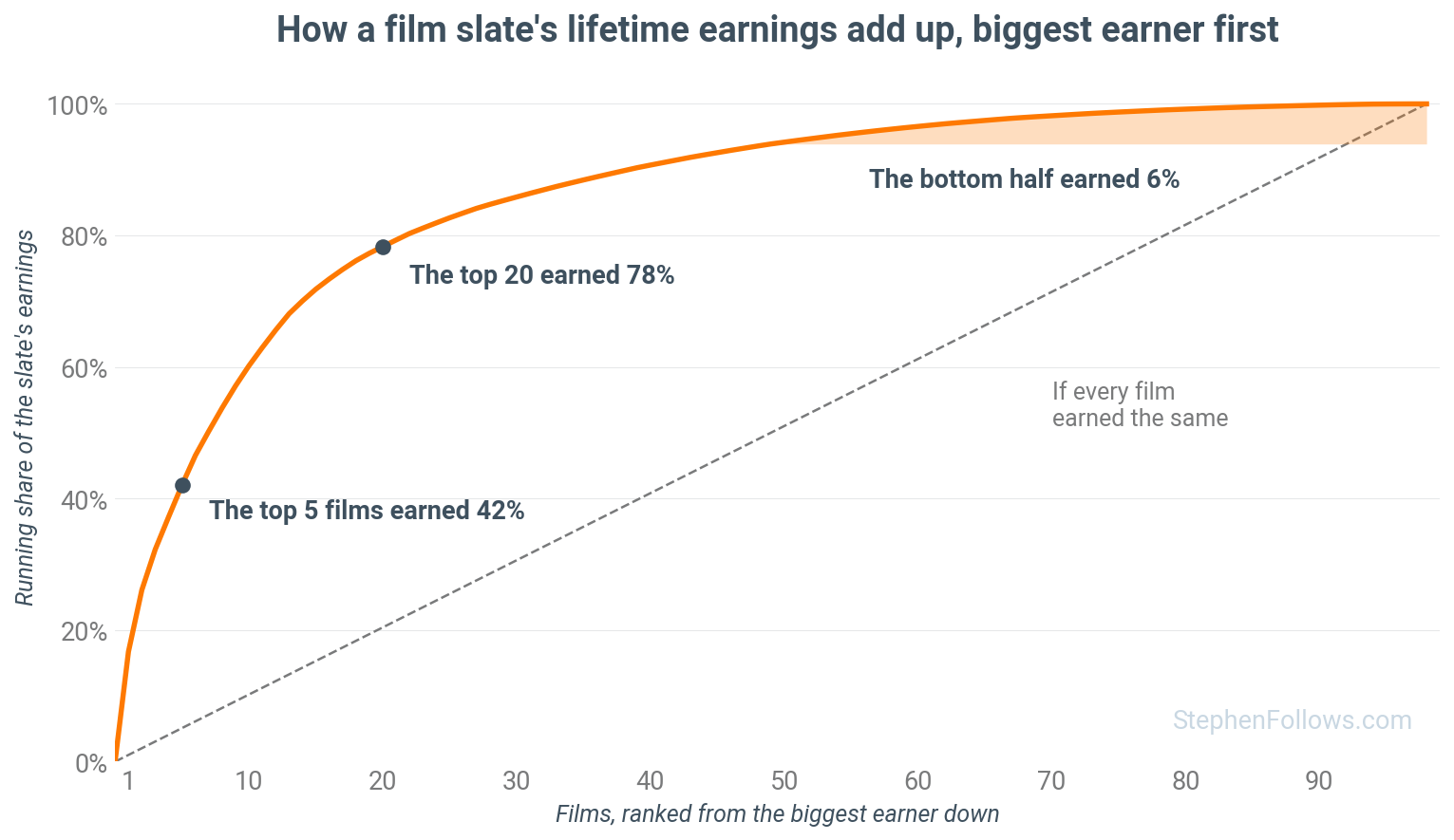
In one slate of almost 100 movies, the top five films brought in 42% of the money. The bottom half of the slate (49 films) brought in 6% between them.
I’ve written more about this before, in an article entitled How to make money in film when nobody can predict a hit.
4. The producer gets paid last
In a 2025 survey of 107 UK producers, 89% said the job was not sustainable. Deferring part of the fee until the film earns money is the traditional way to close a budget gap, and in the UK survey I covered last week, 94% of producers who deferred a fee never received it.
It starts long before the money arrives. Kevin Loader, who has produced films including The Lady in the Van, described development to Screen in 2023.
You go to the development meeting and you’re the only person in the room not being paid.
5. Distributors don’t always pay
The Independent Film & Television Alliance (IFTA) publishes awards from its arbitration service, where many unpaid deals end up. Between 2007 and 2021, over 200 cases involved an agreed minimum guarantee that went unpaid. In 92% of cases, the distributor was ordered to pay. (Being ordered to pay isn’t the same as paying, of course!)
When I spoke to Phil, he described how it goes wrong before anyone reaches arbitration.
MGs are smaller than they were, and more of them are paid on delivery or in instalments instead of on signature. A distributor under pressure will reject delivery on a technicality and hold back the money while everyone argues. And some of them go under before they pay.
6. Money can vanish in the middle
A film’s income passes through several companies before it reaches anyone who financed it, and sometimes one of them fails. When distributor Kew Media collapsed in 2020, it owed nearly £11m to producers and other clients, and its administrators said they did not expect producers to get much back.
A year earlier, the UK collection agent MM Cam (the company whose whole job is to hold a film’s income safely and pay it out in order) left around 200 filmmaking teams waiting.
When the distributor Metrodome was wound up, its unsecured creditors got 0.63p in the pound. In case you read that wrong, that’s NOT 63p (i.e. 63% back), but £0.0063 (i.e. under 1%).
The contracts often outlive the companies. Sales agency agreements can run for 25 years, which is longer than most sales agents, as I discovered in my research entitled How long do film distributors last?
7. Money costs money
When I analysed a cache of film budgets for films costing $5m to $20m, I found that finance, legal, accounting, insurance, and completion bond came to a median 7.0% of the budget. That’s more than two and a half times the sound post-production, music and visual effects budgets combined (together they made up 2.7%).
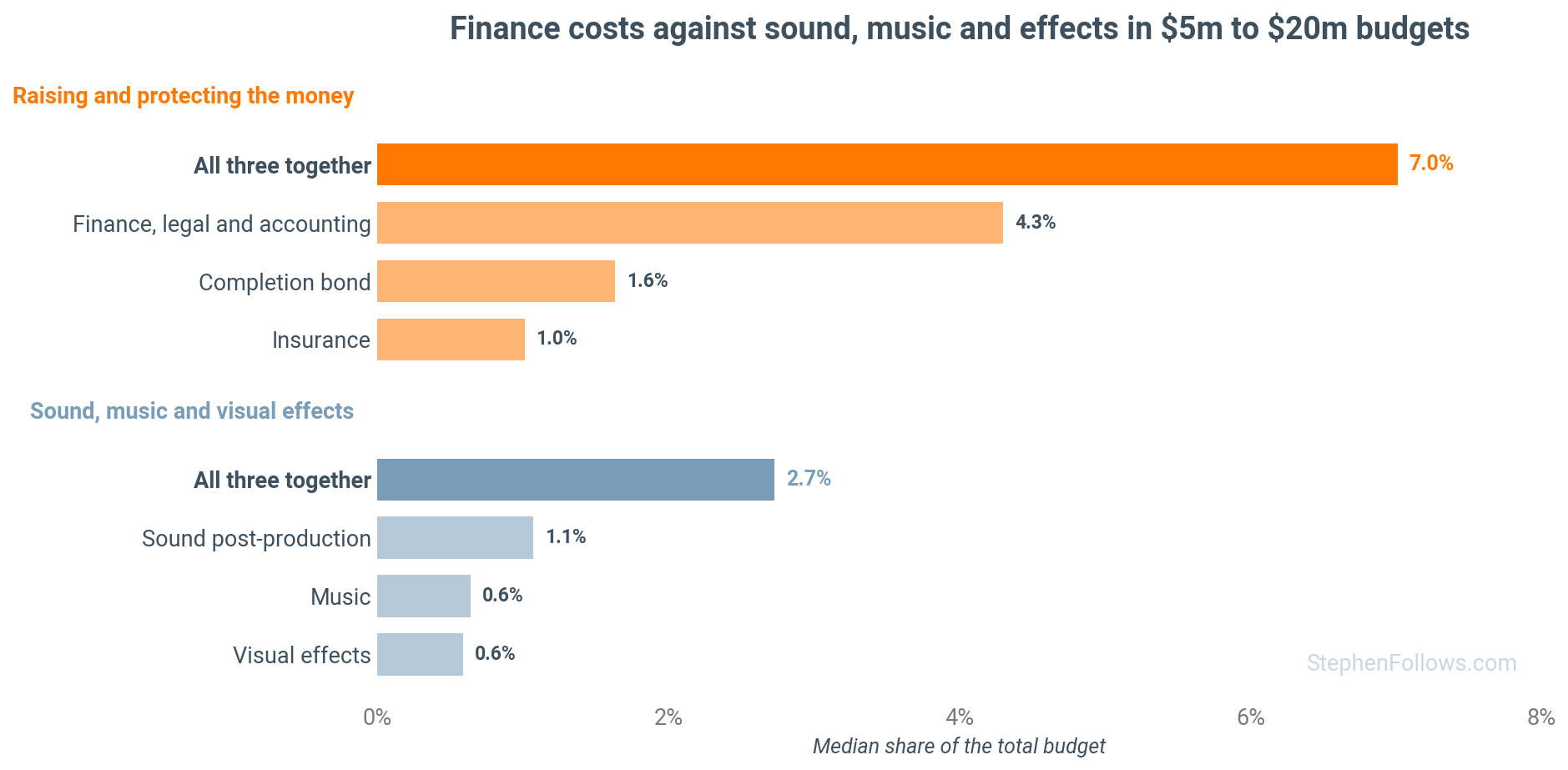
These are the costs of making a film safe enough to lend against, and the riskier the money, the more it costs. You can read more about the costs of different types of film money in last week’s piece entitled The film finance numbers nobody shows you
Even the quoted interest rates understate the bill, and when I spoke to Phil about loan pricing, he was clear that the headline number is where the cost starts.
The headline rate is never the final price. Add the fees, the reserves and the time it takes to get paid back, and the real cost is a lot higher. Producers need to do those sums before they sign.
8. ‘Financed’ doesn’t mean financed
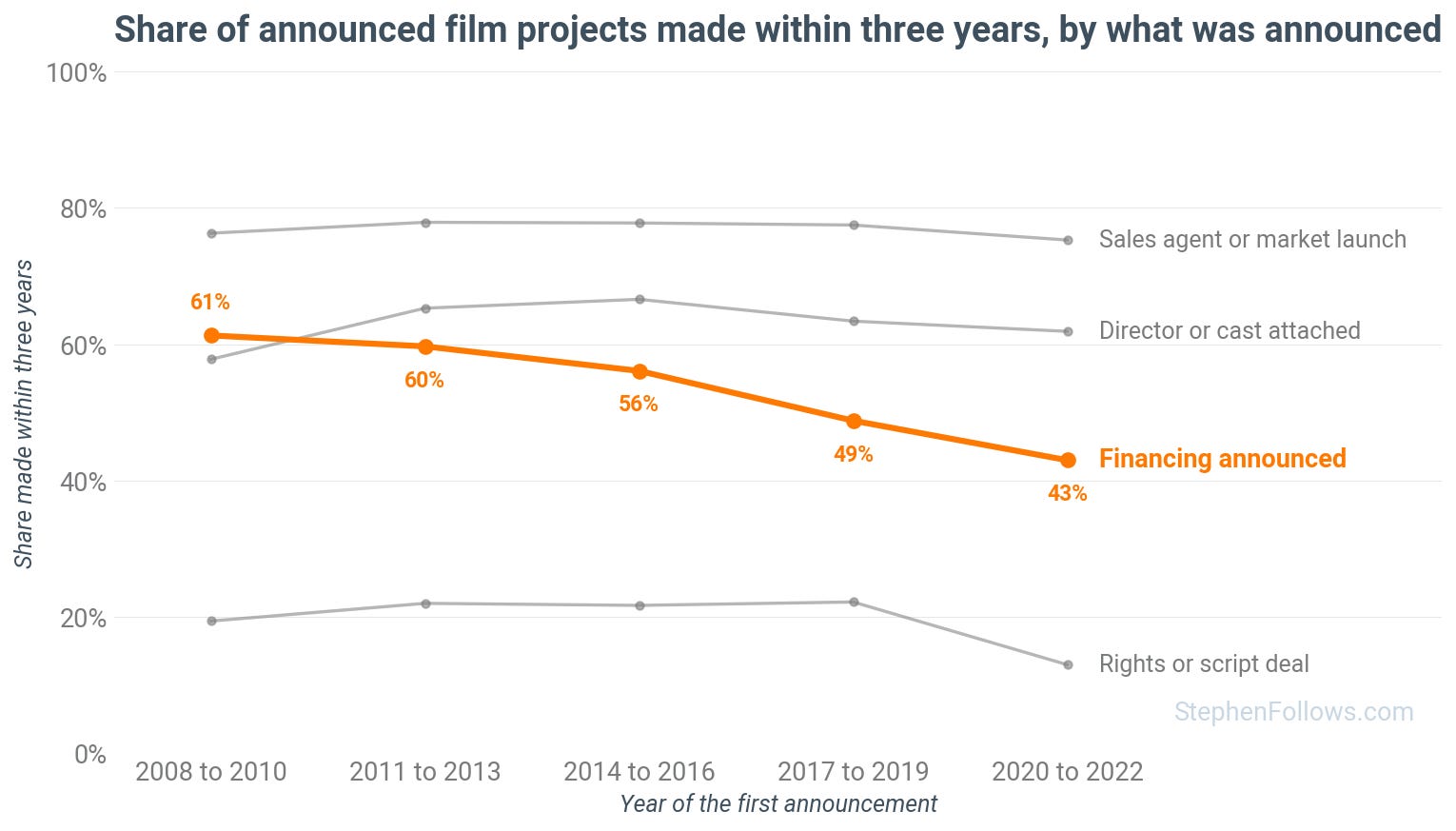
I tracked 611 projects announced in the trade press as financed and checked whether they were made within three years. Overall, 54% were.
And it’s getting worse. From 61% of the projects announced in 2008-10 down to 43% of those announced in 2020-22. A financing announcement is now a weaker sign that a film will happen than a director or cast attaching (62%) or a sales agent taking it to market (75%).
An announcement can still move money, though, and when I spoke to Phil, he described how.
Half of this business runs on announcements. Someone says there’s a deal happening, it never happens, but people have already made decisions based on it.
The worst version is a film that starts shooting before the money is real. When the UK production of The Climb collapsed last year owing crew and suppliers around £340,000, one of them told Deadline what they thought.
Play your film financing games by all means, but don’t hire crew if you haven’t got the money.
9. Nobody can see the real numbers
All of the above is hard to know, because film finance is almost entirely private. Only 10.7% of 89,839 independent features released between 2010 and 2023 credit any financier at all, and 5.2% credit any private money.
Deal terms, loan costs and returns are never published, so every producer learns them one film at a time. When I spoke to Phil, he put it in a line.
You can’t Google the truth of film. The numbers that matter aren’t published anywhere, so there’ll always be someone who believes the brochure.
10. Tax credits now prop up the budget
Tax incentives rose from 18% of all the money in the finance plans I studied in 2018 and 2019 to 28% in 2024 and 2025. The median film took 27% of its budget from a tax credit, offset or rebate, and 92% of the films used one.
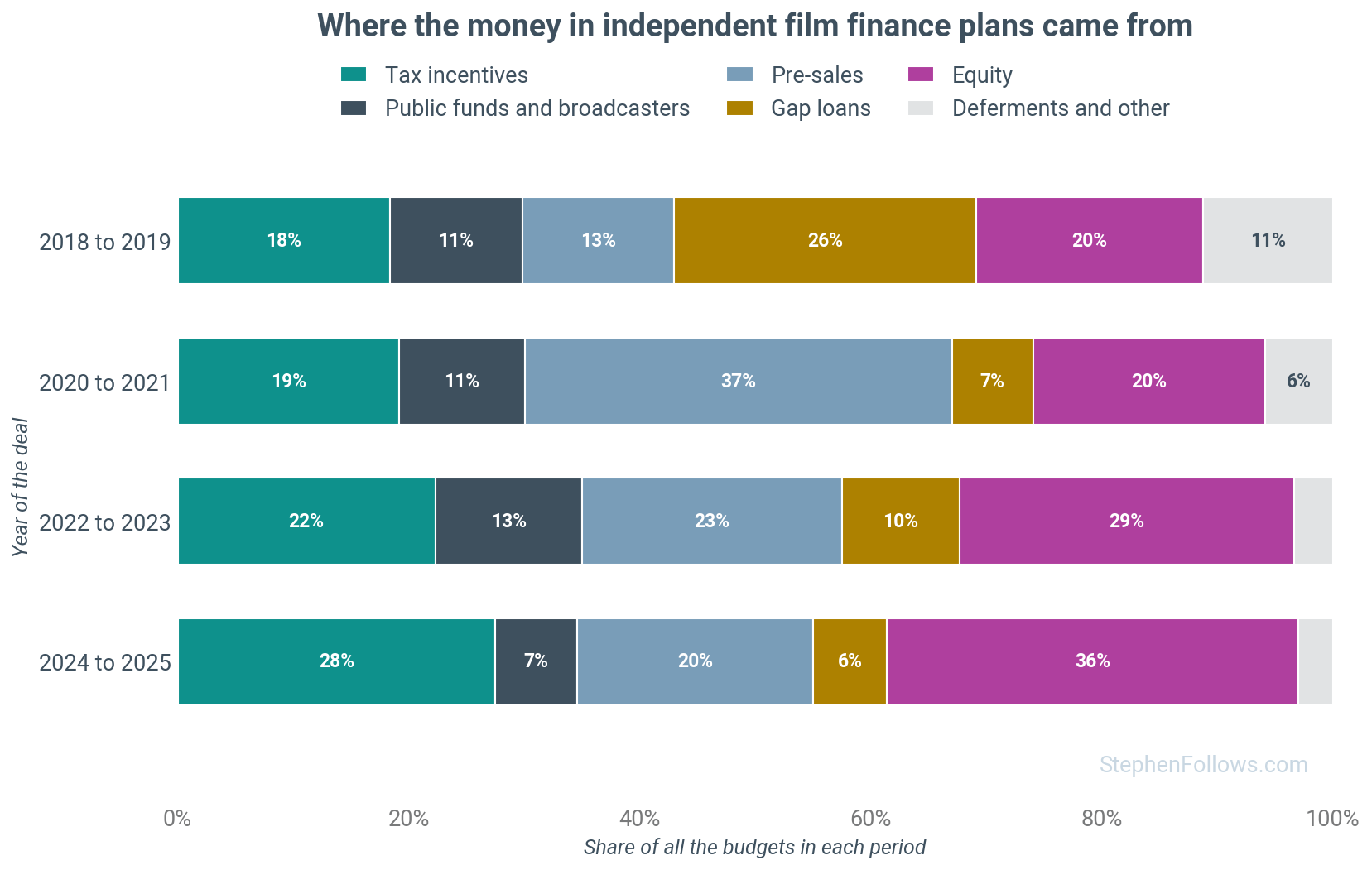
Without the 33 Australian films and their generous producer offset, the rise still holds, from 15% to 27%. France publishes the same breakdown for every film made there, and in 2012 distributors’ advances paid for 21.5% of the average French film, compared with 5.7% from tax credits. By 2025, they had swapped places, at 11.7% and 14.8%.
When I spoke to Phil, he described the change from the lender’s side.
Ten years ago a tax incentive was a helpful extra. Today it is often the single biggest piece of the finance plan. Producers start with the incentive and build the rest of the capital stack around it.
11. Governments pay late or not at all
If the biggest piece of the plan comes from a government, the biggest risk is a government decision. Germany’s federal incentive pot for 2026 (€250m) was fully committed by the end of August, and the draft budget for 2027 would cut it to €200m.
Timing is the other issue. New York’s credit now pays out so slowly that lenders have cut what they’ll advance against it, as a lawyer told The Ankler in April:
They used to loan anywhere between $0.80 to $0.85 on the dollar of the credit. Now, it’s like $0.50 on the dollar because it takes so long.
And more of the budget is heading this way. The UK’s Independent Film Tax Credit pays 53% of qualifying spend on films with core budgets up to £15m, and Congress introduced a US federal production credit of 20% to 30% in September (it’s still only a bill).
Phil knows about this all too well from first-hand experience:
I’ve had governments default on me all over the world. You can sue a distributor, but suing a government doesn’t really work. So the lender has to price in the wait, and it’s the producer who ends up paying the interest.
12. Small films pay most for the wait
An incentive is usually paid after the money is spent (sometimes long after), so somebody has to lend against it in the meantime. That’s a real service carrying a real risk, as Phil’s point above shows, and it has a price. UK producers have been loud about it since the new credit arrived. At the Screen Summit in September 2025, the producer Andy Paterson put the case to Screen International.
The tax credit is effectively a government bond, and people are making 15 to 20% cash-flowing that while producers are not getting paid.
The lenders’ answer, gathered by Screen in March, is that much of the cost is fixed. Legal work on a £100,000 film takes about as long as on a £10m one, so the price hits smaller films hardest. One financier summed it up.
Proportionally speaking, the smaller your production, the worse off you will be in terms of the cost of borrowing.
Both sides are right, which is what makes it a problem with no villain. The subsidy designed to help small films loses the biggest share of its value to the cost of waiting for it.
13. Tax breaks attract the wrong money
Before today’s incentives, many countries supported film through tax shelters, and the shelters kept going wrong in the same way.
In 1990 Quebec scrapped its film and TV tax shelter after its minister said close to two-thirds of the cost had gone to investors and intermediaries, with only a third reaching production.
Canada’s national shelter went the same way. Production peaked at 66 certified features in 1979, and more than half of the films made that year were never released.
In Germany, tax funds sent almost $1.7bn to Hollywood in 2004 alone before the government moved to close them.
Bill Baillieu and John Goodchild found much the same in the UK film partnerships of the 1990s, reckoning that only about 10% of the money invested reached the film industry.
Most modern incentives are paid to the production itself, which fixes the worst of this, although problem 12 shows some of the value still goes on waiting for it.
14. The gap loan is disappearing
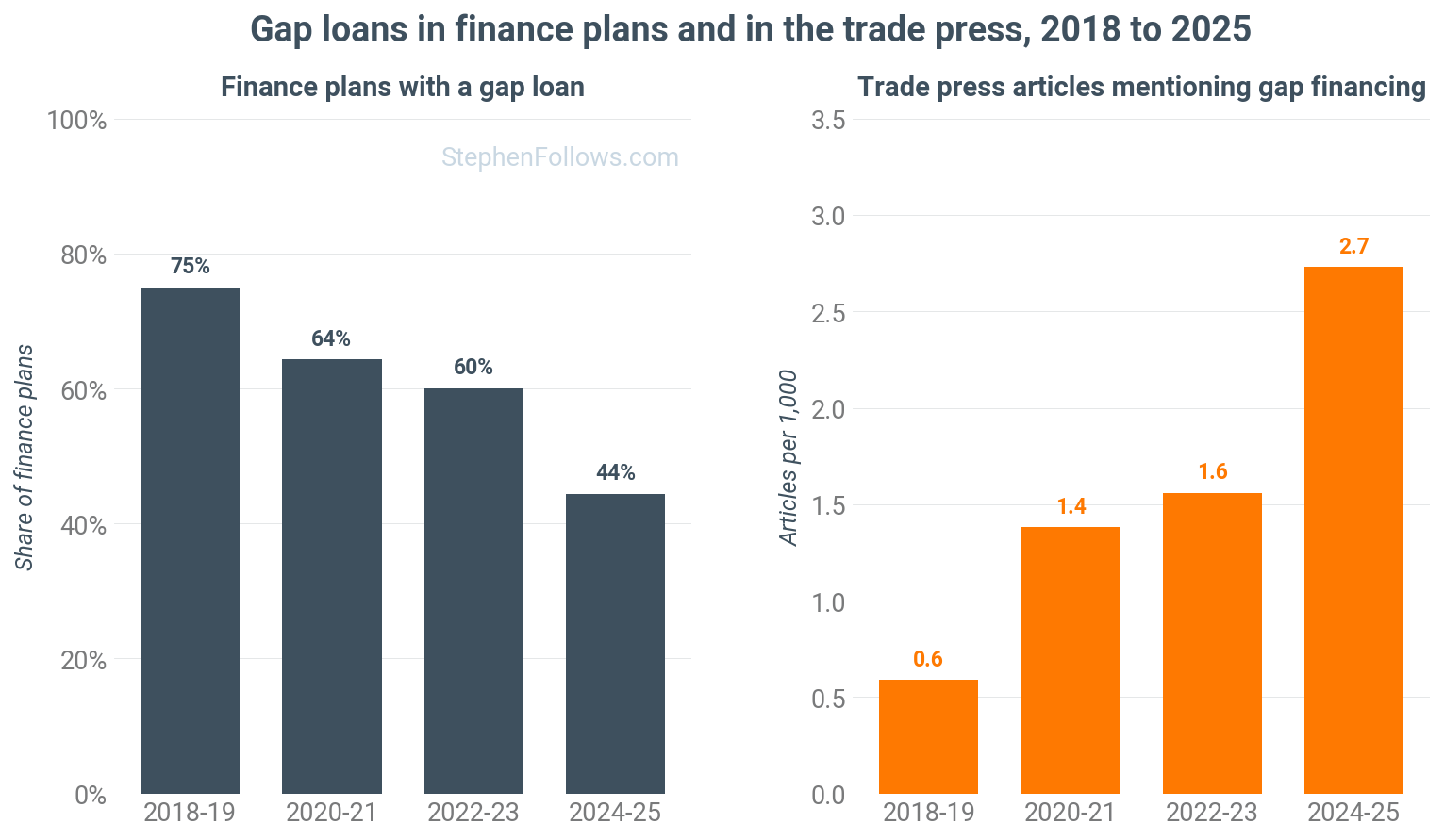
A gap loan is money lent against the estimated value of the territories nobody has bought yet. In the 2018 and 2019 finance plans, three in four films used one. By 2024 and 2025 it was 44%, and the median film used none at all. Pooled across all the films, gap loans fell from 26% of the money to 6%.
But because the deals are private, it took time for this to be discussed outside individual deals. The trade talks about gap financing more than four times as often as it did, from 0.59 per 1,000 articles in 2018 and 2019 to 2.73 in 2024 and 2025.
When I spoke to Phil, his explanation was short:
A lot of lenders are doing zero gap these days because it’s a really hard thing. It’s really hard to get your money back.
15. Equity has to fill the hole
Something had to replace the gap loan, and in the plans it was equity, which is the hardest money in film to raise and the last to be repaid. Its share of all the money rose from 20% in 2018 and 2019 to 36% in 2024 and 2025.
The soft corners of the plan went the same way. In 2018 and 2019, 71% of the plans relied on deferred fees or in-kind deals, and by 2024 and 2025 it was 22%. Phil puts much of that down to tax credit authorities no longer letting as much deferred money count towards the credit, so the hole now has to be filled with cash.
The burden isn’t spread evenly. The chart below shows how much of the budget came from equity and how much was borrowed, by film size.
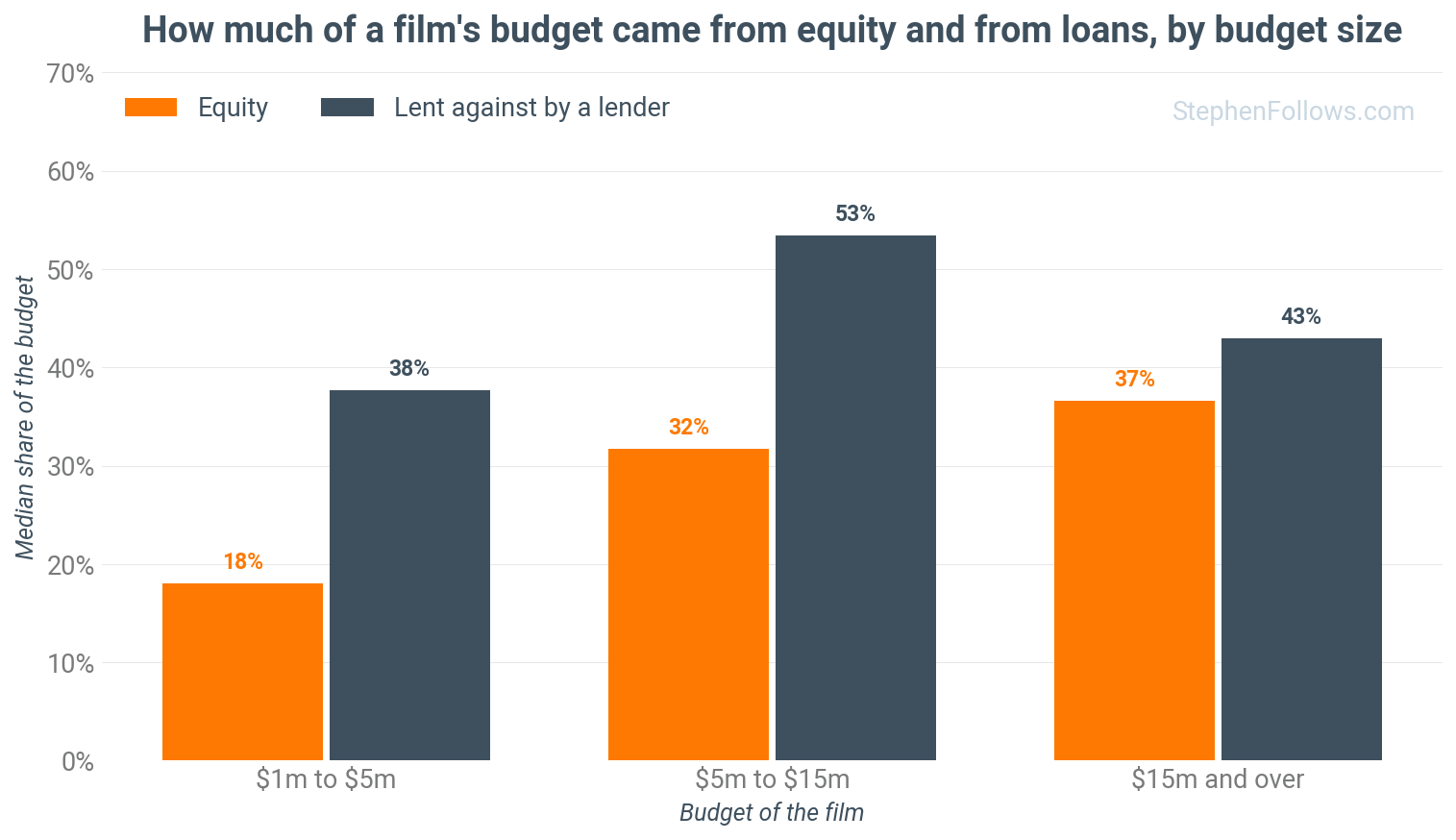
Films costing $1m to $5m raised a median 18% of their budget as equity. Films at $5m to $15m raised 32%, and also had 53% of their budget borrowed against (38% for the smaller films).
16. One buyer carries the film
Pre-sales (a distributor agreeing to pay for a territory before the film is made) still paid about a fifth of the money in the 2024 and 2025 plans. But the sales estimates on the films I studied show the expected money concentrating in fewer places.
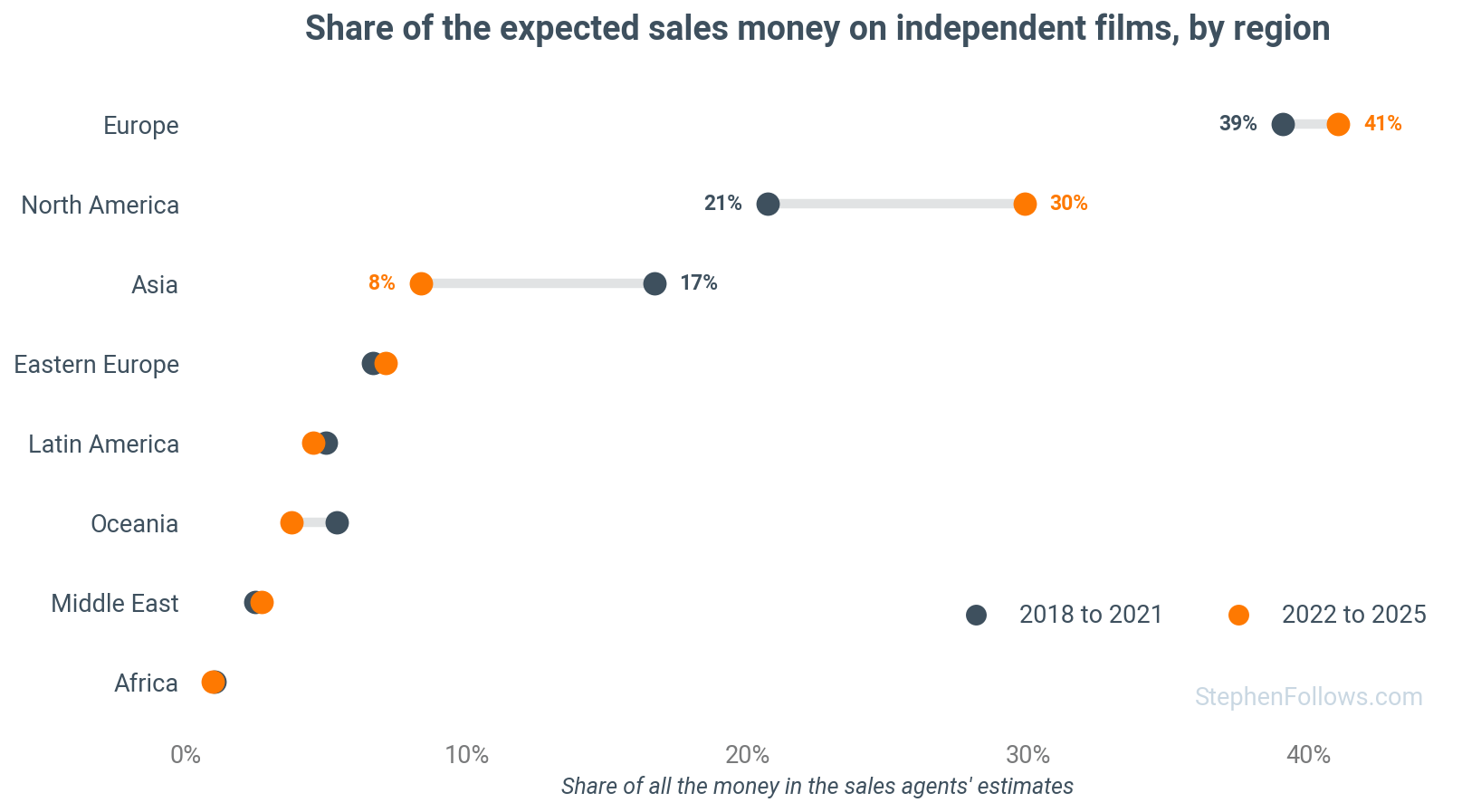
North America’s share rose from 21% to 30%, and Asia’s halved, from 17% to 8%. On the median sales sheet, the US is 31% of the expected money and worth about a fifth of the budget, while 20 of the 40 territories are each worth under 1%.
So one American buyer’s decision now carries a large slice of the plan.
Part of the reason is the collapse of the first pay-TV or streaming window after cinema release (the ‘pay-one’ window), which used to give distributors the confidence to buy before a film was made.
17. The buyers keep changing
Counting only US releases that the trade tracked with a screen count, 22 companies released four or more independent films in 2005, and in 2023 it was still 22. The number is steady, but the names aren’t.
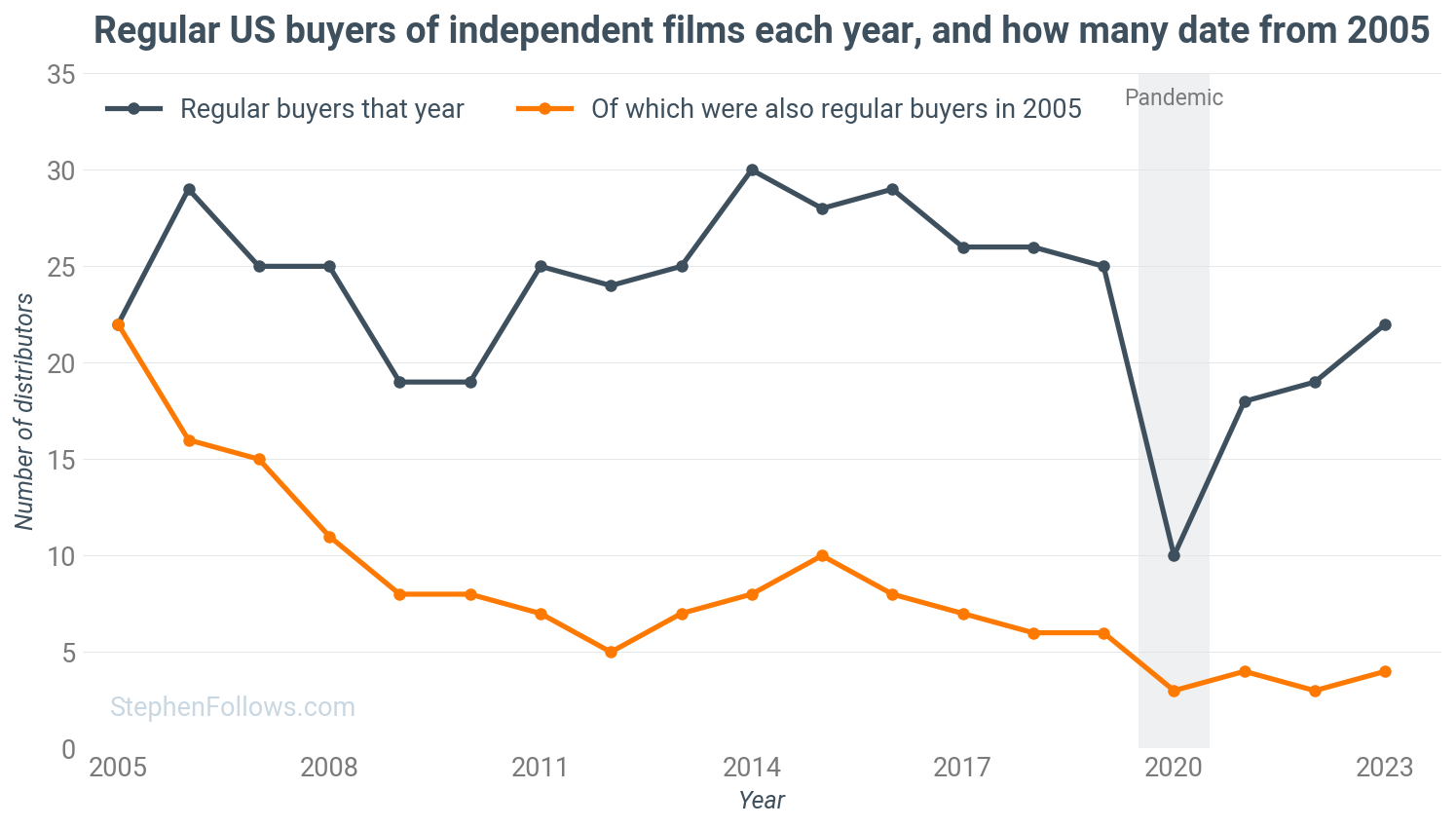
Only 4 of the 22 regular buyers of 2005 were still regular buyers in 2023. A producer’s contacts at the buyers go stale faster than their films do. Since then Paramount and Warner Bros. Discovery have become one company, Skydance, which has agreed with 12 state attorneys general to release at least 30 films a year for five years, at least four of them independent.
Phil puts it like this:
Every merger removes a buyer and the competition that came with it. Merged companies cut costs, cut slates and cut acquisitions.
18. Streamers pay less and keep more
For a few years, a streamer would pay an independent producer the budget plus a fixed premium and keep everything (a ‘cost-plus’ deal). Producers gave up the chance of a hit in exchange for a guaranteed small profit. Phil says that from his point of view, that deal is ever rarer.
The streamer deal where they paid your budget plus a premium and you walked away whole? For independents, that deal has largely gone.
What’s left is often a licence fee with little connection to how much a film is watched.
When I interviewed Uwe Boll last year, he told me Netflix paid $75,000 for a year’s licence to a film that was then watched for 3.8 million hours.
19. Every film needs more pots of money
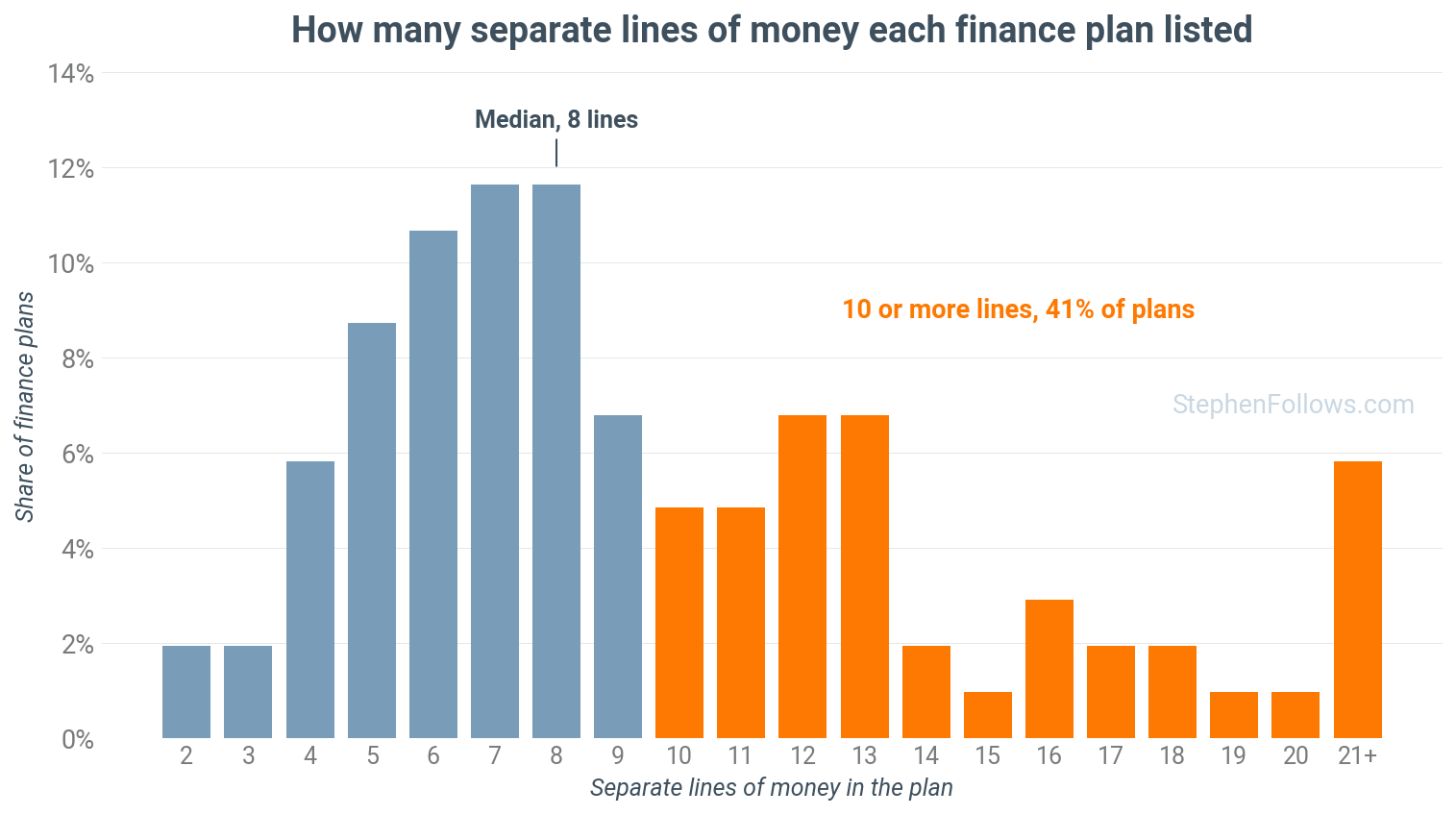
The median closing plan listed 8 separate lines of money, and 4 in 10 listed 10 or more. Each one is a contract, a lawyer and a set of conditions that all have to be met on the same day.
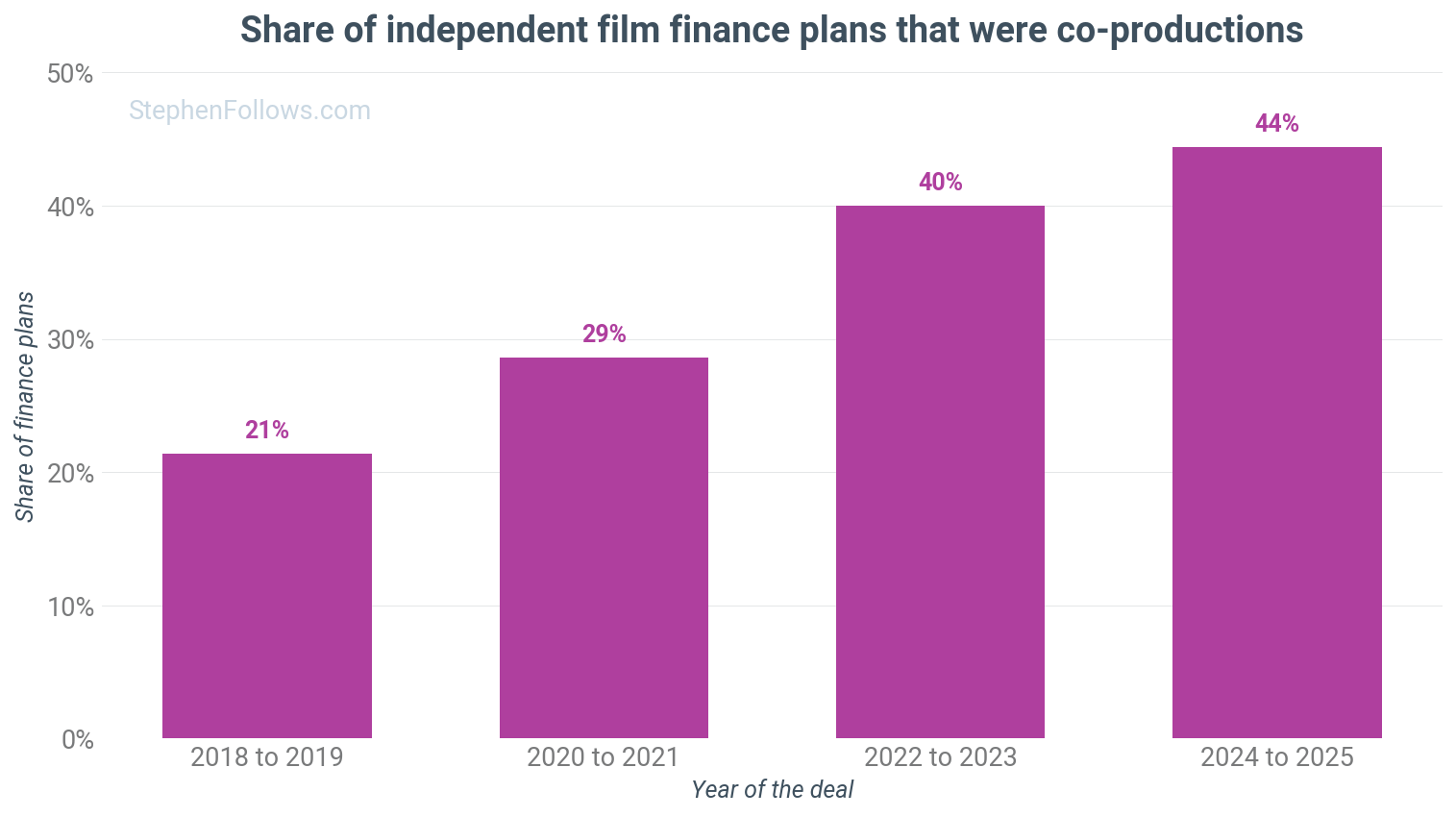
Co-productions, which add a second or third country’s rules on top, rose from 21% of the plans in 2018 and 2019 to 44% in 2024 and 2025.
Phil’s not too happy about this shift!
A film’s money now comes in lots of smaller pieces. Every piece is another contract, another counterparty, another set of delivery obligations and another cheque someone has to chase.
20. New money comes with strings
The biggest new money in film this year came from the Gulf. Saudi Arabia’s Public Investment Fund is putting about $10bn of a $24bn package from three Gulf funds into Paramount’s takeover of Warner Bros. Discovery. Phil’s view is that this money behaves differently.
Gulf money comes with conditions: content sensitivities, local spend requirements, politics. And it gravitates towards big names.
Old problems, new problems
None of the old problems is going away, because they come from the basic deal between people who want to make money and people who want to make films. The new ones are different. They come from where the money is coming from right now, which means a producer who knows about them can plan around them.
That’s why Phil and I wrote the report. It’s free, and it sets out the nine trends behind the new problems, from the base of the budget to the back of the queue.

You can also join us in two ways:
On 8 December, we’re hosting a free webinar entitled ‘What you can’t look up about film finance’, where we’ll take a finance package apart line by line, live. Sign up here.
The main piece is our live online course, Advanced Film Financing, which runs as six live sessions from 12 to 28 January 2027 and ends with a meet-up at the European Film Market in Berlin on Friday 12 February. Find out more and book your place here.
Today’s article is based on a whole bunch of research projects I’ve been running over the past year into how film finance really works. I’ll be sharing much more of it on the course, so if you want to know more, come join us.