


Last month, I looked at how many film festivals still insist on premiere status, and found that most don’t. Only a small fraction of events require your film to be the first screening anywhere, while the majority are open to titles that have already been shown elsewhere.
This time, I’m exploring a related question: how many festivals reject films that are already online?
Where it’s definitely not allowed
At the top of the scale, there is no negotiation - your film cannot have been screened online before its festival run. Cannes, Berlin, Venice, and Sundance all reject feature films that have been publicly available online before their premiere.
Cannes’ regulations require that films “To be chosen and invited to be a part of the Official Selection, films must… not have been screened on the Internet”.
Berlinale’s rules confirm “For participation at the Berlinale films must not have previously been presented online or as VOD; this also includes online festivals”.
For feature films, Sundance says “Completed films that have been or will have been exhibited theatrically or otherwise made available to the general public, either for free or for purchase, prior to February 3, 2025 are not eligible to submit to this category. This includes, but is not limited to, public theatrical exhibition (festival or otherwise), television broadcast, home video, or any digital or online platform“.
This is true of almost all major festivals.
An interesting exception is the Toronto International Film Festival, which places a geographical restriction on any prior online distribution, stating: “Films that are publicly posted or exhibited online but geoblocked to a region outside of North America are still eligible for the Festival”.
What most festivals say
While these top festivals garner the most headlines, the vast majority of filmmakers are submitting to other festivals.
To get a broader picture of what most filmmakers will face, I studied the rules of 10,549 film festivals worldwide.
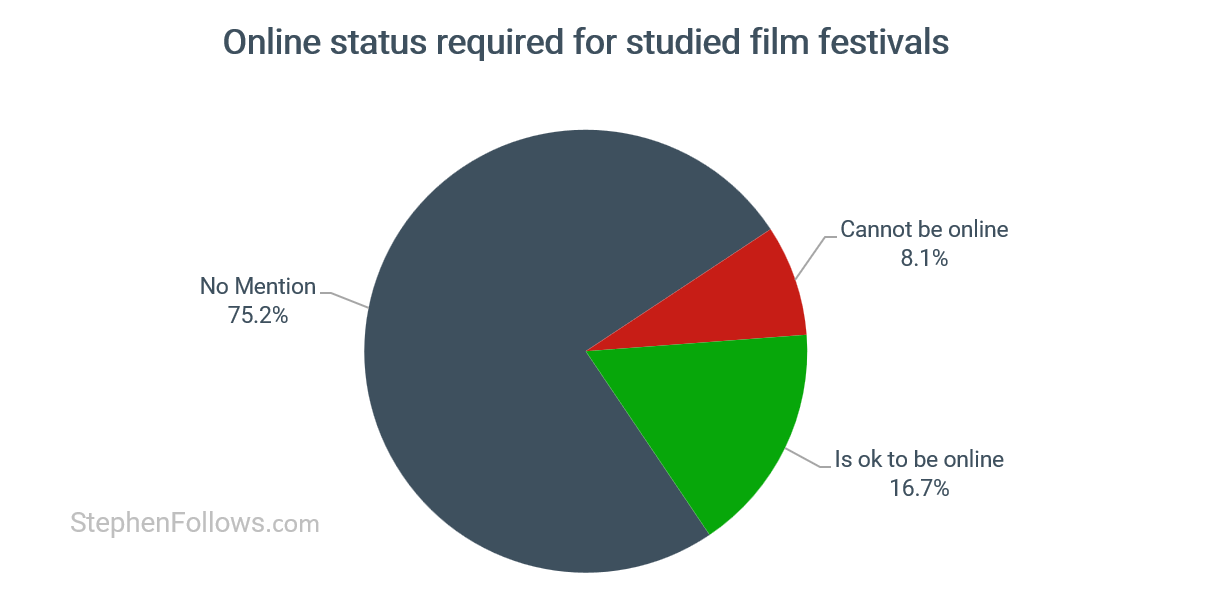
I discovered that only 11.1% actively say they do not accept films that are already online.
Not only that, but 16% of festivals explicitly say that they don’t mind if your film is already online. Here are a few examples;
Kitzbühel Film Festival “Shorts may have been released on DVD, broadcast on television or the internet, and/or publicly screened anywhere in the world and still remain eligible for our Shorts Competition”.
The FAQ for the Edmonton International Film Festival states, “CAN I SUBMIT IF MY FILM IS AVAILABLE ONLINE? Your short film is available publicly on Vimeo and/or YouTube? You can still submit as long as your film was completed after January 1, 2024.“
The Baton Rouge Irish Film Festival stipulates that the film must have an Irish connection but leaves most other aspects of the film open. “Except in the case of eligibility for The O’Kalem Award, there are no stipulations as to genre, when the film was completed, or if/how the film has been released.“
Some festivals apply different rules to each category. Feature films have the toughest requirements, with music video submissions having the laxest.
Sundance allows for short films to have been screened online, stating “Short films have no premiere requirements or prior screening restrictions that impact Festival eligibility and may have been screened at any number of festivals or other public theatrical exhibitions, broadcast or streamed on television or the Internet, and/or released via any home video or other public distribution platform anywhere in the world.“
Manchester Film Festival allows “music videos and experimental films“ to be available online.
Unsurprisingly, festivals that select content primarily created for the web do allow online distribution before selection, such as the “Canadian Web, TV series (episodes), proof of concept & music videos” stream of the Blood in the Snow Film Festival.
Finally, some festivals note that while something may not be a hard-and-fast rule, it can affect their interest. The BFI London Film Festival notes in its rules “For Competition films, preference will be given to European, International and World premieres“.
The vague middle
72.8% of festivals don’t address the issue directly.
This means that, for most filmmakers, the rules are neither restrictive nor clear. Silence does not necessarily mean approval, but it also doesn’t guarantee disqualification.
Why do festivals care if your film is already online?
The reason for these restrictions is status. The premiere is a film’s key currency as it’s the one moment festivals can guarantee exclusivity for audiences, press, and distributors.
A similar pattern appears across smaller and regional festivals. The Canada International Children’s Film Festival, Hot Docs, Sitges, and Fantastic Fest all accept films that have previously been online, provided they haven’t already been seen by that festival’s specific audience.
Why it still might be worth holding back your online premiere
Even when a festival’s rules make no mention of online availability, programmers may still weigh it in their decisions.
Katie Bignell, Festival Formula said:
When a festival doesn’t say then it is a strategist’s perspective that they don’t mind. But I will say from experience is that it still plays a part in the decision process - comparing two films with one that has several thousands of views online versus a film that can offer a premiere as an example.
The festival circuit is never linear nor speedy, and wholly unpredictable. We recommend a filmmaker really understand the lay of the land when they consider straddling going online and submitting to festivals. Whilst there are festivals that don’t care, there are some that do and they generally fall into the camp of being festivals a filmmaker really aspires to screen at. We’ve had a few examples over the years when a film has gone online (suddenly with no discussion) and a festival that has already selected them has had to disqualify it due to ineligibility of their rules. So always do your research, understand the timeline, and don’t spend any unnecessary monies where possible.
As MarBelle from Directors Notes noted:
As the editor-in-chief of Directors Notes, my position is no secret: I advocate for releasing your short film online early to maximize its reach as a core part of your festival strategy. The outdated belief that a film must be held back until the very end of its festival run is not only limiting but, as Stephen’s data confirms, largely unnecessary.
Having worked with countless filmmakers, I’ve seen first-hand how an online presence helps a film find a wider viewership than the festival circuit alone can provide. Crucially, it can lead to *more festival selections, not fewer. This data powerfully dispels the pervasive myth of the premiere requirement, confining it to the exclusive tier of festivals where it truly matters.
For the vast majority of filmmakers, the question is no longer “Should I premiere online?” but ”How can I best use online platforms to build an audience and fuel my film’s entire journey?”
Further reading
If you’re a filmmaker on their festival journey then here are some of my past articles you may find useful:
Notes
Just for the avoidance of doubt, when I say available online, I meant to the public. Almost all festivals recognise a distinction between a private screener and a public upload. A password-protected Vimeo link is acceptable; a public YouTube release is not.
Even the Berlinale, one of the strictest, makes this distinction in its FAQ with password-restricted links created for submission are exempt from its “no internet” rule
Thanks for the data. this just came up in a search I made specifically about this... it seems like a completely outdated idea these days to disqualify a film just because it's already available online. It could have millions of views on YouTube and still the vast majority of people have never heard of it.
Plus for many folks (like myself) releasing it online is how to recoup money from the film. Why should we have to wait to do that?
Thanks for sharing. As an actor I had no idea about this kind of data. Of course most of the films I am a part of have a significant period of festival runs post completion but I’ve never really thought too heavily on the specific festivals that require that exclusivity. Really insightful! Thanks again ☺️